
Ancient Greek inventions are the machines, tools and signal systems that Greek engineers and thinkers devised in antiquity. Small-group trips through Greece run from Athens to Corinth, Delphi and the Saronic islands. The topics run from the Antikythera mechanism and Archimedes’ screw to Ctesibius and the Hydraulis of Dion. Later topics take in Philo, the aeolipile, the Tunnel of Eupalinos, the Diolkos and signal codes. Further reading sits in Museums in Greece, Ancient Greek philosophers and Ancient Greek architecture. All other trips are gathered under Greece tours.
Bookings made through the GetYourGuide widgets on this page earn Classical Greece Tours a commission, at no extra cost to the traveller.
What were the ancient Greek inventions?
Ancient Greek inventions came from a technology that took shape in the 5th century BC. It lasted into the Roman period. Credited devices include the gear, the screw, rotary mills, the water clock and the water organ. Bronze casting methods join the list.
Steam also has a place among ancient Greek inventions. Greek makers used it to run experimental machines and toys. Steam is the hot gas that rises from boiling water. An experimental machine is one built to test an idea rather than to do daily work. The word experimental comes from experiment, a planned trial.
A large share of ancient Greek inventions appeared late in the Greek period. The need for better weapons and battle tactics was a frequent spur behind them. Tactics are the plans that an army follows in a fight. A weapon is any tool made to attack or to defend in combat.
Heron of Alexandria described the first vending machine among ancient Greek inventions. A vending machine hands out goods when a buyer pays. Heron’s machine accepted a coin from the user. In return, it released a fixed amount of holy water. Holy water is water blessed for use in religious rites.
- Museum: The Kostas Kotsanas museum is a private museum devoted to ancient Greek technology.
- Branches: It keeps four permanent annexes, or branches, in Athens, Ancient Olympia, Katakolo and Heraklion.
- Award shortlist: In 2019 the European Museum Forum nominated it for European Museum of the Year.
Philosophers wrote down a large part of the technical progress behind ancient Greek inventions. Archimedes and Heron were two of those writers. Philosophers were thinkers who asked questions about nature, knowledge and right living. Technical progress means better ways of making and using tools.
What makes the Antikythera mechanism stand out among ancient Greek inventions?
Ancient Greek inventions include the Antikythera mechanism, raised in 1901 from a shipwreck off the island of Antikythera. The wreck was a Roman cargo ship, which carried goods for trade. It lay 45 metres below the surface, off a cape named Point Glyphadia.
Captain Dimitrios Kontos holds a place in the history of ancient Greek inventions. With a crew of sponge divers from Symi, he found the wreck in early 1900. Sponge divers collect sea sponges, simple sea animals with soft, porous bodies. Porous means full of tiny holes that soak up water.
In the study of ancient Greek inventions, Valerios Stais first took the device for an astronomical clock. Such a clock tracks the paths of the Sun, Moon and stars. The mechanism ran on a small hand crank, which is now lost. That crank turned its largest gear, a toothed wheel that drives others.
In 2005, a Cardiff University team led by Mike Edmunds applied X-ray tomography to the old device. Tomography builds images of thin slices through a solid object. The scans looked inside fragments still sealed in crust, a hard outer coating. An X-ray is an invisible ray that passes through solid matter.
- Front dial: A fixed front dial showed the twelve zodiac signs in equal 30-degree sectors.
- First setting: In 2022, researchers proposed 23 December 178 BC as the date it was first set.
- Case: Its wooden case measured roughly 34 by 18 by 9 centimetres overall.
Research in 2008 added a theory to the record of ancient Greek inventions. It suggested that the concept for the mechanism began in the colonies of Corinth. In Greek usage, colonies were new towns that settlers from a parent city set up abroad.
How does Archimedes’ screw fit into ancient Greek inventions?
Ancient Greek inventions include Archimedes’ screw, a water machine built from an outer and an inner cylinder. The inner cylinder carries helical blades. Helical means wound in a spiral, like the thread of a bolt. Long tradition credits the water screw to Archimedes of Syracuse.
The earliest written mention of this item among ancient Greek inventions dates from between 250 and 220 BC. According to the writer Posidonius, Archimedes created it on a visit to Egypt. That visit fell possibly between 283 and 246 BC. BC dates run backwards, so 283 BC came before 246 BC.
Scholars of ancient Greek inventions link the design to his work on spirals and circle quadrature. A spiral is a curve that winds around a centre point. Quadrature means finding a square with the same area as a curved shape. Both topics fall within geometry, where mathematicians measure figures and space.
The oldest known image of these ancient Greek inventions at work is a fresco in Pompeii. The painting dates from before 79 AD. Fresco painting puts pigment straight onto wet plaster. It decorates a house called the Casa di P. Cornelius Teges. Casa is the Italian word for a house.
- Vitruvius: Vitruvius described a wooden version of the screw with eight blades in De Architectura.
- Modern pumps: Archimedes’ screw pumps are in wide use today at wastewater treatment plants.
- Dutch drainage: Polder mills of the Dutch Golden Age drove the screws with windmills to drain land.
Diodorus described the screw in use for irrigation in the Nile Delta, near military camps and cities. Irrigation means bringing water to crops through ditches or channels. A delta is the wide, flat fan of land where a river splits before the sea.
What was the Claw of Archimedes in the story of ancient Greek inventions?
Ancient Greek inventions include the Claw of Archimedes, a weapon of war. It guarded the seaward stretch of the city wall at Syracuse. Accounts describe a crane fitted with a grappling hook. It was able to lift an attacking warship by its bow, or front end.
The machines played a large part in 214 BC, during the Second Punic War. That year Rome attacked Syracuse with a fleet of 60 quinqueremes. A quinquereme was a large warship driven by banks of oars. Marcus Claudius Marcellus commanded the Roman fleet in that attack on the city.
Livy and other historians blamed heavy Roman losses on these ancient Greek inventions. They also named catapults devised by Archimedes as a cause. A catapult is a machine that hurls large stones or bolts over a distance. Historians are writers who set down and explain the events of earlier times.
In 2005, a team of engineers designed a realistic Claw from what is known of Archimedes. Their machine tipped a model Roman ship over so that it sank. The test does not prove that the Claw existed. It does suggest that such a machine was possible to build in that age.
- Names: Its Greek name, harpage, means snatcher, and it was also called the iron hand.
- Roman machine: The Romans brought the sambuca, a floating siege tower fitted with grappling hooks.
- Mirror legend: Legend credits Archimedes with another of the ancient Greek inventions, a giant mirror that set sails alight.
Archimedes, the mind behind these ancient Greek inventions, died when the siege ended. A Roman soldier killed him, against orders from Marcellus to spare his life. A siege means encircling a walled town and cutting its supplies for a long time.
Who was Ctesibius in the history of ancient Greek inventions?
Ancient Greek inventions include the work of Ctesibius, a Greek inventor and mathematician. He worked in Alexandria, a city of Ptolemaic Egypt. Ptolemaic means ruled by the Ptolemy family of kings. A mathematician is an expert in numbers, shapes and patterns.
Ctesibius was the son of a barber and began his own working life in the same trade. A barber cuts and shapes hair and beards. During that first career he invented a mirror adjusted by a counterweight. A counterweight offsets a load, keeping it in balance. The mirror counts among ancient Greek inventions credited to him.
Ctesibius improved the water clock, also called the clepsydra, a word meaning water thief. A water clock measures time by a steady flow of water. He fitted these ancient Greek inventions with a dial and a pointer to show the time. His alarms dropped pebbles onto a gong or blew trumpets at set times.
Ctesibius described one of the first force pumps in the record of ancient Greek inventions. The pump produced a jet of water or raised water from wells. A force pump pushes water out under pressure with a piston. A piston is a plunger that slides back and forth inside a tube.
- Title: His work on compressed air earned him the title father of pneumatics, the science of air pressure.
- Lost books: None of his written work survives, including his research collection called the Memorabilia.
- Moon crater: In 1976 a crater on the far side of the Moon was named Ctesibius.
Ctesibius is thought to have been the first head of the Museum of Alexandria. The Museum was a centre of study and research, not a hall of exhibits. Its name honours the Muses, goddesses of the arts in Greek myth.
Why does the Hydraulis of Dion matter for ancient Greek inventions?
Ancient Greek inventions survive in the Hydraulis of Dion, the earliest pipe organ yet found by archaeologists. Experts dated the find to the 1st century BC. A pipe organ makes musical notes by pushing air through a set of pipes.
On the morning of 19 August 1992, archaeologists at Dion found pieces of small copper tubes. Archaeologists dig up and examine the remains that past peoples left behind. Copper is a soft, reddish metal that bends and shapes with ease. Those tubes were the first sign of the buried instrument at the site.
This survivor of ancient Greek inventions measures 120 cm in height and 70 cm in width. Cm is the short form of centimetre, which is one hundredth of a metre. Silver stripes ran across the body of the organ. Rectangular glass ornaments in a range of colours added to that decoration.
The name hydraulis, given to these ancient Greek inventions, means a water-driven pipe instrument. It joins the Greek word hydor, meaning water, with aulos, meaning pipe. Water power pressed the air that sounded each pipe. In this way, the organ turned the moving energy of flowing water into steady air pressure.
- Scale: The first 19 pipes followed the scale system used in ancient Greek music.
- Replica: A reconstruction began at the European Cultural Center of Delphi in 1995.
- Flooding: A neighbouring river had flooded parts of the archaeological site for good.
Among ancient Greek inventions on display, the hydraulis is an exhibit of the Archaeological Museum of Dion. An exhibit is an object placed on public show in a gallery. An archaeological museum holds objects that were dug from the ground at old sites.
What did Philo of Byzantium add to ancient Greek inventions?
Ancient Greek inventions include devices described by Philo of Byzantium, a Greek engineer and writer on mechanics. Mechanics deals with forces, motion and the working of machines. A native of Byzantium, he spent the greater part of his life in Alexandria, Egypt.
His large work bore the title Syntaxis, which means System of Mechanics. Syntaxis comes from a Greek word for an orderly arrangement of parts. The book divided his account of ancient Greek inventions into separate sections. Each section handled one branch of that wide subject, from levers to siegecraft.
Philo’s works hold the oldest known chain drive among ancient Greek inventions, fitted to a repeating crossbow. A chain drive passes motion between wheels by a chain. He was also the first to describe a gimbal, a ring mount that keeps an object level. His gimbal held an eight-sided ink pot that turned any way without spilling.
Philo’s book Pneumatics holds the earliest known escapement in ancient Greek inventions. An escapement lets stored energy out in small, regular steps. In his account, it formed part of a washstand, a stand with a basin for washing hands. The book takes its name from pneumatics, which deals with air and its pressure.
- Secret letters: One section, Peri Epistolon, dealt with codes and hidden letters for military use.
- Heat: He is credited with the first thermoscope, an early form of the thermometer.
- Doubling the cube: He sought a way to build a catapult that fired a projectile twice as heavy.
In that washstand, a spoon with a counterweight filled from a water tank. When full, the spoon tipped into a basin and released a piece of pumice. Pumice, a light stone formed from volcanic froth, scrubs skin clean.
Which steam device did Hero of Alexandria bring to ancient Greek inventions?
Ancient Greek inventions include the aeolipile, a bladeless steam turbine. It spins when the water container at its centre is heated. A turbine turns a flow of gas into spinning motion. Hero of Alexandria described it in the 1st century CE.
Among ancient Greek inventions, it counts as the first recorded steam engine, or reaction steam turbine. A reaction turbine spins because jets of steam push back against it as they leave. Its name means the ball of Aeolus. Greek myth names Aeolus as the god of the air and the winds.
The device is a ball or a cylinder with bent nozzles that point outwards. A nozzle is a narrow spout that directs a jet. The nozzles face in opposite directions, so the escaping steam turns the vessel on its axis. The axis is the imaginary line through the centre of the spin.
The aeolipile leaves an open question about its use. No record shows whether these ancient Greek inventions served any practical purpose in ancient times. The evidence does not show whether people saw it as a tool, a toy or a sacred object. A sacred object is one honoured for religious reasons.
- First description: One source credits Vitruvius as the first to describe it, in De architectura.
- Temple wonder: Hero’s drawing shows a standalone device, presumably meant as a temple wonder.
- Weather: Vitruvius mentions the device as a way to demonstrate how weather works.
In studies of ancient Greek inventions, Hero’s design shows a simple boiler built into the stand. A pair of pipes carried steam from the boiler and also acted as pivots. Each pivot served as a fixed point for the ball to turn upon.
Where does the Pythagorean cup sit among ancient Greek inventions?
Ancient Greek inventions are linked with the Pythagorean cup, a practical joke shaped like a drinking cup. Filled past a certain point, it drains its whole contents through the base. A siphon effect, which pulls liquid up and over a bend, causes this.
A recent folk tradition links the design of the cup to Pythagoras. A folk tradition is a belief handed down by word of mouth, not by scholars. In the 1st century, Hero of Alexandria described a vessel of this kind among his ancient Greek inventions. Its contents flowed out once it was filled to a certain height.
The cup looks like an ordinary drinking cup, except for a column in the centre of its bowl. This column sits directly over the stem and over a hole at its bottom. A column here means an upright post inside the bowl. The stem is the stalk under the bowl.
In these ancient Greek inventions, liquid climbs a second pipe to a chamber atop the column. It does so under Pascal’s principle of communicating vessels. Communicating vessels are linked containers in which a liquid settles at one shared level. Here, principle means a law of nature that holds every time.
- Other names: The cup also goes by the names greedy cup, cup of justice and Tantalus cup.
- Oldest survivor: The oldest surviving Tantalus cup is a late 4th-century Roman cup made of silver.
- Toilets: In the majority of modern American flush toilets, the same principle empties the bowl.
People have used the cup to make statements about greed. Greed here means grabbing more drink than a fair portion. Among ancient Greek inventions, it is a joke device that carries a lesson. A joke device tricks its user for fun.
Which job did the dioptra do among ancient Greek inventions?
Ancient Greek inventions include the dioptra, an instrument for astronomy and surveying from the 3rd century BC. Surveying fixes the shape and size of land. It was a sighting tube, or a rod with a sight at each end, on a stand.
Greek astronomers used it to fix the positions of stars in the sky. Astronomers are the scholars who chart the heavens. Euclid and Geminus both mention the dioptra in their astronomical writings. Their texts give the device an early place in the record of ancient Greek inventions.
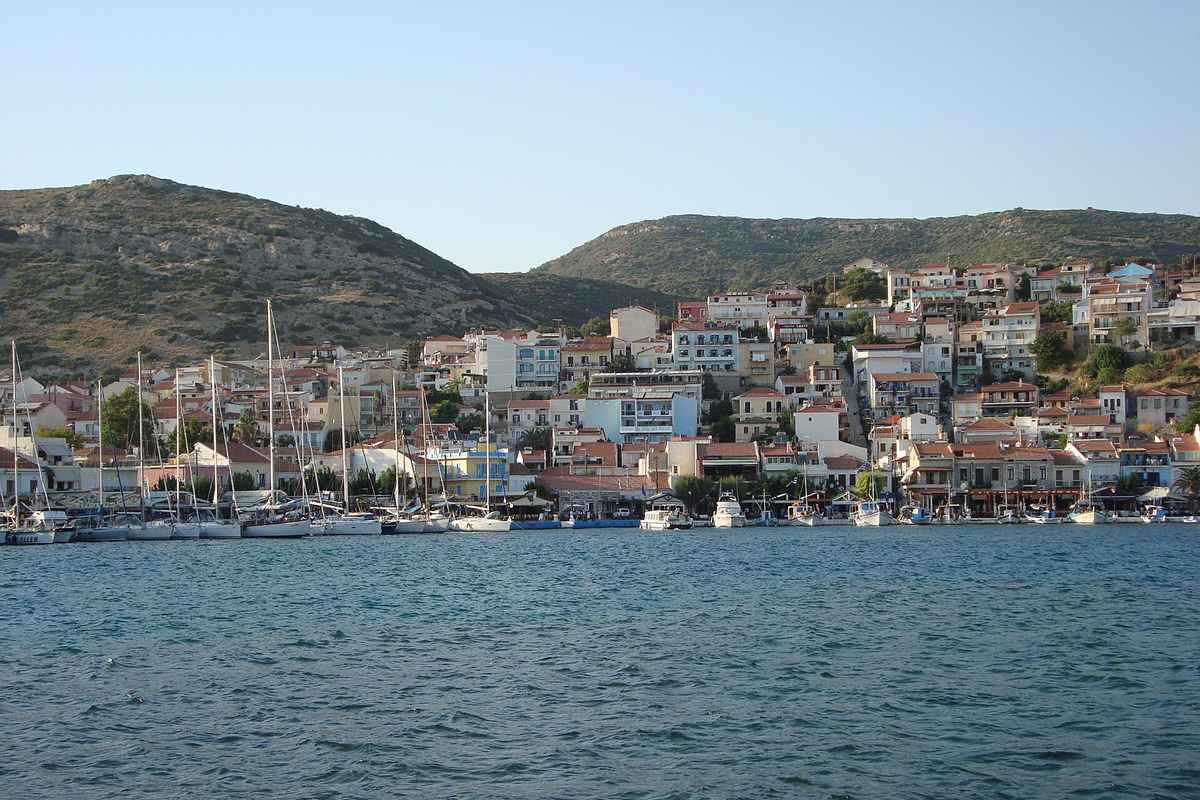
There is speculation that builders used the dioptra on the Eupalinian aqueduct, on the Greek island of Samos. That aqueduct is a tunnel cut through a mountain to carry water. Scholars of ancient Greek inventions disagree, however, on whether the dioptra existed that early. Speculation here means an idea that lacks firm proof.
Among ancient Greek inventions, the dioptra earned a whole book of its own. Hero of Alexandria is credited with that text on building the instrument and using it in surveying. A text of this kind is a manual, a set of practical instructions. Hero’s manual explains the craft of measuring land with the tool.
- Angles: Fitted with protractors, the dioptra measured angles; a protractor is a marked half-circle.
- Groma: The dioptra was a more accurate version of the groma, another surveying tool.
- Fine setting: Screw turns on different parts let users set the instrument for precise readings.
In the end, the theodolite replaced the dioptra as a surveying instrument. A theodolite sights through a small telescope and reads both level and upright angles with care. Its telescope brings far survey marks into sharp, close view for the user.
How did the odometer enter ancient Greek inventions?
Ancient Greek inventions include an early odometer, a device that measures the distance a vehicle travels. Vitruvius first described such a machine in the 1st century BC. Vehicle here means any wheeled carrier, from a cart to a chariot.
Pliny and Strabo listed routes of Alexander the Great, measured by his bematists, Diognetus and Baeton. A bematist measured long distances on foot by counting his steps. Their figure for Hecatompylos to Alexandria Areion was 575 Roman miles. That figure is only 0.2% away from the true distance measured today.
In the record of ancient Greek inventions, Vitruvius’s odometer used chariot wheels 4 Roman feet across. Each wheel turned 400 times in one Roman mile. On every turn, a pin on the axle pushed a cogwheel with 400 teeth forward one step. Cogs are the teeth set all around the edge of such a wheel.
In these ancient Greek inventions, the cogwheel turned a second gear with holes around its rim. Each hole held a pebble, and the pebbles dropped one by one into a box. Counting the pebbles gave the total distance covered on the journey. The rim of a wheel is its outermost ring.
- Possible inventor: The engineer André Wegener Sleeswyk named Archimedes of Syracuse as the possible inventor.
- Hero’s account: Hero of Alexandria describes a similar device in chapter 34 of his Dioptra.
- Leonardo: Leonardo da Vinci later tried to build it from the description, but he failed.
In 1981, the engineer Andre Sleeswyk built his own replica of the Vitruvius design. He fitted the gears with triangular, pointed teeth, like those found in the Antikythera mechanism. With that change, the rebuilt odometer worked well, which links two ancient Greek inventions.
Why does the Tunnel of Eupalinos count among ancient Greek inventions?
Ancient Greek inventions include the Tunnel of Eupalinos on Samos, an aqueduct cut through rock. Herodotus mentions it while telling of the tyrant Polycrates, who ruled around 540 to 522 BC. He never says that Polycrates ordered the work.
The scholar Aideen Carty ties these ancient Greek inventions to the new rulers who ousted the Geomori. The Geomori were the landholding elite of Samos. That new regime granted citizenship to a large group of Megarians, with Eupalinos thought to be among them. The Homeric Hymn to Apollo, which speaks of watered Samos, possibly refers to the tunnel too.
At the source, two rectangular openings, each 28 by 26 centimetres, feed water into a large reservoir. The reservoir has a roughly elliptical plan, which means an oval outline. Later, before the nineteenth century, a church dedicated to St John rose over the reservoir. The church hid the location of the spring even further.
Eupalinos, whose tunnel ranks among ancient Greek inventions, first set out a mountain line to align both halves. This line crossed the summit at its easiest point. From it, he drew a south line and a north line into the rock. A survey line is a straight marked course that steers the digging teams.
- Rockfall guard: In three sections, builders fitted a pointed roof of stone slabs to stop rockfalls.
- Roman repairs: In the Roman Imperial period, curved barrel vaults of small stones and plaster braced other stretches.
- Course fix: A notch cut into the rock marks a spot where the southern dig strayed west.
Two monumental fountains inside the city seem to sit on the line of the southern channel. Monumental here describes a large and grand public structure. Those fountains seem to mark where the water from these ancient Greek inventions finally entered the town.
What role did the Diolkos play in ancient Greek inventions?
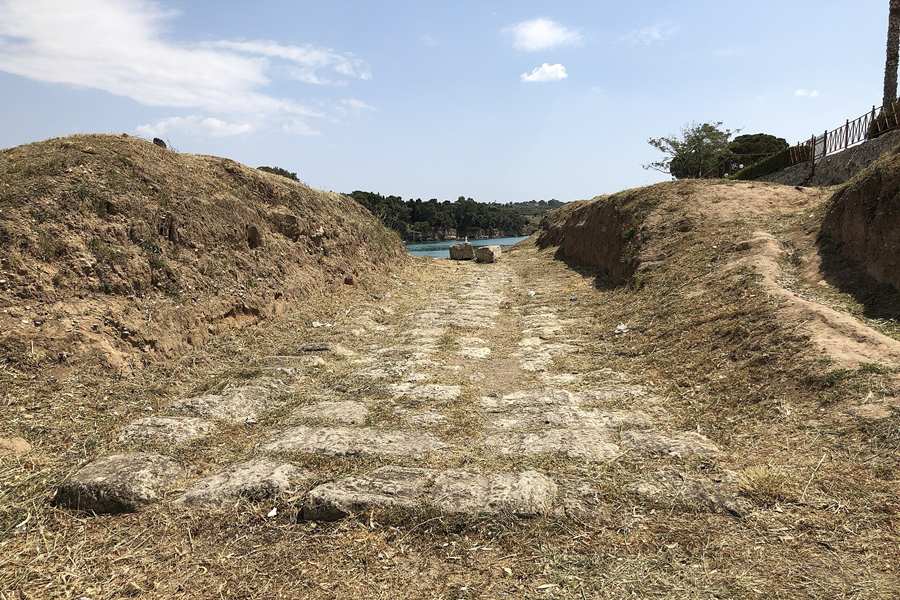
Ancient Greek inventions include the Diolkos, a portage road across the Isthmus of Corinth. Its main task was the transfer of goods. A portage is a route where boats or cargo are carried over land between two stretches of water.
To Thucydides, who lived from 460 to 395 BC, the Diolkos already seemed very ancient. The trackway possibly went out of use after Nero’s failed canal works in 67 AD. Failed here means the digging stopped before the canal was finished. A canal here means a ship channel dug across dry land.
Within ancient Greek inventions, the Diolkos also had a military use, speeding up naval campaigns. A naval campaign is a series of operations by a fleet at sea. During 411 BC, Spartan forces hauled a squadron across it, bound fast for operations at Chios. A squadron here means a detached group of warships from a fleet.
Studies of ancient Greek inventions include work by the scientist Tolley on the manpower for this trackway. Manpower means the number of workers a task needs. His figures point to pulling teams of between 112 and 142 people. Those teams hauled vessels up and over the ridge of the isthmus.
- Macedonian fleet: Philip V sent a Macedonian fleet of 38 vessels across the isthmus.
- Narrow neck: At its narrowest point, the Isthmus of Corinth is just 6.4 km wide.
- Rediscovery: In 1913 James George Frazer reported traces of an ancient trackway in his notes on Pausanias.
Among ancient Greek inventions, the Diolkos possibly first served heavy freight such as marble, monoliths and timber. That use matched the rise of monumental architecture across the Greek world. Monoliths are large columns or blocks cut from a single piece of stone.
How did the Spartan scytale join ancient Greek inventions?
Ancient Greek inventions include the scytale, a cylinder used for secret messages. A strip of parchment was wound around it, and the message went on the strip. The Spartans in particular are said to have used it on military campaigns.
The receiver read the message by winding the parchment around a rod of the same diameter. The diameter is the distance straight across the rod. The method is a transposition cipher, a code that scrambles the order of the letters. Parchment was thin, treated animal hide used for writing.
Records of the scytale among ancient Greek inventions begin with the poet Archilochus, of the 7th century BC. A clear sign of its use for secret writing appears only with Apollonius of Rhodes. He wrote his works in the middle of the 3rd century BC. This craft of hidden writing is known as cryptography.
Plutarch explains how Spartan ephors prepared these ancient Greek inventions for a general or admiral. The ephors were Sparta’s chief officials. They cut two wooden rods that matched each other in length and thickness. One rod stayed with them, and the envoy took the other. An envoy is a person sent out on official state business.
- Name: The Greek word skytale, behind the English name, means a baton or a cylinder.
- Plutarch: No known description of how the device worked predates the writings of Plutarch.
- Doubts: A number of authors think it carried plain text and call Plutarch’s account a myth.
Another theory holds that ancient Greek inventions such as the scytale served for message authentication rather than secrecy. Authentication means proving that a message truly comes from its stated sender. Only a rod of the same diameter turned the jumbled strip into readable text.
What was the hydraulic telegraph of Aeneas in ancient Greek inventions?
Ancient Greek inventions include the hydraulic telegraph, first developed in Greece in the 4th century BC. The word telegraph joins Greek terms for far and for writing. Aeneas Tacticus described the Greek design in that century. Polybius, a historian, followed in the 3rd century BC.
The system used identical containers on separate hills, not joined to each other. Each container held water, with a vertical rod floating inside. Marks on each rod carried fixed codes at points along its height. Hydraulic means driven by water, which gave these ancient Greek inventions their name.
To send a message, the sender first signalled the receiver with a torch. Once both were ready, each opened a spigot at the base of his container. A spigot is a small tap. When the water fell to the right code, the sender signalled with his torch again. Both men then closed their spigots at once.
For these ancient Greek inventions, Aeneas asked for two earthenware vessels of exactly the same size. Each vessel was three cubits deep and one cubit wide. He also had holes of exactly the same size bored in both. A cubit measured roughly from elbow to fingertip. Earthenware means plain fired clay, softer than stoneware.
- Messages: Sections of each rod held wartime news such as cavalry arriving, ships or corn.
- Speed: Modern experiments show that the system can pass on 151 letters per hour.
- Author: Isaac Casaubon held that Aeneas was the Arcadian general Aeneas of Stymphalus.
Aeneas Tacticus ranks among the earliest Greek authors on the craft of war. The craft of war covers planning, defence and command in battle. His water signal design sits among the ancient Greek inventions for sending news over distance.
Which beacon system do the phryctoria add to ancient Greek inventions?
Ancient Greek inventions include the phryctoria, a semaphore system of fire signals. Semaphore means news passed by signs the eye can see. The phryctoriae were towers on chosen mountaintops, each placed in sight of the next. As a rule, towers stood about 20 miles apart.
When one tower lit its flame, the next tower saw the fire and lit its own. The signal thus moved from peak to peak like a chain. Greek speakers called a beacon a phryctos, and two or more were phryctoi. Beacon fires burned on heights so that distant watchers saw them.
Herodotus tells how beacons on Sciathus alerted the Greek forces at Artemisium. The signal reported that the Persian fleet had arrived and seized a number of Greek ships. Sciathus is the ancient name of the island of Skiathos. This account shows ancient Greek inventions for signalling at work in war.
Philip V of Macedon sent men into Phocis, Euboea and Peparethos to find high places for beacons. Height gave each fire a longer line of sight. Philip himself watched for the signals from Tisaeus, a very tall peak. A chain of beacons like his was one of the ancient Greek inventions for war news.
- Signal keeper: The phryctoros was the person in charge of beacon signalling.
- Corcyra: Thucydides wrote that beacons warned the Peloponnesians at Corcyra of sixty Athenian ships from Lefkada.
- Salamis: When Cnemus attacked Salamis Island, the Salaminians asked Athens for help by beacon fires.
The Suda, a Byzantine encyclopaedia, records how the meaning of these ancient Greek inventions depended on handling. A steady, unmoving light marked friends. A moving light warned of enemies. An encyclopaedia gathers knowledge on a wide range of subjects.
How did the Polybius square change signalling in ancient Greek inventions?
Ancient Greek inventions include the Polybius square, a device created by Cleoxenus and Democleitus. The historian Polybius made it famous. It first served for fire signalling, and it allowed the coded sending of any message at all. Fire signalling means sending news with torches or flames.
Among ancient Greek inventions, the device split the alphabet into five tablets, each with five letters. Only the last tablet held just four letters instead of five. A tablet here means a small board with letters written on it. The alphabet here is the Greek set of letters in its fixed order.
To begin, the sender held up two torches and waited until the receiver did the same. That showed that both sides were ready. Next, torches raised on the left told the receiver which tablet to read. Torches raised on the right then picked out the letter on that tablet.
Polybius, who brought fame to these ancient Greek inventions in signalling, was born around 200 BC in Megalopolis. The town lies in Arcadia and was then an active member of the Achaean League. A league, in this sense, is a union of cities under shared rules. Its name, Megalopolis, means great city.
- Lost tablets: No tablets used for the square survive from antiquity, the ancient past.
- Equipment: Both sides needed the same tablets, torches and a sighting tube that narrowed the view.
- Prison code: The square later served as a knock code, tapped on pipes or walls in prisons.
Each letter takes two numbers from one to five, one for the row and one for the column. Ancient Greek inventions such as this let just 5 number symbols stand for 25 characters. Characters here are the letters that a message needs.
Which skill did Glaucus of Chios add to ancient Greek inventions?
Ancient Greek inventions in metalwork include soldering, an art credited to Glaucus from the island of Chios. Soldering joins pieces of metal by melting a filler between them. The Greek name for this craft meant the gluing together of iron.
In accounts of ancient Greek inventions, his best-known work is a welded iron stand for a silver krater. A krater is a wide bowl for mixing wine with water. Herodotus writes that Alyattes, king of Lydia and father of Croesus, gave it to the oracle at Delphi. People came to that shrine to put questions to the god.
The writer Pausanias also saw the iron base and described the way it was put together. Athenaeus, another ancient author, says its surface was chased with tiny animals, insects and plants. Chasing means hammering a raised or sunken design into the front of the metal. Plutarch also speaks of the stand as very celebrated.
For ancient Greek inventions in iron, the word kollesis meant joining metals with no nails, hooks or dovetails. A dovetail is a fan-shaped joint that locks two pieces together. Certain writers linked the proverb, the skill of Glaucus, to this craftsman from Chios. A proverb is a brief folk saying carrying a lesson.
- Date: Eusebius places Glaucus in 691 BC, the second year of the 22nd Olympiad, or four-year Games cycle.
- Royal patron: Alyattes, the king who sent the stand to Delphi, ruled Lydia from 617 to 560 BC.
- Old mistake: Meyer and other scholars wrongly read kollesis as damascene, a kind of engraving on steel.
In the record of ancient Greek inventions, the dates for Glaucus and the king look out of step. Nothing in Herodotus rules out a base made well before Alyattes sent it to Delphi. By the time Pausanias saw it, the krater was possibly already gone.
What calendar tool did Meton of Athens bring to ancient Greek inventions?
Ancient Greek inventions in timekeeping include the Metonic cycle, named after Meton, an astronomer of fifth-century BC Athens. He also worked as a mathematician, geometer and engineer. His cycle rests on the finding that 19 solar years nearly match 235 lunar months.
A solar year follows the seasons, while a lunar month runs from one new moon to the next. After 19 years, a date in the lunar month tends to land again on the same solar day. Callippus, a later astronomer, built on Meton’s work with another of the ancient Greek inventions, the Callippic cycle.
Meton fixed equinox and solstice dates by watching sunrise from his observatory in Athens. A solstice marks the longest or shortest day, and an equinox brings equal day and night. At the summer solstice, the sun rose in line with the hill of Lycabettus. Six months later, it climbed over the brow of Mount Hymettos to the southeast.
Between those two points, the sun seems to travel along a 60° arc every six months. The line splitting that arc in half points towards the Acropolis. For ancient Greek inventions in calendars, these sightlines were important, since Athenians counted years from the summer solstice. Their first month, Hekatombaion, opened at the first new moon following it.
- Partner: Meton made his observations with Euctemon, a fellow observer whose life is otherwise unknown.
- On stage: In Aristophanes’ play The Birds of 414 BC, Meton walks on with surveying tools as a geometer.
- Lost writings: None of Meton’s works survive, but Ptolemy cites an inscribed slab in Athens recording his observations.
Each Callippic cycle spans 76 years, the length of four Metonic cycles. The Antikythera Mechanism, from the second century BC, has a separate dial for each of them. It is the oldest known astronomical calculator among ancient Greek inventions.
Why does the Dipylon inscription stand out among ancient Greek inventions?
Ancient Greek inventions in writing appear early in the Dipylon inscription, a short text on a clay jug. The jug dates to about 740 BC. The text ranks among the oldest known samples of the Greek alphabet being used.
The jug is an oenochoe, a vessel for pouring wine, and it was found in 1871. It came from the Dipylon Cemetery, close to the Dipylon Gate in the Kerameikos area of Athens. Specialists place the jug in the Late Geometric Period, from 750 to 700 BC. Geometric art decorated pots with lines, zigzags and other plain shapes.
In the history of ancient Greek inventions, certain letters here still look like the original Phoenician alphabet. One example is zeta, which resembles the Phoenician letter zayin. The words run from right to left, and each letter is a mirror image of its modern form. The line circles the shoulder of the jug, just below its neck.
Among ancient Greek inventions in writing, this text is also a poem. Its first 35 characters, out of 46, form a line of hexameter, the six-beat metre of Homer. The words mark the jug as a prize in a dancing contest. It goes to whichever dancer now moves with the lightest step.
- Home today: Athens’ National Archaeological Museum holds the jug today as inventory number 192.
- Second hand: The scholar Powell suggested the final marks were a garbled alphabet list by someone learning to write.
- Decoration view: The scholar Binek argued that the last six marks are decoration added by a second inscriber.
Scholars rank either this text or Nestor’s Cup as the earliest alphabetic Greek inscription yet known. Nestor’s Cup, another early witness of ancient Greek inventions in writing, came from Pithekoussai on Ischia, Italy. That cup is thought to be the same age or slightly younger.
What makes the tortoise-shell chelys part of ancient Greek inventions?
Ancient Greek inventions in music include the chelys, the everyday lyre of ancient Greece. Its curved back was made of tortoiseshell, or of wood carved to look like a shell. A lyre is a stringed instrument with two arms joined by a crossbar.
The Greek word chelys and the Latin word testudo both mean a turtle or a tortoise. The name points back to the earliest Greek lyre, credited by tradition to the god Hermes. That tradition places the chelys among ancient Greek inventions with a divine maker, not a human one.
A Homeric hymn is an early Greek poem that praises a god in Homer’s style. The Hymn to Hermes tells how the god found a tortoise by his mother’s door. Hermes scooped out the shell to make the sound box of a seven-string instrument. Greek vase painters showed this lyre with its real tortoiseshell clearly drawn.
In 2011, a study of ancient Greek inventions in music tested a faithful copy of the chelys. Researchers used laser interferometry and impulse response, two ways of tracking how a body vibrates. The sound it gave out gathered between 400 and 800 Hz. Hz, or hertz, counts vibrations per second.
- Roman name: The poet Propertius called the instrument the lyra testudinea, meaning the tortoise lyre.
- Key distinction: Joseph Scaliger is held to be the first writer to separate the chelys from the kithara.
- Later reuse: Athanasius Kircher gave the name chelys to a bowed viol with eight strings.
The results confirm that, among ancient Greek inventions in music, the chelys served to accompany the human voice. Its recorded sound matched the measured shaking of the sound box and bridge. Since classical times, the name has also covered other stringed instruments, bowed and plucked.
Which star tools link Hipparchus to ancient Greek inventions?
Ancient Greek inventions in astronomy include instruments credited to Hipparchus, a Greek astronomer, geographer and mathematician. He is regarded as the founder of trigonometry. Trigonometry is the branch of mathematics that links the angles of triangles with their sides.
Hipparchus was born in Nicaea, in the region of Bithynia. Records show him at work as an astronomer between 162 and 127 BC. Ptolemy notes that certain of these sky observations were made on Rhodes. He seems to have spent his later years on that island, where he is believed to have died.
Within ancient Greek inventions, he is credited with making or improving instruments for naked-eye sky watching. Synesius, a later writer, says he made the first astrolabion. This term can mean an armillary sphere or an early form of the astrolabe. An astrolabe is a disc for measuring the height of stars above the horizon.
Using one of these ancient Greek inventions, the astrolabe, he first found latitude and time from fixed stars. Latitude is a place’s distance north or south of the equator. Before him, people relied on a gnomon’s shadow, the length of the longest day, or a portable scaphe. A scaphe was a bowl-shaped sundial.
- Chord table: He tabulated chords in 7.5-degree steps; a chord is a line joining two points on a circle.
- Star list: Roman sources say he fixed the positions of roughly 850 stars with an instrument.
- Honour: Coins struck in Bithynia in later centuries bear his name and show him with a globe.
Among ancient Greek inventions in geography, his method brought strict mathematics to the latitude and longitude of places. In 1817, Jean Baptiste Delambre called him the father of astronomy. His only surviving work is a commentary on a star poem by Aratus.
How did Anaximander’s map and gnomon enter ancient Greek inventions?
Ancient Greek inventions in mapping go back to Anaximander, a philosopher from Miletus in Ionia. Eratosthenes named him as the first person to issue a world map. The Suda also links him with bringing the gnomon into Greece.
Among ancient Greek inventions, his map stood out by showing the whole inhabited land known to the Greeks. Earlier maps from Egypt, Lydia and Babylon marked roads, towns and borders. The Aegean Sea sat near the centre, ringed by three continents. One reason for the map was better sailing and trade between colonies of Miletus.
In his day, the gnomon was a plain upright pillar or rod set on a flat surface. Its shadow on that surface showed the time of day. In Lacedaemon, or Sparta, he helped build or at least adjust sundials marking solstices and equinoxes. A gnomon needed new settings in each place, because latitude changes the shadow.
Strictly, the gnomon falls outside ancient Greek inventions, since its use came from the Babylonians. The Babylonians also divided the day into twelve parts. Herodotus says they gave the Greeks the art of measuring time. Scholars think his geometry made him the first Greek to fix the equinoxes accurately.
- Earthquake warning: Cicero says he urged the people of Lacedaemon to spend a night outdoors, armed, before a quake.
- Mountain split: The city then fell as the peak of Taygetus broke open like a ship’s stern.
- Later map: His map is thought to have inspired Hecataeus of Miletus to draw a more exact version.
Anaximander, a pupil of Thales, followed him as the second head of the Milesian school. Records of ancient Greek inventions call him the first known maker of a scale world map. He was sixty-four in 547 to 546 BC and died soon after.
Where do the lamp and capital of Callimachus sit in ancient Greek inventions?
Ancient Greek inventions in building include the Corinthian order, credited to the sculptor Callimachus. He also worked as an architect, and his career fell in the late fifth century BC. An order sets the shapes of a column, its capital and the beam above.
The Corinthian capital is richly carved with acanthus leaves and other plant patterns. A capital is the wide top of a column, and acanthus is a plant with deeply cut leaves. Ancient tradition says he made columns in this style for the Corinthians and fixed their proportions. He worked in both Athens and Corinth.
Among ancient Greek inventions for lighting, his golden lamp hung in the cella of the Erechtheion in Athens. A cella is the inner room of a temple. Pausanias says it needed oil only once a year, because its asbestos wick did not burn. A bronze palm branch hung above it to catch any smoke rising from the flame.
The Athenians nicknamed him katatexitechnos, meaning one who finds fault with his own craftsmanship. The name marks him as a perfectionist. Pausanias credits him as the first to bore holes through stone. For ancient Greek inventions in sculpture, the drill deepened light and shade in hair and leaves.
- Temple frieze: He is credited with the winged Victories carved along the frieze of Athena Nike’s temple.
- Lost works: Pliny names his Laconian Dancers, and six frenzied Maenads, followers of Dionysus, survive in Roman copies.
- Northern link: An inscription from Aigai in Macedon, late fifth century BC, possibly relates to his work.
Roman architects later raised the Corinthian order into one of the classical orders. With the Doric and Ionic orders, it completes the trio of ancient Greek inventions in column design. In its own day, it saw less use because those two styles were more popular.
Which tools does myth credit to Daedalus among ancient Greek inventions?
Ancient Greek inventions in myth include a long list credited to Daedalus, a legendary Cretan architect and craftsman. His Greek name, Daidalos, means skilful craftsman or cunning worker. Greek myth treats him as a symbol of wisdom, knowledge and power.
Classical sources disagree on exactly which ancient Greek inventions belong to him. Pliny’s Natural History credits him with carpentry, along with glue, the saw and the axe. He is also said to have made the first masts and sails, for the fleet of King Minos. Carpentry is the craft of cutting and joining wood.
He was said to carve statues so lively that they seemed alive and able to move. Pausanias, touring Greece, credited him with a large group of archaic wooden cult figures, or xoana. A cult figure was an image of a god kept for worship. In Plato’s Meno, Socrates uses these moving statues to picture true understanding.
A craftsman named Daedalus first appears around 1400 BC on Linear B tablets from Knossos. Linear B was an early syllable script that recorded Mycenaean Greek. Ancient Greek inventions credited to him reappear in writing only in the fifth century BC. Writers of that age praise him as inventor, artist and architect.
- Old record: The Linear B form da-da-re-jo-de possibly points to a sanctuary linked with his name.
- Boeotian festival: At the Daedala, an oak effigy dressed as a bride rode in a cart with a bridesmaid.
- Athenian claim: Athenians retold the Cretan-born Daedalus as one of their own, a grandson of King Erechtheus.
His role overlapped with that of Aristaeus, another inventor god of Greek myth. Aristaeus dealt mainly with farming and the arts of the countryside. Daedalus also lent his name to Greek craftsmen and to ancient Greek inventions that showed skilled hands.
Why is Eratosthenes of Cyrene counted in ancient Greek inventions?
Ancient Greek inventions in science include the armillary sphere, which Hipparchus credited to Eratosthenes of Cyrene. The device is a frame of rings marking lines of longitude and latitude in the sky. Eratosthenes also ran the Library of Alexandria as its chief librarian.
His fame rests on being the first known person to work out the Earth’s circumference. Circumference is the distance all the way round a circle or sphere. Among ancient Greek inventions in measurement, his method compared noon shadows in Alexandria and Syene, now Aswan. He treated both cities as lying on one meridian, a north-south line.
At noon on the summer solstice, upright rods in Syene cast no shadow. In Alexandria, the shadow angle was about 7.2 degrees, or 1/50 of a full circle. The cities stood about 5,000 stadia apart, a stadion being a Greek unit of length. Multiplying by 50, he reached roughly 250,000 stadia around the Earth.
Eratosthenes also became the first to work out the tilt of the Earth’s axis. In ancient Greek inventions for maps, his world map was the first global projection with parallels and meridians. These are the lines of latitude and longitude. He also counted 365 days in a year, with 366 in every fourth year.
- Nickname: Admirers called him Pentathlos, after Olympic all-round athletes, for knowing every field of learning.
- Jibe: Critics called him Beta, meaning second, because he never ranked first in any field.
- Athens years: He lived in Athens for about twenty years, studying and writing.
The sieve of Eratosthenes, among ancient Greek inventions in mathematics, picks out prime numbers from a list. A prime number divides only by itself and one. One scholar argues the method was already known, and Eratosthenes only coined the name sieve.
How did the gastraphetes belly bow work among ancient Greek inventions?
Ancient Greek inventions in weaponry include the gastraphetes, a hand-held crossbow whose name means belly-releaser. It was also called the belly bow or belly shooter. A crossbow sets a bow sideways on a wooden stock, so the string stays drawn until release.
It drew power from a composite bow, made of bonded layers. To cock it, the archer pressed his belly into a hollow at the rear of the stock. This summoned far more force than one arm can give with a hand-bow. Unlike later crossbows, it was spanned by pushing a slider down, not by pulling the string up.
Heron of Alexandria, who wrote on ancient Greek inventions for war, described it in his Belopoeica. That first-century work’s title means On Arrow-Making. Heron drew on an earlier account by the famous engineer Ctesibius. No ancient pictures or finds survive, yet Heron’s detailed account allows modern reconstructions.
Heron calls it the forerunner of the catapult, another of the ancient Greek inventions for war. That places its invention at an unknown date before about 420 BC. A long-held view dated it to 399 BC and the craftsmen of Dionysius I of Syracuse. Recent study finds Diodorus was in fact describing a catapult, not this bow.
- Bigger cousin: A larger form, called the oxybeles, was used in siege warfare.
- Named maker: The writer Biton credits two advanced forms of the gastraphetes to a man called Zopyros.
- Home town: Zopyros is thought to have been a Pythagorean engineer from Taras, now Taranto in Italy.
He possibly designed his bow-machines for the sieges of Cumae and Miletus, between 421 and 401 BC. By those dates, the original gastraphetes among ancient Greek inventions must already have existed. Early ballistae later replaced the oxybeles, and smaller ones replaced the gastraphetes too.
Why do a rattle and a wooden dove tie Archytas to ancient Greek inventions?
Ancient Greek inventions credited to Archytas of Tarentum include a baby rattle and the ratchet. This ratchet was a clacking noisemaker, called raganella, or tree frog, in Italian. Tradition also gives him the screw and the pulley. He is remembered as the reputed founder of mathematical mechanics.
Among ancient Greek inventions, tradition also credits him with a flying dove of wood. The only ancient mention comes about five centuries after him, in the writer Aulus Gellius. Gellius quotes his teacher Favorinus: weights balanced the bird, and hidden air inside moved it. Once it landed, it did not rise again.
Vitruvius names him among twelve authors who wrote on mechanics, the science behind machines. His method for doubling a cube used lines traced by moving figures. Diogenes Laertius calls it the first of the ancient Greek inventions to bring motion into geometry. The scholar Winter suggests the Mechanical Problems, long credited to Aristotle, possibly came from Archytas.
Archytas was born in Tarentum, a Greek city in southern Italy within Magna Graecia. Magna Graecia means Great Greece, the Greek colonies of southern Italy. The Tarentines chose him as general seven years running, breaking their own rule against repeat terms. He was said to be undefeated in the field.
- Friend of Plato: The Seventh Letter says Archytas tried to rescue Plato from trouble with Dionysius II of Syracuse.
- Teacher: He taught mathematics to Eudoxus of Cnidus and to Menaechmus, a student of Eudoxus.
- In the sky: A lunar crater and asteroid 14995 Archytas, found in 1997, carry his name.
Ptolemy saw him as the subtlest Pythagorean theorist of music. He gave the harmonic mean its name, though he did not discover it. Among ancient Greek inventions in thought, he framed the best-known ancient argument for an infinite universe.
What fair-start device did ancient Greek inventions give to stadium races?
Ancient Greek inventions in sport include the hysplex, a starting gate used for horse races and footraces. A starting gate is a barrier that stops racers from leaving early. Each racer stood behind a separate gate of his own.
At the start line, an upright bar held a crosswise gate kept up by a string. Behind the runners, the strings all met at one point, where a referee held them. A referee is the official who rules on fair play. When the referee let go, every gate fell at the same moment and released the runners.
Races seem to have begun at first with a sound signal. Athletes ignored it, however, and set off too soon. Officials therefore devised special mechanisms to give every race a fair start. Knowledge of these ancient Greek inventions comes from vase paintings and from Hellenistic and Roman descriptions.
Isthmia shows another version of these ancient Greek inventions, a starting line built for fair footraces. Its triangular pavement has sockets for upright posts beside sixteen lanes. Grooves run from the sockets to a round cutting at the tip, the starter’s place. Each post held a wooden bar on a string, which swung down at the starter’s wish.
- Two ropes: Later sources describe two ropes stretched at the height of the runners’ knees and chests.
- Poles: The ropes were tied to two upright poles set on special mechanisms, not in the ground.
- Release: When the official tripped the mechanism, the ropes dropped and runners sprang onto the track.
The Isthmia system possibly never worked as intended. It soon gave way to one barrier across all the runners. At Nemea, stone starting blocks still carry toe grooves for runners. Holes in them took a hysplex, one of the ancient Greek inventions for accurate starts.
What does the Salamis Tablet show about ancient Greek inventions in counting?
Ancient Greek inventions in counting include the Salamis Tablet, a marble counting board from around 300 BC. It was found on the island of Salamis in 1846. A counting board is a flat surface on which loose markers stand for numbers.
Among ancient Greek inventions, it stands as a forerunner of the abacus. An abacus is a frame for adding and subtracting with movable beads or counters. Users placed pebbles, called calculi in Latin, on the board and moved them as they worked out sums. The slab measures about 150 by 75 centimetres and is 4.5 centimetres thick.
Experts first took the white marble slab for a gaming board. Today it is kept in the Epigraphical Museum in Athens. Five groups of markings cover its face. Along three edges run Greek symbols for numbers in the acrophonic system. In that system, a number sign is the first letter of the number’s name.
Ancient Greek inventions in numbers include two systems, the older Attic and the younger Milesian. The Attic system served trade and labelled the columns of counting boards. Archimedes and Diophantus used the Milesian system, which suited scientific mathematics. In it, each letter of the alphabet also stood for a number.
- Centre: Five parallel lines, split evenly by a vertical line, fill the middle of the tablet.
- Lower field: Below a wide crack, eleven parallel lines carry crosses on the third, sixth and ninth.
- Place value: Each counter stood for one unit of a size set by its position.
Among ancient Greek inventions for sums, its use possibly matched medieval boards with lines for powers of ten. Herodotus says Greeks reckoned from left to right, the reverse of Egyptian practice. One modern teacher, Stephen Stephenson, suggested its two sides showed positive and negative numbers.
How do the Pheidonian weights and measures belong to ancient Greek inventions?
Ancient Greek inventions in trade include the Pheidonian weights and measures, named after Pheidon, a ruler of Argos. He is commonly dated to the first half of the seventh century BC. Weights and measures are agreed units for mass, length and volume.
Digs at the temple of Hera in Argos have turned up short iron spits. Pheidon possibly offered them there when he fixed standard measurements. Such spits are slim rods that once held meat over a fire. Among ancient Greek inventions, his measures came into use across the whole Peloponnese.
Old reports say Pheidon struck the first Greek coins. Historians now see this as an anachronism, a detail placed in the wrong period. Greek coinage only began in the last quarter of the seventh century, on the island of Aegina. So coins sit outside the ancient Greek inventions linked to his name.
Pheidon tightened Argive control over the surrounding Argolid region. On the usual dating, his Argives beat the Spartans at Hysiae in 669/8 BC. They then took the plain of Thyrea, on the border with Sparta. Certain scholars think he was among the first rulers to use the hoplite phalanx. A phalanx is a tight block of armoured spearmen.
- Family: His Dorian dynasty claimed descent from Temenus, and Ephorus puts him ten generations later.
- Pride: Herodotus writes that Pheidon acted with the greatest hubris, or arrogance, of all Greeks.
- Tyrant: Aristotle names him as a king who turned into a tyrant, a ruler holding total power.
Beyond ancient Greek inventions, his son Lacedas followed him, and grandson Meltas was the last king of Argos. A late writer, Nicolaus of Damascus, says Pheidon died in Corinth while stepping into civil strife. Syncellus traces the kings of Macedon to another son, Caranos.
Which chariot do the myths of Erichthonius add to ancient Greek inventions?
Ancient Greek inventions in Athenian myth include the quadriga, credited to Erichthonius, a legendary early king of Athens. A quadriga is a chariot drawn by a team of four horses. Erichthonius was said to be lame and built it to move about more easily.
Certain myths make him autochthonous, meaning born from the soil of the earth itself. They add that the goddess Athena adopted or raised him as a child. Early Greek texts treat him and his grandson Erechtheus as one and the same figure. By the fourth century BC, in Classical times, the two had become separate figures.
The Parian Chronicle, an ancient list of dates, says he taught his people to yoke horses to chariots. Driving these ancient Greek inventions, he is said to have raced in games again and again. Zeus, impressed by his skill at the reins, made him the star pattern Auriga, the Charioteer.
Before taking the throne, he drove out Amphictyon, who had seized it from Cranaus twelve years earlier. Erichthonius did more than add to ancient Greek inventions: as king, he founded the Panathenaic Festival for Athena. He also set up a wooden statue of the goddess on the Acropolis of Athens.
- Family: He married Praxithea, a naiad or water nymph, and their son Pandion I followed him.
- Name: His name has no certain origin and possibly comes from a pre-Greek form.
- Folk meaning: Folk etymologies link the name to erion, wool, or eris, strife, joined with chthon, earth.
Ancient Greek inventions aside, the Erechtheum, holiest building on the Acropolis, is dedicated to him. In one version, Athena dropped a mountain in anger, and it became Mount Lycabettus. During his reign, the goddess Athena frequently stepped in to protect him.
What do travellers ask about ancient Greek inventions, and what are the answers?
The ancient Greek inventions of myth include Talos, the bronze guardian of Crete against raiders from the sea. In sport, halteres served Greek athletes as dumbbells and as weights for the long jump. Records trace them back to 700 BC.
Where does the bronze guard Talos fit among ancient Greek inventions?
In the Argonautica, Talos comes from a race of bronze that sprang from ash trees. The Argonautica is an epic poem by Apollonius of Rhodes. Zeus gave him to Europa to guard Crete, and he ran round the island three times. Pseudo-Apollodorus gives him one vein from neck to ankle, sealed by a bronze nail.
How did halteres work as ancient Greek inventions for the long jump?
These weights, cut from stone or cast in metal, weighed 2 to 9 kilograms. A jumper swung them to and fro, then thrust them forward at take-off. Before landing, he swung them back and let them go. They added about 17 centimetres to a jump of 3 metres.
Which ancient Greek inventions does myth credit to Perdix?
Certain sources make Perdix the nephew and pupil of Daedalus, and the inventor of the saw and compass. Ovid says the jealous Daedalus pushed him from a temple tower, but Minerva turned him into a partridge. Pausanias places a tomb of the boy, there called Kalos, between the Acropolis and the theatre.
What ancient Greek inventions in farming belong to Bouzyges of Athens?
Myth makes Bouzyges, the ox-yoker, the first to yoke oxen to a plough, bringing farming to Athens. His only ancient image is on a krater in Harvard’s Fogg Museum, showing him driving two bulls. Each year, at a festival below the Acropolis, a member of his clan performed a sacred ploughing rite.
Featured photo: Njaker (talk), CC BY-SA 3.0, via Wikimedia Commons.