
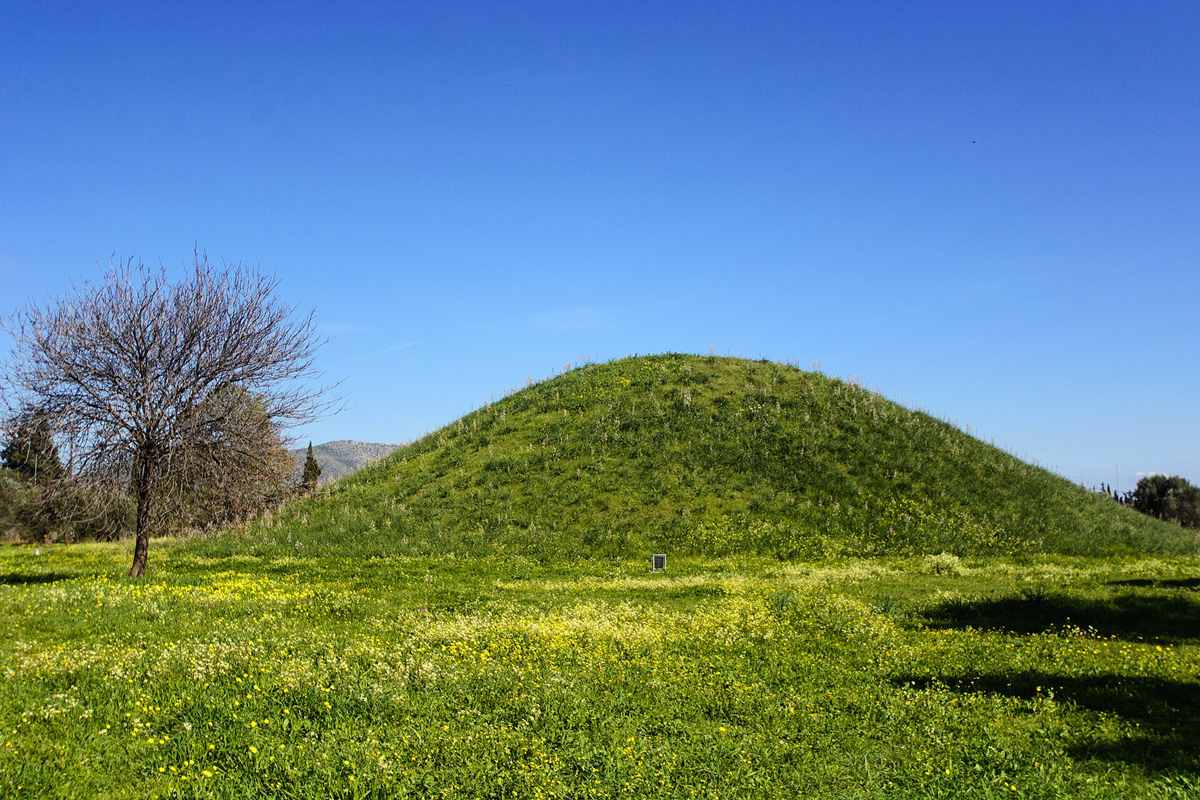
Ancient Greek warfare is the theme of hosted trips across Greece. They take place across mainland Greece, from Attica and Boeotia to the Peloponnese. Its story runs from the hoplite, the phalanx and the aspis shield to the trireme. Its battles range from Marathon, Salamis and Plataea to Leuctra, Sphacteria, Mantinea and Pydna. Linked stories include the Battle of Thermopylae, the Trojan War and Alexander the Great in Greece. Further outings by region sit under Greece tours.
Bookings made through the GetYourGuide widgets on this page earn Classical Greece Tours a commission, at no extra cost to the traveller.
What was ancient Greek warfare?
Ancient Greek warfare ran through the whole history of Greece, from the Greek Dark Ages onward. A growing population brought back town life and the city-states, or poleis. These states then gained the ability to wage organised war on one another.
The Archaic period of Greece ran from 800 to 480 BC. With the city-state came a new style of ancient Greek warfare: the hoplite phalanx. Hoplites were armoured foot soldiers, and a phalanx was their close-packed battle line. The Chigi vase, from around 650 BC, gives the earliest image of a fully armed hoplite.
Soldiers were citizens with other trades, so ancient Greek warfare stayed limited in distance, season and scale. Neither side had the means for heavy losses or drawn-out campaigns. Conflicts appear to have been settled by one set-piece battle, meaning a planned, formal clash. The winning side then handed the fallen back to the losers for a ransom.
The Greco-Persian Wars opened the Classical age of Greece, which lasted from 480 to 323 BC. Later, the Peloponnesian War brought more variety to ancient Greek warfare. Sea battles gained weight, as did blockades and sieges meant to wear an enemy down. The rise of Macedon closed the age of the distinctive hoplite battle.
- Psiloi: These light foot soldiers backed the hoplites and also served as baggage carriers.
- Archers: Archers were rare in Greek armies and came mainly from Crete or hired non-Greek tribes.
- Tarantine cavalry: This horse troop came from Taras, a city-state in Magna Graecia, the Greek south of Italy.
The Greco-Persian Wars changed the scope and scale of ancient Greek warfare. No single city-state had the strength to face the vast armies of the Achaemenid Empire of Persia. Victory came instead through alliances of city-states, on a scale never seen before.
Who were the hoplites of ancient Greek warfare?
Ancient Greek warfare rested on the hoplites, citizen-soldiers of the city-states who carried mainly spears and shields. They were chiefly free men with property, such as farmers and craftsmen. These men had wealth enough for linen or bronze armour and weapons.
The name comes from hoplon, the Greek word for the gear a hoplite carried. In today’s Greek army, hoplite still means an infantryman, or foot soldier. In ancient Greek warfare, hoplites made up an estimated third to half of the men fit to serve. Certain states also kept small elite units called epilektoi or logades, ‘the chosen’.
Athenian men stayed liable for service until the age of 60. In ancient Greek warfare, each hoplite paid for his own kit. A full bronze panoply, the complete set of armour, weighed nearly 32 kilograms. The average farming hoplite lacked the money for armour. He brought only a shield, a spear and a helmet if he had one.
The earliest grand group grave of warriors, on Paros, dates hoplite units to the late eighth century BC. Later in ancient Greek warfare, armour grew lighter, giving rise to the ekdromos, a light hoplite. The Athenian general Iphicrates armed hired troops with linen armour, smaller shields and longer spears.
- Lechaeum: Iphicrates and his new-style troops beat a Spartan force there in 391 BC.
- Shields: Family or clan emblems decorated early shields, later swapped for city-state symbols or monograms.
- Battlefields: Hoplites preferred level ground with high terrain on both sides, so no enemy got round them.
Every hoplite was expected to join any campaign once the leaders of his state called him. Philosophers, artists and poets of note served in the line as hoplites. Ancient Greek warfare drew the bulk of every army from these citizen spearmen.
How did the phalanx shape ancient Greek warfare?
Ancient Greek warfare gives the word phalanx its modern meaning. Today the term names a rectangular mass of heavy infantry, packed tightly and armed with spears. Ancient Greek writers used it more widely, for any massed foot soldiers, whatever their weapons.
The oldest known image of a phalanx-like line is on the Stele of the Vultures, from Sumer. This carved stone slab dates from the 25th century BC. Homer first used the word in the Iliad, Book 6, line 6, for organised line fighting. In Greek, the same word also named a log used as a roller.
In ancient Greek warfare, hoplite phalanxes formed ranks eight men deep or more. Battles between two phalanxes took place on open, flat plains, where keeping the line was easier. The phalanx moved forward at a walking pace, so its formation held together. Each man’s shield guarded himself and the soldier to his left.
A rear-rank officer, the ouragos or ‘tail-leader’, kept order at the back. Friends and family were placed close together on purpose, so shame worked against panic. In ancient Greek warfare, the word dynamis, ‘the will to fight’, named what held hoplites in place. Because shields covered the left, the whole phalanx tended to drift to the right.
- Synaspismos: In this locked-shields order, each man filled a width of only 0.45 metres.
- War cry: Athenian hoplites raised the cry eleleleleu in the instants before the two lines met.
- Marching order: On the march, the phalanx used a loose order called eis bathos, meaning ‘in depth’.
In ancient Greek warfare, hoplites trusted their neighbours to protect them and guarded them in turn. A phalanx was therefore only as strong as its weakest men. Clashes between Greek city-states were frequently settled when one side fled before the fight.
What did the aspis shield mean in ancient Greek warfare?
Ancient Greek warfare depended on the aspis, the heavy wooden shield of Greek foot soldiers. It entered use around the turn from the eighth to the seventh century BC. It is at times wrongly called a hoplon, the Greek word for a soldier’s gear.
An aspis was deeply dished, or hollowed, and built mainly of wood. Certain shields carried a thin bronze sheet on the outer face, at times only around the rim. One account describes three layers: thick wood in the centre, bronze facing the enemy and leather inside. Decorating the shield was the normal custom.
In ancient Greek warfare, an aspis frequently measured over 0.9 metres across. Its weight was about 7 kilograms, and its thickness 2.5 to 4 centimetres. The key change was the Argive grip, which set the handle at the shield’s edge. At the centre sat the porpax, a strap of leather or bronze that held the forearm.
Its weight sat on the shoulders, and it covered a man down to the knees. Its convex face bulged outward like a shallow bowl. One disputed theory of ancient Greek warfare says the curve let a man breathe in a crush. Two points of contact stopped the shield swinging aside when struck, so soldiers rarely lost it.
- Bomarzo shield: Only one aspis survives well enough to show how such shields were built.
- Find: It came to light in 1830 near Bomarzo, in the Lazio region of central Italy.
- Display: The shield is now in the Vatican, in its Gregorian Etruscan Museum.
In ancient Greek warfare, a hoplite in flight was at times forced to drop his cumbersome aspis. Doing so disgraced him before his friends and family. He was then known as a ripsaspis, meaning ‘one who threw his shield’.
Why did the Corinthian helmet stand out in ancient Greek warfare?
Ancient Greek warfare favoured the Corinthian helmet above all others in the Archaic and early Classical periods. Art and finds from digs point to this lead. A large curved projection at the back guarded the nape, or back of the neck.
In ancient Greek warfare, the Corinthian helmet began as a standard type and proved a successful design. Excavations have turned up a large number of these helmets, and Greek pottery frequently shows them. The Greeks appear to have tied it, in a romantic way, to glory and the past. The Romans revered it too.
The helmet carried one or more horsehair crests, or bronze animal horns and ears. A crest is a tall plume running along the top of a helmet. In ancient Greek warfare, helmets were painted in colour as well. In Italy, variants appeared with nearly closed slits, worn like a cap instead of over the face.
Later in ancient Greek warfare, the more open Thracian and Chalcidian types replaced it, with the simpler pilos. The Chalcidian was a lightened version of the Corinthian. The pilos cost less to make than the Corinthian type. It also left the wearer’s sight and hearing unblocked, unlike the closed Corinthian design.
- Herodotus: He mentions the helmet among the Machlyes and Auseans, tribes by the River Triton in Libya.
- Ritual fight: Each year two teams of maidens fought one another there with sticks and stones.
- Festival: The fairest maiden wore Greek armour and a Corinthian helmet at a feast for Athena.
In Italy, the helmet became the Italo-Corinthian, a style shaped like a jockey cap. Its typical nose guard and eye slits turned into mere decoration on its face. The Roman army used this offshoot of ancient Greek warfare until the 1st century AD.
Which role did the dory spear play in ancient Greek warfare?
Ancient Greek warfare armed the hoplite, a heavy foot soldier, with the dory as his chief spear. Its length let more than one rank of a formation strike at the same time. A smaller version went by the name doration.
The word first appears in Homer’s epic poems, where it means both ‘wood’ and ‘spear’. Heroes in those poems carry two spears each. In ancient Greek warfare, the dory stood as a symbol of military power. Words such as doryktetos, ‘spear-won’, and doryalotos, ‘spear-taken’, reflect that status. A phrase for wealth gained through war meant ‘spear-won wealth’.
In ancient Greek warfare, the dory measured about 2 to 3 metres in length. Its wooden shaft, of cornel or ash, was about 5 centimetres across. The whole spear weighed between 0.91 and 1.81 kilograms. A flat, leaf-shaped iron head sat at the front, balanced by an iron spike at the rear.
The rear spike was the sauroter, a name meaning ‘lizard-killer’. Other names for it were ouriachos and styrax. Hoplites used it to stand the spear upright in the ground. If the head broke off, the spike served as a second weapon. Even a broken shaft kept working, though its reach was shorter.
- Grip: The hoplite held the dory in his right hand and his shield on the left.
- Persians: Persian spears in the Greco-Persian Wars were shorter than those of their Greek foes.
- Case: A dory was stored in a case that Homer called syrinx, meaning pipe.
In ancient Greek warfare, the dory was not meant for throwing like a javelin. Historians still debate whether hoplites thrust it overarm or underarm. The Greek proverb ‘with spear and shield’ meant chasing a goal by every possible means.
What was the linothorax in ancient Greek warfare?
Ancient Greek warfare used the linothorax, upper body armour worn across the ancient Mediterranean world. Its modern name comes from a Greek word meaning ‘wearing a breastplate of linen’. Greek and Latin texts from the 6th century BC to the 3rd century AD mention linen armour.
By the late 6th century BC, Aegean art shows hoplites in linen armour. They wear it in place of a bronze cuirass, or metal breastplate. Possible reasons include its lower price, lesser weight or cooler cloth. In ancient Greek warfare, linen armour was the more common type, being cost-effective and decently protective.
Certain scholars read Homer’s ‘linen-breasted’ Ajax the Lesser as a man in such armour. The poet Alcaeus, who lived around 650 to 550 BC, wrote the earliest clear reference to it. How the ancient armour was made remains largely unknown. Linen rots away and leaves little for archaeologists to find.
From around 575 BC, Aegean artists show a distinct armour style of ancient Greek warfare. It has a smooth piece around the chest, two shoulder flaps and a skirt of flaps. These lower flaps are called pteruges. In the 1970s, Peter Connolly built a modern copy from glued layers of linen.
- Glue theory: The idea of glued linen layers traces back to an 1869 mistranslation about medieval armour.
- Twining: Textile expert Hero Granger-Taylor proposes the cloth was woven by a special technique called twining.
- Thickness: The linen used in such armour measured 0.5 centimetres in thickness.
Artists still showed this armour of ancient Greek warfare in the Hellenistic period, after Alexander the Great. Mentions of linen armour grew much rarer under the Roman emperors. Roman iron armour, such as mail made of linked rings, appears to have cut demand for it.
Where did the xiphos sword fit in ancient Greek warfare?
Ancient Greek warfare gave the hoplite a back-up blade, the xiphos. It was a straight, double-edged short sword of the Iron Age, used with one hand. Greek armies treated it as a second weapon, behind the dory spear or the javelin.
Homer used the word xiphos as a name for a sword, according to one glossary. That entry describes a blade widest about two-thirds of the way from the point. It ended in a very long point. The word also appears in Linear B, the early script of Mycenaean Greek, as qi-si-pe-e.
In ancient Greek warfare, the classic xiphos blade ran about 45 to 60 centimetres long. Spartans reportedly favoured blades as short as 30 centimetres around the time of the Greco-Persian Wars. The sword was light, weighing around 450 to 900 grams. It hung from a baldric, a shoulder strap, under the wearer’s left arm.
In ancient Greek warfare, hoplites drew it chiefly when the spear broke, was taken or was dropped. Its leaf-shaped blade suited both cutting and thrusting. A very short xiphos slipped through gaps in the shield wall when hoplite lines met. Its blade looks almost identical to that of the Mycenaean Naue II sword.
- Handles: Two slabs of local wood, ebony or bone were pinned to the tang, the blade’s hidden end.
- Gold foil: Hilts decorated with gold foil come only from burials and appear ceremonial.
- Scabbard: The Greek name for the sword’s scabbard, or sheath, was koleos.
Surviving xiphe, the plural of xiphos, are rare finds from ancient Greek warfare. They turn up beside iron weapons in burial sites of the period. The early Celtic La Tène short sword, from the same era, had a virtually identical blade.
What made the trireme a weapon of ancient Greek warfare?
Ancient Greek warfare at sea used the trireme, a warship rowed on three levels. Digs at the ship sheds of Zea give a broad outline of the Athenian type. Zea, in Piraeus, served as ancient Athens’ chief harbour for warships.
Dragatsis and Wilhelm Dörpfeld first dug these sheds in the 1880s. Each shed was about 40 metres long and just 6 metres wide. The writer Vitruvius gave each rower a space of 2 cubits, an old unit of length. From that, the overall ship length comes to just under 37 metres.
In ancient Greek warfare, building one trireme took around 6,000 man-days of work. Shipwrights made the outer hull first and fitted the ribs afterwards. Fir, pine and cedar were the three main timbers. A draught of about 1 metre, the depth below the waterline, let crews beach the ship easily.
In ancient Greek warfare, a wooden statue of a god above the bronze ram showed the home port. The rams, or embola, sat on the prows to rupture enemy hulls. Crews preferred to strike from behind, tearing as long a stretch of hull as possible. Masts and railings came down before battle, to deny grappling hooks a grip.
- Ramming: Striking at 60 degrees, a ship needed only 4 knots, a sea speed unit, to pierce a hull.
- Crew: A typical Athenian crew held 80 citizens, 60 metics, or resident foreigners, and 60 hired outsiders.
- Rowing chants: Aristophanes’ play The Frogs preserves two rowing calls, ryppapai and o opop.
Ancient Greek warfare manned its galleys with free men, not galley slaves. A piper set the rhythm for the rowers. Each crewman needed about 7.6 litres of fresh drinking water every day. At times, thousands of spectators on shore watched these sea battles.
How did the Battle of Salamis unfold in ancient Greek warfare?
Ancient Greek warfare at Salamis pitted a Greek fleet of 378 triremes, by Herodotus’s count, against the Persians. Herodotus says their fleet first numbered 1,207 triremes. The common modern view sets the figure at Salamis at 600 to 800 ships.
On the way to this clash of ancient Greek warfare, Themistocles left carved messages at springs. They addressed Ionian Greek crews serving Persia and urged them to change sides. The exiled Athenian general Aristides arrived that night with news of the Persian deployment. The Persians spent the night at sea, searching in vain for a Greek escape.
Ancient Greek warfare at sea knew the diekplous, a move the Persians and Asiatic Greeks used. It seems to have meant rowing through gaps between enemy ships, then ramming their sides. Herodotus suggests the Greek ships were heavier and less nimble. Plutarch says the Greeks first backed away to gain position and wait for the morning wind.
Herodotus repeats a legend that a ghostly woman scolded the Greeks for backing their ships away. The Athenians said the ship of Ameinias of Pallene rammed first, though the Aeginetans claimed that honour. Herodotus says Persian losses ran higher because the bulk of the Persians were unable to swim.
- Aeschylus: The playwright, who fought at Salamis, put the Greek fleet at 310 triremes.
- Ambush: Herodotus says the Aeginetans lay in wait for Persian ships at the exit of the straits.
- Marines: One theory links the heavier Greek ships to marines: twenty armoured hoplites came to 2 tons.
The next year, the Persian fleet numbered 300 triremes. Plutarch says this clash of ancient Greek warfare brought the little-known Cimon great repute in Athens. In 2017, archaeologists announced the find of the anchorage used by the Greek fleet beforehand.
What happened at Marathon in ancient Greek warfare?
Ancient Greek warfare faced the Persian Empire on the battlefield of Marathon, in Attica. Herodotus says King Darius sent a fleet of 600 triremes. Modern historians broadly agree on about 25,000 Persian foot soldiers, with roughly 1,000 horsemen.
Attica, the land ruled by Athens, had about 315,000 people at this time, slaves included. On the battle monument, the writer Pausanias noticed names of former slaves freed in return for military service. In ancient Greek warfare, hoplites were exposed to cavalry attack, which kept the Athenians on the defensive.
The armies stood about 1,500 metres apart, or 8 stadia in Greek measure. In this clash of ancient Greek warfare, Miltiades set two tribes, Leontis and Antiochis, in the centre. They formed only four ranks. The tribes on the wings lined up eight ranks deep. The signal to advance was simple: ‘At them’.
One view holds that they marched to the limit of arrow range, about 200 metres out, then ran. Herodotus suggests no Greek army had run into battle like this before. In the centre, the Persians and the Sacae, another people of the Persian army, broke through. Fleeing Persians who ran into the swamps drowned in unknown numbers.
- Ships taken: The Athenians captured seven Persian ships, though the bulk got away.
- Armour: At this time the Greeks wore upper body armour of leather or linen, not bronze.
- Old estimates: Plutarch and Pausanias each put the Persian force at 300,000 men.
Ancient Greek warfare at Marathon claimed the general Stesilaos and Callimachus, the war archon, a senior official. Cynaegirus, brother of the playwright Aeschylus, grabbed a Persian trireme and began hauling it ashore. He died after a crew member cut off his hand.
How did ancient Greek warfare play out at Plataea?
Ancient Greek warfare brought a large Spartan army to Plataea, a city in Boeotia. Herodotus says Sparta sent 45,000 men. They were 5,000 Spartiates, or full citizens, and 5,000 other Laconian hoplites. The rest were 35,000 helots, Sparta’s serfs.
Pausanias, regent for his cousin Pleistarchus, led the Spartans at this battle of ancient Greek warfare. Each Athenian tribe, or phyle, had its own commander. The historian Lazenby puts the Persian army at 70,000, including 10,000 cavalry. He compared the size of their camp with later Roman army camps.
In ancient Greek warfare at Plataea, the Persians on the left faced 11,500 Spartan and Tegean hoplites. In the Persian line, men called sparabara stood in front, wearing scaled iron corslets. Pausanias held back, waiting for favourable omens, or signs from the gods. Under the arrows, the Tegeans charged the Persian lines first.
The Persians tried to snap the Greek spears by grabbing them, and failed. One historian credits a soldier named Aeimnestus with killing Mardonius, the Persian commander, with a thrown stone. At the Persian camp, the Spartans waited for the Athenians, who knew how to scale walls. The Tegeans broke through the walls first.
- Amompharetus: This Spartan battalion leader refused a night retreat, judging it cowardly.
- Callicrates: An arrow struck him while he sat behind his shield, before he fought.
- Camp: By Herodotus’s estimate, just 3,000 Persians came through the fight at their camp alive.
Among spoils of ancient Greek warfare, the cuirass of Masistius, the Persian cavalry commander, reached the Erechtheion. This breastplate hung in the shrine of Athena Polias in that Acropolis temple. The Tegeans gave the bronze manger of Mardonius’ horse to their temple of Athena Alea.
What did Leuctra change in ancient Greek warfare?
Ancient Greek warfare came to Leuctra, in Boeotia, after a quarrel between Sparta and Thebes. The two disagreed over how to renew a common peace treaty in 371 BC. The writer Pausanias later called the Theban win the best-known victory of Greeks over fellow Greeks.
As guarantor of the King’s Peace, Sparta had earlier made the Boeotian League disband. That league was a union of Boeotian cities led by Thebes. At the renewal, Sparta demanded that each Boeotian city sign on its own. Thebes wished to sign for the whole league and refused. The Spartans marched over the hills south of Mount Helicon.
Xenophon is the only writer of that time to describe this battle of ancient Greek warfare. He says the Spartan phalanx stood no more than twelve men deep. Polyaenus reports that the Theban commander Epaminondas crushed a large snake’s head before his troops. He likened Sparta’s allies to a body made useless once the head is crushed.
The battle opened with a cavalry clash, and the Spartan horsemen were quickly beaten. Xenophon blames riders who did not own their horses or arms. By his count, this defeat in ancient Greek warfare cost the Spartans almost 1,000 dead. About 400 of the 700 Spartiates present were among them.
- Tactics: Leuctra is credited with an oblique, or slanting, attack, a held-back right wing and reserves.
- Philip II: The future Macedonian king lived in Thebes as a hostage from 368 to 365 BC.
- Invasion: In the winter of 370/69 BC, Thebes led the first recorded land invasion of Sparta’s homeland.
Ancient Greek warfare cost Sparta more than a quarter of its full citizens at Leuctra. Aristotle called the battle the ‘single blow’ that ended Spartan dominance in Greece. The loss also shattered the aura of invincibility that surrounded Sparta.
What was the Sacred Band of Thebes in ancient Greek warfare?
Ancient Greek warfare knew the Sacred Band as an elite Theban heavy infantry force of 300 men. Heavy infantry are foot soldiers in full armour. The band was made up of 150 pairs of male couples. The commander Gorgidas organised it in 378 BC.
The earliest surviving record that names this unit of ancient Greek warfare dates from 324 BC. It appears in a speech by Dinarchus, an Athenian speech-writer. Gorgidas picked the 300 members for skill and merit alone, whatever their social class. Plutarch traces the word sacred to vows each pair swore at the shrine of Iolaus in Thebes.
The band served as a standing force, meaning a permanent army, inside the Cadmea. The Cadmea was the citadel of Thebes. People sometimes called it the City Band, because the Boeotian polis paid for its training and housing. A polis was a self-governing Greek city. Its training for ancient Greek warfare included wrestling and dance.
In 375 BC, command of the band passed to Pelopidas, a younger boeotarch. A boeotarch was a Boeotian commander. Pelopidas made the band one unit of shock troops. Shock troops are soldiers who lead a fierce, close attack. As one unit, the band won its first recorded victory at Tegyra, near Orchomenus in Boeotia.
- Tegyra: The clash was the first defeat of a Spartan force in a pitched, or planned, battle.
- Main task: In ancient Greek warfare, its job was to cripple the enemy by killing top fighters and leaders.
- Early unit: At first Gorgidas spread its members across the front ranks of the phalanx, the packed infantry line.
Accounts of Tegyra give different numbers for this episode of ancient Greek warfare. Diodorus counts 500 Thebans against 1,000 Spartans. Plutarch instead puts the Thebans at 300. Xenophon leaves the Theban victory out of his Hellenica, a history of Greek affairs.
Why did the Battle of Sphacteria shake the world of ancient Greek warfare?
Ancient Greek warfare reached the island of Sphacteria in 425 BC, in the Peloponnesian War. Athens fought Sparta in that conflict. A Spartan force was stranded on the island. Athenians under Cleon and Demosthenes attacked and forced it to surrender.
Demosthenes first tried to starve the Spartans out with a blockade. A blockade means ships ringing a coast to stop supplies. His blockade was never tight enough. Sparta promised freedom to helots, the serfs it ruled, and cash to free men who ferried food. A number of carriers swam underwater, towing sacks of food.
Short of rations, the Athenians drew fresh water from one spring. Then Spartan sailors cooking a meal set off a fire that stripped Sphacteria of its plants. The bare ground showed Demosthenes the defenders’ positions. One night he landed 800 hoplites on both sides of the island. Hoplites were armoured spearmen of ancient Greek warfare.
Next, light troops in companies of about 200 men held the high ground. Light troops wore little armour, so they ran clear whenever the Spartans charged. Dust and ash from the fire hid the attackers from Spartan eyes. Comon, leader of the Messenian troops, then led men along the rough shore into the Spartan rear.
- Prisoners: Of 440 men from Laconia on the island, 292 surrendered, including 120 Spartiates, or full citizens.
- Leverage: In this phase of ancient Greek warfare, Athens vowed to execute prisoners if Sparta invaded Attica.
- Reward: Cleon won free meals in the prytaneum, the town hall, an honour shared with Olympic champions.
The historian Donald Kagan wrote that the outcome shook the Greek world. Until then, Greeks had assumed that Spartans in ancient Greek warfare never surrendered. Afterwards, for the first time in the war, Athenians farmed their crops in safety.
What set the Battle of Delium apart in ancient Greek warfare?
Ancient Greek warfare met planned tactics at Delium, in Boeotia, in 424 BC. It was one of the first such uses in recorded history. Athenians fought Boeotians, who were allies of Sparta. The Boeotian leader, Pagondas, gradually changed his tactics as the fighting went on.
The plan began with two Athenian generals, Demosthenes and Hippocrates, who aimed to invade Boeotia. Demosthenes sailed too early and landed at Siphae. There a man from Phocis called Nicomachus betrayed the plan. Hippocrates later arrived with 7,000 hoplites and 1,000 cavalry. His men then turned the temple at Delium into a fort.
The Boeotian side counted 7,000 hoplites, 1,000 cavalry, 500 peltasts and 10,000 light troops. Peltasts were javelin throwers who carried light shields. Men from Thespiae, Tanagra and Orchomenus made up the Boeotian left wing. In a surprise of ancient Greek warfare, the Boeotians charged while Hippocrates was still addressing his men.
On the Boeotian left, only the men of Thespiae held their ground. Pagondas then sent his cavalry to support that wing, and the Athenians there gave way. The Athenian centre also fled once both its wings had broken. About 500 Boeotians and 1,000 Athenians died, and Hippocrates was among the dead.
- Holy ground: A Boeotian herald told the Athenians in the fort that they were offending sacred Boeotian land.
- Allies: Corinth later sent 2,000 hoplites to strengthen the Boeotian army.
- New methods: At this point in ancient Greek warfare, Pagondas used deeper ranks, reserves, cavalry and skirmishers.
Before Delium, ancient Greek warfare between city-states was a simple clash of massed hoplite lines. Cavalry played no major part in those older battles. Success rested on the unity and weight of the infantry ranks pushing against the enemy line.
How did both rival generals fall at Amphipolis in ancient Greek warfare?
Ancient Greek warfare came to Amphipolis, an Athenian settlement beside the Strymon river in Thrace. Athens and Sparta fought there in 422 BC, during the Peloponnesian War. Both rival commanders, the Spartan Brasidas and the Athenian Cleon, lost their lives.
This episode of ancient Greek warfare grew out of the Spartan capture of Amphipolis in 424 BC. Brasidas offered residents their property or safe passage away. Thucydides, then an Athenian general and later a historian, was at Thasos with seven ships. He reached nearby Eion on the day the city surrendered. Athens later recalled, tried and exiled him.
In 422 BC, Cleon reached Thrace with 30 ships, 1,200 hoplites and 300 cavalry. Brasidas camped at Cerdylion, a raised settlement across the Strymon. Unwilling to fight before reinforcements came, Cleon began a retreat. Cleon’s withdrawal was poorly organised, so Brasidas fell on the disordered Athenians.
In a short speech, Brasidas listed a good soldier’s three virtues. They were zeal in battle, a sense of honour and obedience to leaders. Brasidas was mortally wounded in the rout, and Cleon died at the hands of men led by Clearidas. About 600 Athenians fell before reaching Eion, against only seven dead on the Spartan side.
- Hero cult: Following this test of ancient Greek warfare, Amphipolis honoured Brasidas with games and yearly offerings.
- New founder: They named him founder and pulled down buildings raised by Hagnon the Athenian.
- Burial find: A silver ossuary, or bone box, thought to hold his remains, is in the Archaeological Museum of Amphipolis.
Socrates, in Plato’s Apology, says he served in this battle. After this clash of ancient Greek warfare, neither Athens nor Sparta wanted to keep fighting. The Peace of Nicias followed in 421 BC, though this treaty was later broken.
Who were the peltasts in ancient Greek warfare?
Ancient Greek warfare took the peltast from Thrace and Paeonia, lands to the north. A peltast was a light infantryman, a foot soldier with little armour. The name comes from the pelte, a crescent-shaped shield of woven wicker.
Aristotle describes the pelte as rimless and covered in goat or sheep skin. Thracian peltasts slung the shield on their backs when they ran from an enemy. The first Greek peltasts were hired from Greek cities on the Thracian coast. In ancient Greek warfare, peltasts took the flanks of the phalanx, beside the cavalry.
Vase painters show the peltasts of ancient Greek warfare in Thracian dress. They wear a Phrygian cap of fox fur with flaps over the ears. A Phrygian cap is a soft, pointed hat. Long cloaks called zeiras carry bright geometric patterns. Art also shows the Amazons, the women warriors of Greek myth, with peltast gear.
By the 4th century BC, peltasts were the main Greek mercenary foot soldiers. Mercenaries were professional soldiers who served for wages. Their kit cost less than a hoplite’s, so it suited poorer men. In 390 BC the Athenian general Iphicrates destroyed a Spartan phalanx at Lechaeum, using mostly peltasts.
- Tactics: Facing hoplites, peltasts threw javelins at short range and fell back when charged.
- Terrain: On the march, peltasts seized mountain passes and hills that were easy to defend.
- Later change: In ancient Greek warfare of the 3rd century BC, thureophoroi, oval-shield troops, gradually replaced peltasts.
Thucydides mentions Thracian peltasts, and Xenophon’s Anabasis separates Thracian peltasts from Greek ones. The Anabasis is Xenophon’s account of a long march by Greek mercenaries. Long after ancient Greek warfare, the word peltast named a Byzantine foot soldier of the Middle Ages.
What did the Helepolis tower bring to ancient Greek warfare at Rhodes?
Ancient Greek warfare produced the Helepolis, a moving siege tower whose Greek name means Taker of Cities. Demetrius Poliorcetes built it for his siege of Rhodes in 305–304 BC. That siege ranked among the great sieges of antiquity.
Polyidus of Thessaly invented the tower, and Demetrius improved it with Epimachus of Athens. A siege tower is a tall wheeled frame that carries soldiers and weapons up to a wall. Each side of the Helepolis rose about 40 metres and spread 20 metres wide. It stood on eight wheels, each 5 metres high.
Iron plates made its three exposed sides fireproof. Moving it took 3,400 men working in relays, or shifts that took turns. Shutters guarded the openings used for shooting, and skins stuffed with wool and seaweed lined them against fire. Its floors carried catapults, the stone-throwing engines of ancient Greek warfare.
Vitruvius, a Roman writer, tells a different story. The Rhodians asked Diognetus, once their town architect, to stop the tower. At night his men cut a hole through the city wall. Water, mud and sewage flowed onto the ground where the attack was due. Next day the Helepolis sank into the mire and stuck fast.
- Camp followers: Over 1,000 private trading ships trailed the fleet of Demetrius, hoping for plunder.
- Early breach: Early in this episode of ancient Greek warfare, troops breached the walls, but all who entered died.
- Hostages: Under the peace, Demetrius chose 100 hostages from leading families, though not from serving officials.
After the failed siege, the Rhodians melted down the tower’s metal plates and sold the abandoned engines. The money and metal paid for the Colossus, a statue of Helios. Demetrius used a similar machine of ancient Greek warfare against Thebes in 292 BC.
How did the siege of Plataea unfold in ancient Greek warfare?
Ancient Greek warfare closed around Plataea, an Athenian ally between Boeotia and Attica. The siege ran from 429 to 427 BC, in the Peloponnesian War. Spartans and their Theban allies pressed the city until its last defenders gave up.
The trouble began when two Plataean citizens let 300 Thebans in after dark. The night was stormy and moonless. In a rare case for ancient Greek warfare, women and slaves joined the fight. Over half the Thebans were killed. A Plataean woman handed the fleeing Thebans an axe to break open a gate.
Other invaders mistook a large building for a way out of town. The Plataeans locked them inside and later killed them all. A second, larger Theban force was held back by bad weather and the flooding Asopos river. Athens sent a messenger to stop the killing of the prisoners, but he arrived too late.
Later the Spartan king Archidamus II brought ancient Greek warfare to Plataea’s fields, destroying its crops. A herald from Plataea reminded him of a decree from 479 BC. In it the Spartan general Pausanias had declared Plataea holy ground, never to be attacked. The Spartans still ringed the city with a line of walls and forts.
- Breakout: Only 220 defenders agreed to escape, and 212 slipped past the guards on a stormy night.
- No trial: Each captive was asked only whether he had helped Sparta and its allies in the war.
- Losses: In this chapter of ancient Greek warfare, Sparta killed over 200 defenders, 25 of them Athenians.
The Thebans razed Plataea and raised an inn two hundred feet square beside Hera’s shrine. After 338 BC, Philip II of Macedon restored the town. He presented it as a symbol of Greek courage in resisting the Persian invaders.
Why did victory at Mantinea cost Thebes dearly in ancient Greek warfare?
Ancient Greek warfare brought two great alliances to Mantinea on 4 July 362 BC. Thebans under Epaminondas faced Spartans, Eleans, Athenians and Mantineans. The clash was to settle which alliance dominated Greece. Thebes won the field but lost its leader.
Before the main battle, Athenian horsemen beat the Theban cavalry in a bitter skirmish. Gryllus, son of the historian Xenophon, died in that clash. The armies of this chapter of ancient Greek warfare met on level ground between two mountains. The Spartan alliance fielded 20,000 infantry and 2,000 cavalry. Running foot soldiers called hamippoi fought among Theban horsemen.
Epaminondas moved west toward the hills, so his enemies believed he was making camp. He massed his best Boeotian troops on the left, in a phalanx of great depth. That wing marched ahead of the right, so the line struck at a slant. Xenophon likened it to a trireme warship with its ram out in front.
The Boeotian wedge smashed into the Mantineans on the enemy right. Their leader Podares fought hard, and his hoplites fled when he fell. Epaminondas then took a mortal wound from a man named as Anticrates, Machaerion or Gryllus. His men carried him to the high point of Skopi, where he watched the fighting.
- Lost heirs: Iolaidas and Daiphantus, the leaders meant to succeed him, were also killed.
- Last order: On his deathbed, Epaminondas told the Thebans to make peace despite their victory.
- Shield badges: City emblems on shields seem to have spread widely in ancient Greek warfare only by this battle.
Xenophon and Ephorus, who wrote of ancient Greek warfare, felt let down by the indecisive result. The deaths of Epaminondas and his chosen successors stripped Thebes of its military leaders. With both alliances weakened, the way opened for Macedonian conquest under Philip II.
Where does the Lamian War fit in the history of ancient Greek warfare?
Ancient Greek warfare flared in the Lamian War of 323–322 BC. Athens led a broad alliance of Greek states against Macedonian rule. This was the final time Athens acted as a major independent power. The revolt ultimately failed in 322 BC.
The Greeks first called the conflict the Hellenic War. The name recalled their earlier victory over the Persian Empire. The poet Choerilus of Iasus wrote an epic called Lamiaka about the war. Epics were long poems about heroes and wars. The later name comes from Lamia, where the Greeks besieged the Macedonian general Antipater.
An Athenian mercenary leader named Leosthenes kept about 8,000 hired soldiers at Cape Taenarum. The allied Greeks named him General of the Greeks. With an army of about 30,000 men, he moved north and held the pass of Thermopylae. Antipater then barricaded himself in Lamia and waited for help from Asia.
At sea, Athens began with over 410 warships, including 360 triremes, 50 quadriremes and 7 quinqueremes. Quadriremes and quinqueremes were galleys of ancient Greek warfare, larger than the trireme. Yet Athens had crews for only about 200 ships. Off Amorgos in 322 BC, its undermanned fleet lost the war’s largest sea battle.
- Slinger: Leosthenes died in a sortie, a raid out of besieged Lamia, possibly at a slinger’s hand.
- Cavalry clash: Thessalian horsemen under Menon of Pharsalus got the upper hand and killed the Macedonian commander Leonnatus.
- Crannon: The last battle of this round of ancient Greek warfare came at Crannon on 6 August 322 BC.
At Crannon, 500 Greeks died, 200 of them Athenians, against 130 Macedonians. The defeat forced Athens and its allies to seek peace, closing this phase of ancient Greek warfare. The famous orator Demosthenes took his own life to avoid capture by the Macedonians.
What did the Battle of Pydna mean for the phalanx in ancient Greek warfare?
Ancient Greek warfare met Roman power at Pydna in 168 BC. Rome beat Macedon there in the Third Macedonian War. The result ended the Antigonid line of kings. Their power went back to Antigonus, one of the generals who succeeded Alexander the Great.
King Perseus of Macedon drew up his army by Katerini, a village to the south of Pydna. The plain there was level and well suited to the phalanx. A phalanx was a dense block of pikemen. The night before the battle brought a lunar eclipse, which the Macedonians read as a bad omen.
The Roman commander Lucius Aemilius Paullus placed 22 war elephants with his right wing. On the Macedonian side, an elite Guard of 3,000 men stood left of the phalanx. Paullus later admitted that the advancing phalanx left him alarmed and amazed. Allied troops of Rome tried to hack the pike points off, with little success.
As the phalanx pushed into the foothills, the uneven ground broke its line apart. Paullus sent his legions into the gaps to strike the exposed flanks. A legion was a Roman infantry unit. At close range, the Romans’ longer swords and heavier shields beat the Macedonian kopis. The kopis was a curved sword of ancient Greek warfare.
- Captives: Nearly 11,000 Macedonians were captured, and the elite Guard fought to the death.
- Lost sword: Marcus Porcius Cato Licinianus, son of Cato the Elder, lost his sword and won it back.
- Aftermath: After this defeat in ancient Greek warfare, four restricted republics replaced the Macedonian kingdom.
Athens honoured Calliphanes, a citizen who carried news of the victory home, in a decree of 168 BC. The Monument of Aemilius Paullus also commemorates the Roman victory. Writers on ancient Greek warfare treat Pydna as flexible legions beating a rigid phalanx.
How did one ship turn the Battle of Naupactus in ancient Greek warfare?
Ancient Greek warfare at sea turned at Naupactus in 429 BC, a naval battle of the Peloponnesian War. Phormio led twenty Athenian ships against seventy-seven Peloponnesian ships under Cnemus. A single bold Athenian manoeuvre reversed the naval fight.
Athens used its base at Naupactus, a port on the Gulf of Corinth, to harass Corinthian shipping. Shortly before, Phormio’s twenty ships had routed forty-seven Peloponnesian ships at Rhium. Sparta then sent advisers, including Brasidas, to oversee Cnemus. Athens sent twenty more ships, but they first sailed to Crete to attack Cydonia and missed the battle.
Cnemus led his fleet east into the gulf, as if to attack the unguarded Athenian base. Phormio had to follow along the northern shore in single file. Single file means one ship behind another. Messenian hoplites from Naupactus marched beside his ships on land. The Peloponnesian fleet sailed in four lines along the southern shore.
At a signal, the Peloponnesians raced across the gulf. Nine Athenian ships were trapped, forced onto the beach and seized. The other eleven fled for Naupactus, chased by the twenty fastest enemy ships. Ten reached the harbour and turned their prows outward. The pursuers were already singing the paean, a victory hymn of ancient Greek warfare.
- The turn: The last Athenian ship swung 270 degrees around an anchored merchant ship and rammed its leading pursuer.
- Confusion: Peloponnesian rowers stopped to wait for the main body, and other ships ran aground.
- Result: Athens seized six enemy ships in this naval duel of ancient Greek warfare and regained all but one.
Both sides claimed victory and raised trophies after this sea fight of ancient Greek warfare. Yet Athens kept Naupactus and its control of the Gulf of Corinth. In 428 BC, wary Spartans sent no help to Mytilene when it rebelled against Athens.
What do travellers ask about ancient Greek warfare, and what are the answers?
An ancient Greek warfare custom gave English the word trophy, from the Greek tropaion. A tropaion was a monument raised to mark a victory over enemies. The Romans later took up the same custom. The armour of the beaten enemy was hung upon it.
In ancient Greek warfare, where did a tropaion stand?
A tropaion first stood on the battlefield, at the turning point where the beaten phalanx fled. The Greek word trope means a turn. Builders dressed it in a hoplite panoply, meaning a helmet, a cuirass, or body armour, and shields. Later Greeks raised trophies at shrines such as Olympia or Delphi for prestige.
What kind of sword was the kopis in ancient Greek warfare?
The kopis was a single-edged sword with a forward curve, and also a heavy knife. Early blades reached 65 cm, while later Macedonian ones measured about 48 cm. Xenophon advised horsemen to carry a kopis, not the straight xiphos. From a horse’s back, he wrote, a cut works better than a thrust.
How large was a penteconter in ancient Greek warfare?
Calculations put a penteconter at 28 to 33 metres long and around 4 metres wide. Its name means fifty-oared. A heavy metal ram at the bow pierced enemy hulls. A ram was a pointed beak at the waterline. Its deck carried armoured hoplites, the heavy spearmen of the age.
Who were the hippeis of ancient Greek warfare?
The word hippeis means horsemen. In Athens, two hipparchs, or cavalry commanders, each had five phylarchs below them. A phylarch led the horsemen of one tribe. Sparta set up a regular cavalry force in 424 BC, after long neglect. Greek riders fought without horseshoes or stirrups, the foot loops that steady a rider.
Featured photo: George Fournaris, CC BY-SA 4.0, via Wikimedia Commons (File:Τύμβος Αθηναίων στο Μαραθώνα-1.jpg).