
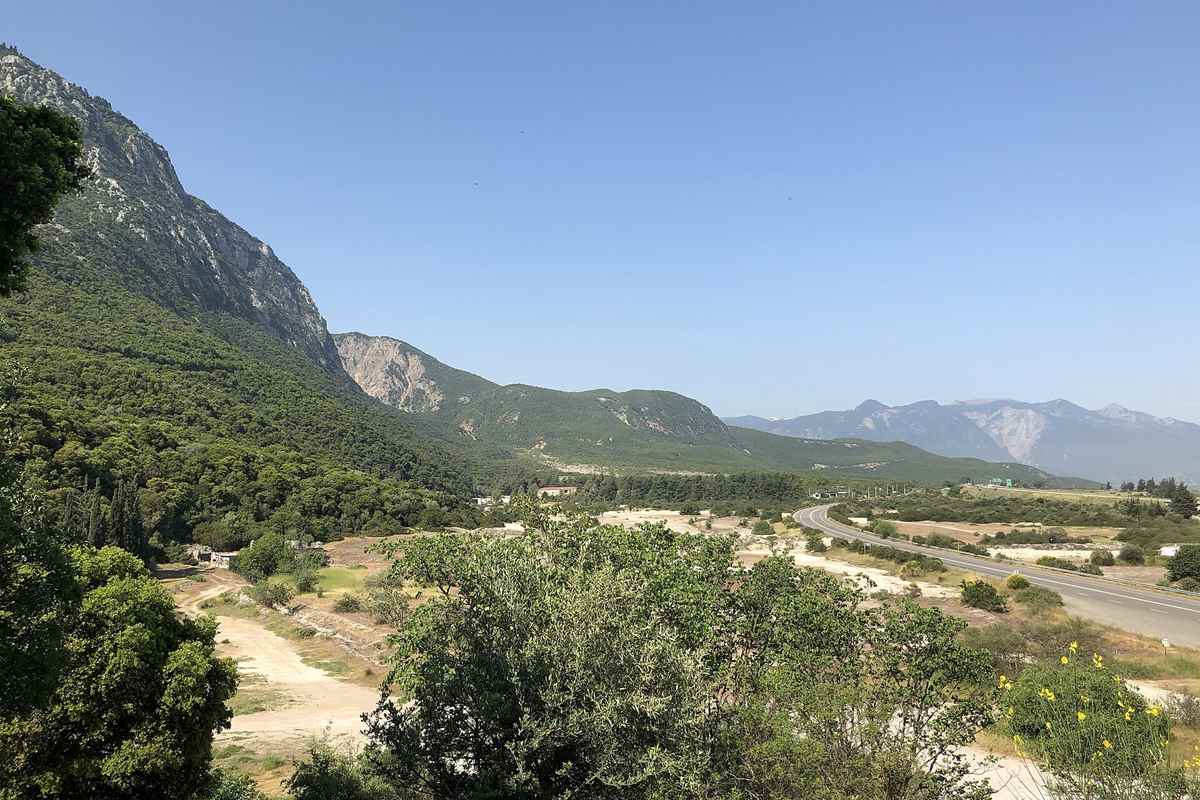
Battle of Thermopylae day trips run from Athens to the narrow pass in Phthiotis, in central Greece. In 480 BC, Leonidas I of Sparta and his Greek allies met the army of Xerxes I there. Leonidas, Xerxes, the Immortals, Demophilus, Ephialtes, Mount Kallidromo and Dienekes each get a short answer. Simonides, molon labe and a painting by Jacques-Louis David follow. Related trips appear on the Ancient Greece tours, Athens Delphi Meteora tour and Mainland Greece tour pages. Further trips are grouped under Greece tours.
Bookings made through the GetYourGuide widgets on this page earn Classical Greece Tours a commission, at no extra cost to the traveller.
What was the Battle of Thermopylae?
The Battle of Thermopylae took place in 480 BC. On one side stood the Achaemenid Persian Empire, on the other an alliance of Greek city-states. Achaemenid is the name of the Persian royal house. The fighting lasted three days, inside the wider Greco-Persian Wars.
The Battle of Thermopylae ran at the same time as a sea fight, the Battle of Artemisium. Ancient writers put the Persian army in the millions. Modern scholars give 120,000 to 300,000 soldiers. The Greek force kept the Persians at bay for seven days. Three of those days saw direct battle.
Two main accounts of the Battle of Thermopylae survive, one by Herodotus and one by the poet Simonides. Herodotus, a Greek historian, told it in Book VII of his Histories. The first modern historian to survey the ground of Thermopylae in full detail was George B. Grundy. His survey was topographical, mapping the shape of the land.
Diodorus Siculus, a Sicilian historian of the 1st century BC, also wrote about these wars. Part of his account came from an earlier writer named Ephorus. Archaeology supports certain details in Herodotus. One example is the Serpent Column. It now stands in the Hippodrome of Constantinople, the old racecourse of that city.
- Sea front: Themistocles led the Greek ships at Artemisium when word came that the pass had fallen.
- Withdrawal: Because both points had to hold, the Greeks then chose to pull back to Salamis island.
- End of the invasion: A Greek army beat Mardonius at Plataea the next year, ending the second Persian invasion.
Writers ancient and modern use the Battle of Thermopylae as an example of force multipliers. They name training, equipment and the use of terrain. A force multiplier is anything that lets a small army fight above its numbers. Terrain means the natural features of the land.
How did Leonidas I lead the Greeks at the Battle of Thermopylae?
The Battle of Thermopylae placed Leonidas I at the head of the Greek side. He was a son of King Anaxandridas II of Sparta. The allied Greek states chose him in 481 BC to command their combined forces against the Persian invasion.
Before he took the throne, Leonidas married Gorgo, the daughter of Cleomenes. For the Battle of Thermopylae he led north a royal bodyguard of 300 men, the Hippeis. A bodyguard is a troop that protects a ruler. Herodotus, the Greek historian, writes that Leonidas picked only Spartans who had living sons.
At the Battle of Thermopylae, Leonidas camped at the middle gate, where the pass was at its narrowest. The Phocians, whose state lay nearby, had built a defensive wall there. Word reached him from the nearby city of Trachis about a mountain track around the pass. He placed 1,000 Phocians up on the heights as a guard.
Leonidas was killed early on the third and final day of the Battle of Thermopylae. Persian archers shot him down in the assault. Archers were soldiers armed with bows and arrows. Both sides then fought over his body, and in the end the Greeks took possession of it.
- Burial: Forty years after the battle, his bones returned to Sparta for burial with full honours.
- Successor: His son Pleistarchus followed him on the throne of Sparta as the next king.
- Leadership: Two years after Leonidas died, the allies chose Athenian leaders over Spartan ones.
Plutarch, a later Greek writer, tells a story from before the Battle of Thermopylae. Gorgo asked her husband what she ought to do if he never came back. Leonidas replied that she was to wed a good man and raise good children.
Why did Xerxes I bring a Persian army to the Battle of Thermopylae?
The Battle of Thermopylae came about when Xerxes I invaded Greece in 480 BC. From 486 BC to 465 BC he ruled as King of Kings, the fourth of the Achaemenid Empire. His parents were Darius the Great and his wife Atossa.
King of Kings was the title of the supreme Persian ruler. The name Xerxes comes from an Old Iranian form meaning “ruling over heroes”. Old Iranian is an early stage of the languages of Iran. Xerxes was crowned in 486 BC, at the age of about 32. He inherited a large empire of different peoples.
Xerxes took up the plan to punish Athens and its allies for their part in the Ionian Revolt. That revolt was a rising against Persian rule. At first Xerxes wanted no major war with Greece. His father’s generals, led by his cousin Mardonius, changed his mind. They accused him of timidity, meaning a lack of courage.
A storm broke the flax and papyrus cables of his first bridges over the Hellespont, a narrow strait. Herodotus says Xerxes had the strait whipped three hundred times. In the spring of 480 BC, he left Sardis with his fleet and army. They arrived for the Battle of Thermopylae by late August or early September.
- Army size: More recent estimates put the Persian force at around 60,000 fighting men.
- Watching: On the first day of the Battle of Thermopylae, Xerxes reportedly rose three times from his seat.
- Brothers: Two brothers of Xerxes, Abrocomes and Hyperanthes, fell during the fighting at the pass.
After the Battle of Thermopylae and the rest of the campaign, Xerxes went back to Persia. There he oversaw the completion of the Gate of All Nations at Persepolis, a seat of royal palaces. He also completed the Apadana, an audience hall there.
Which part did the Immortals play in the Battle of Thermopylae?
The Battle of Thermopylae drew in the Immortals, a corps of 10,000 elite heavy infantry. They served in the Achaemenid Persian army. Herodotus, the Greek historian, gave them that name in his account. Heavy infantry means foot soldiers with strong armour and weapons.
Xerxes led 10,000 of these elite warriors to the Battle of Thermopylae. The Immortals worked both as an imperial guard and as part of the standing army. A standing army is a force kept ready in peace as well as war. Persians made up the bulk of the unit, joined by Medes and Elamites.
Their name came from a simple rule. Any member who died, fell ill or was badly hurt was replaced at once. Herodotus describes wicker shields covered in leather, short spears, bows and arrows. Wicker is woven from thin, bendy twigs. The men wore coats of scale armour, built from small overlapping plates of metal.
On day one of the Battle of Thermopylae, Xerxes sent the Immortals into a second assault. They did no better than the Medes before them and gained no ground. The Spartans reportedly pretended to run, then turned and struck the men who chased them. This trick is called a feigned retreat.
- Spear ends: Silver counterweights balanced the spears of ordinary soldiers, and officers carried gold butt-spikes.
- Supplies: A train of carriages, camels and mules carried special food kept only for the Immortals.
- Last morning: At dawn, Xerxes poured libations, drink offerings, giving the Immortals time to come down the mountain.
Before the Battle of Thermopylae, the Immortals served in the conquest of Egypt in 525 BC. Cambyses II led that campaign. They later stayed among the Persian troops holding Greece in 479 BC under Mardonius. Persian records of this corps do not use the name Immortals.
Who was Demophilus, the Thespian commander at the Battle of Thermopylae?
The Battle of Thermopylae saw Demophilus, son of Diadromes, command 700 Thespians, according to Herodotus. Thespians were the citizens of Thespiae, a Greek city in Boeotia that had not submitted to Persia. He and his men stayed to the end.
As the bulk of the Greek army withdrew, the 700 Thespians refused to leave. They chose to fight on beside the Spartans. Their force held every hoplite in Thespiae. A hoplite was a heavily armed foot soldier. Pausanias, a Greek traveller and geographer, also wrote about how the Thespians stayed at Thermopylae.
At the close of the Battle of Thermopylae, Demophilus and his men joined the 300 Spartans. Together they made the last stand, a final fight with no way out. All of them were killed. Afterwards the Persian army burned the city of Thespiae. Its citizens had already fled to the Peloponnese.
In 1997 the Greek government unveiled a marble monument to the 700 Thespians. It stands at the Battle of Thermopylae site. A bronze statue of the god Eros stands on it. The plate below calls Eros a god of creation, beauty and life. A sign under the statue honours the memory of the seven hundred Thespians.
- Headless figure: The male figure has no head, standing for the nameless sacrifice of the 700 Thespians.
- Broken wing: One wing of the statue is broken, a sign of voluntary sacrifice and death.
- Home town: Demophilus also has a monument of his own in Thespies, the modern town.
At the Battle of Thermopylae site, a monument to Demophilus and his men stands beside that of Leonidas. The Thespians met the Persians again at Plataea in 479 BC. On at least two later occasions, a Thespian force chose a fight to the death.
What path did Ephialtes of Trachis reveal during the Battle of Thermopylae?
The Battle of Thermopylae turned on Ephialtes, a man of Malis and son of Eurydemus. He told the Persians about a path around the Greek position at the pass. That path allowed the Persian army to get behind the Greek defence.
Herodotus gives the Greek land forces at the Battle of Thermopylae as no more than 4,200 men. They held the gap between the Trachinian Cliffs and the Malian Gulf. That gap was only wide enough for one carriage. Locals knew a trail over the mountains and had used it to raid the Phocians.
Herodotus names two other men who were accused of giving the same information. They were Onetas of Carystus and Corydallus of Anticyra. Herodotus still holds that Ephialtes was the source. His reason is that the Pylagorae set a reward for Ephialtes alone. The Pylagorae were the deputies sent by the Greek states.
Ephialtes expected a Persian reward after the Battle of Thermopylae, but none ever came. His hopes ended when the Persians lost the Battle of Salamis. He then fled to Thessaly, a region of northern Greece. The Amphictyons at Pylae, a council of Greek states, had offered a reward for his death.
- Death: Athenades of Trachis killed him around 470 BC, apparently for an unrelated reason.
- Payment: The Spartans still gave Athenades a reward after the killing, all the same.
- Meaning: In the Greek language, the name Ephialtes came to mean “nightmare”.
Writers compare the Battle of Thermopylae with the Battle of the Persian Gate in 330 BC. There, a local shepherd reportedly told the army of Alexander the Great about a secret path. The path led to the rear of the defenders.
Where does Mount Kallidromo rise in the Battle of Thermopylae story?
The Battle of Thermopylae took place below Kallidromo, a mountain of Central Greece. It is shared by southeastern Phthiotis and the northeast of Phocis. The site of Thermopylae lies north of it. Its highest point rises to 1,399 metres.
Kallidromo stands south of the Malian Gulf and east of Mount Oeta. Drymaia is a village on its slopes. The Kallidromos hot springs were known in the past as Psoroneria, and their waters reach 33 degrees Celsius. Ancient writers, among them Herodotus and the physician Hippocrates, noted the effects of these springs on health.
In the Battle of Thermopylae, the main Greek weakness was a mountain track beside the pass. The track suited foot soldiers better than horsemen. A large share of the Persian infantry knew mountain warfare. Infantry means soldiers who fight on foot. It followed the crest of Mount Anopaea, at the back of the cliffs that lined the pass.
The path split in two. One branch led to Phocis. The other dropped to Alpenus on the Malian Gulf, the first town in Locris. At daybreak on the third day of the Battle of Thermopylae, the Phocians stood on watch. They heard oak leaves rustling as the Persian column came near.
- Rain: Torrential downpours fall on the area for four months of the year.
- Brush: Thick brush covers the hillsides along the pass, with plants up to 3 metres tall.
- Shrubs: Low, thorny shrubs make up the sparse plant cover of the area.
The ground around the Battle of Thermopylae still forms a natural defensive position. In 1941, during the Second World War, British Empire forces made a defence there. They held a line just metres from the original battlefield, against the German invasion of Greece.
Which saying made Dienekes famous after the Battle of Thermopylae?
The Battle of Thermopylae made a name for Dienekes, a Spartan soldier. He fought at the pass and fell there in 480 BC. He was hailed as the bravest of all the Greeks in that battle. Herodotus records his remark about fighting in the shade.
The name Dienekes comes from a Greek word meaning “continuous, unbroken”. Herodotus tells this Battle of Thermopylae story in book 7, section 226, of his Histories. In it, a man from Trachis warned the Spartans about the Persian archers. Their arrows, he said, flew so thick that they blotted out the light of the sun.
Dienekes was not at all dismayed by this news. Dismayed means upset and afraid. If the arrows hid the sun, he said, the Greeks were to fight in the shade. Herodotus adds that Dienekes made other remarks of the same kind. These sayings kept his name from being forgotten.
Plutarch wrote hundreds of years after the Battle of Thermopylae. He tells the same story in his Sayings of the Spartans. In his version, the reply belongs to Leonidas I, the general of Dienekes. Latin authors took up the line. Cicero gave it as in umbra igitur pugnabimus, a Latin line about fighting on in the shade.
- Latin echo: Valerius Maximus, another Latin writer, also cited the shade remark in his own words.
- Street name: In modern Sparta, a street named after Dienekes runs east of the Tomb of Leonidas.
- Survivors: Of all the Spartans sent to the pass, only Aristodemus and Pantites were not killed there.
Herodotus places the remark before the Greeks first engaged the Medes at the Battle of Thermopylae. Dienekes made light of their great numbers. On the first day of fighting, Xerxes ordered 10,000 Medes and Cissians forward to capture the defenders.
How did Simonides of Ceos remember the Battle of Thermopylae in verse?
The Battle of Thermopylae lives on in the verse of Simonides of Ceos. He was a Greek lyric poet of about 556 to 468 BC. After the second Persian invasion, he wrote epitaphs for Athenians, Spartans and Corinthians. An epitaph is a short text for a grave.
Scholars in Alexandria placed him on their standard list of nine lyric poets. Lyric poems were verses meant to be sung. He composed a song in honour of Leonidas and his men at the Battle of Thermopylae. He also wrote a Dirge for the Fallen at Thermopylae. A dirge is a song of mourning.
Modern scholars accept just one epigram linked to his name as surely his own. It is the inscription for the seer Megistias, quoted by Herodotus. An epigram is a short poem. This doubt reaches even the famous epitaph for the Spartans at Thermopylae. Its original stone, set on the Spartan burial mound, has not survived.
In 1955 the epitaph from the Battle of Thermopylae was carved on a new stone. Its form is an elegiac couplet, a pair of lines widely used for epitaphs. An alternative ancient reading puts “laws” where the usual text has “words”. Ioannis Ziogas notes that common English translations are far from the only possible reading.
- Short story: Heinrich Böll, a German Nobel Prize winner, used the first line as a story title.
- Monte Cassino: A variant of the epigram is carved at the Polish Cemetery at Monte Cassino.
- Latin version: Cicero recorded a Latin form of the epitaph in his Tusculan Disputations.
Beyond the Battle of Thermopylae, Simonides was popularly credited with inventing four letters of the Greek alphabet. As an author of inscriptions, he was the first major poet to write verses for reading. Such verses were not meant for reciting, or speaking aloud.
What does molon labe mean in the Battle of Thermopylae story?
The Battle of Thermopylae is the setting of molon labe, a Greek phrase meaning “come and take them”. It is credited to Leonidas I, in writing to Xerxes on the eve of the fighting. Xerxes had demanded that the Spartans give up their weapons.
Plutarch, a Greek writer, reports the phrase among his short Spartan sayings. He cites it in his Apophthegmata Laconica, a title meaning “Sayings of Spartans”. The words are in the Classical Greek that Plutarch himself wrote. They do not necessarily match the Doric dialect, the regional Greek that Leonidas spoke.
In the Battle of Thermopylae story, the first word, molon, is a participle meaning “having come”. A participle is a verb form that works partly like an adjective. The second word, labe, is an order meaning “take”. Both words are singular, so Leonidas addresses Xerxes in person rather than the whole Persian force.
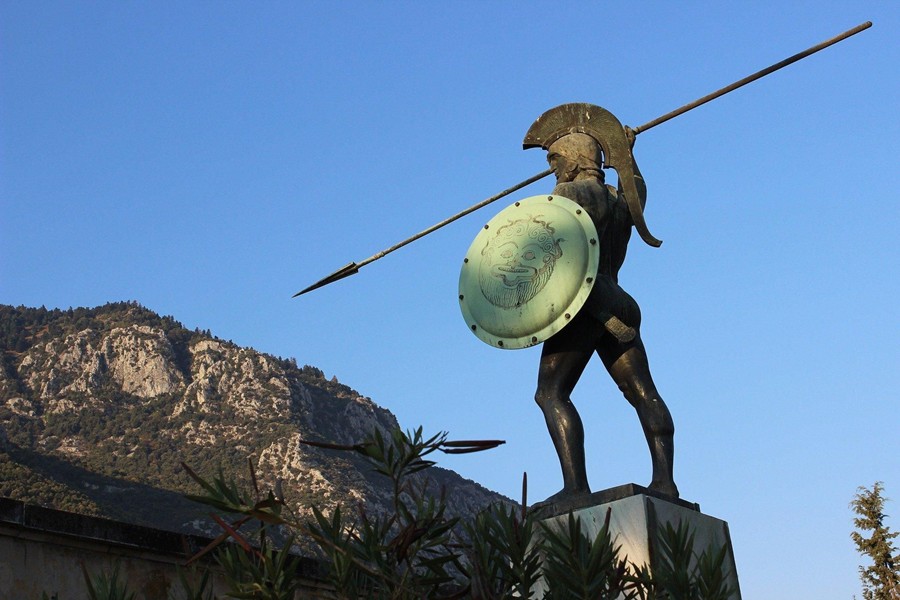
Before the demand, Xerxes sent an envoy with an offer. The Greeks were offered their freedom, the title “Friends of the Persian People” and better land to settle. An envoy is a messenger sent to bargain. The Leonidas Monument at the Battle of Thermopylae site, by Vassos Falireas, carries his bronze statue.
- Old script: The 1955 monument shows the phrase in an archaic, or very old, style of lettering.
- Army emblem: The phrase was the motto on the emblem of the I Army Corps of Greece.
- Metope: Below the statue, a metope, or carved panel, shows scenes of battle.
Long after the Battle of Thermopylae, the phrase became a military motto. That use seems to begin in Greece, either during the First World War or the Greco-Turkish War. An English form, “come and take it!”, was noted in 1778 at Fort Morris in Georgia.
How did Jacques-Louis David paint Leonidas before the Battle of Thermopylae?
The Battle of Thermopylae inspired Leonidas at Thermopylae, an oil painting by French artist Jacques-Louis David. It shows the Spartan king just before the fighting began at the pass. The large canvas now hangs in the Louvre in Paris, France.
The canvas is very large, at 3.95 by 5.31 metres. David finished his Battle of Thermopylae scene 15 years after he began it. He worked on it from 1799 to 1803, then again in 1813 and 1814. His pupil Georges Rouget took part in the work. A pupil is a student who learns from a master.
In 1799 Napoleon Bonaparte faulted an earlier David picture, The Sabine Women, for weak action and stiff poses. That criticism sent David back to the classical ideals of ancient art. In 1813 and 1814, allied European powers were invading France. David turned once more to Leonidas and the Battle of Thermopylae for inspiration.
Leonidas sits at the centre, bathed in more light than any other figure. He keeps a still pose while nearly everyone around him moves. On the left, a soldier carves a famous line of verse into the rock. A Greek temple and temperate mountains fill the background. Temperate means mild, neither very hot nor very cold.
- Royal dress: A golden embroidered cape, a fine helmet and a huge shield mark his high rank.
- Purchase: French king Louis XVIII bought it in November 1819, together with The Intervention of the Sabine Women.
- Earlier poems: Poems by Richard Glover in 1737 and Willem van Haren in 1742 revived interest in the battle.
David’s 1814 sketch for this Battle of Thermopylae scene is a compositional study made in two separate parts. A compositional study plans the layout of a picture. The final painting shows more background, because trees and branches were taken out.
What do travellers ask about Battle of Thermopylae, and what are the answers?
The Battle of Thermopylae drew in other figures beyond its two kings. Megistias was a seer from Acarnania, and Leontiades led the Theban troops. Hydarnes commanded the Persian Immortals. Demaratus, a former king of Sparta, gave advice to Xerxes.
Which seer stayed to the end of the Battle of Thermopylae?
Megistias was a soothsayer, one who reads signs of the future. He came from Acarnania and followed the Greeks to Thermopylae of his own free will. His son came with him. He traced his family line back to Melampus. On the last day, he sent his only son away and stayed until the end.
Who led the Theban troops at the Battle of Thermopylae?
Leontiades commanded the Theban force of 400 men. Little was recorded about his life, but Herodotus names his father as Eurymachus. For the first two days, his men fought in rotation with the other Greek units. Fighting in rotation means that units took turns at the front line.
Who commanded the Immortals during the Battle of Thermopylae?
Hydarnes the Younger, a Persian commander, led the 10,000-man Immortals. His brother Sisamnes led the levy of the Aryans. A levy is a body of troops called up. After the Battle of Salamis, Xerxes gave Hydarnes a new task. He was to take the Persian army back over the Hellespont to Asia.
Before the Battle of Thermopylae, which exiled king advised Xerxes?
Demaratus was a king of Sparta from around 515 BC to 491 BC. After he was forced to flee, he went to the Persian court. Xerxes gave him the cities of Teuthrania and Halisarna, near Pergamum. Demaratus told Xerxes that Spartans dressed their hair before risking their lives in battle.
Featured photo: Davide Mauro, CC BY-SA 4.0, via Wikimedia Commons (File:Thermopylae panorama 2.jpg).