
Ancient Greek education is a theme for expert-led outings through Athens, Sparta and the rest of Greece. The topics include the gymnasium, the palaestra and the letter teacher. Others are the agoge, the Academy, the Lyceum, the sophists and the ephebes. Related reading covers Ancient Sparta, Ancient Athens and Ancient Greek philosophers. More trips appear under Greece tours.
Bookings made through the GetYourGuide widgets on this page earn Classical Greece Tours a commission, at no extra cost to the traveller.
What was ancient Greek education?
Ancient Greek education took two forms, formal and informal. The formal kind came from a public school or a hired tutor. It was mainly for free males. Athenian fathers chose the lessons, while the Spartan state organised its own system.
Aristophanes gave old Athenian schooling the name arkhaia paideia, a phrase that means ancient education. Informal learning sat beside it, given by an unpaid teacher in a private setting. Ancient Greek education also touched the law, because certain poleis, the Greek city-states, passed rules against teaching slaves. Schooling also helped to define a person’s identity.
Athenian lessons carried a charge and no law forced boys to attend them. Each father settled which subjects his son took and how long the schooling ran. Ancient Greek education at this basic level stopped at about the age of 14 or 15. Boys from richer homes began earlier and carried on later than the rest.
The full form of this elementary schooling took shape only in the early fifth century BC. The Sophists, Plato and Isocrates then helped to open learning to far more Greeks in that century. Later, in the Hellenistic period, gymnasium schooling counted as essential for joining Greek culture. Much teenage learning stayed informal and rested on plain life experience.
- Body: Physical training held the place of honour among the three divisions of Athenian schooling.
- Literacy: Reading and writing grew in demand because men needed them for trade and politics.
- Higher study: Later teaching arose from a sophist reform late in the fifth century BC.
Sparta shaped ancient Greek education to turn every male citizen into a soldier with stamina and skill. Athens valued sport for two reasons. It prepared boys for local and all-Greek games, and it built the strong body that Greek culture prized.
How did the gymnasium shape ancient Greek education?
Ancient Greek education met the body and the mind in the gymnasium. This public institution gave young men physical training. Its name comes from gymnos, the Greek word for naked, because athletes trained without clothes. Heracles and Hermes were its protectors.
Public officials called gymnasiarchs supervised these grounds, ran sport at public festivals and directed the schools. Athens appointed ten of them each year, one from each tribe. They also paid those training for public contests and kept the buildings in repair. Ten sophronistae, a lower rank of officials, watched how the youths behaved at their games.
The gymnastai taught and coached athletes, monitored the health of pupils and prescribed remedies when they fell ill. Paedotribae, physical trainers, picked suitable sports for the youths. In ancient Greek education the aleiptae oiled and dusted young bodies and acted as surgeons. The writer Galen also records a teacher who gave instruction only in ball games.
Solon made early laws for the Athenian gymnasium, and one of them barred slaves from entering. The first gymnasia were simply broad open grounds outside the cities, not enclosed buildings. Early examples seem to have spread during the sixth century BC. Ancient Greek education later moved in, as lectures on philosophy, literature and music filled these grounds.
- Three great sites: The Lyceum, the Academy and the Cynosarges were the three large public gymnasia of Athens.
- Location: Athenian gymnasia stood in the suburbs, which offered level ground, cooler air and better water.
- Buildings: A typical complex held a stadium, a palaestra or wrestling school, baths and covered walks for lectures.
Prodicus the sophist first linked gymnastics with health, according to Plato, after exercise helped his own weak constitution. Hippocrates later improved his method. Ancient Greek education thus joined athletics with medicine. Greek medical writers prescribed special exercises as cures for named diseases.
Why did the palaestra matter to ancient Greek education?
Ancient Greek education gave wrestling its own school, the palaestra. The name is linked to palaiein, the Greek verb for wrestling. Boxing and wrestling took place there because they needed little space. A palaestra sometimes stood alone, yet no gymnasium lacked one.
The Roman author Vitruvius left an important description of this building type in De architectura. He gives a square or rectangular plan with colonnades, rows of columns, along all four sides. The inner perimeter measured two stadia, the length of the diaulos footrace. Its northern portico, a covered walkway, had double depth as protection against weather.
Rounded halls with seats, called exedrae, lined the single-depth sides for philosophers, orators and other scholars. At the centre of the double-depth side lay the ephebeum, a larger hall. Ancient Greek education reached older pupils there, since ephebes were young men in state military training. A punching bag room, the coryceum, stood nearby.
Boys at Athens trained under a paidotribes, a physical trainer who had frequently been a professional athlete. He supervised their lessons in a privately owned palaestra, while the great public gymnasium served adult citizens. Ancient Greek education here centred on the fighting arts of wrestling, boxing and pankration. Racing, discus, javelin and long jump formed another important strand.
- Oil room: The elaeothesium was a storeroom for oil, set on the right of the central hall.
- Bad weather: A covered wrestling arena called the xystus stood ready for training during poor weather.
- Director: A palaestrophylax acted as the guardian or director of a wrestling school.
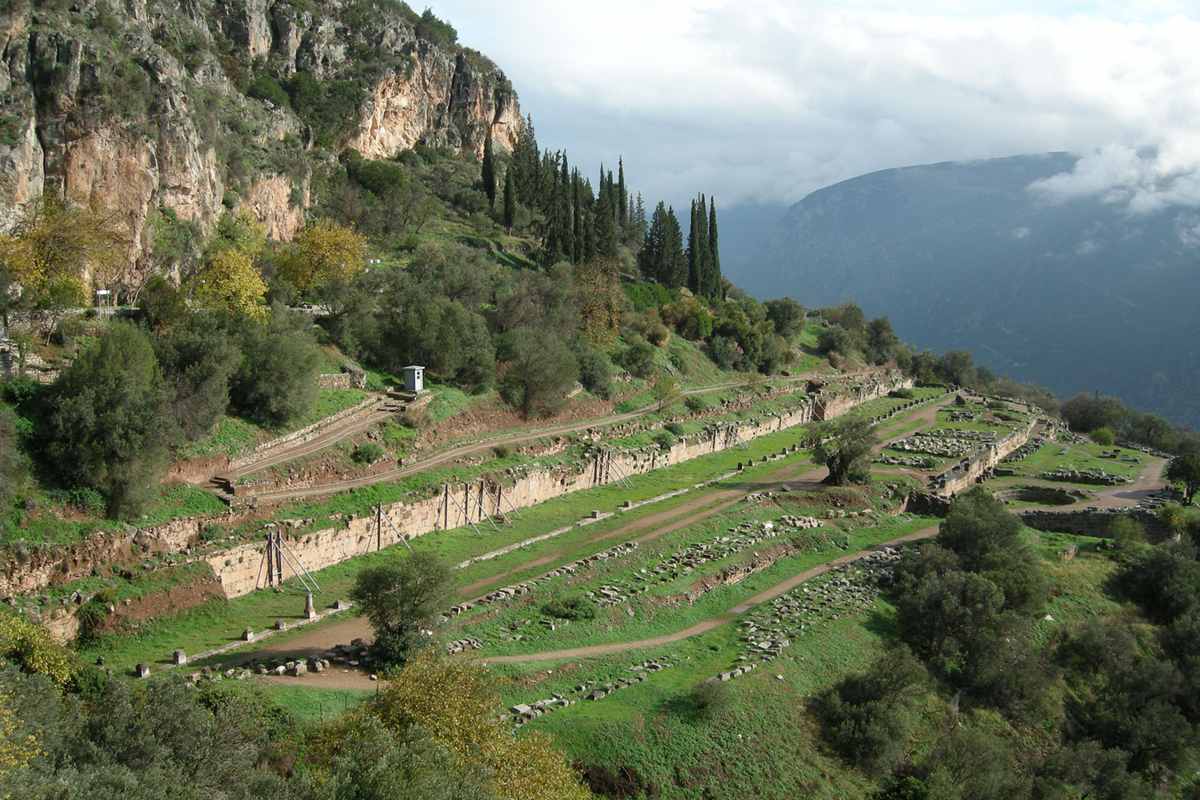
Olympia and Delphi hold good examples of this building type. The standard plan was a rectangular court ringed by colonnades, with rooms for bathing, ball games and storage. Ancient Greek education also used these rooms for instruction, with seats for talk and observation.
What did the grammatistes teach in ancient Greek education?
Ancient Greek education at Athens placed letters in the hands of the grammatistes, a letter teacher. Boys learned reading and writing, literature and arithmetic with him. A father short of money for all three classes sent his son to this teacher.
Pupils first memorised the Greek letters, then learned to recognise them in short syllables. Writing began while they were still growing familiar with the alphabet. Paintings on the Douris cup show this stage of ancient Greek education. Plato’s Protagoras describes writing masters who drew faint outlines for beginners to follow.
Poetry followed once a boy had made progress with letters. Reciting verse mattered greatly in the adult life of Athenians, above all the works of Homer and Hesiod. Knowledge of the Homeric epic opened the door to banquets for an educated Athenian man. Ancient Greek education treated heroic tales learned by heart as a mark of Athenian identity.
The grammarian Dionysius Thrax, a pupil of Aristarchus of Samothrace, trained in Alexandria and later moved to Rhodes. Grateful pupils on Rhodes gathered enough silver for him to make a cup modelled on Nestor’s. The Art of Grammar credited to him runs to fifty pages in print. Byzantine commentaries on it reach about 600 pages.
- Priority: In practical terms, literacy ranked above sport and music among the three school subjects.
- Name: The name Thrax points to Thrace, although Dionysius did not come from that region.
- Definition: Dionysius defined grammar as knowledge drawn from the usage of poets and prose writers.
Dionysius worked above all as a scholar of Homer. He also wrote running commentaries and treatises. Scholars long treated him as author of the earliest grammatical text in Greek. Ancient Greek education handed that manual onward as a standard text for about 1,500 years.
Which role did the kitharistes play in ancient Greek education?
Ancient Greek education handed music to the kitharistes, literally a player of the kithara. It was a stringed instrument, like a lyre. This teacher showed boys how to play it, sing, compose lyric songs and dance. Music counted as an essential part of the old schooling.
Plato set music level with sport. He paired gymnastics for the body with music for the soul. His phrase pointed to the moral function of music and poetry. Aristophanes said boys went to music class even when snow fell as thick as flour. Music and gymnastics formed the main divisions of schooling.
Ancient Greek education treated a man unable to play the lyre and sing in a choir as uneducated. Lessons cost money, so ignorance of music also marked a lower social and economic position. The lyre served as the standard training instrument for an aristocratic education. It had a tortoise-shell frame and seven or more strings.
Aristotle believed that music belonged in education beside reading, writing and gymnastics. He argued that learning an instrument was essential to human development, since music combines rest with company. For ancient Greek education he ruled out harp and flute lessons, judging both too complicated. Learned players, in his view, belonged below professional level but above slaves and commoners.
- Melodies: Aristotle kept ethical melodies for the classroom and passionate or active ones for performances.
- Damon: Plato reports his claim that changes in musical scales, called modes, bring changes in the state.
- Word: The word music once expressed the whole of a Greek education.
Ancient Greek education, in Aristotle’s view, kept children occupied and quiet through music. He held that teaching methods had a large effect on their growth. Modern knowledge of Greek music theory rests almost entirely on surviving teachings, including those of Aristoxenus.
How did the agoge fit into ancient Greek education?
Ancient Greek education at Sparta took the form of the agoge, a severe military training system. Reading and writing stayed at a minimum, because intellectual knowledge counted as trivial. The state removed boys from their parents at about the age of seven.
Each boy moved into a barracks with boys of his age, who became his family. For five years the unit ate, slept and trained together. Instruction came from an adult citizen who had finished his military training and seen battle. Ancient Greek education of this kind gave little food and scant clothing, so boys learned to forage.
A second stage, with harsher punishment and near constant training, lasted until about eighteen. Fighting inside the unit was encouraged, and mock battles were staged. Young men formed phalanxes, close ranks of soldiers, and learned to move as one body. Ancient Greek education added dance and music at this point, to help them move gracefully together.
Xenophon credited the system to the half-legendary lawgiver Lycurgus. Modern scholars date its start to the seventh or sixth century BC. Evidence for agoge as the name of this schooling starts only in the third century BC. Cleomenes III revived it in 226 BC. Philopoemen abolished it when Sparta joined the Achaean League.
- Exemptions: The firstborn sons of the Eurypontid and Agiad ruling houses stayed outside the system.
- Speech: Boys also studied Laconism, the art of speaking in brief and witty phrases.
- Weapons: Children in the system learned no weapon drill, since Spartans favoured group tactics over single combat.
By one account students finished at eighteen and took the title of ephebes. They pledged full allegiance to Sparta. Two further years of gymnastics, hunting and planned battles followed. Ancient Greek education at Sparta then ended, and the men of twenty counted as soldiers.
Where did Spartan girls stand in ancient Greek education?
Ancient Greek education treated Spartan girls differently from Athenian ones, because Sparta supervised and controlled their formal schooling. Physical training filled much of that schooling. Spartan girls stayed outside the agoge, and they were not eligible to become citizens.
Until about eighteen, young women learned to run, wrestle and throw both the discus and the javelin. Competitions tested these skills at regular intervals, among them a yearly footrace at the Heraea in Elis. In ancient Greek education the Heraean Games at Olympia offered footraces between unmarried girls.
Girls at Sparta also learned to sing, dance and play instruments. Their teachers were elderly women of the city or travelling poets, among them Alcman. Ancient Greek education here aimed to train future mothers of soldiers and keep the Spartan phalanx strong. The law of Lycurgus tied fit female bodies to healthy children and easier childbirth.
Across Greece, active gymnasium training was chiefly for boys and young men. Sparta stood apart in ancient Greek education by letting girls exercise at the gymnasium beside boys and men. In other cities, the gymnasium opened on certain days only to girls and women. It remains unclear whether they only bathed and swam there or also took exercise.
- Letters: Old Spartan stories show mothers sending written letters to absent sons, which points to female literacy.
- Choruses: Girls danced in age-based groups led by an older girl and trained by a professional poet.
- Cleitagora: Aristophanes refers to this Spartan woman poet, which hints at a high level of female literacy.
Surviving sources say more about Spartan boys than about girls, which limits ancient Greek education studies here. Unlike boys, girls were raised at home with their mothers during their schooling. They also studied mousike, a subject joining music, dance and poetry.
What did Plato’s Academy add to ancient Greek education?
Ancient Greek education gained the Academy when Plato returned to Athens after ten years abroad. He had left in anger after the execution of his teacher Socrates, rejecting a career in politics. The school rested largely on science, philosophy and dialectic, the art of reasoned debate.
Plato saw schooling as a way to produce citizens fit for the civic community of Athens. He accepted that people learned through daily life as community members, yet he also valued deliberate training. In ancient Greek education this belief led straight to the founding of the Academy. Plato outlined much of this programme in the Republic, his best-known work.
The Republic starts with elementary schooling in music, poetry and physical training. Two to three years of compulsory military training follow. Ancient Greek education on this plan then demands ten years of mathematical science and five of dialectic. Fifteen years of practical political training complete it. Graduates become philosopher-kings, the rulers of his ideal city.
Whether the real Academy followed this plan remains in dispute. Its subjects almost certainly included mathematics and the philosophical topics of Plato’s dialogues, though reliable evidence is thin. One common claim makes it a school for future politicians. Malcolm Schofield finds its real interest in practical politics hard to measure.
- Rival school: Isocrates opened his school about five years before Plato opened the Academy.
- Aristotle: Aristotle joined the Academy in his late teens and stayed until the age of thirty-seven.
- Travels: After leaving Athens, Plato travelled to Italy and Sicily before his return to the city.
Scholars of ancient Greek education have no record of the exact date of its official founding. Sextus Empiricus, a later writer on the school, counted five divisions among Plato’s followers. Cicero recognised only two Academies, the Old and the New.
How did the Lyceum serve ancient Greek education?
Ancient Greek education met organised research at the Lyceum, the school Aristotle founded in Athens. Research formed a large part of its work, and information was collected in a systematic way. Empirical study, based on direct observation, stood at the centre.
Aristotle held that argument among research students got in the way of truth. Any subject known at the time lay open to its students. One comparison likened it to a factory that turned out professionals of every kind. In ancient Greek education the library drew scholars who then taught and carried out research.
Aristotle left Athens in 322 BC and passed the school to Theophrastus. Theophrastus led it for 36 years, until his death in 286 BC. The senior members then chose Strato of Lampsacus, who stayed head until 268 BC. Ancient Greek education then saw a split, as Neleus took the library books to Skepsis in Mysia.
Decline appears to have set in from about 300 BC. Its last certain scholar, Lyco of Troas, left the Lyceum to all his colleagues, not to one man. Excavations in 1996, made to clear ground for a museum of modern art, uncovered the remains. The first digging revealed a gymnasium and a wrestling area.
- Dicaearchus: This member of the school wrote widely on ethics, politics, psychology and geography.
- Papyrus: One account of the library gives a total of 10,000 rolls of papyrus.
- Later heads: Critolaus, Diodorus of Tyre and Erymneus were among the later heads of the school.
King Philip of Macedon invited Aristotle to teach his thirteen-year-old son, Alexander, and Aristotle moved to Pella. Alexander later helped to pay for the Lyceum. Ancient Greek education therefore owed this school in part to a royal pupil.
Who were the sophists of ancient Greek education?
Ancient Greek education gained the sophists, professional travelling teachers active in the fourth and fifth centuries BC. Their subjects ranged across philosophy, rhetoric, music, athletics, mathematics and arete, meaning excellence. Young statesmen and nobles formed the bulk of their pupils.
The Greek word sophos first named an expert in a trade, such as a charioteer or a sculptor. Sophistes, a noun from the same root, first meant a master of a craft, then a wise man. Ancient Greek education adopted the title in the later fifth century BC, above all at Athens.
Athens drew them through its wealth and its freedom of speech for free citizens. Persuasive ability carried real weight for political power and private wealth at the time. Protagoras argued that arete came from training, not from noble birth. In ancient Greek education he also trained pupils to argue from both points of view.
Contradictions, or antitheseis, formed a key technique, since a good speaker defended a view and its opposite. Gorgias wrote a Praise of Helen that set out to clear a woman of a poor reputation. In ancient Greek education they also met criticism, as Plato called them paid hunters after wealthy youths.
- Gorgias figures: Aristotle later gave this name to the devices used in the speech on Helen.
- The Clouds: Aristophanes mocked sophists in this comic play as hairsplitting wordsmiths willing to argue for a fee.
- Socrates: He charged no fee, unlike the sophists, and questioned people instead of instructing them.
Sophists have also been called the first lawyers in the world, thanks to their skill in argument. Athens grew more democratic during the years of their activity. Under the Roman Empire, the title in ancient Greek education meant just a teacher of rhetoric.
What did Isocrates bring to ancient Greek education?
Ancient Greek education met small classes in the Athenian school of Isocrates. He never took more than nine pupils at once. His first students were Athenians, but his fame spread across Greece after his Panegyricus appeared in 380 BC.
Isocrates began as a logographer, a writer of courtroom speeches for others. Athenians hired no lawyers, because each citizen had to represent himself in court. The work made him rich, yet his weak voice kept him from public speaking himself. After founding his school, he gave up legal work and spoke badly of speech-writing.
He named three needs for every learner: natural aptitude, training from teachers and textbooks, and applied practice. Students wrote and delivered speeches on a range of subjects. Ancient Greek education in his hands placed natural ability and practice above fixed rules. He prized kairos, the ability of a speaker to adapt to changing situations.
His speech Against the Sophists set out the aims of the new school. It attacked the Eristics, who argued over theory and ethics, and the Sophists, who taught political debate. Ancient Greek education lasted in this form for over fifty years at his school. It laid much of the core of liberal arts study, including oratory, history and citizenship.
- Pupils: Timotheus, Isaeus, Ephorus, Hypereides and Theopompus ranked among the pupils he taught.
- Statue: Timotheus showed his gratitude by raising a statue of his teacher at Eleusis.
- Family trade: His father Theodorus owned a workshop that made auloi, a type of musical instrument.
Isocrates sought to bring a love of wisdom to his audience by urging intellectual consistency in their lives. Consistency at the individual, civic and all-Greek levels formed the basis of his teaching. Ancient Greek education felt this influence above all in Athens.
Which training made ephebes part of ancient Greek education?
Ancient Greek education passed military training at Athens to the ephebia, an official body for young men. An ephebe, or ephebos, was a male adolescent preparing to become an adult. The word joins epi, meaning upon, with hebe, meaning youth.
From about 335 BC, Athenian youths aged 18 to 20 served two years under supervision. They paid no taxes and had no civic duties, but they lost the bulk of their civic rights. Court cases stayed closed to them, whether as plaintiffs or defendants. Ancient Greek education kept public records too, with names engraved on a bronze pillar in Athens.
Each new ephebe swore an oath of allegiance in the temple of Aglaurus. He then joined the garrison at Munichia or Acte. A review followed the first year, and the state gave each successful youth a spear and a shield. The chlamys, a cloak, and the petasos, a broad-brimmed hat, completed the outfit.
Second-year ephebes moved to other garrisons in Attica and patrolled the frontiers. Ancient Greek education here reached into religion, since ephebes fetched the sacred objects from Eleusis for the Mysteries. They also escorted the image of Iacchus along the sacred way. They also carried out police duty at meetings of the ecclesia, the citizen assembly.
- Change: After the fourth century BC, enrolment stopped being compulsory and service shrank to one year.
- Foreigners: Foreigners, including Romans, gained admission in the Hellenistic and Roman periods.
- Little city: The college later worked like a small city, with an archon, or chief official, and a herald.
The ephebia later turned into a kind of university for wealthy young men of good family. By the first century BC, ancient Greek education in this college included philosophic and literary studies. The institution lasted until the end of the third century AD.
What do travellers ask about ancient Greek education, and what are the answers?
The ancient Greek education proposal in Book VIII of the Politics came from Aristotle. He argued that schooling belonged to a public system. Werner Jaeger, a German-American classicist, later traced Greek thought and schooling from Homer to Demosthenes.
In ancient Greek education, who was the paidagogos?
A paidagogos was a slave trusted with the supervision of boys from the age of seven. The Roman Republic kept the post under the name paedagogus. A slave or freedman in that role taught Greek to the sons of citizens. Later imperial usage made him more a child attendant than a teacher.
How did paideia shape the goals of ancient Greek education?
Paideia meant the rearing and schooling of the ideal member of a Greek city-state. The ideal man was well rounded, refined in intellect, morals and body. Young people were formed to the ideal of kalos kagathos, a phrase joining beauty and goodness. These ideals later spread through the Greco-Roman world, where Latin called them humanitas.
What rules did the Pythagorean school add to ancient Greek education?
Pythagoras taught life philosophy, religion and mathematics at his own school in Kroton, a Greek colony. Men and women alike were allowed to join, unlike in other systems of the time. Pupils, called mathematikoi or learners, abstained from beans and avoided touching white chickens. The school’s dictum was All is number.
Which lessons did Athenian girls receive in ancient Greek education?
Athenian girls learned textile work, cleaning, household upkeep and the care of younger children. They also learned to manage a household staff. Errands and religious ceremonies took them away from the home. Religion let them join community life and learn about their culture. Bearing and raising children formed another large part of their lessons.
Featured photo: Luarvick, CC BY-SA 3.0, via Wikimedia Commons.