
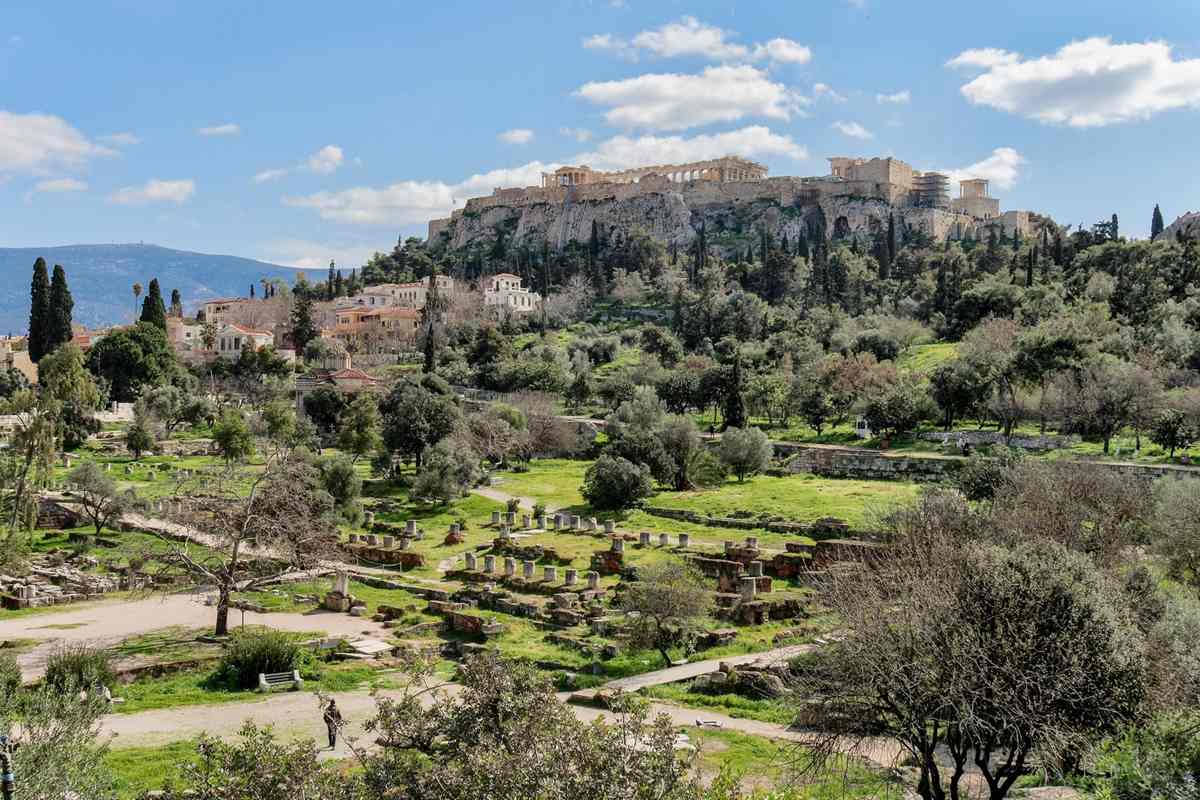
Ancient Athens was a prominent city-state on the peninsula of Attica. It was a centre of art, learning and philosophy. Tours here are small-group trips with a host, setting out from Athens to sites across Greece. The sections cover Cecrops, Draco, the Panathenaic Way and the Dipylon gate. Further sections cover Cimon, the Delian League, Melite, the plague, Thucydides, Alcibiades and Sulla’s siege. Related pages cover the Parthenon, day trips from Athens and other ancient Greek sites. More trips appear under Greece tours.
Bookings made through the GetYourGuide widgets on this page earn Classical Greece Tours a commission, at no extra cost to the traveller.
What was ancient Athens?
Ancient Athens was a prominent polis of ancient Greece, on the peninsula of Attica. In Greek, a polis meant a self-ruling city together with its farmland. In the Classical period, the city was a centre for the arts, learning and philosophy.
The first signs of people at ancient Athens date from the Neolithic, the late Stone Age. The later city lay about 30 stadia back from the coast. The stadion was an old Greek measure of distance, and stadia is the plural. Homes spread over the southwest slope of Mount Lycabettus, a hill.
Xerxes, the Persian king, burnt the city in 480 BC. Building began again soon after, under the lead of Themistocles. He was an Athenian politician and general. The years of Pericles, from 461 to 429 BC, brought ancient Athens its greatest splendour. Pericles himself was a statesman and general.
Its beauty came chiefly from its public buildings. Private houses were mostly plain, and the streets were badly laid out. Athens and Sparta fought each other in the Peloponnesian War. Near the end of that war, the city held more than 10,000 houses. At 12 people to a house, that gives a population of about 120,000.
- City size: Inside its walls, the city measured about 1.5 km across.
- Port: Piraeus, the port city, had its own walls and joined the town by the Long Walls.
- School of Hellas: In the words of Pericles, ancient Athens became an education for Hellas, meaning Greece.
The city proper had two levels. The Upper City was the Acropolis, the high citadel. Walls built by Themistocles closed in the Lower City around it. The philosophers Socrates, Plato and Aristotle all lived in ancient Athens during the Classical period.
Why does Cecrops stand at the very start of ancient Athens?
Ancient Athens traced its first king to Cecrops, its legendary founder. The Parian Chronicle is an old Greek table of dates. It says the region was earlier called Acte or Actice, after Actaeus. Cecrops married Aglaurus, daughter of Actaeus, and succeeded him.
In the stories of ancient Athens, Cecrops was a culture hero, a figure who brings people basic skills. He taught the Athenians marriage, reading and writing, and the proper burial of the dead. Strabo, a Greek geographer, held that his name was not Greek. Diodorus tied the king’s double form to two citizenships, Greek and barbarian, meaning non-Greek.
Legend made Cecrops the first to honour Zeus as a god and to order sacrifices to him. Pausanias, a Greek traveller, records a stricter rule. Cecrops banned the killing of any living creature as an offering. He allowed just cakes in the form of a horned ox, which Athenians called Pelanous.
Cecrops is also said to have taught his people the art of sailing. For fairer justice, he split them into four tribes: Cecropis, Autochthon, Actea and Paralia. A tribe here meant a large civic group of families. Through the next five reigns, the people of ancient Athens called themselves the Cecropidae, after him.
- Roman retelling: In the scholar Varro’s version, one extra woman voter gave Athena victory over Poseidon.
- Lost day: Ancient Athens dropped the second day of the month Boedromion, the contest day, from its calendar.
- Egyptian tale: Later Greek writers had him arrive with settlers from Sais in Egypt, a story modern scholars reject.
Certain writers also made Cecrops the founder of the Areopagus, an old council of Athens. His son Erysichthon died before him. The throne of ancient Athens then passed to Cranaus. He was said to be one of the wealthiest citizens of that time.
How did Draco write the first laws of ancient Athens?
Ancient Athens held Draco to be its first legislator, or lawmaker, active from about 625 to 600 BC. He swapped spoken law and revenge feuds between families for a written code. Only a court of law was to enforce the new code.
Draco set out his code while Aristaechmus served as archon, a chief yearly official. So that everyone in ancient Athens knew the rules, the laws went up on wooden tablets. These wooden tablets were called axones. The name possibly came from turning them on an axis to read each side.
The code was very harsh, with the death penalty for the majority of offences in ancient Athens. Even the theft of a cabbage was punished by death. Plutarch, a Greek biographer, reports Draco’s own defence of this rule. Lesser crimes, he said, deserved death, and he had no heavier penalty left for greater ones.
The laws told murder apart from involuntary homicide, which was a new idea at that time. Involuntary homicide means killing someone without intending to. A surviving inscription, a text cut in stone, left it to the victim’s relatives to prosecute the killer. Under that text, an unintentional killer was sent into exile.
- Strange death: A Byzantine encyclopedia, the Suda, says admirers on Aegina smothered him under hats, shirts and cloaks.
- Serpent theory: The historian Karl Julius Beloch argued that Draco was not a person, as drakon means serpent.
- Court frieze: Draco stands among great lawgivers on the courtroom frieze of the United States Supreme Court.
Since 1777, the English word draconian has described rules or punishments of extreme severity. The adjective comes from the lawgiver’s own name. In 409 BC, after long debate, ancient Athens revised its laws. The homicide law of Draco was part of that review.
Which road carried the great processions of ancient Athens?
Ancient Athens had a major processional road called the Panathenaic Way. Traces of wear on its surface reach back to the Neolithic period. Tradition places its formal laying out around 566 BCE, linked to the Great Panathenaia, a festival for Athena.
The greater part of the road had a hard pebble surface. Where it climbed the Acropolis, builders added retaining walls and steps. From the Agora, the market square of ancient Athens, it passed the Eleusinion shrine and the Klepsydra spring. It then rose to the Acropolis through the Propylaia, the gateway. In total the route climbs 94 metres.
In the classical period, the Way measured 10 metres across at its narrowest point. Typical streets in ancient Athens ran 3.5 to 4.5 metres across. The extra width served rituals such as the yearly Epitaphia. At that rite, Athenians and allies killed in battle that year received a public burial.
By the Hellenistic period, the road reached 39 to 40 metres at its widest. That widest point lay just outside the Dipylon gate. That era began after Alexander the Great died. During the Great Panathenaia, runners raced along the road carrying torches. This torch race, the lampadedromia, ran from altars in the Academy to the Acropolis.
- Paving: In the first century CE, the Agora-to-Acropolis stretch was paved, which was rare in ancient Athens.
- Wheel ruts: That paving still preserves wheel ruts left by traffic moving along the road.
- Rediscovery: Part of the course of the Way came to light again in 1837.
The name Panathenaic Way is known from an inscription of the fourth century BCE. It sits near the Klepsydra fountain, in the north wall of the Acropolis. The great processions of ancient Athens along the road had certainly ended by 430 or 431 CE.
What made the Dipylon the main gate of ancient Athens?
Ancient Athens had its main city gate at the Dipylon, a name meaning Two-Gated. It stands in today’s Kerameikos district. Builders raised it with the nearby Sacred Gate in 478 BC. Both formed part of the walls Themistocles built after the Persian Wars.
The new walls of ancient Athens ran much wider than the old circuit the Persians wrecked. Builders reused graves and grave monuments from the Kerameikos cemetery in the work. A cemetery is a burial ground. The reuse earned Themistocles the anger of Athenians whose family tombs were despoiled, meaning robbed.
The gate was the main link of ancient Athens with the rest of Greece. Roads ran from it north to Boeotia and south to the Peloponnese. Its first form had two sets of gates set back from the line of the walls. Between them sat a square yard, guarded by four towers, where attackers were trapped and killed.
The name Dipylon only came into use in the 3rd century BC. Before that it was the Thriasian Gates, as it led to the Thriasian Plain. Lucian, a 2nd-century AD writer, says its walls carried graffiti, or scratched writing, such as love messages. In 200 BC its defences helped ancient Athens hold off Philip V of Macedon.
- Hellenistic wall: The later wall here stood 9 metres high and 4 metres thick between its towers.
- Well house: A well house beside the gate had a floor of marble slabs from Mount Hymettus.
- Fore-wall: A second wall, the proteichisma, stood about 6 metres in front of the main wall.
Digging in the Kerameikos area began in 1870, led by St. Koumanoudis for the Greek Archaeological Society. Up to 8 m of soil then covered the gate. Since 1913, digs at this edge of ancient Athens have been run by the German Archaeological Institute.
How did the Delian League make ancient Athens a sea power?
Ancient Athens led the Delian League, a confederacy of 150 to 330 Greek city-states. A confederacy is a league of partners. It was founded in 478 BC. Its aim was to continue the war on the Persian Empire after the Greek victory at Plataea.
The league of ancient Athens was a symmachia, a Greek word for an alliance that attacks and defends. Its members were autonomous, meaning self-governing. Delegates met in congresses at the Temple of Apollo on Delos, which gave the modern name. Writers of that age simply used the name the Athenians and their Allies.
Each member chose between sending armed forces and paying a tax into a shared treasury. The bulk of states picked the tax. On joining, members swore an oath to keep the same friends and enemies. They then dropped bars of iron into the sea, as a sign of a lasting alliance.
The Athenian politician Aristides spent the rest of his life on League business. Plutarch says he died in Pontus while fixing the tax of new members. By the mid-fifth century BC, the alliance had become a naval empire, the Athenian Empire. Courts of Athenian citizens in ancient Athens settled disputes between member states.
- New label: In time, ancient Athens began calling the members all the cities Athens rules.
- End: Lysander broke up the alliance in 404 BC, as the Peloponnesian War closed.
- Revival: Athens later revived part of the alliance as the Second Athenian League.
Thucydides was an Athenian historian. He gives the official aim as revenge on Persia, by ravaging its king’s lands. League money first strengthened the Athenian navy. The remaining funds then adorned ancient Athens with fine art and new architecture.
What did Cimon build and win for ancient Athens?
Ancient Athens had Cimon as a strategos, or general and admiral, and as a politician. He was born into the Athenian nobility in 510 BC. His clan, or family group, was the Philaidae. His father, Miltiades, was also a strategos of Athens.
His home deme, a local district of Attica, was Lakiadai. His grandfather, Cimon Coalemos, won three Olympic victories with a four-horse chariot. As a young man, Cimon had a name for wild living and hard drinking. People also found him blunt and unrefined, more like a Spartan than an Athenian.
Cimon first won fame for his bravery in the sea Battle of Salamis in 480 BC. Around 466 BC he fought the Persians at the Eurymedon river. His land and sea forces destroyed or seized the whole Persian fleet of 200 triremes. Each trireme was a galley with three tiers of rowers.
In 462 BC Cimon led 4,000 hoplites, or armoured foot soldiers, to Mount Ithome to help Sparta. The Spartans sent the force back home. The rebuff ended his popularity in ancient Athens. He was ostracised in 461 BC, meaning voted into exile. One surviving ostrakon, a voting sherd, reads: Cimon, son of Miltiades, and Elpinice too.
- Amphipolis: In 465 BC Cimon founded the Athenian colony of Amphipolis with 10,000 settlers.
- Truce: Back from exile around 451 BC, he arranged a truce between Athens and Sparta.
- Grave: Cimon was buried in ancient Athens, where a monument was raised in his memory.
Money from war booty and the Delian League paid for his building plans in ancient Athens. He expanded the Acropolis and city walls and laid public roads and gardens. His death at Citium on Cyprus, in 450 BC, was kept secret from the army.
Where did the great bronze Athena stand in ancient Athens?
Ancient Athens raised the Athena Promachos, a colossal bronze statue by Phidias, on its Acropolis. It stood between the Propylaea, the grand gateway, and the Parthenon. Athena was the protecting goddess of the city and the goddess of wisdom and warriors.
The statue ranks among the earliest recorded works of Phidias, the sculptor. Pausanias, the Greek traveller, simply called it the great bronze Athena. The name Promachos, meaning one who fights in front, came much later. No surviving text uses the full title before an inscription of the early fourth century CE.
Ancient Athens set up the statue around 456 BCE. It honoured either the Battle of Marathon or the wider Greco-Persian Wars. Those wars set Greek cities against the Persian Empire. An inscription records that trophies from the Persian War once stood around its pedestal. A pedestal is the base on which a statue stands.
Digs in 1878, in 1963 and 1964, and from 2001 uncovered a bronze casting workshop. It lay on the southern slope of the Acropolis. Its finds point to the making of the statue there. For a long time, scholars doubted that the statue had existed. Roman coins showing it now convince the majority that it did.
- Shield: The painter Parrhasius of Ephesus drew the shield designs, and an engraver named Mys cut them.
- Coins: Roman coins of the 2nd and 3rd centuries show the goddess holding a Nike, a winged victory figure.
- Removal: Shortly after 465 CE, the statue left ancient Athens for Constantinople, the eastern Roman capital, as a trophy.
In Constantinople it stood in the Forum of Constantine, a public square. Niketas Choniates, a Byzantine historian, recorded a riot there in 1203. A drunken crowd smashed a large bronze Athena there. Scholars now link it with the lost Promachos of ancient Athens.
Which quarter of ancient Athens was called Melite?
Ancient Athens had a city-centre district called Melite. It was a deme of Attica, meaning a local district. Melite lay inside the walls of Themistocles, to the west of the Acropolis. It took in the Agora, the main square, and the Pnyx hill.
Old stories tied the name of the deme to Melite, a daughter of Myrmex. She was said to have brought Heracles into the Eleusinian Mysteries, secret rites of Demeter. Scholars once saw Phoenician roots in the name. Today scholars trace the name to meli, the Greek word for honey.
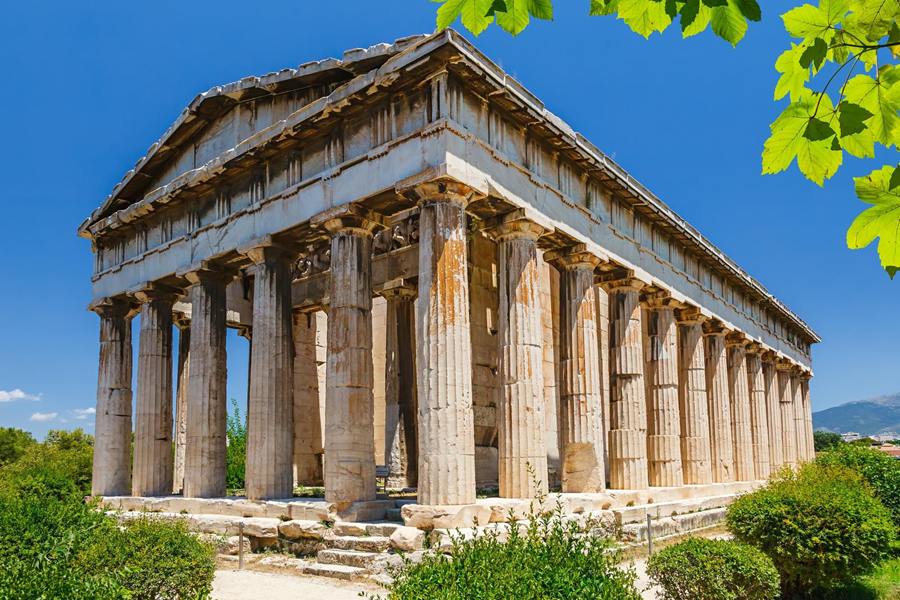
Besides the Agora buildings, Melite held the Temple of Hephaestus. A sanctuary of Heracles stood there as well. Its statue, by Phidias or his teacher Ageladas, marked the end of an epidemic in 429 BCE. An epidemic is a wide outbreak of disease. Eurysaces, son of Ajax, had his own shrine in the deme, shared with his father.
The deme also held a temple of Theseus, said to contain his grave. Tradition says the first people of Melite moved away to Diomea. They carried the cult of Heracles with them to their new home. In this sense, a cult is the honouring of a god or hero. Melite was a very populous part of ancient Athens.
- Themistocles: The statesman lived in Melite and had a temple to Artemis built near his house.
- Epicurus: The philosopher lived here and left his home to the later heads of his school.
- Gate: The Melitian Gate in the wall of ancient Athens took its name from this deme.
Melite belonged to the tribe of Kekropis, one of the ten tribes of Athens. On the map of ancient Athens, it lay in the west of the city. Directly to its north lay the inner Kerameikos, known as the potters’ quarter.
What did the great plague do to ancient Athens?
Ancient Athens was struck by a deadly epidemic during the Peloponnesian War, its long war with Sparta. Historians call it the Plague of Athens. The disease is believed to have entered through Piraeus, the port. That harbour was the city’s sole source of food and supplies.
Under Pericles, Athenians pulled back inside the city walls and relied on the fleet. This strategy brought a mass migration from the Attic countryside into a crowded city. The population tripled or quadrupled, from 100,000–150,000 to 300,000–400,000. Close quarters and poor hygiene then made ancient Athens a breeding ground for disease.
Thucydides traced the disease from Ethiopia, through Egypt and Libya, into the Greek world. Physicians were helpless against it. They also died fastest, having the closest contact with the sick. The sight of burning funeral pyres in ancient Athens made the Spartans pull back their troops. A pyre is a pile of wood for burning a body.
The plague came back in 429 BC and a third time in the winter of 427/426 BC. Thucydides says people stopped fearing the law, as they felt already sentenced to death. Survivors, Thucydides among them, gained immunity, meaning protection from catching it again. They became the main carers for those who fell ill later.
- Mass grave: A shaft-shaped mass grave dug out in 1994–95 held an estimated 240 people, at least ten children.
- DNA: In 2005, a DNA study of dental pulp found sequences close to Salmonella enterica, a bacterium.
- Causes: Researchers have put forward around 30 pathogens, or germs, behind the plague in ancient Athens.
Athenians tried to ease the crowding by moving their cattle to Euboea, a large Greek island. Thucydides also describes a decline in traditional religious practice in ancient Athens. Superstitious explanations of the disease rose in its place.
Who was Thucydides, the historian of ancient Athens?
Ancient Athens produced Thucydides, a historian and general born about 460 BC. He died around 400 BC. His History of the Peloponnesian War tells the story of the war between Sparta and Athens. The account runs up to the year 411 BC.
His father was Olorus, and his home deme was Halimous in Attica. A disputed story says he heard Herodotus lecture in the agora of ancient Athens. He was then 10 to 12 years old. Herodotus was an earlier historian. His family seems to have been linked to the general Miltiades and his son Cimon.
Thucydides held gold mines at Scapte Hyle, whose name means Dug Woodland. This coastal area of Thrace lay opposite the island of Thasos. In 424 BC ancient Athens sent him to Thasos as a strategos, or general. When he reached Amphipolis, the city was already under Spartan control.
The loss of Amphipolis was blamed on him, and he was sent into exile. As an exile, he travelled freely among the allies of Sparta and saw the war from both sides. He says he started writing the moment the war began. He has been called the father of scientific history.
- Melian dialogue: His debate between Athenians and Melians is a founding text of international relations theory.
- Study: Universities and military colleges across the world still read his text.
- Corcyra: On civil conflict at Corcyra, he wrote that war is a violent teacher.
Pausanias placed the tomb of Thucydides near the Melite gate of ancient Athens. Plutarch preserves a different tradition about his grave. In his account, a monument to the historian stood in the family plot of Cimon. That plot lay outside the deme of Thucydides himself.
Why did Alcibiades rise and fall in ancient Athens?
Ancient Athens knew Alcibiades as a statesman and general, born about 450 BC. He was the last of the Alcmaeonidae, a powerful noble family. His own name was of Spartan origin. After his father died at Coronea in 447 BC, Pericles and Ariphron became his guardians.
He married Hipparete, daughter of Hipponicus, a wealthy man of ancient Athens. She brought a large dowry, a gift of property from the bride’s family. In art and literature he is remembered as a student of Socrates. At the Battle of Delium in 424 BC, he rescued the philosopher.
In 415 BC envoys from Segesta in Sicily asked Athens for help against Selinus. Alcibiades was a leading voice for the Sicilian Expedition that followed. One night the hermai, carved heads of Hermes on stone posts, were smashed across the city. The scandal brought a charge of asebeia, or impiety, against him.
The fleet sailed with the charges unresolved. At Thurii, a Greek colony, Alcibiades escaped with his crew. Back in ancient Athens, he was convicted and condemned to death in his absence. He fled to Sparta and served there as a strategic adviser. Later he advised Tissaphernes, a satrap, or Persian provincial governor.
- Return: Once restored to Athens, he played a crucial role in a string of Athenian victories.
- Death: In 404 BC his house was surrounded and set on fire, and arrows killed him.
- Place: Aristotle put the site of his death at Elaphus, a mountain in Phrygia.
In war, Alcibiades favoured unconventional tactics. He frequently won cities over by negotiation or treachery, not by siege. A siege is the long blockade of a city. He was famous all his life in ancient Athens for his good looks. He was excessively vain about them.
What happened when Sulla besieged ancient Athens?
Ancient Athens faced a Roman siege from the autumn of 87 BC to the spring of 86 BC. It formed part of the First Mithridatic War. Rome’s forces, under Sulla, fought the troops of the Kingdom of Pontus and of the Athenian city-state.
The Greek and Pontic side had two commanders, Aristion and Archelaus. Mithridates VI was king of Pontus, which gave the war its name. Sulla’s army landed at Dyrrachium, in Illyria, in the spring of 87 BC. Archelaus held Piraeus, the port, while Aristion led the main defence of ancient Athens.
The outer wall that joined the city to Piraeus lay in ruins. Sulla therefore had to run two separate sieges, around Athens and around its port. A Pontic fleet ruled the nearby sea, which kept Piraeus supplied. To raise money, Sulla took treasure from temples, and coins struck from it stayed in use for centuries.
Inside ancient Athens, hunger grew so bad that people ate shoe leather and grass. A delegation went out to Sulla but praised the glory of their city instead of bargaining. Sulla sent them away. Greek deserters then told him that Aristion was neglecting the Heptachalcum, a stretch of the city wall.
- Breach: Sulla’s sappers, or tunnelling soldiers, brought down nine hundred feet of wall between the Sacred and Piraeic gates.
- Sack: On 1 March 86 BC, a midnight sack of the city began.
- Surrender: Aristion’s men held the Acropolis until their water ran out, then surrendered.
Archaeology shows that the damage Sulla’s troops did to ancient Athens was less severe than once assumed. In 85 BC Sulla and Mithridates VI signed the Treaty of Dardanos. That treaty brought the First Mithridatic War between Rome and Pontus to an end.
What do travellers ask about ancient Athens, and what are the answers?
Ancient Athens, by tradition, had Medon, son of King Codrus, as its first archon, a chief official. The deme of Alopece belonged to the tribe of Antiochis. The owl of Athena became a Western symbol of wisdom. The small Eridanos river flowed right through the town.
Who was Codrus in the legends of ancient Athens?
Codrus was the last of the semi-mythical kings of Athens, meaning part history, part legend. During a Dorian invasion, the Delphic Oracle promised the Dorians victory if the king stayed unharmed. Codrus was killed in a quarrel with Dorian soldiers. Realising who had died, the Dorians retreated in fear.
Where did the deme of Alopece lie in ancient Athens?
Alopece was an asty deme, a district counted with the city of Athens itself. Even so, it lay outside the city wall. The deme stood only eleven or twelve stadia from town, close to the Cynosarges gymnasium. It held a temple of Aphrodite and also, it seems, one of Hermaphroditus.
Why did an owl appear on the coins of ancient Athens?
The little owl traditionally stands for Athena, the goddess of wisdom, or keeps her company. After 510 BC the owl became the common obverse, or main face, of the Athenian tetradrachm. A tetradrachm was a silver coin worth four drachmas. The writer Philochorus says the coin was called glaux, or little owl, across the ancient world.
What was the Eridanos river of ancient Athens?
The Eridanos was a small stream rising in the foothills of Lykabettos. It flowed through the Agora of ancient Athens to the Kerameikos, where its bed still shows. The greater part of its course has been covered since ancient times. A brick tunnel built in classical times was repaired in Roman and early Byzantine eras.