
National parks in Greece guard mountains, river deltas, lagoons and seas, from Thrace to the Ionian Islands. Trips with a host run across the mainland and the islands. The answers start with the first park law and Laganas Bay. They go on to Alonnisos, the Missolonghi lagoons, the Axios Delta, Valia Calda, the Rodopi range and Prespa. Related outings appear under Pelion tours, Delphi tours and Greece small group tours. Other regions of the country appear under Greece tours.
Bookings made through the GetYourGuide widgets on this page earn Classical Greece Tours a commission, at no extra cost to the traveller.
What are the national parks in Greece?
The national parks in Greece began in 1938, when the first park was set up around Mount Olympus. A second park, centred on Mount Parnassus, followed in the same year. Each park has a core and an area that surrounds it.
Greece has an extremely broken and rugged landscape. That ground holds a great range of ecosystems, groups of plants and animals sharing one setting. Its biodiversity, meaning the variety of life, is outstanding. Almost 5% of the long Greek coastline is sensitive wetland, ground where shallow water stays for long spells.
Protected ground in the country goes back to ancient times and the Altis, the sacred grove at Olympia. A grove is a patch of trees, and sacred means set apart for the gods. The first law for the national parks in Greece came in 1937. That law drew on the protected forests of a Forest Code from 1929.
In 1986, Law 1650/1986 rebuilt the legal frame for the national parks in Greece. A legal frame is the set of laws that rules a subject. Article 19 of that law sets out five types of protected area. A mainly marine or forested park can become a National Marine Park or a National Woodland Park.
- Woodland parks: In 2022 a world database of protected areas listed 10 National Woodland Parks.
- Marine parks: The same 2022 record counted 2 National Marine Parks within the country.
- National parks: That record also held 15 areas with the plain title of National Park.
The land of the national parks in Greece has a climate divided into three classes. A climate class groups places with similar weather across the years. The Mediterranean class pairs mild, rainy winters with hot summers that stay dry. Mild here means gentle, without harsh cold.
Why do the national parks in Greece reach out to Laganas Bay?
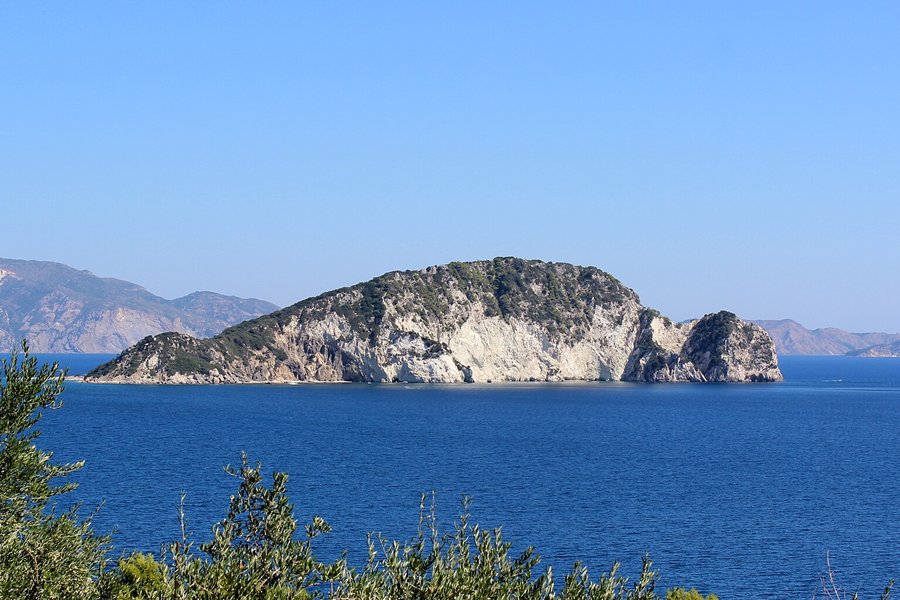
The national parks in Greece reach the sea at Laganas Bay, home of the Zakynthos marine park. The park belongs to Natura 2000, a European network of protected nature sites. Fishing is strictly banned inside each of its marine zones.
Loggerheads are sea turtles, shelled reptiles that swim in open water. The loggerhead spends the greater part of its life out at sea. Within the national parks in Greece, female loggerheads lay their eggs on this bay. They come ashore on its beaches to do so at night.
The turtles’ yearly trip to their nesting grounds has grown more and more risky. Obstacles met on the beaches are the cause. Speedboats add to the danger when they ignore the ban on boats close to the nesting beaches. A ban is an official rule that forbids something. A speedboat is a fast motor boat.
Specific codes of conduct apply in this marine unit of the national parks in Greece. A code of conduct is a written set of rules on how to behave. The codes cover sightseeing, awareness activities, rambling and trips out on the sea. Rambling means walking for pleasure through the countryside.
- Strofades: These islands lie inside the Zakynthos marine park, one of the national parks in Greece.
- Monastery: The Stamfani monastery was built at the request of Princess Irene Laskarina, a shipwreck survivor.
- Birds: The Strofades have a strong bird presence, and hunting is forbidden on the islands.
In legend, Zetes and Calaïs, the sons of Boreas, chased the Harpies, winged monsters of myth. Boreas was the god of the north wind. Iris, goddess of the rainbow, turned the brothers back at the Strofades. A legend is an old story handed down over time.
How did the national parks in Greece gain a marine first at Alonnisos?
The national parks in Greece gained their first marine park of its kind around Alonnisos. This Northern Sporades park forms an important habitat for about 300 species of fish. Up to 80 bird species also use the area as a home.
Thomas Schultze-Westrum, a German zoologist, made a series of trips to the islands in 1976. A zoologist is an expert in the lives of animals. He noted the high natural value of the islands and proposed a protected area. Six years later, the local fishermen of Alonnisos accepted the plan and pledged their help with its protection.
In 1986 the Magnesia Prefecture issued the first order to protect the region. A prefecture was a regional level of Greek government. Alonnisos later gained the first health centre in the Mediterranean for the monk seal. A seal is a sea mammal that swims with flippers. Such a centre treats sick or hurt seals.
Within the national parks in Greece, this park records an average yearly temperature of 17 °C. Its average rainfall is 515 mm. Chasmophytes, plants that root in cracks in rock, include endemic species such as Campanula reiseri. Endemic means found in one area and nowhere else. Linum gyaricum and Arenaria phitosiana are two more.
- Striped dolphin: The striped dolphin is one of the dolphin species recorded in this sea region.
- Sperm whale: The sperm whale is among the whales named for this corner of the national parks in Greece.
- Beaked whale: Cuvier’s beaked whale is a second whale species named for the same waters.
Piperi forms the core of this marine park among the national parks in Greece. A core is the best-protected heart of a park. Boats are barred from the waters within 3 nautical miles of the island. A nautical mile is a unit of distance used at sea.
Which protected lagoons lie beside the national parks in Greece at Missolonghi?
The national parks in Greece stand alongside protected wetlands such as the Missolonghi–Aitoliko Lagoons. This complex lies in the north part of the Gulf of Patras, on the central west coast. Its waters form a shallow area of 150 square kilometres.
The Ramsar Convention, a world treaty for wetlands, protects the complex. A Ramsar listing stands apart from the legal status of the national parks in Greece. A wetland is ground where shallow water covers the land for long spells. The complex is also part of Natura 2000, the nature network of the European Union.
The largest portion is Kentriki Limnothalassa, Greek for “central lagoon”. A chain of sand islands separates it from the sea. In plain words, a lagoon is shallow salt water held behind a strip of land. To the north, Aitoliko lagoon joins it through a narrow neck. Aitoliko looks more like a deep lake, reaching 28 m in depth.
Eight fishing co-operatives lease the lagoons and work barrier traps where the lagoon meets the sea. A co-operative is a business owned and run by its members. About 200 fishermen work at those traps. Another 700 independent fishermen fish the rest of the lagoon, which has no lease.
- Lights: Lamps are a main tool of the independent fishermen in this wetland beside the national parks in Greece.
- Spears: Spears, poles with sharp points, are a second main tool of the independent fishermen.
- Longlines: A longline, a long cord carrying baited hooks, completes the main kit of these fishermen.
Avgotaracho Messolongiou is a traditional product tied to fishing in the lagoons. Its makers wash flathead grey mullet ovaries, salt them and dry them under the sun. Melted wax then seals them. The food comes from a wetland protected alongside the national parks in Greece.
What does the Axios Delta add to the national parks in Greece near Thessaloniki?
The national parks in Greece include the Axios-Loudias-Aliakmonas Delta National Park, its full official name. The park borders the Thermaic Gulf along its western coastline. Its borders reach as near as 10 kilometres from the city of Thessaloniki.
Sand dunes run between the Alyki Kitrous lagoon and the Aegean Sea. A dune is a hill of sand piled up by wind. These dunes hold the largest population of Hermann’s tortoises in Europe. Within the national parks in Greece, that population is also the densest in the world.
Nutria have lived in the park for more than 60 years. A nutria is a large rodent that lives by water. The first ones escaped from a fur farm. Among the national parks in Greece, this one holds one of the country’s largest water buffalo herds. The herd lives at the mouth of the Gallikos river.
Along the coast of the park, about 30,000 tons of mussels are produced each year. A mussel is a shellfish with a dark shell in two halves. The species grown here carries the Latin name Mytilus galloprovincialis. That harvest makes up 80-90% of all mussel production in Greece.
- Alyki Kitrous: This lagoon is one of the wetlands joined together inside the park.
- Nea Agathoupoli: The wetland of Nea Agathoupoli forms a further part of the protected area.
- Gallikos estuary: The park takes in the estuary, or wide river mouth, of the Gallikos river.
About 10,000 hectares of rice paddies cover almost a third of the park. A paddy is a flooded field for growing rice. A 400-hectare evaporation pond in this part of the national parks in Greece makes salt. It yields 28,000 tons each year.
Which wild valley joins the national parks in Greece north of Metsovo?
The national parks in Greece take in Pindus National Park, also called Valia Calda. In Aromanian that name means the Warm Valley. The park lies in an isolated mountain area and dates from 1966. It covers 6,927 hectares.
The park lies on the borders of Grevena and Ioannina, north of the town of Metsovo. Grevena and Ioannina are regional units, which are districts of local government. Inside its borders, this one of the national parks in Greece has no settlements or facilities. A settlement means a village or town with residents.
The underlying rock is mainly serpentine, which supports a special range of plants. Serpentine is a green rock named for its snake-like pattern. Woods of European black pine and common beech clothe the low and middle slopes. A number of these trees are more than 700 years old.
Eurasian brown bears live in the park. It is one of three Greek areas that hold a population of them. The brown bear is a large, heavy forest mammal. The dense, mature forests also host eight types of woodpecker. A woodpecker is a bird that drills into tree bark with its beak. The black woodpecker is one of them.
- Avgo: The peak of Avgo reaches 2,177 m, among the high points of the national parks in Greece.
- Kakoplevri: The summit of Kakoplevri stands at 2,160 m, another peak above 2,000 m.
- Flegga: Flegga reaches 2,159 m and belongs to the same group of high peaks.
Of the national parks in Greece, Pindus National Park is considered among the least visited in Europe. It is also counted among the least known parks on the continent. A continent is one of the great land masses of the world.
How large a forest do the national parks in Greece hold in the Rodopi range?
The national parks in Greece include the Rodopi Mountain Range National Park, which covers about 170,000 hectares. Its forest ecosystems are the largest in Greece. Those forests also rank as the country’s highest-yielding. An ecosystem is a living community and its setting.
Of the national parks in Greece, this one sits in the central-west massif of the Greek Rhodope. A massif is a compact block of mountains. Its northern edge follows the Greek-Bulgarian border, from near Kato Neurokopi in Drama to Dimario. To the south, its edge begins on the north-east flank of Mount Falakro and follows the Nestos.
The Rhodope Mountains were not covered by ice in the Pleistocene, a long age of ice sheets. Within the national parks in Greece, this park records 827 plant species and 288 subspecies. A subspecies is a distinct local form of a species. Lilium rhodopeum, a lily, is endemic and found in no other part of the world.
The park is one of the last areas in Greece where hazel grouse and western capercaillie live together. Both are grouse, plump birds of the forest floor. It is also the southernmost region in Europe for the adder, a venomous snake. The sand lizard reaches its southern European limit here too.
- Scots pine: Scots pines help cover another 17.5% of the land in this national park.
- Birch: Birches grow in the same zone, mixed with the pines and spruces there.
- Spruce: These mountains form the southern region where spruce, a tall conifer, can be found.
Inside this unit of the national parks in Greece, 180 Lepidoptera species are found. Greece as a whole has recorded 235 species of them. Lepidoptera is the scientific name for butterflies and moths. The name means scale wings, after the tiny scales on their wings.
What wildlife do the national parks in Greece guard at Prespa?
The national parks in Greece reach the Western Macedonia region at Prespa National Park. It covers the land around the southeastern part of Lake Prespa in Greece. Small Prespa Lake lies inside it as well. Western Macedonia is one of the regions of Greece.
As a wetland, the park is designated as a Ramsar site. A Ramsar site is a wetland listed under a world treaty for its value. Small Prespa Lake is recognised as an important wetland for rare water birds. Those birds breed and feed there, within the national parks in Greece. Breeding means producing and raising young.
Bird species of the park include the great white pelican and the great egret. The pygmy cormorant and the golden eagle are on the same list. In the Prespa unit of the national parks in Greece, the local flora counts about 1,400 species. Centaurea prespana is an endemic plant among them. Endemic means it grows in one area only.
Greece holds 42.5 square kilometres of the surface of Small Prespa Lake. Albania holds the other 4.3 square kilometres. A visitor centre stands in Agios Germanos. A visitor centre is a building with displays about a place. The lake is one of the waters guarded by the national parks in Greece.
- Laimos: Laimos is one of the Greek villages that surround Small Prespa Lake.
- Mikrolimni: Mikrolimni also sits among the villages on the Greek side of the lake.
- Vrontero: Vrontero and Pyli complete the list of villages around the Greek shore.
In 1999 a Prespa conservation society won the Ramsar Wetland Conservation Award. A society here means a group of people who work for a shared aim. The award honoured the group’s work to conserve the Lake Prespa Ramsar site.
Which plants and animals set Olympus apart among national parks in Greece?
National parks in Greece include Olympus. Its mountain ranks second in height across the Balkan Peninsula. Its slopes climb from mixed rock and forest belts to open alpine ground. Bats, buntings, beech and pine all find a home inside its borders.
Among the national parks in Greece, Olympus rests mainly on limestone. That rock strongly shapes the local climate and plant life. Limestone is a pale stone built from ancient shells and lime mud. Gneiss appears on the mountain’s west side, from 700 to 1,100 metres. Gneiss is a banded rock hardened by heat and pressure.
Flysch from the Eocene covers parts of the northwestern side, from 600 to 1,200 metres. Flysch is a layered mix of sandstone and shale. The Eocene is an early age of Earth’s history, long before humans. Elsewhere on the mountain, beech and silver fir form shared woods from 600 to 1,400 metres.
Bulgarian fir, oriental hornbeam and black pine grow in places among the beech. Hornbeam is a hardwood tree with ribbed leaves. Within the national parks in Greece, pure black pine forests also stand at these middle heights. A pure forest holds one kind of tree alone. Black pine is a dark-barked conifer, a tree that carries cones.
- Above the trees: Above the tree line on Olympus lie alpine grasslands, rocky peaks and deep gorges.
- Bats: The greater horseshoe bat and Geoffroy’s bat both live within the park.
- Buntings: Ortolan and Cretzschmar’s buntings, small seed-eating songbirds, appear there in the breeding season.
Among the national parks in Greece, Olympus takes its name straight from the mountain. Ancient Greeks placed the throne of Zeus on its heights. They believed the gods held stormy debates there. A throne is a ruler’s ceremonial seat.
How do climate and old villages define Vikos–Aoös for national parks in Greece?
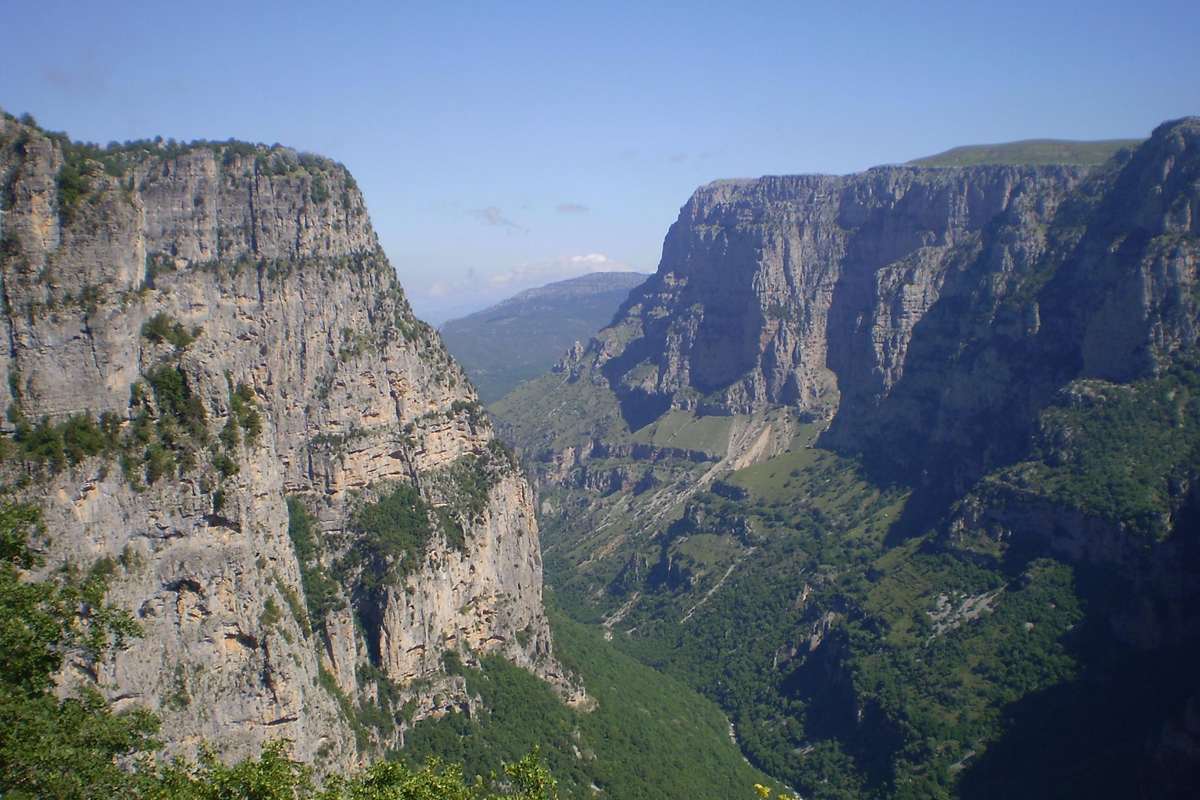
National parks in Greece include Vikos–Aoös in Epirus, northwestern Greece. Over 100,000 people arrive there each year. Its climate sits between two types, Mediterranean and continental. A continental climate has wide gaps between hot summers and cold winters.
The park’s mean yearly temperature stands at 11.9 degrees Celsius. Its yearly precipitation reaches 1,100.9 millimetres. Precipitation means all rain, sleet and snow that falls. Among the national parks in Greece, this area falls within the humid zone, marked by cold winters. A humid zone receives plenty of moisture through the year.
Inside the Vikos Gorge, oriental plane trees line the banks of the Voidomatis river. They form a gallery forest. A gallery forest is a narrow belt of trees along a river. Among the national parks in Greece, Vikos–Aoös keeps roe deer, wild horses, foxes and wolves all year. Roe deer are small, shy deer of woodland edges.
In past centuries, the land served mainly for herding and for gathering firewood. Herding means keeping and moving farm animals across open pasture. Between the 17th and 19th centuries, the Zagori region enjoyed autonomous status inside Ottoman lands. Its people were spared the heavy taxes paid by lowland villages. Autonomous means self-governing.
- People: Villages in and around the park are home to 1,515 people in total.
- High birds: Alpine choughs, shore larks and alpine swifts nest high up, in the subalpine zone below the peaks.
- Tourism: Lodging and other tourist facilities grew fast in the 1980s, mainly through state plans.
In Vikos–Aoös, ecotourism is viewed as an answer to economic decline. Ecotourism means nature travel that protects the places it reaches. Among the national parks in Greece, this park’s villages lost much of their population. Such villages are called depopulated, meaning emptied of residents.
Who looks after Chelmos-Vouraikos, one of the national parks in Greece?
National parks in Greece include Chelmos-Vouraikos, run by a Management Body based in the town of Kalavryta. Its land holds rivers, lakes, the full Chelmos range and the Vouraikos Gorge. A gorge is a steep-sided cleft carved by a river.
The Management Body was set up in 2002 and gained its staff in 2007. A management body is an official team that runs a protected area. Among the national parks in Greece, this team includes an environmental scientist, a geologist and a forester. Six rangers also work for it. Rangers patrol and watch over protected land.
Since October 2009, it has sat within both the European and the Global Geoparks Networks. A geopark is land protected for its rocks, landforms and earth history. Limestone covers the larger part of its ground. In places that limestone is strongly karstified. Karstified rock has been dissolved by water into caves, sinkholes and hidden channels.
Among the national parks in Greece, Chelmos-Vouraikos holds thirty plants endemic to the Peloponnese. Over one hundred Greek endemics also grow there, and five others belong to Chelmos alone. An endemic plant grows naturally in one region and nowhere else. Globularia stygia grows on limestone at heights of 1,150 to 2,300 metres.
- Animals: The park records 9 amphibian, 23 reptile and 18 mammal species.
- Butterflies: Endemic butterflies, rare kinds among them, live in the alpine grasslands.
- Mavrolimni: This lake on Mount Chelmos is a glacial alpine lake, formed by ancient ice.
Psili Korfi is the highest peak of Mount Chelmos. In Greek, the name means high summit. Farms with sheep, goats and cattle add greatly to local income. These farms work land inside one of the national parks in Greece.
Where do old forts and a 2007 fire meet within national parks in Greece?
National parks in Greece include Parnitha, a mountain range north of Athens. Much of it is a protected habitat for wildfowl. Wildfowl are water birds such as ducks and geese. Its slopes also carry ancient forts, mines and the scars of a major fire.
One of its peaks, Xerovouni, rises to 1,120 metres. The name means dry mountain in Greek. Among the national parks in Greece, Parnitha also offers two mountain shelters, called Mpafi and Flampouri. A mountain shelter is a simple hut where walkers rest or spend the night. Towns such as Aspropyrgos, Fyli and Acharnes ring the mountain.
Below 300 metres, farms cover the larger share of land, and suburban homes spread over the eastern side. Suburban means lying on the outer edge of a city. Large mines lie to the northwest of the range. Ore from those mines once travelled to a nearby factory. Ore is rock that holds useful metal.
Among the national parks in Greece, Parnitha holds places of archaeological interest. Archaeology examines old objects and ruins to learn about earlier people. Panakton was one notable fortress, in the area of Dervenochoria. Dekeleia was another key fort. The former royal palace at Tatoi now occupies its site. A fortress is a walled stronghold built to resist attack.
- Fire: A wildfire in 2007 burned about 56 square kilometres of the mountain’s land.
- Forest loss: That fire took 80% of the forest of rare Greek fir and Aleppo pine.
- Recovery: Scientists estimate that the burned area can take up to a century to recover.
Since the mid-1950s, Parnitha has carried the second transmitter for Athens. It broadcasts radio and television. A transmitter sends signals through the air. Its ecoregion, a zone of hard-leaved forest, also holds the Parnassus and Sounion national parks in Greece.
Which animals and refuges does Mount Oeta bring to national parks in Greece?
National parks in Greece include Mount Oeta in Central Greece, where two wildlife refuges ban hunting. A wildlife refuge is land set aside so animals can live undisturbed. Slightly over 10% of the mountain is meadow, a high share for such terrain.
The Gorgopotamos Gorge holds the status of a Special Area of Conservation. That means European Union law protects it. Among the national parks in Greece, the Oeta park joins that gorge in a wider protected zone. The Asopos valley belongs to it too, and the whole is a Special Protected Area. Such an area shields wild birds.
One refuge, Skasmeni Frantzi–Dyo Vouna, covers the northeastern slopes. The other, Oiti–Pavliani, sits on the southeastern slopes. A Management Body oversees the park and its protected areas. It was formed in 2002 and works as an agency under the Environment Ministry. An agency is a public office that carries out state work.
Meadows and bare rocky slopes hold the richest plant life on Oeta. A meadow is open grassland rich in wild flowers. Oeta, together with Giona and Vardousia close by, marks the southern edge for plants of northern origin. Planes, willows and alders grow along its river gorges. Planes are broad-leaved trees with flaking bark.
- Mammals: Roe deer, wild boar and hare roam the Oeta slopes within the national parks in Greece.
- Alpine newt: This small amphibian of the park is endangered, meaning at real risk of dying out.
- Woodpeckers: Grey-headed, white-backed, black and Syrian woodpeckers all live on Oiti, the Greek name of Oeta.
Rivers and lakes in the park hold Sperchios barbel, Macedonian chub, Sperchios spirlin and Greek trout. Barbel and chub are freshwater fish of the carp family. Spirlin is a silvery river fish. Those waters belong to the Oeta park, part of the national parks in Greece.
What was Parnassos created to protect within national parks in Greece?
National parks in Greece include Parnassos, a park created to protect the natural habitat of Mount Parnassus. Its creation meant governing how the mountain’s natural resources were used. Natural resources are the water, wood, soil and wildlife that a place provides.
Soon after the park’s founding, its role among the national parks in Greece fell dormant. Dormant means inactive. The mountain then sheltered partisans fighting the Axis occupation. Partisans are irregular fighters working outside a regular army. After the Second World War, the range became a theatre of the Greek Civil War. Theatre here means an area of fighting.
Once the conflicts ended, the park returned to active use. Its species were counted and listed, and endemic and endangered kinds were picked out. Endemic species live naturally in one area alone. The idea of a protected area then took root. Among the national parks in Greece, Parnassos gained protection for its birds under the Birds Directive.
After 2000, the mountain also became a Natura 2000 site named Oros Parnassos, with the code GR2410002. Natura 2000 is a chain of protected areas run under European Union rules. The Birds Directive, one of its two founding laws, guards wild birds. Oros Parnassos is Greek for Mount Parnassus. The park and this site are not identical.
- Size: The Natura 2000 area covers about 344 square kilometres, taking in land outside the park.
- Ski slopes: Gerontovrahos, a small ski centre with two drag lifts, lies across a ridge from Kellaria.
- Resort dates: Workers began the ski resort in 1975 and completed it in 1976.
Among the national parks in Greece, Parnassos sits on a range whose melting snow supplies municipal water. Municipal water is the public supply that reaches homes through pipes. The towns and villages around the mountain draw on that supply.
Which wetland of lagoons and pines joins the national parks in Greece at Strofylia?
National parks in Greece include Kotychi and Strofylia, a coastal wetland in the northwest Peloponnese. Strofylia alone covers 22 square kilometres and forms part of Natura 2000, a European nature network. The site also enjoys protection under the Ramsar Convention, an international wetland treaty.
The wetland stretches along about 22 kilometres of coast. Its average width is 1.5 kilometres. Among the national parks in Greece, it joins two lagoons, Prokopos and Kalogria, with the Lamia marshes. A lagoon is shallow salty water parted from the open sea by sand. A marsh is wet, soft ground with reeds.
The Strofylia forest, also spelled Strofilia, belongs to the same protected system among the national parks in Greece. No stone pine woodland in Greece is more extensive. Stone pine is a pine with a broad, umbrella-shaped crown and edible seeds. The larger part of this forest grows on dune ground. A dune is a wind-heaped ridge of sand.
Kalogria lagoon covers 450 hectares. A hectare equals ten thousand square metres. The lagoon reaches a maximum depth of 3.4 metres. Prokopos lagoon lies southwest of Araxos village, while Kalogria lagoon lies to the north. The village of Akrotirio Araxou sits beside it. Locals also call this lagoon Pappas or Araxos.
- Beach: Kalogria beach, beside the park, runs about 9 kilometres and is 80 metres wide.
- Dunes: Sand dunes near the beach cover 200 hectares and rise up to 10 metres.
- Big dune: The largest sand dune in the Peloponnese stands at the beach’s north edge.
Among the national parks in Greece, Strofylia has dunes built by wind and waves. Westerly winds and Ionian Sea waves push the sea sand ashore. On 13 August 2015, a fire burned 160 acres of its forest. An acre is an old unit of land area.
What do travellers ask about national parks in Greece, and what are the answers?
National parks in Greece sit inside wider protection systems. The Ramsar Convention guards wetlands, while Natura 2000 joins protected sites across the European Union. Lake Vistonida in Thrace lost an endemic fish. Half of the Mediterranean wetlands vanished during the 20th century.
Before a trip to national parks in Greece, what is a Ramsar site?
Ramsar sites are wetlands named under the Ramsar Convention, a pact for wetland care. The treaty was signed in 1971 in Ramsar, a city in Iran, which gave it its name. Greece joined on 21 December 1975. Its ten Ramsar sites take up 1,635 square kilometres together.
Around national parks in Greece, what does Natura 2000 mean?
Natura 2000 is a web of nature protection sites across the European Union. It forms the Union’s share of the Emerald network. That network rests on the Bern Convention, a wildlife treaty. Each member state names its own Special Protection Areas for birds. Every site has a standard data form, a legal reference.
Where does Lake Vistonida sit among wetlands and national parks in Greece?
Lake Vistonida lies in Western Thrace, in northeastern Greece, and the Kompsatos river feeds it. Lagos village stands on the bar between the lake and the Aegean Sea. A bar here is a narrow strip of sand or land. The Thracian shad lived in this lake and nowhere else, and it is now extinct.
Beyond national parks in Greece, how have Mediterranean wetlands changed?
Wetlands are places where land and water meet. Across the Mediterranean region, half of all wetlands vanished during the 20th century. The wetlands that remain have lost quality or been turned into man-made sites. One in three Mediterranean wetland species is now endangered. An endangered species faces a real threat of vanishing.