
Greece weather in June forms the backdrop for expert-led trips on Santorini, on Crete and across the Aegean. The sections give station figures for Santorini, Ierapetra, Gavdos, Milos, Kythira, Serres, Kozani and Thasos. They also cover the meltemi wind, the Klidonas custom and the Miaoulute festival on Hydra. Related pages cover the best time to visit Greece, Greece weather in September and best beaches in Greece. Further outings on the islands and mainland are grouped under Greece tours.
Bookings made through the GetYourGuide widgets on this page earn Classical Greece Tours a commission, at no extra cost to the traveller.
What is Greece weather in June like?
Greece weather in June follows the Greek summer pattern, where sunny, dry weather is the commonest kind. At the Downtown Athens station, the mean daily maximum for June is 31.6 °C. A daily maximum is the highest reading of a day.
The Athens figures are normals for 1991–2020, meaning averages worked out across those years. In that period, the June daily minimum averaged 21.6 °C. A daily minimum is the lowest reading of a day, the opposite of a daily maximum. For Greece weather in June, rainfall at the same station averages 11.6 millimetres in total.
The Downtown Athens table also lists extremes, the hottest and coldest readings on record. Its extremes run from 1890 to the present. The June record high in that set is 44.8 °C. A record high is the single warmest reading logged in a given month across all of those years.
Heatwaves are spells of unusual heat. Along the Greek coasts, they stay quite mild as a rule. The relatively cooler sea moderates the temperature there. So does the sea breeze, meaning air that moves off the water onto the shore. Moderate, as a verb, means to make something less extreme.
- Thessaloniki: For Greece weather in June, the Aristotle University station records a mean high of 30.0 °C.
- Lindos: This station, 65 metres above sea level, logs June highs averaging 31.8 °C.
- Rain: Summer rain in Greece comes as showers or thunderstorms out of heaped, cumuliform clouds.
Greece weather in June falls within a Greek summer in which the air is hot during the day. At night, the summer air stays pleasantly warm. Pleasantly warm here means mild enough to feel comfortable, rather than hot or cold, on the skin.
How does the Santorini station record Greece weather in June?
Greece weather in June on Santorini is measured at a station 183 metres above sea level. There, the mean daily maximum for the month reaches 27.9 °C. Rainfall at that station averages just 3.6 millimetres across the whole of June.
The National Observatory of Athens rates Santorini as hot and semi-arid, with the code BSh. Semi-arid describes dry land with more rain than a desert but less than a humid zone. The code comes from the Köppen scheme, a world system for sorting climates. The island also shows Mediterranean features: its summers are dry, and its winters a little wetter.
The same Santorini station gives a June daily mean of 24.4 °C. A daily mean is an average temperature for a whole day. Averaged over the month, it shows the middle point of June temperatures. For Greece weather in June, this single figure blends daytime and night-time readings into one number.
For Greece weather in June, the Santorini numbers are drawn from the observatory’s monthly bulletins. Each bulletin is a brief official summary, put out on a fixed schedule. An observatory is a place built for watching the sky or the weather. Every new bulletin adds one more month of readings to the long record.
- Record high: The hottest June reading at the Santorini station stands at 38.7 °C.
- Record low: The coolest June reading on the same station’s list is 16.2 °C.
- Extremes: Record highs and lows are single readings, unlike averages built from every day.
Greece weather in June on Santorini also includes a mean daily minimum of 21.0 °C. The daily minimum is the coolest temperature logged in a day. Set beside the daily maximum, it marks the cool end of the June temperature range at the station.
Which figures describe Greece weather in June at Ierapetra, on Crete’s southeast coast?
Greece weather in June at Ierapetra centres on a mean daily maximum of 29.3 °C. Ierapetra, on the southeastern shore of Crete, is both a city and a municipality. The figure comes from the town’s own weather station, which keeps long-run June averages.
Under the Köppen scheme, Ierapetra falls in the hot-summer Mediterranean type, written Csa. In that code, C marks a mild climate group. The letter s marks a dry summer, and a marks a hot summer. For Greece weather in June, the town’s summer season is hot and dry. Its winters, by contrast, are mild and rainy.
The Ierapetra station stands 18 metres above sea level. Its normals, or long-run averages, cover the years 1956-2010. Each normal is an average across those years. In June, the station’s daily mean comes to 25.6 °C. That mean blends the warm and cool parts of each day into one figure for the month.
Relative humidity at Ierapetra averages 56.0% in June. Relative humidity measures how much water vapour the air holds, compared with its full capacity at that temperature. A lower figure means drier air, and a higher figure means damper air. Water vapour is water held in the air as an invisible gas.
- Rain: The Ierapetra station averages only 1.3 millimetres of precipitation in June.
- Wet days: June has an average of 0.7 precipitation days at the station, fewer than one.
- Sunshine: For Greece weather in June, Ierapetra records 355.4 sunshine hours across a typical month.
Greece weather in June at Ierapetra also has a cool end. The month’s mean daily minimum stands at 19.9 °C. It is the average of the lowest reading taken on each day of June. A cool end here means the lower edge of the daily temperature range.
Why does Gavdos matter for Greece weather in June south of Crete?
Greece weather in June on Gavdos includes a mean daily high of 29.3 °C. Gavdos lies south of Crete and is run as part of the Chania regional unit. Regional units are districts within the Greek system of local government.
Gavdos has a hot semi-arid climate, which the Köppen scheme writes as BSh. In that code, B stands for a dry climate group. The second letter, S, marks steppe, a dry grassland type. The final letter, h, marks a hot version of that steppe climate. Semi-arid itself describes land that is dry, yet wetter than a true desert.
Gavdos is ringed by the Mediterranean Sea, which works as a thermal regulator on all sides. A thermal regulator is something that evens out swings in heat. The same sea keeps its warmth, rising past 26 °C in summer. Summer is the season of Greece weather in June. Swings here means rises and falls.
The Gavdos weather station stands 25 metres above sea level. For Greece weather in June at Gavdos, the daily mean comes to 25.5 °C. That daily mean is one average figure covering the whole of each June day. Covering the whole day means it takes in both daylight and night hours.
- Low: The Gavdos station puts its mean daily minimum for June at 21.6 °C.
- Record: The hottest June reading in the Gavdos table is 41.5 °C.
- Rain: Rainfall at the station averages 8.8 millimetres for the month of June.
Gavdos summers stay dry because of the Subtropical High of the Azores. That high is a large zone of settled air pressure over the Atlantic. It pushes the island’s rain into winter, which leaves Greece weather in June there with little rainfall.
What does the Milos climate table say about Greece weather in June?
Greece weather in June on Milos reaches a mean daily maximum of 27.1 °C. The island’s climate table lists that average. Precipitation there averages only 3.3 millimetres for the month. Precipitation means water that falls from the sky, such as rain.
Milos has a Mediterranean climate, coded Csa under the Köppen system of climate types. Its winters are mild and bring rain. Its summers range from warm to hot, and they stay dry. Mediterranean, as a climate label, points to the shores of the Mediterranean Sea. That sea gives its name to the whole climate type.
The island is of volcanic origin. Its ordinary rocks include tuff, trachyte and obsidian. Tuff is rock made from volcanic ash, and trachyte is a hardened lava rock. Obsidian is a natural volcanic glass. Its volcanic activity dates back 2 to 3 million years, to the Pliocene epoch.
For Greece weather in June, relative humidity on Milos averages 58.8%. This percentage sets the moisture in the air against its upper limit. Warm air has a higher limit than cool air. Moisture here means water vapour, the invisible gas form of water. A higher percentage therefore means damper air.
- Record high: For Greece weather in June, the Milos table gives a record high of 44.0 °C.
- Record low: At the other extreme, the June record low on Milos is 10.0 °C.
- Daily low: The mean daily minimum on the island in June comes to 19.8 °C.
For Greece weather in June, Milos records a daily mean of 23.5 °C. That single figure sits between the average daily high and the average daily low. It gives one plain number for a whole June day across the island.
How warm is Greece weather in June on Kythira?
Greece weather in June on Kythira peaks at a mean daily high of 26.4 °C. Kythira faces the Peloponnese, close to that peninsula’s south-eastern point. The Peloponnese is a peninsula, which means land with water on three sides.
Kythira is strategically placed between the Greek mainland and Crete. Strategically placed means set in a spot of value for movement or defence. The island’s climate type is Csa, the hot-summer Mediterranean kind. For Greece weather in June, its summers run from warm to hot and stay dry. Winters there are mild and wet.
The Kythira Island station puts the June mean low at 20.3 °C. Relative humidity there averages 57.2% for the month. That percentage shows how close the air comes to holding all the water vapour it can. A daily minimum, in these tables, is the lowest temperature of each day, averaged across the month.
The station also counts precipitation days, and June has an average of 0.9 of them. Each precipitation day is one with rain or other moisture above a set amount. For Greece weather in June, the Kythira figure stays below one such day per month. Moisture here includes drizzle and hail as well as rain.
- Record high: Kythira Island lists 41.6 °C as its highest June reading on record.
- Record low: Its lowest June reading on record stands at 11.8 °C.
- Records: A record is one single reading at the far edge of the station’s range.
Greece weather in June on Kythira includes very little precipitation. At the island station, the June average is just 1.6 millimetres. One millimetre of precipitation matches a litre of water per square metre of ground. That measure helps compare one place with another.
Why is inland Serres a hot spot for Greece weather in June?
Greece weather in June at Serres reflects an inland location, which gives the city particularly hot summers. The Hellenic National Meteorological Service runs a station there, 32 metres above sea level. Its mean daily maximum for June is 32.9 °C.
For Greece weather in June, Serres sits in the Csa class, a Mediterranean type with hot summers. It also has touches of a humid subtropical climate, coded Cfa. Humid subtropical means warm and damp, with rain spread across the year. In the Cfa code, f marks a climate with no dry season.
For Greece weather in June, the same national station gives a mean daily minimum of 17.4 °C. Its June precipitation averages 41.6 millimetres. Precipitation here covers rain together with any other moisture dropping from clouds. A national weather service is the state body that measures and forecasts weather across the country.
A second table covers the Serres synoptic station for 1971–2010. A synoptic station takes full weather readings at fixed hours, in step with other stations. That station averages 7.1 precipitation days in June. A precipitation day counts as one on which a measurable amount of water falls from the sky.
- Record high: The national station’s hottest June reading at Serres is 42.1 °C.
- Sunshine: June brings an average of 293.9 sunshine hours to the synoptic station.
- Yearly sun: The national service’s climate atlas puts the Serres regional unit close to 2,600 sunshine hours yearly.
Greece weather in June at Serres belongs to a year of fairly light rainfall. Light here means that the city’s rain totals stay low through all twelve months. Rainfall, the rain part of precipitation, is counted in millimetres of depth on level ground.
Which Greece weather in June readings come from Kozani in the Aliakmonas valley?
Greece weather in June at Kozani reaches a mean daily maximum of 26.8 °C. Kozani sits in the northern Aliakmonas river valley, in western Macedonia. The figure is a normal for 1955–2010, an average of June highs across those years.
Kozani lies between four mountains: Pieria, Vermio, Vourinos and Askio. A river valley is low land shaped by a river. This valley takes its name from the Aliakmonas river. For Greece weather in June, the Kozani station’s mean daily minimum is 13.7 °C. That low is the average of the coolest reading of each June day.
Under the Köppen scheme, Kozani has a humid subtropical climate, coded Cfa. Its summers are warm to hot. In the Cfa code, the letter a marks a hot summer, and f marks rain in every season. Subtropical describes the zone just beyond the tropics, the hot belt that circles the equator.
The daily mean at the Kozani station comes to 21.8 °C in June. That mean folds the warm and cool hours of each day into one value. June rainfall at the station averages 36.6 millimetres. Rainfall in a climate table is the total depth of water that falls in the month.
- Rainy days: For Greece weather in June, the Kozani station averages 7.8 rainy days.
- Normal: A normal is a long-run average that smooths out single hot or cool years.
- Köppen: The Köppen scheme sorts world climates by their temperature and rainfall patterns.
Rainfall at Kozani is spread quite evenly through the year. Spread evenly means that no single season takes the largest share of rain. Greece weather in June at Kozani therefore sits inside a steady, all-year rainfall pattern.
Where does Thasos fit into Greece weather in June in the northern Aegean?
Greece weather in June on Thasos sees a mean daily maximum of 28.3 °C. Among the major Greek islands, Thasos lies furthest north and ranks 12th by area. That average comes from the Thasos weather station in the island’s climate table.
Thasos sits about 7 kilometres off the northern Greek mainland. Kavala lies 20 kilometres to the north-west of the island. Thasos has a roughly round shape, without deep bays or large peninsulas. Bays are curved inlets of sea cutting into a coastline. Peninsulas are arms of land with water along three of their sides.
Its terrain is mountainous but not rugged, rising little by little from the shore towards the middle. Rugged means rough, broken and steep. Terrain means the shape and character of the land surface. Mountainous land holds high ground and peaks. Its climate carries the Köppen label Csa: Mediterranean, with mild winters and hot summers.
For Greece weather in June, the Thasos station averages 57.5 millimetres of rainfall. That total is the depth of water that a rain gauge collects over the month. A rain gauge is an open container that catches and measures falling rain. The gauge reading is given in millimetres of depth.
- Record high: For Greece weather in June, Thasos holds a record high of 35.7 °C.
- Record low: The lowest June reading in the Thasos table is 11.4 °C.
- Extremes: Record values mark the outer edges of every June the station has logged.
Greece weather in June on Thasos has a mean daily minimum of 19.1 °C. That figure averages the lowest reading of each June day at the station. Together with the mean high, it frames the normal span of a June day there.
How does the meltemi wind shape Greece weather in June across the Aegean?
Greece weather in June falls inside the season of the etesians, the summer winds also called meltemia. Their season runs from around mid-way through the fifth month until mid-September. In Greece, the etesians stand out as a widely known local wind.
The etesians keep Aegean temperatures below those of the Ionian Sea and mainland Greece. They also keep diurnal swings lower there. Diurnal means daily, so a diurnal swing is the gap between the day’s high and low. A local wind is one that belongs to a particular region and its landscape.
A trough of low pressure reaching into the Eastern Mediterranean drives the etesians in summer. A trough is a long, narrow zone of lower air pressure. The chief cause is a deep continental depression above southwest Asia. A depression, in weather terms, is a large area of low air pressure over land or sea.
The direction of the etesians during Greece weather in June changes across the sea. In the northern Aegean they come from between northeast and north. Over the central Aegean, their direction is due north. In the southern Aegean they turn into northwesterlies, meaning winds from the northwest. Wind direction always names where a wind comes from.
- Staying power: At times the etesian winds blow for days on end without stopping.
- Dry air: For Greece weather in June, the meltemi is a dry wind with no opposite winter wind.
- Meltemi: Meltemia is the plural of meltemi, the Greek name for these winds.
The etesians are a dominant influence on Greece weather in June across the Aegean Basin. A basin, in this sense, is a sea together with the land around it. Dominant means strongest, or having the largest effect. Influence means an effect on how something turns out.
What is Klidonas, the midsummer custom that comes with Greece weather in June?
Greece weather in June shares its calendar with the feast of St John the Baptist. In the Byzantine Rite, his Nativity falls on June 24. In Greece, the eve of that feast is linked with Klidonas, a love and marriage divination ritual.
The name Klidonas means sign or oracle. An oracle is a message believed to reveal the future. Klidonas was seen as a time for unmarried girls to discover their future partners through a ritual. Divination is the practice of seeking hidden knowledge through signs. Nativity, in church use, means birth.
For Greece weather in June, the eve of St John’s feast also brings bonfire jumping. Bonfires were widespread in Greece as late as the 1970s. An eve is the evening or day before a feast. A bonfire is a large fire lit in the open air. Widespread means found across a wide area.
St John is also known by two epithets in Greece. Riganas means the oregano bearer, and Lampadiaris means the bonfire bearer. An epithet is a descriptive name added to a person’s own name. Oregano is a fragrant herb of the mint family. A bearer is someone who carries something from place to place.
- Festivals: The eve brings festivals to mainland towns and villages and to the Greek isles.
- Today: For Greece weather in June, the bonfire custom survives as a revived folk performance.
- Byzantine Rite: This is the church tradition of worship that grew from the Byzantine Empire.
Greece weather in June marks the time of one more custom on that eve. Wild oregano is picked before dawn. Dawn means the first glow of morning, just before the sun rises. Wild means growing naturally, without being planted by people.
Who was Andreas Miaoulis, honoured on Hydra during Greece weather in June?
Greece weather in June comes with a big festival on Hydra, the Miaoulute. It is held each year on the weekend closest to 21 June. It honours Andreas Miaoulis, admiral of the Greek naval forces in the independence war of 1821–1829.
Andreas Vokos was better known by his nickname, Miaoulis. A nickname is a familiar name that replaces a person’s real one. An admiral is a senior commander at sea. Naval forces are the warships and sailors of a state. Independence here means self-rule, free from control by another state.
Among other islanders on Hydra, he was known for trading corn. During the Napoleonic Wars he had made money from a wheat-shipping business. He spent that money on the cause of the rising. The Napoleonic Wars were conflicts fought across Europe in the time of Napoleon. Corn, in older English, can mean grain such as wheat.
Miaoulis served among the delegates who asked King Otto to take the crown of Greece. A delegate acts on behalf of a larger group. Otto made him rear-admiral and then vice-admiral. These are naval ranks, with vice-admiral the higher of the two. A crown here stands for the role of king.
- Death: Athens was the city where Miaoulis died, on 24 June 1835, within Greece weather in June.
- Return: In 1993, the remains of Andreas Miaoulis were transferred to the island of Hydra.
- Festival name: The Miaoulute of Greece weather in June takes its name from Miaoulis, the admiral it honours.
Greece weather in June brings the festival back to the island where Miaoulis started life. Hydra was his place of birth. The Miaoulute therefore honours him in his own birthplace each year. A birthplace is the town or island where a person is born.
What do travellers ask about Greece weather in June, and what are the answers?
The Greece weather in June raises four common questions. They concern the longest day and the cool Kaimaktsalan mountain station. Two more ask about the island of Hydra and the rainfall at Theodoriana. The June solstice and three climate tables answer them in turn.
When is the longest day of Greece weather in June?
Each year, the June solstice falls on a date from 20 to 22 June. North of the equator it counts as the summer solstice, when daylight lasts longest. On that day the Sun is straight above the Tropic of Cancer. That tropic is a circle of latitude in the northern half of Earth.
How cool is Greece weather in June at the Kaimaktsalan station?
The Kaimaktsalan station sits at a ski centre, 2090 metres above sea level. Its June mean daily maximum is only 13.6 °C. The mean daily minimum there drops to 7.3 °C. June precipitation at the station averages 90.6 millimetres. A ski centre is a mountain site laid out for skiing.
What is Greece weather in June like on the island of Hydra?
The Hydra station gives a June mean daily maximum of 29.7 °C. Its June mean low comes to 22.8 °C. Rainfall there averages 12.6 millimetres in June. A daily minimum, or low, marks the coolest point of each day. Rainfall is measured as the depth of water that lands on flat ground.
How wet is Greece weather in June at the Theodoriana station?
The Theodoriana station stands 962 metres above sea level. It averages 96.7 millimetres of precipitation in June. Its June mean daily maximum is 24.6 °C, and its mean daily minimum is 12.4 °C. Precipitation covers rain, hail and snow, all measured as water. Metres above sea level give the height of the station.
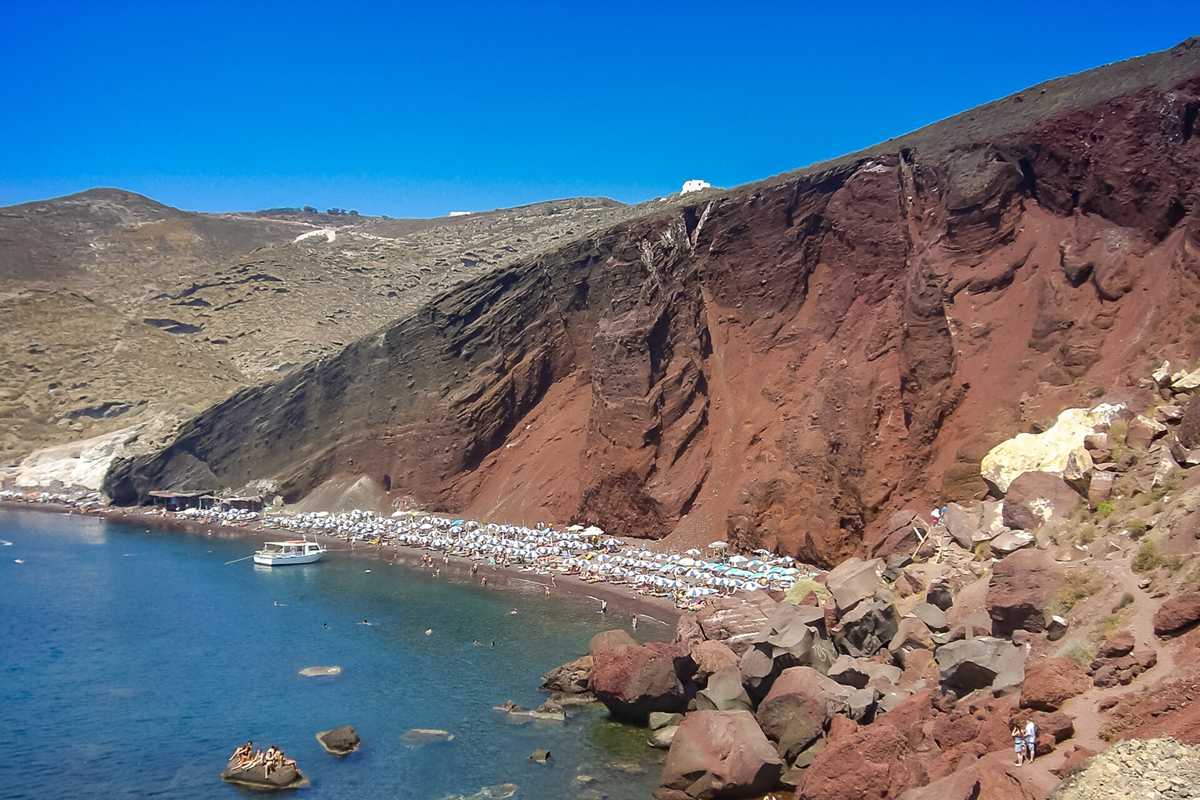
Featured photo: dronepicr, CC BY 2.0, via Wikimedia Commons (File:Red Beach Strand Santorin (23719830069).jpg).