
Greece weather in August sets the scene for expert-led day trips and small-group outings across Greece. They run in Athens, Crete, Rhodes, Santorini and Meteora. Station figures here come from Athens, Lamia, Argostoli and Lindos. The meltemi wind and three church dates follow: the Transfiguration, the Paraklesis evenings and Saint Phanourios. Related pages cover the best time to visit Greece, Greece weather in September and the best Greek islands. More trips sit among the site’s Greece tours.
Bookings made through the GetYourGuide widgets on this page earn Classical Greece Tours a commission, at no extra cost to the traveller.
What is Greece weather in August like?
Greece weather in August, in the Csa climate zone, brings sunny, dry days more than any other pattern. Csa is the Köppen code for a Mediterranean climate with a hot summer. The Köppen scheme sorts the world’s climates by temperature and rainfall.
Within that zone, Greece weather in August keeps the air hot through the day. After dark, the air turns pleasantly warm. Rain, when it comes, arrives as showers or thunderstorms out of cumuliform clouds. Cumuliform clouds are heaped, puffy clouds that grow upwards as warm air rises. A thunderstorm is a storm with thunder and lightning.
Summer also brings very windy days, above all on the Cyclades and in the waters around them. The Cyclades make up an Aegean island group, and the Aegean lies between Greece and Turkey. On the coast, a cooler sea and the sea breeze hold temperatures down. A sea breeze is air that blows from the water onto the shore.
Summer average highs reach their peak for Greece in Skala, Messenia, and in the Evrotas Valley. An average high takes the top temperature of every day and averages it over the period. Messenia covers the south-western corner of the Peloponnese. The Evrotas is a river of the southern Peloponnese, the large peninsula of southern Greece.
- Thessaloniki: The Aristotle University station, 32 m above sea level, averages an August daily maximum of 32.3 °C.
- Kaimaktsalan Ski Center: At 2090 m, Greece weather in August gives a daily maximum averaging 16.6 °C.
- Xerokampos: The station sits 8 m above the sea and averages an August daily minimum of 26.0 °C.
The Sparta station lies in the south of the Peloponnese. For Greece weather in August, its average daily maximum reaches 36.0 °C. A weather station is a fixed site whose instruments record temperature, rain, wind and sunshine.
How does the meltemi shape Greece weather in August?
Greece weather in August feels the etesians, also called meltemia, which stand among the best-known winds of Greece. They return each year, blowing from about mid-way through the fifth month until mid-September. Meltemi is the singular modern Greek name; etesians is ancient Greek.
Across Greece weather in August, the meltemi blows hardest in the afternoon and frequently fades at night. Sometimes the pattern breaks, and the etesians blow for days without a pause. Periodic winds is the meaning of etesiai, the ancient Greek form of the name. A periodic wind is one that returns in the same season each year.
For Greece weather in August, the direction of the etesians is not fixed. Local topography sets it anywhere in the arc between north-east and north-west. Topography means the shape of the land, such as mountains, valleys, capes and channels between islands. A north-east wind blows from the north-east towards the south-west.
The etesians hold Aegean temperatures below the levels of the Ionian Sea or the mainland. They also keep the daily swing in the Aegean smaller. A daily swing is the gap between the warmest and coolest reading of one day. West of Greece, the Ionian Sea stretches between the Greek mainland and southern Italy.
- Northern Aegean: Here the etesians arrive from the north-east or from due north.
- Southern seas: Across the southern Aegean and the Cretan and Carpathian seas, they turn into north-westerlies.
- Cyprus: In Cyprus, these winds come in as westerlies or south-westerlies and hold more humidity.
For Greece weather in August, the northerly etesians temper the region’s summer heat. That heat at times turns fierce. To temper something is to soften it and make it milder. A northerly wind is one that comes from the north.
Which readings does Athens give for Greece weather in August?
Greece weather in August in downtown Athens reaches an average daily maximum of 34.3 °C. That figure comes from the downtown station’s 1991 to 2020 normals. Normals are thirty-year averages that climate scientists use as the standard picture of a place.
At the downtown station, Greece weather in August brings an average daily minimum of 24.4 °C. A daily minimum is each day’s lowest temperature, averaged over the month. The station’s extremes go back to 1890. Its highest August reading on record stands at 43.9 °C. That record is the single warmest moment the station has measured.
At the downtown Athens station, Greece weather in August gives an average relative humidity of 47%. Relative humidity compares the water vapour in the air with the greatest amount it can hold. Water vapour is the invisible, gas form of water. Lower figures mean drier air at the same temperature.
The urban heat island effect gives other parts of the Athens agglomeration higher mean annual temperatures. An agglomeration is one large built-up area made of a city and its suburbs. Under that effect, a built-up zone stays warmer than the open land around it. In the north, Kifissia has moderately lower temperatures because it stands higher.
- Elliniko daily maximum: The coastal Elliniko station in southern Athens averages a daily maximum of 32.2 °C in August.
- Elliniko sunshine: The same station logs 341.0 hours of sunshine in an average August.
- Elliniko rain days: Rain falls on 1.6 days in an average August at this coastal site.
For Greece weather in August, the downtown Athens station averages 5.4 mm of rainfall across the month. A millimetre of rain is the depth of water left on flat ground when none drains away. Athens is the capital of Greece.
How does Greece weather in August play out at Lamia airport?
Greece weather in August at the Lamia airport station gives an average daily maximum of 33.4 °C. Lamia is a city of central Greece. A set of weather instruments placed at an airfield is called an airport station.
Lamia stands on the flanks of Mount Othrys, with the river Spercheios nearby. Othrys and the Spercheios are a mountain and a river of central Greece. Lamia’s climate falls in the Csa class, the hot-summer Mediterranean group. In that code, C marks a mild winter and s marks a dry summer. The letter a marks a hot summer.
Greece weather in August falls inside Lamia’s warm, moderately dry period. That period runs from mid-April to late October. Moderately dry describes a season with light rain rather than none at all. In climate terms, a dry period is a stretch of months with low rainfall. Rainfall is the amount of rain that falls in a set time.
Lamia’s highest temperature on record is 46.5 °C, set during the summer of 1973. The airport station stands 143.4 m above sea level. For Greece weather in August, its record high is 45.4 °C. An August record high marks the hottest single reading the station has logged in that month.
- Rainfall: The Lamia airport station collects an average of 21.3 mm of rain in August.
- Rainy days: The station counts 3.9 rainy days in an average August.
- Sunshine: Bright sunshine adds up to 278.3 hours across an average August at the airport.
For Greece weather in August, the Lamia airport station averages a daily minimum of 18.8 °C. Each daily minimum is the coolest reading of a full day and night. Central Greece is the region between Thessaly and the Gulf of Corinth.
What does Argostoli on Cephalonia add to Greece weather in August?
Greece weather in August at the Argostoli station on Cephalonia averages a 29.9 °C daily maximum. The figure rests on data from 1981 to 2010. Argostoli is the main town of Cephalonia, the island also spelt Kefalonia, in the Ionian Sea.
Summers on Cephalonia are hot and sunny, and its winters are mild and rainy. Under the Köppen scheme, the island’s climate is hot-summer Mediterranean, labelled Csa. Greece weather in August belongs to the island’s hot, sunny summer season. Mediterranean here names the climate type of lands around the Mediterranean Sea.
Summer temperatures on Cephalonia range from nearly 30 °C by day to around 21 °C at night. Celsius is the temperature scale used across Greece, on which pure water freezes at zero degrees. Nearly means just under the figure, and around means close to it on either side.
In the early 20th century, the Greek royal family sent its children to Lixouri for the summer. Lixouri is a town on the western side of Cephalonia. Cephalonia is a well-liked holiday spot for Italians, thanks to its closeness to Italy. A holiday spot is a place where people travel for rest and leisure.
- Daily mean: The Argostoli station gives Greece weather in August a daily mean of 25.7 °C.
- Night low: The average August daily minimum at Argostoli comes to 21.6 °C.
- Rainfall: Argostoli records an average of 5.6 mm of August rain.
Greece weather in August on Cephalonia falls in summer months that bring little to no rainfall. Cephalonia is one of the Ionian Islands, the chain of Greek islands off the west coast. The phrase little to no means a small amount or none at all.
How hot is Greece weather in August at Lindos on Rhodes?
Greece weather in August at the Lindos station peaks at a mean daily maximum of 35.0 °C. Its instruments sit 65 m above sea level. The Dodecanese are the island group of the south-east Aegean, and Rhodes is one of them.
Lindos is at once a fishing village, an archaeological site and a former municipality of Rhodes. It sits on the eastern shore of Rhodes. Archaeologists study the remains of past human life at such a site. A municipality means a town or district run by its own local council.
Greece weather in August at Lindos belongs to a Csa climate, the hot-summer Mediterranean type. The Mediterranean Sea strongly influences that climate. The Mediterranean is the sea that lies between southern Europe, North Africa and western Asia. An influence of this kind means the water shapes the temperature and moisture of the air on shore.
Lindos has mild winters, while its summers run particularly hot and dry. Rain at Lindos falls mostly in the winter. That dry summer season is the setting for Greece weather in August on the island’s east coast. A mild winter is one without hard frost or lasting cold. Dry means low rainfall.
- Day and night average: The Lindos station gives an August daily mean of 31.4 °C.
- Daily minimum: Its August daily minimum averages 27.8 °C across the month.
- Record low: The coldest August reading on record at the Lindos station is 24.0 °C.
For Greece weather in August, the Lindos station holds a record high of 43.1 °C. Rhodes lies in the south-east Aegean, close to the coast of Turkey. A record high of this kind stands until a hotter reading replaces it.
Which feast marks the sixth day of Greece weather in August?
Greece weather in August shares its sixth day with the Feast of the Transfiguration. Eastern Orthodox churches on the Revised Julian calendar keep the feast on 6 August. The Transfiguration is the Gospel scene in which Jesus shone with light on a mountain.
Orthodox churches on the older Julian calendar keep it on a different day. Their 6 August falls on 19 August in the Gregorian calendar. The Gregorian calendar is the everyday civil calendar. The Revised Julian calendar is a reformed church calendar that keeps Gregorian dates. The Transfiguration ranks among the twelve Great Feasts of Orthodoxy.
If 6 August falls on a Sunday, the feast’s liturgy is not combined with the Sunday liturgy. It replaces the Sunday service completely. A liturgy is the fixed order of prayers, readings and hymns for a church service. A feast here is a church holiday, and this one comes early in Greece weather in August.
The origins of the feast are not fully certain. One account links its beginnings to three basilicas dedicated on Mount Tabor. A basilica is a large church built on a long hall plan. Mount Tabor is a hill in Galilee. By the 9th century, the feast existed in a range of forms.
- All-Night Vigil: The feast opens on its eve with a vigil, a service of prayer through the night.
- Grapes: Worshippers carry grapes into church, where they are blessed once the Divine Liturgy ends.
- Other fruit: Where grapes are not available during Greece weather in August, apples or other fruit go instead.
For the church year, the grape blessing during Greece weather in August begins the Blessing of First Fruits. First fruits are the earliest crops of a harvest, offered with thanks. A blessing is a prayer that asks for holiness on a person or thing.
When is the Paraklesis sung during Greece weather in August?
Greece weather in August runs alongside the Dormition Fast, from 1 to 14 August. In that fortnight, the Typikon sets the Small and Great Paraklesis on alternate evenings. The Typikon is the rule book that orders Orthodox church services through the year.
A Paraklesis, or Supplicatory Canon, is a Byzantine Rite service. It is a supplication for the welfare of the living. Supplication means asking humbly for help. The service is addressed to a specific saint or to the Theotokos. Theotokos, a Greek title, names Mary, the mother of Jesus. The Byzantine Rite is the Orthodox way of worship.
In each Paraklesis of Greece weather in August, the supplicatory canon is chanted with psalms, hymns and litanies. A canon in Orthodox worship is a long hymn in linked sections called odes. Psalms are the sung prayers of the Book of Psalms in the Bible. A litany is a series of short prayers, each answered by the people.
Theosterictus the Monk composed the Small Paraklesis in the 9th century. Monks are men who live under religious vows, apart from ordinary life. Emperor Theodore II Laskaris composed the Great Paraklesis in the 13th century. An emperor rules over an empire. To compose means to write a piece of music or verse.
- Rest of the year: During the larger share of the year, only the Small Paraklesis to the Theotokos is chanted.
- Widest following: The Paraklesis with the widest following addresses its canon and hymns to the Theotokos.
- Transfiguration eve: On the night of 5 August, early in Greece weather in August, the Paraklesis is left out.
When Greece weather in August opens on a weekday, the cycle starts with the Small Paraklesis. A weekday here means any day from Monday to Friday, outside the weekend. Here a cycle means a sequence that comes round again in set order.
Who is Saint Phanourios, honoured late in Greece weather in August?
Greece weather in August includes the feast of Saint Phanourios. Eastern Orthodox and Roman Catholic churches alike venerate Phanourios as a saint. To venerate is to show deep respect and honour. A saint is a person honoured for a holy life.
He is commemorated on 27 August, late in Greece weather in August. A commemoration is a yearly day of remembrance in the church calendar. Everything known about Phanourios comes from icons found on Rhodes in the 16th century. Icons are holy pictures, painted on wood, that serve in Orthodox worship.
Orthodox tradition knows Phanourios for finding people’s lost belongings after fervent prayer. Fervent means deeply felt and full of strong feeling. Belongings are the things a person owns, such as keys, papers or a wallet. A fixed feast like his returns on the same date with Greece weather in August each year.
When the icon came to light, the Bishop of Rhodes was called to the scene. He pronounced Phanourios a saint. Bishops are senior clergy, each in charge of a church region. His veneration later spread to Cyprus, and then to Greece. Cyprus is an island in the eastern Mediterranean, south of Turkey.
- Name: Phanourios means the revealer, one who brings hidden things into view.
- Soldier: His icons show a soldier who lived on the island of Rhodes.
- Dragon: The Cretan artist Angelos Akotantos painted icons of him, repeatedly showing him killing a dragon.
On his feast day in Greece weather in August, a Greek lenten cake called Fanouropita is baked. Lenten food leaves out meat, eggs and milk, following the rules of a church fast. The name joins the saint’s name with pita, Greek for pie or cake.
What do travellers ask about Greece weather in August, and what are the answers?
The Greece weather in August record draws on stations in Florina, Theodoriana, Sparta, Thessaloniki, Kaimaktsalan and Ioannina. Their tables record rain, record heat and sunshine for the month. The month also holds the Dormition, the feast of Mary’s death, on 15 August.
Where does Greece weather in August still bring rain?
The Florina station, with data from 1961 to 2010, averages 30.6 mm of August precipitation. Precipitation falls there on 5.3 days in an average August. Precipitation means any water that falls from the sky. The Theodoriana station, 962 m above sea level, averages 42.8 mm for the month.
How high have Greece weather in August records climbed?
The Sparta station holds an August record high of 45.7 °C. In Thessaloniki, the Aristotle University station keeps extremes back to 1930. Its hottest August reading on record is 41.6 °C. The Kaimaktsalan Ski Center station has an August record high of 24.6 °C. Kaimaktsalan is a mountain in northern Greece.
How much sunshine comes with Greece weather in August?
The Ioannina station, 475 m above sea level, logs 296.0 sunshine hours in an average August. Ioannina, capital of the Epirus region, sits in north-western Greece. Over a whole year, mountain areas of Epirus get under 1,600 sunshine hours. In South Crete, the yearly total climbs past 3,250 hours.
Alongside Greece weather in August, why does 15 August matter?
Emperor Maurice reigned from 582 to 602. His edict set the Dormition feast on 15 August. An edict is a decree, an order with the force of law. Churches on the Julian calendar mark it on 28 August by the modern Gregorian calendar. Fragrant herbs receive a blessing on the feast day in certain places.
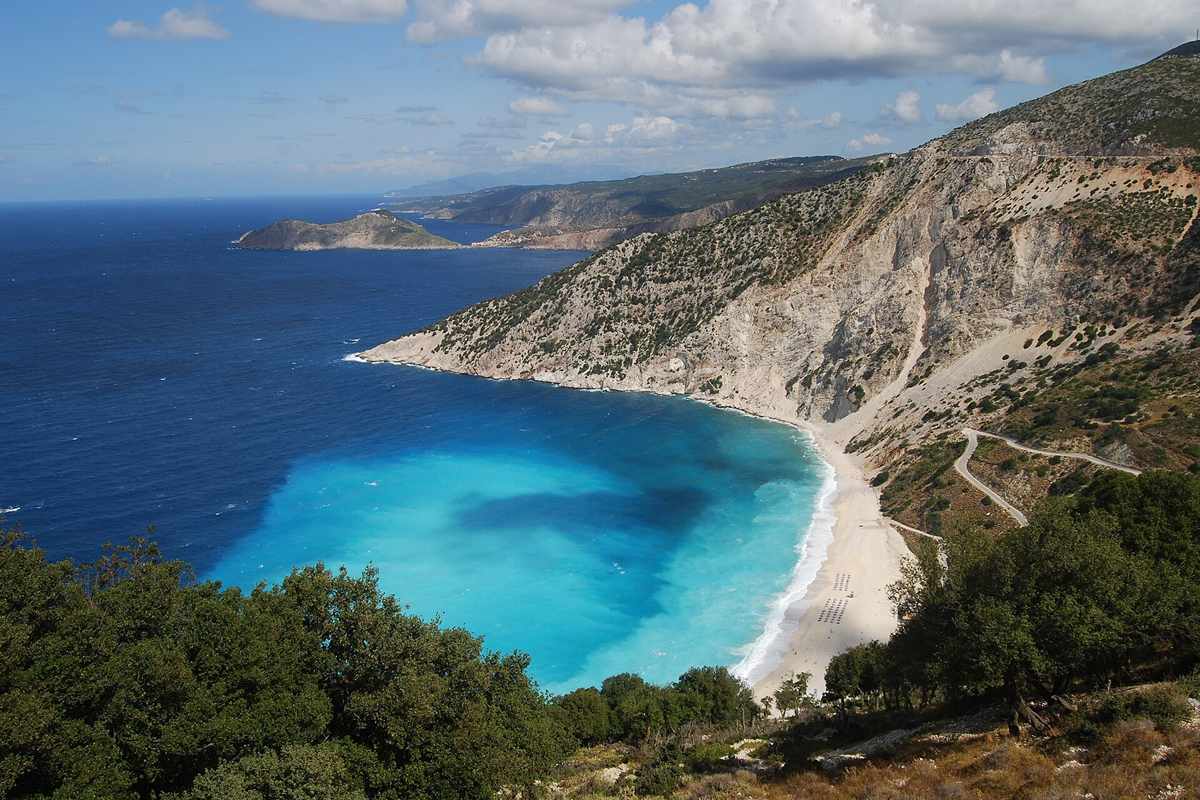
Featured photo: Matt Sims, CC BY 2.0, via Wikimedia Commons (File:Myrtos Beach, Kefalonia.jpg).