
Greece and Turkey tours are trips through two neighbours on either side of the Aegean Sea. Greek cities once stood on both shores. The sections cover Ionia, Ephesus, Miletus, Priene, Didyma, Smyrna and Cyme, then Troy, Pergamon, Halicarnassus and Xanthos. They also cover Samos, Chios, Lesbos, Kos, Rhodes and Kastellorizo, plus Hagia Sophia and the Bosphorus. Related trips include Greek island cruises, the Footsteps of Paul tour and other Greece tour packages. The wider range sits under Greece tours.
Bookings made through the GetYourGuide widgets on this page earn Classical Greece Tours a commission, at no extra cost to the traveller.
What are Greece and Turkey tours?
Greece and Turkey tours are trips through both countries, and their shared Greek past runs through Ionia. That ancient region covered the central part of the western coast of Anatolia, the Asian side of Turkey. Greeks settled it around the 11th century BC.
Ionia took its name from the Ionians, Greek settlers who arrived before the archaic period. That term covers the early age of Greek city-states, before the classical age. Ionia proper was a thin strip of coast from Phocaea in the north to Miletus in the south. The islands of Chios and Samos also belonged to it.
For Greece and Turkey tours, Ionia’s core was a group of twelve cities. They formed the Ionian League, a union of worship and culture rather than of politics or war. Its members shared a sanctuary and festival at the Panionion. Sanctuary here names a plot of land held sacred to a god.
Across the lands of Greece and Turkey tours, Greeks lived in Ionia through Roman, Byzantine and Ottoman rule. They left in 1922, in events that ended with the population exchange between Turkey and Greece. Refugees from Ionia settled the suburbs of Nea Ionia and Nea Smyrni. The names mean New Ionia and New Smyrna.
- Size: Ionia measured no more than 150 kilometres from north to south.
- Shore: Its coast twists so much that a voyage along it measured nearly four times the direct distance.
- Ancestor: Ancient Greeks believed the Ionians came from Ion, a son or grandson of Hellen, the Greeks’ mythical ancestor.
The Persian word for Greek, Younan, comes from the name Ionia. Arabic, Turkish and Urdu later adopted that word. The historian Herodotus wrote that no region in the whole world had fairer weather. For Greece and Turkey tours, Ionia’s neighbours were Aeolia, Lydia and Caria.
Which Athenian legend ties Ephesus to Greece and Turkey tours?
Greece and Turkey tours connect with Ephesus, an ancient Greek city of Ionia in present-day Selçuk, İzmir Province. Greek colonists from Attica and Ionia built it in the 10th century BC. The site had been Apasa, capital of a kingdom called Arzawa.
For Greece and Turkey tours, legend names Androklos, a prince of Athens, as founder of Ephesus. He left home after the death of his father, King Kodros. The oracle at Delphi gave him a sign: a fish and a boar to point the way. That oracle was a holy site where Greeks sought answers from a god.
In Ephesus, the Greek goddess Artemis and the great Anatolian goddess Kybele became one figure. People called her Artemis of Ephesus. Her temple was finished around 550 BC. It has a place on the old list of Seven Wonders. That list named seven famous buildings and statues of ancient times.
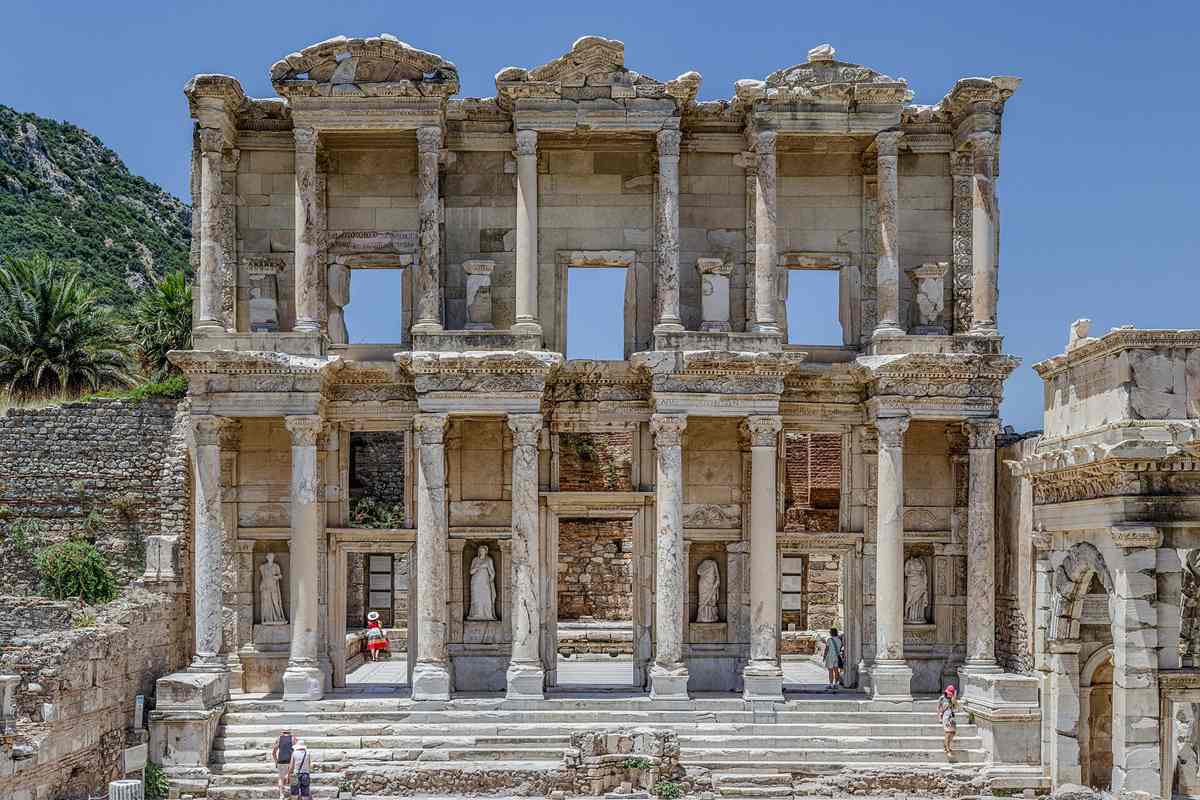
Greece and Turkey tours span two countries, and the Celsus library lies in the Turkish one. The library honours a Greek governor of Roman Asia, Tiberius Julius Celsus Polemaeanus. Roman Asia was a Roman province whose capital was Ephesus. The library held nearly 12,000 scrolls. Its front faces east, so the reading rooms caught the morning light.
- Theatre: The theatre of Ephesus held up to 24,000 spectators in its day.
- Harbour: Silt from the Küçükmenderes River slowly filled the harbour, and trade at Ephesus declined.
- Heritage: UNESCO named the ruins of Ephesus a World Heritage Site in 2015.
In the shared past behind Greece and Turkey tours, the town beside the ruins was Ayasuluğ. The name is a worn form of the original Greek one. It became Selçuk in 1914. Found there in 1954, a Mycenaean Greek burial ground dates from 1500 to 1400 BC.
How does Miletus, home of early Greek science, fit Greece and Turkey tours?
Greece and Turkey tours reach back to Miletus, an influential ancient Greek city. It stood near the mouth of the Maeander River, in present-day Turkey. The city was home to the Milesian school of Thales, Anaximander and Anaximenes, early Greek thinkers.
Miletus served as a Mycenaean stronghold on the coast of Asia Minor from about 1450 to 1100 BC. Within Greece and Turkey tours, Mycenaean means the Bronze Age culture of early Greece. Linear B records at Pylos list female slaves called mi-ra-ti-ja, Mycenaean Greek for women from Miletus. Linear B uses one sign per syllable.
For Greece and Turkey tours, Miletus is the city of Thales. Aristotle wrote that Thales named water as the base of all things. Thales also held that the earth rests on water. His student Anaximander proposed the apeiron as a more abstract origin of existence. Apeiron is Greek for the infinite or indefinite.
Pliny the Elder, a Roman writer, said Miletus founded over 90 colonies. Each colony was a fresh town whose settlers came from a parent city. Around the Black Sea, Milesian towns such as Sinope, Olbia and Panticapaeum grew into busy trading hubs. Milesian means from Miletus. Greeks and local peoples exchanged goods there.
- Market Gate: The Market Gate of Miletus now stands in the Pergamon Museum in Berlin.
- Coastline: Silt and soil loss left the ruins about 10 kilometres from the sea.
- Founding tale: An old tradition says settlers from Crete first built and walled Miletus above the sea.
In the story of Greece and Turkey tours, the main finds from Miletus rest in Didim, Aydın. The Miletus Museum there has held them since 1973. In antiquity, Miletus shared a large bay with Priene and Myus, two more Ionian cities.
What makes Priene, a planned Ionian town, matter for Greece and Turkey tours?
Greece and Turkey tours touch on Priene, a Greek city of Ionia below a cliff of Mount Mycale. A colony from the Greek city of Thebes founded it around 1000 BCE. Its ruins lie west of Güllübahçe in Aydın Province, Turkey.
Around 350 BCE, the satrap Mausolus planned a new Priene on the steep slopes of Mycale. Satrap was the Persian title for a provincial governor. Alexander the Great later offered to fund the Temple of Athena, designed by the architect Pytheos. Within Greece and Turkey tours, Alexander’s dedication of the temple dates to 323 BCE.
That dedication survives in stone at the British Museum. It records that King Alexander gave the temple to Athena Polias. Polias marks Athena as goddess of the city. Builders used marble from quarries on Mycale, with wood for roofs and floors. The water supply and sewer channels of the city still survive.
For Greece and Turkey tours, Priene was a small city-state of 6000 people in only 15 hectares. One hectare covers ten thousand square metres. River silt cut Priene off from the open sea by about the 1st century BCE. Today the ruins stand at the edge of a fertile plain of private fields.
- Model city: Alexander and Mausolus meant Priene to be a model city.
- Districts: The town had political, cultural, commercial and religious districts, each with its own buildings.
- Exchange: By 1923, the remaining Greek residents had to leave under the Greece-Turkey population exchange.
Priene’s later names reflect the two languages behind Greece and Turkey tours today. In the 13th century CE, Greek speakers called the town Sampson, after the biblical hero Samson. In Turkish it became Samsun Kale, meaning Samson’s Castle.
Which oracle of Apollo links Didyma with Greece and Turkey tours?
Greece and Turkey tours link to Didyma, a Greek sanctuary in the lands of Miletus. Apollo was its main god, and his famous oracle spoke inside his temple. An oracle was a holy voice that answered questions in a god’s name.
In Greek, didyma means twins. Carians, the people of Caria, lived in the area first. Ionian Greeks then settled at Didyma around 1000 BC. Greek and Roman writers tied the name to twin temples or to the twins Apollo and Artemis. The modern town of Didim, in Aydın Province, Turkey, takes its name from the ruins.
For Greece and Turkey tours, Didyma’s Sacred Way ran about 20 kilometres from Miletus. Builders laid it in the 6th century BC for festival processions, which were religious parades. Statues of noblemen, noblewomen and beasts lined the route. The Branchidae, a priestly family, ran the sanctuary until the Persians destroyed it in 494 BC.
Once free of Persian rule, the Milesians began a new temple for Apollo. Only the temples of Hera on Samos and Artemis at Ephesus were larger in the Hellenic world. Within Greece and Turkey tours, Hellenic means Greek. A double row of Ionic columns ringed the temple. Ionic columns carry scroll shapes at the top.
- Inner court: The court held the oracle spring, a sacred laurel tree and a small temple called the naiskos.
- Festival: The Didymeia festival later opened to all Greeks and took place every four years.
- Emperor: The Roman emperor Hadrian visited in 129 AD and served as Prophet, the top sanctuary office.
Greece and Turkey tours span both languages here: Byzantine Greeks called Didyma Hieronda, and Turks call it Yoran. Hieronda comes from hieron, the Greek word for a sanctuary. An earthquake in 1493 ruined the temple and emptied the village. About 300 years later, Greeks resettled it.
Which Greek past does Smyrna, now İzmir, bring to Greece and Turkey tours?
Greece and Turkey tours deal with a city once called Smyrna, officially İzmir since 1930. The ancient Greek city stood at a key point on the Aegean coast of Anatolia. Its good port, easy defence and inland roads lifted it to prominence.
Old Smyrna began around the 11th century BC as an Aeolian settlement. Aeolians were Greeks who settled the coast north of Ionia. Ionians later took over the town and developed it in the archaic period. Its site, Bayraklı Höyüğü, now lies about 700 metres inland. Höyük is Turkish for an artificial mound.
Homer’s Smyrna now lies in Turkey, one of the two lands of Greece and Turkey tours. A steady tradition ties Homer, the Greek epic poet, to the valley of Smyrna and the Meles River. Coins of Smyrna showed his figure, and coin experts call one class Homerian. His temple, the Homereum, stood on the river’s banks.
Alexander the Great inspired a new Smyrna in the 4th century BC. For Greece and Turkey tours, the hill the Greeks called Pagos is now Kadifekale. Its chief street, known as the Golden, crossed the town from west to east. Smyrna also founded a cult of Rome, so the Smyrneans count as creators of the goddess Roma.
- Agora: The İzmir Agora Open Air Museum preserves the core of late Hellenistic and early Roman Smyrna.
- Rival cities: Under Rome, Smyrna competed with Ephesus and Pergamum for the title First City of Asia.
- Rebuilding: After an earthquake in 178 AD, Smyrna rose again under the emperor Marcus Aurelius.
Across Greece and Turkey tours, Smyrna’s gulf let Greek ships sail deep into Lydia. Lydia was a kingdom east of Ionia. Its trade route linked Anatolia with the Aegean. Once the harbours of Miletus and Ephesus silted up, Smyrna had no rival.
How did Phocaea’s sailors shape the Greek story of Greece and Turkey tours?
Greece and Turkey tours look back to Phocaea, now Foça in Turkey. It was an Ionian Greek city on the western coast of Anatolia. Its colonists founded Massalia, today Marseille in France, in 600 BC. It was the northernmost Ionian city, bordering Aeolis.
The ancient Greek geographer Pausanias says Phocians under Athenian leaders founded Phocaea. They settled on land given by the Aeolian people of Cyme. They entered the Ionian League after accepting kings from the line of Codrus. Codrus was a king of Athens in legend. Pottery shows Aeolian people there until the 9th century BC.
Herodotus wrote that the Phocaeans were the first Greeks to sail on long sea journeys. They reached the coasts of the Adriatic and Spain. Arganthonios, king of Tartessus in Spain, invited them to settle there. When they declined, he gave them money for a wall around their city. Phocaea had two natural harbours, each with small islands.
Phocaean colonists founded Emporion, now Empúries in Catalonia, Spain, in 575 BC. They founded Elea, now Velia in Campania, Italy, in 540 BC. In 494 BC, Dionysius of Phocaea commanded the Ionian fleet at the Battle of Lade. Phocaea sent only three ships. Within Greece and Turkey tours, Lade was a small island off Miletus.
- Coins: Phocaea’s earliest coins were made of electrum, a natural blend of silver and gold.
- Seal: The British Museum holds a Phocaean coin showing a seal, the sea animal, from 600 to 550 BC.
- River: In Greece and Turkey tours, the Hermus near Phocaea goes by its modern name, Gediz.
For Greece and Turkey tours, the Phocaeans once abandoned their city rather than accept Persian rule. Later, Benedetto Zaccaria of Genoa held the town as a lordship passed down in his family. It stayed a Genoese colony until the Turks took it in 1455.
Which olive oil story links Clazomenae to Greece and Turkey tours?
Greece and Turkey tours share a past with Clazomenae, one of the twelve cities of ancient Ionia. Its ruins lie in the modern town of Urla near İzmir, Turkey. In Greek, Urla is Vourla. It was among the first cities to issue silver coins.
Clazomenae arose after the Ionians reached Asia. Its founders came largely from Phlius and Cleonae, two Greek cities. The town first stood on the mainland at Limantepe. Around the early 5th century BC, it moved to Karantina Island off the coast. Alexander the Great later joined the island to the mainland by a causeway, a raised road.
For Greece and Turkey tours, a silver coin of Clazomenae shows Apollo, the city’s main god. Large numbers of swans lived there, and the verb klazo is thought to name their call. The swan on the coin is a pun on the city’s name. Such wordplay is called a pun.
Within Greece and Turkey tours, Clazomenae was known for olive oil and painted terracotta coffins. Terracotta is baked clay. Around 350 BC, the city ran short of grain and funds. Its rulers asked citizens with stored olive oil to lend it to the city at interest. They hired ships and bought wheat on the security of the oil’s value.
- Philosopher: The thinker Anaxagoras, who lived from about 510 to 428 BC, was born in Clazomenae.
- Olympic winner: Herodotos of Clazomenae won the boys’ foot-race, his city’s first Olympic victory.
- Olive press: A 6th-century BC olive press here is the only surviving lever-and-weights press from a Greek city.
Across Greece and Turkey tours, a painted clay coffin and lid found near Clazomenae weigh about 2 tonnes. It dates to about 500 BC and now sits in the British Museum. In 431, its bishop Eusebius sat at the Council of Ephesus.
Where does Teos, the city of Anacreon, sit in Greece and Turkey tours?
Greece and Turkey tours hold a Greek chapter in Teos, a city on an Ionian peninsula. Minyans from Orchomenus, joined by Ionians and Boeotians, founded it. Its ruins lie south of Sığacık, within Seferihisar district, İzmir Province, Turkey.
Pausanias names Athamas, a descendant of Athamas son of Aeolus, as the founders’ leader. More colonists later came from Athens and Boeotia. After that founder, the poet Anacreon also called the city Athamantis. Teos belonged to the Lydian group of the Ionian League, one of four groups by dialect. A dialect is the way one region speaks a language.
Teos was a busy seaport with two fine harbours until the Persian king Cyrus invaded Ionia. A ruler named Antigonus Cyclops later revived the port. A shipwreck near Tektaş, a small rock by the harbour, dates from the 6th to 4th centuries BC. It points to sea trade with the eastern Aegean islands.
For Greece and Turkey tours, Roman-era Teos was known for wine, a theatre and a Temple of Dionysus. In Greek belief, Dionysus was lord of wine and the stage. Hermogenes of Priene designed that temple, according to the Roman writer Vitruvius. Ploughing on the farmed site has brought ancient pottery to the surface.
- Poet: Teos, a Greek name in Greece and Turkey tours, was home to the poet Anacreon.
- Epicurus: The philosopher Epicurus is said to have spent his youth in Teos, studying under Nausiphanes.
- Inscription: In 2016, a rental agreement carved into stone came to light in the ruins.
Across Greece and Turkey tours, Teos also held the base of a major Hellenistic theatre guild. It was the Synod of the Dionysiac Artists of Ionia and the Hellespont, founded around 250 BC. Its headquarters later moved to Ephesus, Myonnesus and Lebedus.
What does Erythrae, facing Chios, add to Greece and Turkey tours?
Greece and Turkey tours relate to Erythrae, one of the twelve Ionian cities of Asia Minor. It stood on a small peninsula directly opposite the island of Chios. Its ruins lie north of Ildırı, a town of Çeşme district in İzmir Province.
For Greece and Turkey tours, Pausanias names Erythrus, son of Rhadamanthus, as founder. Erythrus led Cretans, Carians and Lycians. Later, Knopos, a son of Codrus, came with an Ionian colony. For that reason the city was sometimes called Cnopopolis, the city of Knopos. The town lay a little inland, with a harbour on the coast named Cissus.
Erythrae was the seat of the Erythraean Sibyl. A sibyl was a woman who spoke prophecies. The city was the birthplace of two sibyls. Strabo places one, Sibylla, in the city’s early period. The other, Athenais, was a contemporary of Alexander the Great. The Erythraean Sibyl presided over the oracle of Apollo.
Erythrae was never large; its fleet at the Battle of Lade had only eight ships. In 334 BC, Alexander the Great restored its freedom. He planned a canal through the peninsula to link the bay of Teos with the gulf of Smyrna. A canal here means a waterway cut through dry land for ships.
- Exports: Roman-era Erythrae, a name in Greece and Turkey tours, was known for wine, goats, timber and millstones.
- Athena: Its temple of Athena held a huge wooden seated statue with a spinning tool in each hand.
- Walls: Well-kept Hellenistic walls survive, and five of their towers still stand.
Within Greece and Turkey tours, the later port called Litri traded with Chios and Smyrna. That trade ran from the mid-18th to the early 20th century. Epitherses of Erythrae won two Olympic boxing prizes, and his city set up his statue at Olympia.
Why does Cyme, the leading Aeolian city, count for Greece and Turkey tours?
Greece and Turkey tours look north of Ionia to Cyme, an Aeolian city near Lydia. The Aeolians saw it as the largest and leading city of their twelve on the Asia Minor coast. Aeolians were Greek settlers of that coast.
Across Greece and Turkey tours, legend names the Amazon Kyme as founder of the city. The mythical Amazons were warrior women from Pontos who fought Greek heroes. Another account says Greeks from Locris, in central Greece, founded it after the Trojan War. They first took Larisa, a Pelasgian stronghold near the river Hermus.
For Greece and Turkey tours, Cyme’s old dialect resembled the speech of Thessaly and Boeotia in mainland Greece. Cyme grew into a regional centre and founded about thirty towns in Aeolis. Later writers mocked the Cymeans for never charging harbour taxes in three hundred years. The Philogelos, an old Greek joke book, also teased the people of Cyme.
The father of Hesiod, the Greek poet, is said to have set out across the Aegean from Cyme. The historian Ephorus, who lived from 400 to 330 BCE, was a native of Cyme. Tradition says a daughter of Agamemnon, king of Cyme, married Midas, a king of Phrygia. Phrygia was a kingdom in central Anatolia.
- Persian fleet: After the Battle of Salamis, the rest of the Persian king Xerxes’ fleet wintered at Cyme.
- Alphabet: Phrygian letter shapes stand closest to the inscriptions found in Aeolis.
- Taxes: After the defeat of Antiochus III, Cyme gained freedom from taxation, says Polybius.
Within Greece and Turkey tours, digs at Cyme began in the mid-19th century on the southern necropolis. Necropolis is Greek for city of the dead. In 1925, A. Salaç uncovered a small temple to Isis. The Turkish archaeologist E. Akurgal began his own project in 1955.
Why does Troy stand at the centre of Greece and Turkey tours?
Greece and Turkey tours tie a Turkish site to Greek legend through Troy, also called Ilion. This ancient city stood in present-day Çanakkale, in Turkey. It is best known as the setting of the Greek myth of the Trojan War.
For Greece and Turkey tours, the city’s two Classical Greek names are Troia and Ilion. Those names gave the Iliad, an ancient epic poem, its title. An epic tells the deeds of heroes in a long poem. Nine archaeological layers have been found at the site. Each is a city raised on the ruins of the last.
In the Late Bronze Age, Troy bore the name Wilusa. The city was then a vassal of the Hittite Empire. A vassal is a state that serves a stronger ruler. For Greece and Turkey tours, a clear Greek chapter starts around 700 BC. Greek immigrants then began building at the site and made Troy a major city.
Alexander the Great came to the site in 334 BC. He made sacrifices at tombs linked to Achilles and Patroclus, two heroes of Homer’s poems. Later, a league of cities in the Troad, the land around Troy, ran the yearly Panathenaia festival. The festival took place at the sanctuary of Athena Ilias.
- Market: The festival created a huge market, the panegyris, that drew traders from across the region.
- Museum: The Troy Museum opened in 2018 at Tevfikiye, 800 metres east of the excavation.
- Collection: The museum holds more than 40,000 portable artefacts, and 2000 of them are on display.
In 1998, UNESCO placed Troy on its World Heritage list. That United Nations agency guards places judged to matter to all of humankind. For Greece and Turkey tours, Troy joins Greek myth and Hittite history at one site.
Which two kings named the city that Greece and Turkey tours know as Alexandria Troas?
Greece and Turkey tours gain an ancient Greek city at Alexandria Troas, beside the Aegean Sea. Those waters divide the Greek and Turkish shores. The site stands near the northern tip of the western coast of Turkey. That area was once called the Troad.
For Greece and Turkey tours, Strabo gives the first name of the site: Sigia. Around 306 BC, Antigonus refounded it as Antigonia Troas, a much larger city. To refound means to found a town anew. He moved the people of five other towns into Sigia. One of them was Neandreia, once an influential city.
In 301 BC, Lysimachus changed the name to Alexandria Troas. Greece and Turkey tours link that name to Alexander the Great of Macedon, whose memory it honours. As the chief port of north-west Asia Minor, the city grew rich in Roman times. In old writings, Asia Minor means Anatolia, the land now in Turkey.
Julius Caesar and Constantine both considered making Troas the capital of the Roman Empire. Paul of Tarsus, says the Acts of the Apostles, first sailed for Europe from Alexandria Troas. Troas is also a titular see of the Eastern Orthodox Church under the Ecumenical Patriarchate. A titular see is a bishop’s title tied to an old church seat.
- Walls: The old walls ran about ten kilometres around and had towers at regular intervals.
- Stadium: German archaeologists uncovered a large stadium from about 100 BC at the site.
- Baths: Herodes Atticus endowed a bath and gymnasium complex, known locally as Bal Saray, or Honey Palace.
The Turks came to know the ruins as Eski Stambul, meaning the Old City. The harbour had two large basins, which sand has now almost filled. For Greece and Turkey tours, Alexandria Troas joins Greek, Roman and Turkish chapters in one place.
What ties Assos to Lesbos and Aristotle on Greece and Turkey tours?
Greece and Turkey tours find a direct island link at Assos, an ancient Greek city. Its ruins stand near today’s Behramkale in Turkey. Aeolian colonists from Lesbos founded it between 1000 and 900 BC. The Aeolians formed one branch of the ancient Greek people.
The settlers built a Doric temple to Athena on top of the main crag in 530 BC. The Doric order is a plain Greek column style. Six of the original 38 columns remain. For Greece and Turkey tours, its remains are those of the only Doric order temple in Asia Minor.
Hermias of Atarneus, a student of Plato, ruled Assos, the Troad and Lesbos. Aristotle, the Greek philosopher, came to Assos in 348 BC and married Pythia, the niece of Hermias. He founded an Academy, a school of thinkers, in the city. He made new observations on zoology and biology. Zoology is the study of animals.
For Greece and Turkey tours, Assos is also the birthplace of Cleanthes. He later became head of the Stoic school of philosophy in Athens. Philosophy is careful thinking about truth, life and right action. Assos once offered the only good harbour along 80 kilometres of the coast. That harbour made it important for shipping in the Troad.
- Theatre: A 3rd-century BC theatre near the shore was built for 5,000 spectators.
- Gate: The main gate of the 4th-century BC city wall has towers 14 metres high.
- Lion: Archaeologists uncovered a lion sculpture made about 2,200 years ago at Assos.
Byzantine describes the Eastern Roman realm, whose people spoke Greek. In Byzantine times, the city took the name Makhramion from an officer called Makhram. The modern name Behramkale comes from that name. For Greece and Turkey tours, Assos joined the UNESCO Tentative list in 2017.
What made Pergamon a second Athens for Greece and Turkey tours?
Greece and Turkey tours meet Pergamon, a rich and powerful ancient Greek city in Aeolis. Under the Attalid dynasty, it served as capital of the Kingdom of Pergamon from 281 to 133 BC. The site lies northwest of the modern city of Bergama, in Turkey.
The Attalid kings aimed to make Pergamon a second Athens, a hub of Greek culture and art. They remodelled their acropolis on the Acropolis of Athens. Acropolis means the upper, fortified part of a Greek town. For Greece and Turkey tours, the Library of Pergamon ranked second only to the Library of Alexandria.
Pergamon was a busy centre for making parchment, a writing material made from skin. The word comes from pergamenos, meaning from Pergamon. The great Pergamon Altar carried a frieze of the Gigantomachy. A frieze runs as a carved strip of pictures along a building. The Gigantomachy was the battle between the Olympian gods and the Giants.
The theatre held around 10,000 people in 78 rows of seats. At 36 metres high, it is the steepest of all ancient theatres. For Greece and Turkey tours, Galen, doctor to Emperor Marcus Aurelius, worked for years at the Asclepieion. It was the sanctuary of Asclepius, the god of healing.
- Heir: Attalus III died without an heir in 133 BC and left the whole of Pergamon to Rome.
- Gifts: The Attalids sent gifts to Greek cultural sites such as Delphi, Delos and Athens.
- Heritage: Pergamon joined the World Heritage List of UNESCO in 2014.
For Greece and Turkey tours, the frieze length of 113 metres ranks second among surviving ancient friezes. Only the Parthenon Frieze in Athens is longer. Pergamon was also the northernmost of the seven churches of Asia in the Book of Revelation.
Where do the Dorian roots of Halicarnassus fit into Greece and Turkey tours?
Greece and Turkey tours reach a Dorian Greek colony at Halicarnassus, an ancient city of Caria. It stood on the Gulf of Gökova, now in Bodrum, Turkey. Caria was a region of Anatolia. The Dorians were one of the main peoples of ancient Greece.
Halicarnassus kept a monarchy, or rule by a king. Other Greek city states had mostly dropped their kings long before. Each city state ran its own affairs and its rural hinterland. Its Ionian neighbours rose up against Persian rule. For Greece and Turkey tours, Halicarnassus stands apart again, since it stayed loyal to Persia.
Large Mycenaean tombs have been found at Musgebi, now Ortakent, close to Halicarnassus. Mycenaean refers to the Bronze Age Greek culture named after Mycenae. More than forty burial places from that time have come to light. Carian, a Luwic language, was spoken there alongside Greek. Luwic languages formed a family of old Anatolian tongues.
For Greece and Turkey tours, coins of Halicarnassus showed the heads of Medusa, Athena or Poseidon. The city was an early member of the Doric Hexapolis, a union of six Dorian towns. It was expelled after a citizen, Agasicles, took home a prize tripod instead of dedicating it to Apollo. A tripod stands on three legs.
- Buildings: Mausolus had his workmen raise walls, watchtowers, a theatre in Greek style and a temple of Ares.
- Columns: Pliny says thirty-six Ionic columns surrounded the square inner room of the Mausoleum.
- Steps: Above those columns, a pyramid rose by 24 steps to its top.
Ada of Caria formally adopted Alexander the Great as her son. For Greece and Turkey tours, the city was also home to Dionysius of Halicarnassus. He was a historian and a teacher of rhetoric, the art of persuasive speech.
Which famous Knidians does Knidos add to Greece and Turkey tours?
Greece and Turkey tours gain Knidos, a Hellenic city of high antiquity in modern Turkey. By the fourth century BC, it stood at modern Tekir, opposite Triopion Island. Hellenic means Greek, and high antiquity means a very early date.
Earlier, the city is thought to have stood at modern Datça, half-way along the peninsula. For Greece and Turkey tours, Knidos joined Halicarnassus, Kos, Lindos, Kamiros and Ialyssos in the Dorian Hexapolis. The Triopian headland also held the Temple of Aphrodite at Knidos. A headland is a high point of coast pushing into open water.
The Knidians in the end submitted to Cyrus. Later, Rome let Knidos keep its freedom for help against Antiochus III the Great. For Greece and Turkey tours, Eudoxus the astronomer also counts as a Knidian. An astronomer studies the stars and planets. Ctesias, a writer on Persian history, came from Knidos as well.
Sostratus, the builder of the famous Pharos at Alexandria, was another Knidian. The Pharos was the great lighthouse of that Egyptian city. Artemidorus, a minor figure in Shakespeare’s play Julius Caesar, came from Knidos too. In 451, Bishop Ioannes of Knidos took part in the Council of Chalcedon. A council is a meeting of church leaders.
- Excavation: C. T. Newton carried out excavations at Knidos in 1857 and 1858.
- Battle: A lion tomb nearby is thought to mark Conon’s naval victory at Cnidus in 394 BC.
- Museum: The Knidos Lion now stands under the roof of the Great Court in the British Museum.
For Greece and Turkey tours, the position of Knidos favoured commerce, and its people gained great wealth. Commerce means buying and selling goods across land and sea. Bishop Evander later attended the Second Council of Constantinople in 553.
Why do the rock tombs of Kaunos matter for Greece and Turkey tours?
Greece and Turkey tours touch ancient Caria at Kaunos, which lies just west of modern Dalyan. The Calbys river, now the Dalyan river, once marked the border between Caria and Lycia. Both were regions of ancient Anatolia, the land of modern Turkey.
For Greece and Turkey tours, the city carries two names. Its Carian name was Kbid, but it was commonly known by its Greek name, Kaunos. Myth says it was founded by King Kaunos, a grandson of the god Apollo. In the story, the Calbys river rose from the tears of his twin sister, Byblis.
Later inscriptions show that Kaunos had become a Greek city. None of its citizens bore Carian names. Kaunos joined the Delian League once the Persians pulled back from the western Anatolian coast. Athens led that union of Greek city states. In 425 BC, its tax rose tenfold, a sign of a thriving port.
For Greece and Turkey tours, a bilingual inscription, in both Greek and Carian, came to light in 1996. Such texts helped decipher the Carian alphabets. Under Mausolos, a Persian governor called a satrap, the city was greatly changed. It took on a Greek character, with an agora, or market square, and temples to Greek gods.
- Rock tombs: Six tombs cut into rock by the Dalyan river date from the fourth to second century BC.
- Facades: Their fronts copy Hellenistic temples, with two Ionian pillars and a triangular top called a pediment.
- Painter: Protogenes, a Greek painter of the fourth century BC, came from Kaunos.
For Greece and Turkey tours, Kaunos served both sides as a port in the Peloponnesian War. In that conflict, Athens and Sparta led the two rival camps. In 167 BC, Kaunos and other western Anatolian cities rose against Rhodes.
How does Aphrodisias, the city of Aphrodite, fit Greece and Turkey tours?
Greece and Turkey tours turn to Aphrodite, Greek goddess of love, at Aphrodisias, the city named after her. It was a Hellenistic Greek city in Caria, near the modern village of Geyre. Hellenistic describes Greek culture in the years following Alexander’s death.
Before that name, the city had three earlier Greek names. One of them was Megale Polis, meaning Great City. Sometime before 640, the city was renamed Stauropolis, or City of the Cross. By the 8th century, people called it Caria, after its region. That name later gave rise to Geyre, its modern Turkish name.
Marble sculptures and sculptors from Aphrodisias won fame across the Roman world. The city had notable schools of sculpture and of philosophy. A school here means a group of artists or thinkers who share methods. For Greece and Turkey tours, a local man, Gaius Julius Zoilos, largely paid for the civic building programme.
The stadium had a top capacity of around 30,000 spectators. Its meetings followed the model of Delphi, where artistic contests mattered more than at the Olympic Games. For Greece and Turkey tours, the Bouleuterion, or council house, seated an estimated 1,750 people. A council house was where city leaders met to decide public matters.
- Sebasteion: The Sebasteion was dedicated to Aphrodite, the Divine Augusti, or deified emperors, and the People.
- Inscriptions: Excavators for New York University have recorded upwards of 2000 inscriptions at the site.
- Excavations: Kenan Erim began the ongoing excavations at Aphrodisias in 1962.
In 2017, UNESCO inscribed Aphrodisias on its World Heritage list. For Greece and Turkey tours, the Temple of Aphrodite was the focal point of the town. Later it became a Christian basilica, a large church shaped like a long hall.
What Lycian and Greek layers does Xanthos bring to Greece and Turkey tours?
Greece and Turkey tours add a Lycian city with Greek ties in Xanthos, called Arna in Lycian. The ruins stand near the village of Kınık in Turkey. Xanthos was a centre of culture and commerce for the Lycians, and later for Persians, Greeks and Romans.
The acropolis of Xanthos dates from the 8th century BCE. BCE is another way of writing BC. For Greece and Turkey tours, the Greek historian Strabo called Xanthos the largest city in Lycia. The sanctuary of Leto at Letoon lies 4 kilometres to the south. A sacred road once linked it with the city.
For Greece and Turkey tours, the Nereid Monument at Xanthos directly inspired the Mausoleum at Halicarnassus. Nereids were sea nymphs in Greek myth. The Nereid Monument, the Tomb of Payava and the Harpy Tomb sculptures are now in the British Museum. The Harpy Tomb itself still stands at Xanthos, with copies of its carved panels.
Digs at Xanthos have found inscriptions in both Lycian and Greek. Among them are bilingual texts that help scholars understand Lycian. Bilingual texts give the same words in two languages. The Xanthian Obelisk, also called the Inscribed Pillar, is a trilingual stele. A stele is an upright carved stone slab, and trilingual means in three languages.
- Diocese: Xanthoupolis was a titular diocese, a bishop’s title, under the Ecumenical Patriarchate.
- Bishop: Its last known bishop, Father Ignatios, led the diocese from 1863 to 1884.
- Heritage: UNESCO named Xanthos and nearby Letoon a World Heritage Site in 1988.
Near the River Xanthus, Alexander the Great found an inscribed bronze tablet. It foretold that the Greeks were to destroy the Persian Empire. For Greece and Turkey tours, Ptolemy I Soter then took Xanthos from Antigonus after Alexander died.
In what way does Patara, once a Lycian capital, belong to Greece and Turkey tours?
Greece and Turkey tours look to Patara, for a period the capital of Lycia. It was a flourishing maritime and trading city on the Turkish coast. Maritime means linked to the sea. Its ruins sit close to the village of Gelemiş, in Antalya Province.
Legend says Patarus, a son of Apollo, founded the city. Its temple and oracle of Apollo ranked second only to that of Delphi. At an oracle, a priest or priestess passed on the replies of a god. For Greece and Turkey tours, the Greek link runs through Crete. Patara received Dorian settlers from the island.
Patara was the main seaport of Lycia. It was also a leading city of the Lycian League, with 3 votes, the maximum. That league was a union of Lycian cities that met to decide shared matters. Ptolemy Philadelphus renamed the city Arsinoë after his wife, but its old name Patara stayed in use.
Saint Nicholas was born at Patara in 270 and lived the bulk of his life in nearby Myra. For Greece and Turkey tours, the Bouleuterion held about 1400 people. A bouleuterion is a council hall, and this one served the Lycian League. The theatre, rebuilt in 147 AD after an earthquake, held about 6000 spectators.
- Lighthouse: The lighthouse was built in 60 AD under Nero and is one of the oldest surviving.
- Pillar: In 1993, diggers unearthed the Stadiasmus Patarensis, a Roman pillar inscribed in Greek.
- Altar: Finds in 2020 included a cylindrical ancient Greek altar carved with a coiled snake.
For Greece and Turkey tours, the main street is one of the widest and best-preserved in Lycia. Ionic-order colonnades line both sides, with granite columns on the east and marble on the west. Colonnade means a line of columns set at even spaces.
Which Greek chapters of Myra stand out on Greece and Turkey tours?
Greece and Turkey tours trace Greek history at Myra, a city of ancient Lycia in modern Turkey. It stood on the river Myros. By the 3rd century BC, Myra was Hellenized, meaning it had taken on Greek language and ways.
The city is thought to have been founded by Lycians. Its Lycian citizens worshipped Artemis Eleutheria, the protective goddess of the town. In Greek belief, Artemis presided over the hunt. Pliny the Elder wrote of a spring of Apollo there called Curium. In his account, its fish answered like an oracle when called three times by pipe.
In Roman times, Myra belonged to the Greek-speaking lands that quickly embraced Christianity. For Greece and Turkey tours, the earliest Church of St. Nicholas there dates from the 6th century. Its floor is opus sectile, a mosaic of coloured marble. In 325, Lycia became its own Roman province, and Myra was named its capital.
For Greece and Turkey tours, two necropoleis at Myra hold Lycian rock-cut tombs shaped like temple fronts. Necropolis is a Greek word for an old burial ground. The tombs are carved into the sheer faces of cliffs. In 1840 the traveller Charles Fellows found them still coloured red, yellow and blue.
- Harbour: Andriake, the ancient harbour of Myra, kept a granary built under the emperor Hadrian.
- Museum: Today that old granary serves as the Museum of Lycian Civilizations.
- Dye: A large heap of Murex shells, from sea snails, shows that Andriake produced purple dye.
In 1923, the Greek inhabitants of Myra had to leave under the Greek and Turkish population exchange. For Greece and Turkey tours, a later step followed in 2007. Turkey’s Ministry of Culture then allowed the Divine Liturgy in the church for the first time in centuries.
Why does Samos matter on Greece and Turkey tours?
Greece and Turkey tours gain an early chapter from Samos. Its first Ionian settlers traced their roots to Epidaurus in Argolis, on the Greek mainland. By the 7th century BC, the island stood among the foremost trading centres of the Greek world.
Samos founded colonies, which are new towns settled by people from a home city. Two of them, Nagidos and Kelenderis, stood in southern Anatolia. Anatolia is the broad landmass that makes up the Asian side of today’s Turkey. Greece and Turkey tours share a past where Samians are credited as the first Greeks at Gibraltar.
Around 535 BC, a tyrant named Polycrates overthrew the small group ruling Samos. Greek tyrants were sole rulers who took power without a legal claim. Under Polycrates, the island reached the height of its prosperity. The fabulist Aesop, a teller of short moral tales, ranks among the famous names of classical Samos.
In Roman times, Samos competed with Smyrna and Ephesus for the title of first city of Ionia. Under Ottoman rule, in 1572/3, the island became a personal domain of Kilic Ali Pasha. He was the chief admiral of the Ottoman navy. New settlers then received privileges, such as a seven-year exemption from tax.
- Principality: Samos later had its own prince, a Christian of Greek descent named by the Ottoman government.
- Capital: For Greece and Turkey tours, Vathy stands out as the port that hosted the principality’s government.
- Revolt: On 18 April 1821, Samos took up arms and entered the Greek fight for independence.
Samos gives Greece and Turkey tours a story of self-rule through a chamber of 36 deputies. The Greek Orthodox Metropolitan, the senior bishop of the island, presided over that chamber. Laws for the principality of Samos came from this body of deputies.
Which past does Chios bring to Greece and Turkey tours?
Greece and Turkey tours draw on Chios, whose traditional competitor was Erythrae, a city on the mainland. Before the Ionians arrived, the writer Pherecydes placed a pre-Greek people, the Leleges, on the island. The invading Ionians eventually drove them out.
In the 6th century BC, Chios adopted a constitution like the one Solon made for Athens. Its government later gained a voting assembly and officials called damarchoi. These were magistrates of the people, officials who ran public business. Estimates put the island’s population above 120,000 in the 5th to 4th centuries BC.
In 14 BC, King Herod of Judaea paid for a stoa on Chios. Greece and Turkey tours meet the word stoa, which means a long roofed walkway with columns. Much later, from 1090, a ruler named Tzachas held Chios for a short time. He was a Turkish bey, or lord, from the region of Smyrna.
Under Genoese rule, in the 1470s, Chios was home to Christopher Columbus. This was before his voyages to the Americas. Genoa lost the island to the Ottoman Empire in 1566. At that time, 12,000 Greeks and 2,500 Genoese lived on the island. Genoa was a trading republic in northern Italy.
- Shipping: In the later 19th century, Chios grew into the cradle of the modern Greek merchant fleet.
- Refugees: After the population exchange, refugees from Asia Minor made homes in Kastro, a former Turkish quarter.
- Treaty: Greece and Turkey tours link to the 1913 Treaty of London, when the Ottomans recognised Greek Chios.
Greece and Turkey tours share a sea with an island whose fleet grew fast in the 19th century. Records from 1764 list just 6 vessels and 90 sailors on Chios. By 1889, the island had 440 registered sailing ships and 3,050 sailors.
How does Lesbos tie into Greece and Turkey tours?
Greece and Turkey tours gain a Homeric link from Lesbos. In the Iliad, the island belonged to the kingdom of Priam, who ruled from Troy. In the Late Bronze Age, emigrants mainly from Thessaly settled Lesbos and Aeolis, on the opposite coast.
These settlers brought the Aeolic dialect, a regional form of the Greek language. Sappho and other poets wrote their verse in it. A Hittite letter of the Late Bronze Age tells of purple-dyers from Lesbos. These workers, who coloured cloth purple, deserted the Sehan king. The letter is known as the Manapa-Tarhunta letter.
The largest early settlement on Lesbos lies at Lisvori and dates to 2800–1900 BC. Part of that site now rests in shallow coastal water. Lesbos also gives Greece and Turkey tours Terpander, creator of a seven-note scale for the lyre. A lyre is a stringed instrument held in the arms while played.
The Byzantine Empress Irene was sent into exile on Lesbos in 802 and died there. Byzantine describes the empire of the eastern Romans, whose capital was Constantinople. During Ottoman rule, islanders were frequently bilingual in Greek and Ottoman Turkish. The island’s town of Mytilene counted as the busiest Ottoman port of the Aegean.
- Monument: Greece and Turkey tours link to the Statue of the Asia Minor Mother, given by refugees in Mytilene.
- Population: The island had a total population of 83,755 people in 2021.
- Settler: Yakub, father of the admiral Hayreddin Barbarossa, was among the settlers on Lesbos.
Greece and Turkey tours share their sea with Lesbos, where people have lived since at least 3000 BC. The oldest objects found on the island possibly date to the late Paleolithic period. Paleolithic refers to the Old Stone Age, and this was its final phase.
What role does Mytilene play for Greece and Turkey tours?
Greece and Turkey tours gain Mytilene, whose founding dates to the 11th century BC. In the 7th century BC, it beat Mithymna, in the north, for leadership of Lesbos. It then became the centre of the rich eastern hinterland, the inland farm country.
Longus, a Roman writer, described white stone bridges that linked the two sides of the city. In 428 BC, Mytilene revolted against Athens, and an Athenian force overcame the revolt. Later, a fast trireme brought a decision cancelling a general massacre. It covered 344 km in less than a day. Triremes carried three tiers of rowers and served as warships.
From 337 to 335 BC, Aristotle spent two years in Mytilene. Theophrastus, a native of Lesbos who later succeeded him, lived there too. Before that, he had tutored the young Alexander, whose father was Philip II of Macedon. Plutarch named the city’s theatre as the model for Pompey’s theatre in Rome of 55 BC.
Digs inside the Castle of Mytilene uncovered a sanctuary of Demeter and Kore. Its altars later also honoured Cybele, Anatolia’s great mother goddess. Demeter ruled over grain in Greek myth, and Kore was her daughter. Today, the city produces ouzo, a Greek drink. Lesbos has more than 15 commercial producers of the drink.
- Students: Six university schools in Mytilene hold 3,671 undergraduates, the largest group in the University of the Aegean.
- People: Greece and Turkey tours belong to a region where Mytilene’s municipal unit counted 41,379 inhabitants in 2021.
- Mosque: Greece and Turkey tours link to the Yeni Mosque, listed among the landmarks of Mytilene.
Greece and Turkey tours also connect with the Jewish history of Lesbos. Jewish people had lived in Mytilene and across Lesbos since ancient times. In 1170, the traveller Benjamin of Tudela recorded ten small Jewish communities on the island.
Where does Mithymna fit into Greece and Turkey tours?
Greece and Turkey tours gain a castle town from Lesbos in Mithymna, still widely called Molyvos. Before 1919, Molyvos was its official name, a name from the Genoese period. An old Genoese fortress crowns the hill at the centre of the town.
Mithymna, called Methymna in antiquity, had a long rivalry with Mytilene. In 428 BCE, it sided with Athens when the other cities of Lesbos backed Mytilene. After Athens put down that revolt a year later, only Methymna kept its land. The others had territory turned into cleruchies, lands held by Athenian military settlers.
During the Macedonian Wars, Methymna kept faith with Rome. In 167 BCE, the Romans rewarded it with the territory of nearby Antissa. Antissa had been punished for disloyalty to Rome. Much later, in 1450, Molyvos drove back an Ottoman invasion force. Its defences gave way during a second invasion in 1458.
Ottoman officials called the town Molova. It formed a kaza, or district, inside the sanjak of Metelin, which belonged to the vilayet of Rhodes. A sanjak was a province, and a vilayet was a larger region. During the early Ottoman centuries, a large part of the population moved to the opposite coast.
- Trade: Greece and Turkey tours gain a trade story: locals shipped goods to Asia Minor, the Balkans and Russia.
- Name: Greece and Turkey tours link to a town renamed Mithymna after Greece gained Lesbos in 1912.
- Area: Its municipal unit covers only 50.166 square kilometres, less land than any other on Lesbos.
Greece and Turkey tours share the Aegean with Mithymna, a city that Herodotus described. He wrote that in the Archaic period Methymna enslaved Arisba, another city on Lesbos. That gain gave Methymna fertile land around the Gulf of Kalloni.
What does Kos add to Greece and Turkey tours?
Greece and Turkey tours gain a shared name story from Kos. In Turkish, the island is called İstanköy, from a Greek phrase that means “to Kos”. Ancient myths also called Kos the birthplace of the goddess Leto, mother of Apollo.
Dorians invaded Kos in the 11th century BC and founded a Dorian colony. Greece and Turkey tours tie Kos to Epidaurus, home of a large group of its settlers. These newcomers brought the cult of Asclepius, the healer among the Greek gods. That cult made Kos famous for its sanatoria, places where the sick went to recover.
Under the Ptolemies, the Greek dynasty that ruled Egypt, Kos became a favoured place to educate royal princes. Three kings in 240 BC guaranteed that the Kos Asclepeion became an asylum. In this sense, an asylum is sacred ground where people cannot be seized. The Asclepeion was the island’s sanctuary of the healing god.
When the Ottomans took Rhodes in 1522, Kos was surrendered to them as well. The island’s Greek Orthodox people stayed where they were. Their homes lay in the suburbs outside the castle. Today, the Patriarchate of Constantinople holds direct authority over the church metropolis of Kos. A metropolis here means a church district under a senior bishop.
- Census: An Ottoman census recorded 2,439 Muslims, 10,459 Greeks and 67 Jews in the kaza, or district.
- Community: Greece and Turkey tours link to Kos, whose Turkish community is estimated at 2,000 people.
- Mosque: Kos keeps a mosque that serves its Turkish Muslim community.
Greece and Turkey tours use an island name with deep Homeric roots. Kos is first named in the Iliad, and people have used the name ever since. In antiquity, the island also went by other names: Meropis, Cea and Nymphaea.
Why is Rhodes central to Greece and Turkey tours?
Greece and Turkey tours gain a close neighbour in Rhodes. Turkey’s southern shore is just 18 km from the island. As the eastern gate to the Aegean, it was a key stop for Phoenician merchants. Phoenicians were traders of the eastern Mediterranean.
In the Hellenistic age, Rhodians took control of the Carian shore facing their island. That stretch of mainland became known as the Rhodian Peraia. Peraia is a Greek word for land on the far side of the water. It reached from the area of modern Muğla south to Kaunos, near present-day Dalyan in Turkey.
In Late Antiquity, the Roman province of the Islands had Rhodes as its capital. That province covered the bulk of the Aegean islands and held twenty cities. Around 1090, forces of the Seljuk Turks occupied Rhodes. The Byzantine emperor Alexios I Komnenos won the island back during the First Crusade.
After 1522, Rhodes stayed under Ottoman rule for close to four hundred years. In 1912, Italy took the island during the Italo-Turkish War. Under Italian rule, its people avoided the Greek-Turkish exchange of minorities. Rhodes still has a Turkish Muslim minority. It includes Greek Muslims whose forebears converted during the Ottoman period.
- Citizens: Greece and Turkey tours belong to a past where, in 1947, about 12,000 Muslims became Greek citizens.
- Rescue: Greece and Turkey tours link to Selahattin Ülkümen, the Turkish consul who saved about 200 Jews.
- Association: The Turkish Association of Rhodes says it represents 3,500 people on the island.
Rhodes lends Greece and Turkey tours a Roman saying cited by Hegel, Marx and Kierkegaard. The Latin words Hic Rhodus, hic salta mean here is Rhodes, jump here. The phrase urged boasters to prove their claims by deeds, not talk.
Which story does the city of Rhodes give Greece and Turkey tours?
Greece and Turkey tours gain an old island capital in the city of Rhodes. The island lies where routes from Europe, the Middle East and Africa meet. Ialyssos, Kamiros and Lindos joined to form the city in 408 BC. It then prospered for three centuries.
The ancient city had a well-built sewage system. Its water supply network followed a design by Hippodamus, a Greek town planner. During the Middle Ages, ships sailing from Constantinople to Alexandria passed through this important Byzantine trading post. Constantinople was the Byzantine capital, the city now called Istanbul in Turkey.
The Knights Hospitaller set up their headquarters on Rhodes after leaving Cyprus. They were a Christian military order that began by caring for the sick. In December 1522, the Knights and Suleiman the Magnificent agreed terms. The people of the city were free to keep practising Christianity, and no reprisals were to follow.
In the Ottoman era, new mosques, public baths and mansions for new patrons rose in the city. Greek families had to move out of the fortified town into new suburbs beyond its walls. The city kept its main role as a market. It traded farm products from the island’s interior and the small islands around it.
- Mosque: Greece and Turkey tours link to the Mosque of Suleiman the Magnificent, a landmark of the city.
- Lightning: Greece and Turkey tours belong to a city where lightning hit a gunpowder store in 1856.
- Style: Italian-era buildings blended Ottoman, Venetian, Renaissance and local elements in one mixed style.
Greece and Turkey tours owe the first modern English histories of Rhodes to the writer Cecil Torr. He covered both the city and the wider island in his work. His two books came out in the years 1885 and 1887.
How does ancient Camirus connect with Greece and Turkey tours?
Greece and Turkey tours gain a Dorian city from Camirus, or Kamiros, on the northwest coast of Rhodes. Dorian Greeks, one branch of the Greek people, founded the city itself. Work on its temple foundations started no later than the eighth century BC.
In the 8th century BC, Dorians on Rhodes built three key cities: Lindus, Ialysus and Camirus. Together with Kos, Cnidus and Halicarnassus, these formed the Dorian Hexapolis. Hexapolis is Greek for six cities. Halicarnassus in this league lay on the mainland. At the Kameiros temple site, archaeologists found carved ivory figurines of the eighth century BC.
The main settlement filled the middle terrace of the hillside city. It had a grid of parallel streets and blocks of houses. The lower terrace held a Doric temple, the Fountain House and, before it, the Agora. Greeks used an agora as a public square for trade and meetings.
The Peribolos of the Altars, on the same lower terrace, held gifts to a range of gods. A peribolos is a walled courtyard set around holy ground. An earthquake in 226 BC ruined both the city and its temple. A second earthquake in 142 AD destroyed Camirus once again.
- Finds: Finds from the digs of 1859 to 1864 now sit in the collections of the British Museum.
- Excavation: Greece and Turkey tours link to Camirus, where Italian archaeologists began systematic digs in 1928.
- Poet: Greece and Turkey tours gain a poet from Camirus: Peisander, an epic writer of the 7th century BC.
Greece and Turkey tours span a region where Mycenaean Greeks lived around Camirus in prehistoric times. These people belonged to the Late Bronze Age culture named after the city of Mycenae. Prehistoric means the long age before people kept written records.
What does Symi share with Greece and Turkey tours?
Greece and Turkey tours gain a close coastal link from Symi, a Greek island and municipality. The closest land lies in Turkey: the Datça and Bozburun peninsulas, part of Muğla Province. Symi belongs to the Rhodes regional unit, a local government district.
Symi grew rich through trade. Its position among the Dodecanese turned it into a key stop for trade. That role lasted until steam-powered shipping arrived in the 19th century. In that century, the island’s population peaked at about 22,500 people. The Dodecanese island group lies in the Aegean’s south-eastern waters.
Panormitis, on the island, holds a famous monastery. Greece and Turkey tours share an island whose monastery draws people from all over the world. Each year, Greek pilgrims, people on a journey of faith, honour St Michael of Panormitis. The municipality also takes in small uninhabited islands, among them Nimos, Sesklio and Chondros.
In Ottoman times, Symi went by the name Sömbeki. Symiots, the people of Symi, joined the Greek revolution of 1821 to 1829. Even so, Symi stayed outside the new Greek state and under Ottoman rule. In 1912, the Dodecanese broke from Ottoman rule and declared themselves the Federation of the Dodecanese Islands.
- Italy: Symi was formally ceded to Italy in the year 1923.
- Surrender: On Symi, German forces in the area surrendered to the British as World War II ended.
- Sister city: Greece and Turkey tours tie Symi to Tarpon Springs in Florida, its sister city since 2008.
Symi offers Greece and Turkey tours a trail of older island names. In antiquity, people knew the island as Aigli and also as Metapontis. Pliny the Elder, a Roman writer, traced the name Symi to simia, which means a monkey.
Which links does Kastellorizo hold for Greece and Turkey tours?
Greece and Turkey tours gain a near neighbour of Turkey in Kastellorizo. Its Cape Agios Stefanos sits 2.25 km south of Kaş, a modern town in Turkey. Kaş, called Andífli in Greek, was the ancient Greek city of Antiphellos.
In ancient times, Dorian Greeks settled on the island and gave it the name Megiste. It also bore the name Cisthene, but later only Megiste stayed in use. Inscriptions show that Rhodes ruled the island in the Hellenistic period. The Rhodians sent an epistates, or overseer, to watch events on the island.
In 1395, the traveller Nicola de Martoni visited the island and wrote about it. He recorded that residents owned vineyards on the opposite shore. A truce with the Turks let them cross the water to tend their crops. Later, an Ottoman census counted 4,871 people in the kaza of Kastellorizo, which the Ottomans called Meyis.
Under Italian rule, the island escaped direct effects of the 1923 Greek-Turkish population exchange. Yet the forced departure of the large Greek population on the nearby Anatolian coast hurt its economy badly. Earlier, its sailing ships had carried Anatolian coal, timber and pine bark. They traded these goods for Egyptian products.
- Today: Greece and Turkey tours link to an island of 594 people, counted at the 2021 census.
- Eclipse: On 29 March 2006, it was the only European Union territory to see a total solar eclipse.
- Custom: Greece and Turkey tours belong to an island where men leap into the sea before Saint Elias’s feast.
Kastellorizo gives Greece and Turkey tours an old island culture, partly shaped by Muslim tradition. Women of the island once wore necklaces, brooches, pendants and earrings made from gold coins. The coins themselves were ancient Venetian or Byzantine pieces.
What does Hagia Sophia add to Greece and Turkey tours?
Greece and Turkey tours link to Hagia Sophia, a landmark of Istanbul. Two Greek experts in geometry, Isidore of Miletus and Anthemius of Tralles, designed it. Finished in AD 537, it held the largest interior space in the world.
Its formal Greek name was the Temple of the Holy Wisdom of God. For Greece and Turkey tours, the Greek word hagia means holy, and sophia means wisdom. For more than five hundred years, the building stayed the largest church in the world. Its record ended in the 12th century, when the Cluny abbey church was completed.
Apart from one break, Hagia Sophia served as the cathedral of Constantinople from 360 until 1453. A cathedral is the seat church where a bishop leads worship. Istanbul once carried the name Constantinople. For Greece and Turkey tours, Byzantine names the Roman state of the east. Services there followed the Byzantine form of Christian worship.
After the Ottoman capture of Constantinople in 1453, the building was turned into a mosque. That word names a hall for Muslim prayer. Minarets were added soon after that change. For Greece and Turkey tours, minarets are the thin towers that rise next to such halls. Ottoman names the Turkish empire that gained the city that year.
- Ottoman echo: Ottoman mosques took up its building style a thousand years after its creation.
- First church: The earliest church on this site bore the Greek name Megale Ekklesia, or Great Church.
- Standing today: The building ranks among the major historic and cultural sites of Istanbul today.
For Greece and Turkey tours, the building’s use changed twice in modern times. It became a museum in 1935. In 2020, it was named a mosque once more. Museums keep objects from the past and show them to the public.
Why does the Bosphorus matter to Greece and Turkey tours?
Greece and Turkey tours link to the Bosphorus, a strait that runs through the city of Istanbul. It joins the Sea of Marmara with the Black Sea. Straits are thin arms of sea, squeezed tightly between two separate coasts.
For Greece and Turkey tours, the name comes from the Ancient Greek word Bosporos. Popular word lore read it as cattle passage, joining the Greek words for ox and crossing. That reading points to the Greek myth of Io, who was turned into a cow. She roamed the world in that form until she crossed this strait.
Another Greek myth tied to Greece and Turkey tours placed the Symplegades, or Clashing Rocks, by the strait. The rocks smashed any ship that tried to pass between them. The hero Jason finally beat their power and sailed through unharmed. The rocks then stayed fixed, which opened the Black Sea to Greek ships.
In the 5th century BC, Athens relied on grain shipped from Black Sea ports. For that reason, Athens kept close alliances with the cities that held the straits. One such city was Byzantium, a colony of the Greek city of Megara. A colony means a new settlement planted by a parent city overseas.
- Boundary: The strait forms one of the continental lines between Asia and Europe.
- Width: No strait used for international shipping anywhere is narrower than this one.
- Shores: Istanbul’s metropolitan population of 17 million spreads inland from both banks.
For Greece and Turkey tours, the strait has carried other names too. People once called it the Strait of Constantinople. It was also the Thracian Bosporus, set apart from the Cimmerian Bosporus in Crimea. Thracian means linked to Thrace, an old land beside the strait.
How does the Ecumenical Patriarchate link Greece and Turkey tours?
Greece and Turkey tours connect with the Ecumenical Patriarchate of Constantinople, an Orthodox church seat in Istanbul. Its area covers the greater part of modern Turkey, plus northern Greece, Mount Athos, the Dodecanese and Crete. Orthodox refers to the Eastern Christian church.
It ranks among the self-governing churches of the Eastern Orthodox Church. The Ecumenical Patriarch of Constantinople stands at its head. The word patriarch here names the top bishop of a whole church. Among the world’s Orthodox leaders, he holds the rank of first among equals. In Latin, that rank is called primus inter pares.
In 330 AD, Constantine the Great made the city his home and renamed it New Rome. In 381 AD, the First Council of Constantinople ranked the city as the fourth ancient patriarchate. Only Antioch, Alexandria and Rome came before it. For Greece and Turkey tours, a council is a meeting of bishops that decides church questions.
The title Ecumenical points to oikoumeni, a Greek word used for the household of the empire. The title placed the Patriarch at the centre of that household. It did not claim rule over all other bishops. For Greece and Turkey tours, an empire joins wide lands and peoples under one throne.
- Phanar: The Patriarch lives in the Phanar, called Fener in Turkish, whose name also stands for the Patriarchate.
- Headquarters: Since 1586, its main seat has been St George’s Church in Fener.
- Mount Athos: The Patriarch also shares the role of head of state on Mount Athos.
For Greece and Turkey tours, the present leader is Bartholomew I. He has led it since 1991 and was born Dimitrios Archontonis. Its local churches include 66 metropolises, each reporting straight to the Patriarch. In church use, a metropolis means an area under one senior bishop.
Which Greek eras do the walls of Constantinople recall for Greece and Turkey tours?
Greece and Turkey tours link to the walls of Constantinople, the last great fortress system of antiquity. Antiquity is the long age of the ancient world. A fortress system is a set of defensive walls, towers and gates. Constantinople was the earlier name for Istanbul.
Ancient Byzantium, the Greek city before Constantinople, had a small wall of its own. Twenty-seven towers protected that wall, according to a late Byzantine text. The French researcher Raymond Janin linked the wall to a rebuilding of the city. That rebuilding followed the capture of Byzantium by the Spartan general Pausanias in 479 BC.
Later came the double Theodosian walls, about 2 km west of Constantine’s older wall. They took their name from Emperor Theodosius II, who reigned from 402 to 450. For Greece and Turkey tours, their Greek name teichos Theodosiakon means Theodosian wall. Double means the walls ran in two lines, one behind the other.
On 6 November 447, a strong earthquake wrecked large parts of the wall. It brought down 57 towers. The city’s chariot-racing teams then joined the repair work. Byzantine writers say the walls stood again in a record 60 days. For Greece and Turkey tours, such teams were called factions, meaning rival supporter groups.
- Cannons: Gunpowder siege cannons played a part in the fall of 1453 but never broke these walls.
- Golden Gate: Thessaloniki copied the Golden Gate of these walls when naming its own main entrance.
- Restoration: A large restoration programme on the walls has been running since the 1980s.
For Greece and Turkey tours, the old Greek wall of Byzantium saw repairs in 340 BC. A man named Leo led the work and used tombstones as building stone. The repair came during an attack by Philip II of Macedon.
What story does the Chora Church bring to Greece and Turkey tours?
Greece and Turkey tours link to the Chora Church, a Byzantine church in Istanbul. It stands in the Edirnekapı quarter of the Fatih district. Today it serves as the Kariye Mosque, a mosque for the second time. Muslims use such a building for prayer.
The first church here rose in the early 4th century as part of a monastery. Monks share their daily life and worship inside a monastery. It then lay outside the walls of Constantine the Great. In 413–414, the new Theodosian walls brought the church inside the city’s defences. It still kept the name Chora.
The Byzantine statesman Theodore Metochites gave the church a large share of its mosaics and frescoes. Mosaics build pictures from tiny cubes of tinted stone or glass. Frescoes are painted straight onto fresh, damp plaster. For Greece and Turkey tours, these mosaics rank as the best work of the Palaeologian Renaissance.
The scholar Maximus Planudes lived at the monastery during the late 13th century and the early 14th. He restored Ptolemy’s Geography and reintroduced the book to the Byzantines. Through his work, the book went on to reach Renaissance Italy. For Greece and Turkey tours, a scholar is someone devoted to learning and books.
- Rebuilding: Maria Doukaina rebuilt the church in 1077–1081, and that work forms the bulk of today’s building.
- Name: The Turkish name Kariye comes straight from the Greek name Chora.
- Mosaic words: One mosaic calls Mary, in Greek, the container, or chora, of the uncontainable.
For Greece and Turkey tours, the church’s fame rests on mosaics and frescoes from the Late Byzantine age. Late Byzantine covers the closing centuries of that empire. Renaissance means rebirth, and here it names a new rise in art.
How does the Basilica Cistern fit into Greece and Turkey tours?
Greece and Turkey tours link to the Basilica Cistern, the largest of hundreds of ancient cisterns under Istanbul. Cisterns hold water in sealed chambers below ground. Its Greek name is Vasiliki Kinsterna, and its Turkish name is Yerebatan Sarnıcı. That Turkish name means Subterranean Cistern.
The cistern lies 150 metres southwest of Hagia Sophia. Its construction dates from the 6th century, under the Byzantine emperor Justinian I. Its name comes from a large public square above it, the Stoa Basilica. For Greece and Turkey tours, a basilica is a large public hall. That square stood on the First Hill of Constantinople.
In time, only local people still knew the cistern, drawing water from it. In 1565, the French traveller Petrus Gyllius wrote an account of the place. He described being rowed between the columns in a boat. Fish swam in the water below his boat. For Greece and Turkey tours, his record brought the cistern back into wider knowledge.
The ceiling rests on a forest of 336 marble columns. Each column rises 9 metres from the floor. They form 12 rows of 28 columns, set 5 metres apart. Marble is a hard, gleaming stone cut from quarries. For Greece and Turkey tours, a column is an upright stone pillar.
- Column tops: Ionic and Corinthian styles shape the capitals, or tops, of the columns.
- Medusa: Two column bases in the northwest corner reuse old blocks carved with Medusa’s face.
- Size: The chamber covers about 9,800 square metres and holds up to 80,000 cubic metres of water.
For Greece and Turkey tours, the cistern belongs to the Historic Areas of Istanbul. UNESCO has listed that area as a World Heritage Site since 1985. Such sites earn that listing for their worth to the whole of humankind.
What Greek roots lie beneath the Hippodrome of Constantinople for Greece and Turkey tours?
Greece and Turkey tours link to the Hippodrome of Constantinople, now Sultanahmet Square in Istanbul. A hippodrome was a long track for horse and chariot races, with seats along its sides. Chariots were light two-wheeled carts pulled by teams of horses.
The word hippodrome comes from two Greek words. Hippos means horse, and dromos means path or way. For Greece and Turkey tours, tracks of this kind were common features of Greek cities. This held true across the Hellenistic, Roman and Byzantine periods. Hellenistic names the Greek age that began once Alexander the Great had died.
Septimius Severus, a Roman emperor, rebuilt the city in AD 203, when it was still Byzantium. He widened its walls and gave it a hippodrome for chariot races. Constantine’s Hippodrome measured about 450 metres long and 130 metres wide. For Greece and Turkey tours, emperor was the highest title of a Roman ruler.
Among the monuments on the track stood Plataea’s sacrificial tripod, known today as the Serpent Column. It was cast in the 5th century BC to honour the Greek win against Persia. Tripod means a three-legged stand. For Greece and Turkey tours, the Persian Wars were the conflicts between Greek cities and the Persian Empire.
- Crowds: The stands had room for around 100,000 spectators watching the races.
- Statues: The track’s statues included a 4th-century BC Heracles made by Lysippos.
- Horse Square: In Turkish, the site is also called Atmeydanı, which means Horse Square.
For Greece and Turkey tours, the Hippodrome still served for entertainment in the 10th and 11th centuries. The final chariot race on record took place there in the year 1200. Entertainment means shows and games held to please a crowd.
Why does the politiki lyra belong to Greece and Turkey tours?
Greece and Turkey tours link to a bowed instrument with Greek and Turkish names. Greek speakers call it the politiki lyra, or Constantinopolitan lyre. Turkish speakers call it the classical kemençe, or kemençe of Istanbul. Players draw a bow across its strings.
The instrument comes from the medieval Greek lyre of the Byzantine Empire. The first recorded mention of a bowed lyra dates from the 9th century. It came from the Persian geographer Ibn Khurradadhbih, who died in 911. He called the lyra the usual instrument of the Byzantine people. A geographer describes lands and their peoples.
Its main users were Greek immigrants from Asia Minor and players of Ottoman classical music. For Greece and Turkey tours, Asia Minor means Anatolia, the broad peninsula forming Turkey’s Asian side. It also once served popular music, such as early Smyrna-style rebetiko. Rebetiko is a Greek urban song style, and Smyrna is today’s İzmir.
By the mid 19th century, it had become the leading bowed instrument in Ottoman classical music. Ottoman classical music is the formal art music of the Ottoman Empire. For Greece and Turkey tours, the instrument has a pear-shaped body and three strings. Pear-shaped means wide at the bottom and narrow at the top, like a pear.
- Bow names: Turkish players call the bow yay, and the Greek word for it is doksar.
- Playing: Players stop the strings by touching them from the side with their nails.
- Build: Its body, neck and pegbox, which holds the tuning pegs, come from one block of wood.
For Greece and Turkey tours, the Turkish name kemençe comes from the Persian word kamancheh. It simply means small bow. The Greek name lyra goes back to the lyre of ancient Greece. Persian is the chief language of Iran.
What place does halva hold in Greece and Turkey tours?
Greece and Turkey tours link to halva, a sweet that was well known in the Byzantine Empire. The Ottoman Turks later adopted it, sesame kind included, and spread it across their empire. Byzantine labels the Roman state of the east, centred on Constantinople.
The English word halva arrived between 1840 and 1850 through Romanian. Romanian took it from Ottoman Turkish helva, which came in turn from Arabic. The Arabic root of the word means sweet. In 7th-century Arabia, the word named a paste of dates kneaded with milk. For Greece and Turkey tours, a paste is a soft, thick mixture.
By the 9th century, the name covered a wide range of sweets. Among them was a cooked, sweetened paste of semolina or flour. Semolina is coarse flour ground from hard wheat. For Greece and Turkey tours, sesame halva is drier and crumblier than the semolina kind. Semolina halva can range from buttery and moist to almost jelly-like.
Grain halva starts with flour or cornstarch toasted in oil. Cooks stir it into a roux, then cook it with a sugary syrup. A roux is a cooked blend of flour and fat. In Turkey, the semolina version goes by the name irmik helvası. For Greece and Turkey tours, irmik is the Turkish word for semolina.
- Celebrations: In Turkey, halva appears at births, weddings, circumcisions and religious gatherings.
- Mourning: Semolina halva is served by custom at funerals and during Ramadan, the Muslim fasting month.
- A grim name: Flour halva is also called ölü helvası, which means halva of the dead.
For Greece and Turkey tours, one Turkish saying ties this sweet closely to loss. The phrase roasting halva for someone suggests that the person in question has died. A saying is a fixed phrase with a meaning beyond its plain words.
How does one cup of coffee link Greece and Turkey tours?
Greece and Turkey tours link to Turkish coffee, brewed from beans ground very fine and served unfiltered. It is brewed in a pot that Turks call a cezve. Elsewhere, people also know it as Egyptian, Syrian or Greek coffee.
The grounds stay in the cup when the coffee is served. Any beans can be used, though Arabica types count as the best. Arabica is a common type of coffee plant. The drink is poured into small cups that hold about 90 ml. Traditionally these are porcelain cups called kahve fincanı, meaning coffee cup.
Istanbul already knew coffee by 1539. A legal record says the house of the Ottoman admiral Barbaros Hayreddin Pasha had a coffee room. The first coffeehouse in the city opened in 1554, run by two Arab merchants. For Greece and Turkey tours, a coffeehouse is a public room where people meet to drink coffee.
Making the drink well took real skill at the time, so leading Ottoman Turks kept expert coffee cooks. Suleiman the Magnificent had a kahvecibasi, a chief coffee cook. Keeping such a cook then became a custom among sultans. For Greece and Turkey tours, sultan was the title of each Ottoman monarch.
- Fortunes: Patterns left by the grounds are read to tell fortunes, a practice called tasseography.
- Old Greek name: In Greece, the drink was once known simply as tourkikos, meaning Turkish.
- New Greek name: During the 1990s, advertising campaigns promoted the name Greek coffee for the drink.
For Greece and Turkey tours, Turkish coffee also plays a part in the traditional Turkish wedding custom. The bride-to-be prepares and serves it to the visiting family of the groom. She sometimes adds salt instead of sugar to the groom’s cup, to test his temper.
What do travellers ask about Greece and Turkey tours, and what are the answers?
The Greece and Turkey tours questions turn to a city, a school, a church and a lute. Byzantium was an ancient Greek city, now Istanbul. The Halki seminary sits on an island in the Sea of Marmara. Hagia Irene stands by Topkapı Palace.
Before Greece and Turkey tours, where does the name Byzantium come from?
In ancient times Byzantium was a Greek city; its later names were Constantinople and Istanbul. The origin of its name is unknown. One idea links it to Byzas, a Thracian personal name meaning he-goat. In 1555, the historian Hieronymus Wolf applied the name Byzantium to the whole eastern Roman state.
For Greece and Turkey tours, what is the Halki seminary?
The Halki seminary opened on 1 October 1844 on Halki, called Heybeliada in Turkish. Until 1971, it was the main theology school of the Ecumenical Patriarchate. That year, a Turkish law banned private colleges and universities. Its buildings top the Hill of Hope, on land of the Byzantine-era Monastery of the Holy Trinity.
Ahead of Greece and Turkey tours, what is Hagia Irene?
Hagia Irene, meaning Holy Peace, is a former Orthodox church at Topkapı Palace in Istanbul. It is the oldest known church building in the city. It was never made a mosque, because it stored weapons as an arsenal until the 19th century. Today it serves as a museum and concert hall.
What is the oud, for Greece and Turkey tours?
The oud is a short-necked, pear-shaped string instrument without frets. As a rule, it has 11 strings set in six courses. A course is a pair or group of strings. In Greek it is the outi, and in Turkish the ud or ut. Anatolian Greeks have played the Turkish oud under that Greek name.
Featured photo: Benh LIEU SONG, CC BY-SA 3.0, via Wikimedia Commons (File:Ephesus Celsus Library Façade.jpg).