
Greek souvenirs come from crafts and flavours found across the country. The tours on this page are outings with a host, held in Athens, Thessaloniki, Crete, Naxos and Rhodes. This page covers red-figure pottery, the meander border, Tanagra figurines, the mosaics of Delos and Cretan school icons. It turns to evil eye charms, the crepida sandal, theatre masks, sea sponges, mastic, pine honey and ouzo. Related reading sits under Greek food, Greece food tours and Greek Easter traditions. Further trips through the country appear among Greece tours.
Bookings made through the GetYourGuide widgets on this page earn Classical Greece Tours a commission, at no extra cost to the traveller.
What are Greek souvenirs?
Greek souvenirs are objects a traveller buys or collects and carries home to recall a visit. The word souvenir is French for remembrance or memory. Such an object also goes by the name memento or keepsake. Each one holds memories that its owner links with it.
Greek souvenirs, like all souvenirs, can hold value of their own or act as symbols of experience. Without the owner’s input, the symbolic meaning is lost. It then cannot be put into words. The tourism industry labels tourism souvenirs as commemorative goods tied to one location. Commemorative means made to recall a person, place or event.
The souvenir trade helps to improve the local economy and lets visitors take home a memento. The range of Greek souvenirs takes in folk art and local artisan handicrafts, which are not mass-produced. An artisan is a skilled worker who makes handicrafts, or goods shaped by hand. Objects that stand for local traditions and culture count too.
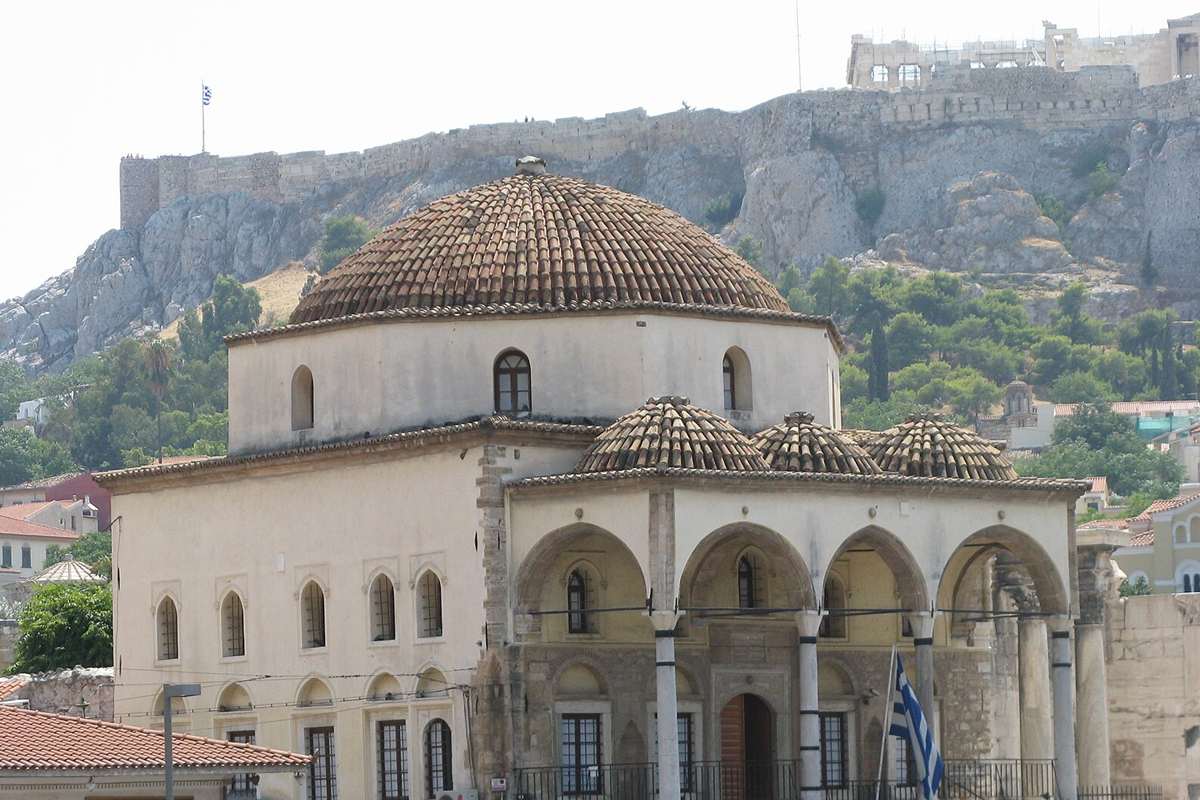
In Athens, the Museum of Greek Folk Art began in 1918 as the Museum of Greek Handicrafts. Its first home was the Tzistarakis Mosque on Monastiraki Square. The museum later became the National Museum of Decorative Arts. In 1959 it took the name that it still holds today.
- Clothing: Among mass-produced Greek souvenirs, clothing such as T-shirts and hats has a place.
- Collectables: Postcards, refrigerator magnets, key chains, souvenir coins, miniature bells and figurines are collectable souvenirs.
- Household items: Spoons, mugs, bowls, plates, coasters and notepads belong to the household group of souvenirs.
In 1973 the larger part of the collection moved to Kydathinaion Street in Plaka. The main work of the museum moved there too. The old mosque was then joined to the museum as an annex. An annex is an extra building linked to a main one.
Which story does red-figure pottery tell behind Greek souvenirs?
Greek souvenirs meet red-figure pottery, a style formed in Athens that lasted until the late 3rd century AD. Painters coated the background black and left figures in the red or orange of the clay. Before long, it replaced the older black-figure style.
Painters of the red-figure vases behind Greek souvenirs worked on shaped, unfired vessels. Each pot had dried to a leathery, near-brittle texture. The figures’ outlines were drawn with a blunt scraper or with charcoal. A scraper left a slight groove, while the charcoal burned away during firing. Firing means baking clay at great heat until it hardens.
Of the red-figure vases made in Athens alone, more than 40,000 pieces and fragments survive. Southern Italy, second among production centres, keeps more than 20,000 vases and fragments. Study of the style advanced fast after work by John D. Beazley and Arthur Dale Trendall. Certain vases can be credited to single artists or schools.
Red-figure painting, a root of Greek souvenirs, let painters show humans from the front or behind. Three-quarter views also became possible, not only the side view called profile. The painted scenes serve as evidence for Greek everyday life, iconography and mythology. Iconography is the study of images and the symbols in them.
- Clay colour: In Attica, the region around Athens, unfired clay showed an orange colour at this stage.
- Firing: Three-phase firing turned the glossy clay black or black-brown on finished vases.
- Etruria: Etruria, in central Italy, became an important production centre outside the Greek world.
Attic red-figure vases, early forerunners of Greek souvenirs in clay, went out across Greece and beyond. For a long time, they led the market for fine ceramics, objects of fired clay. Only a handful of centres matched Athens in new ideas, quality and output.
How does the meander pattern run through Greek souvenirs?
Greek souvenirs draw on the meander, a border made from one continuous line in a repeated motif. A motif is a shape or design used again and again. The names Greek fret and Greek key are modern labels for this design.
The name meander recalls the winding path of the Maeander River, in present-day Turkey. The river ran through the region once called Asia Minor. Karl Kerenyi saw the meander as the figure of a labyrinth drawn in a single line. A labyrinth is a puzzle of twisting passages.
Meanders are common decorative elements in Greek and Roman art. In ancient Greece they run along architectural friezes, the decorated bands on buildings. They also circle pottery in bands from the Geometric period onward. The Geometric period is an early stage of ancient Greek art. To certain Italians, these patterns on Greek souvenirs are simply Greek lines.
The motif on Greek souvenirs is older than its modern names. It appears among Near and Far Eastern cultures too. The oldest meander found so far is a key pattern from Mezin, in Ukraine. It dates from the Palaeolithic era, around 23,000 BCE. Palaeolithic means the Old Stone Age. Rounded versions are called running scrolls.
- China: Labyrinth-like meanders, called the thunder pattern, appear on bronzes of the Shang era.
- Americas: Mayan and Aztec art used meander motifs centuries before any contact with Europeans.
- Today: The design stays common in classicising architecture, which copies ancient styles, and on printed borders.
Greek souvenirs with a meander border use a pattern found far beyond Greece. One theory holds that meanders of Greek origin reached China under the Han dynasty, around 202 BC. The route was trade with the Greco-Bactrian Kingdom, a Greek state in Central Asia.
What do Tanagra figurines add to the story of Greek souvenirs?
Greek souvenirs have an ancient cousin in Tanagra figurines, named after the Boeotian town of Tanagra. Boeotia lies in central Greece. Large numbers were dug up there, but other cities made them too. The figures were widely exported around the ancient Greek world.
Such figures also came from other Mediterranean sites, including Alexandria and Tarentum in Magna Graecia. Magna Graecia means the Greek south of Italy. Centuripe in Sicily and Myrina in Mysia produced them too. Like Greek souvenirs, the bulk of them seem to have served as pure decoration. They resemble porcelain figures made from the 18th century onward.
The figures were placed in their owners’ tombs as grave goods, things buried with the dead. Certain character pieces are thought to show stock figures from the New Comedy of Menander. A stock figure is a familiar type of comic character. The model makers liked to show the body under the folds of a himation, a cloak.
These ancestors of Greek souvenirs drew little notice before the end of the 1860s. Then ploughmen of Vratsi in Boeotia began to uncover tombs from a long run of centuries. The main finds, chiefly from the 4th and 3rd centuries BC, were secured in 1874. Their realism suited the middle-class taste of the 19th century.
- Fakes: Collector demand in the late 19th century led to fake Tanagra figures in terracotta, or baked clay.
- Paris: A French critic called their fashionable women the parisienne, or Paris lady, of the ancient world.
- Literature: In The Picture of Dorian Gray, Oscar Wilde has Dorian liken Sybil to a Tanagra figurine’s grace.
Tanagra figurines, ancient relatives of Greek souvenirs in clay, inspired later artists. The artist Jean-Léon Gérôme made a multicoloured sculpture showing the spirit of Tanagra. The actress Mary Anderson planned a Galatea costume based on the draped Tanagra figurines.
Why do the mosaics of Delos matter to Greek souvenirs?
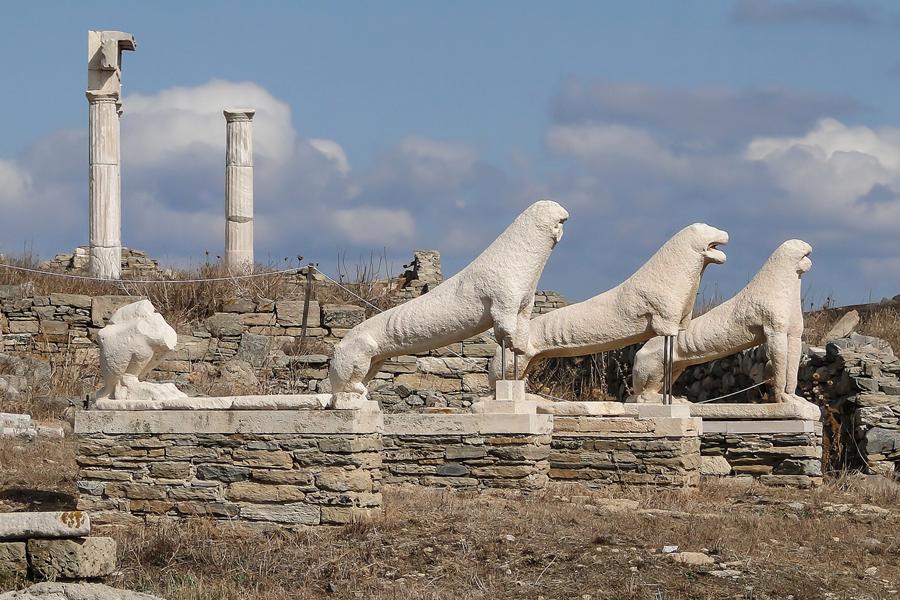
Greek souvenirs in mosaic echo the mosaics of Delos, an island of the Cyclades. These form a significant body of ancient Greek mosaic art. Exactly 354 mosaics from Delos survive, and the French archaeologist Philippe Bruneau studied them. Mosaic art builds pictures from small fitted pieces.
The bulk date to the late 2nd and early 1st centuries BC, long before Greek souvenirs. That span covers the Hellenistic period and early Roman Greece. Hellenistic refers to Greek culture in the years after Alexander. Roughly half of the surviving tessellated Greek mosaics of that age come from Delos. Tessellated means laid with small cubes.
Opus tessellatum used pieces averaging eight millimetres a side. Finer opus vermiculatum used pieces under four millimetres a side. Opus is Latin for work. Chip pavement, a floor of white marble chips, appears in 55 homes, mainly on ground floors. Kitchens and toilets got floors of pottery, brick and tile fragments to keep water out.
A three-coloured lozenge, far older than Greek souvenirs, creates the illusion of cubes. It appears in fifteen places, which makes it one of the commonest patterns. A lozenge is a diamond shape. The single wave pattern leads all border designs on the island. Figured scenes gained depth from blue, green, red, yellow, black and white.
- Lead lines: Thin strips of lead set into the cement trace the edges of geometric designs.
- Roots: The style goes back to pebble mosaics of the 5th century BC at Olynthus in northern Greece.
- Black ground: Mosaics on Delos share the black-background method of Classical red-figure pottery.
Greek souvenirs in mosaic draw on finds that came to light through excavation. Excavations on Delos by the French School at Athens began in 1872. In 1876 the French archaeologist Jacques Albert Lebègue described the mosaics in a report.
Where do Cretan school icons fit among Greek souvenirs?
Greek souvenirs in the form of icons recall the Cretan school, a leading school of icon painting. An icon is a sacred picture on a wooden panel. The school flourished while Crete was under Venetian rule in the late Middle Ages.
Well before Greek souvenirs, Crete was saturated with painting workshops between 1454 and 1526. The number of painters passed 145. A single order in 1499 called for 700 Virgin icons. Of these, 500 were to follow a Western style and 200 a Byzantine one. Such bulk painters earned the dismissive name Madonneri, after the Madonna.
By the late 15th century, Cretan artists had a distinct style of icon painting. It used precise outlines, dark brown underpaint and tiny highlights on the cheeks. Records name two manners, the Byzantine maniera greca and the Western maniera Latina. Both sometimes sit side by side in one icon, a blend that Greek souvenirs of this kind inherit.
About 120 artists worked in Candia, now Heraklion, between 1453 and 1526. They formed a painters’ guild of the Italian type. Such a guild was a society of workers in one craft. Cretan painters took up signing their works, which was not a traditional Byzantine practice. Cretan icons were ordered for monasteries on Mount Athos and elsewhere.
- Wall paintings: Crete keeps about 850 church wall paintings made in the 14th or 15th century.
- El Greco: The best-known painter of the school, El Greco, left the Byzantine style far behind in later years.
- Rome: A famous Virgin icon in Rome, the Mother of Perpetual Help, is a probable early example.
Greek souvenirs in icon form echo a golden age of Cretan art. Once Constantinople fell in 1453, Crete became the leading centre of art in the Greek world. Its painters shaped artistic change across the rest of that world.
Which old beliefs sit behind evil eye charms among Greek souvenirs?
Greek souvenirs share a symbol with Turkey: an eye that looks back at the viewer. In both lands, amulets against the evil eye take this form. An amulet is a charm worn for protection. The evil eye is a curse cast by a harmful look.
These amulets are known as Greek eyes or Turkish eyes, depending on the region. In the Aegean, light-coloured eyes are fairly rare. There, people with green and especially blue eyes are thought to cast the curse, with or without intent. Greek souvenirs in eye form follow this belief.
Ancient Greeks had a range of names for protective items, such as probaskania, periapta and phylaktiria. They placed talismans in their houses and wore amulets against the evil eye. They also tied charms to their animals. A talisman is a lucky charm. Peisistratus hung the figure of a kind of grasshopper before the Acropolis of Athens for protection.
Plutarch gave a separate chapter of his Symposium to evil eye beliefs. He saw the eyes as the chief source of deadly rays, like poisoned darts. Ancient Greeks and Romans believed the evil eye harmed humans and animals, such as cattle. Long before Greek souvenirs, an old custom dressed boys as girls to avert the evil eye.
- Blue rings: Discs of blue and white rings around one centre serve as charms in West Asia and the Balkans.
- Glass: Glass beads were made and widely used from Mesopotamia and Egypt to ancient Greece.
- Colours: A typical eye bead is handmade glass with rings of dark blue, white, light blue and black.
Greek souvenirs of this kind belong to a class of charms called apotropaic. The word is Greek and means turning away. Such charms turn harm away or turn it back. In one folk version, the staring eyes bend a harmful gaze back to the sorcerer.
How does the ancient crepida sandal tie in with Greek souvenirs?
Greek souvenirs in leather have an ancient model in the crepida, also called krepis. This footwear looked like a sandal but differed from a basic one. It served as a middle form between a fully enclosed boot and a simple sandal.
Peasants wore it first, on a thick, sturdy sole at times reinforced with nails. Certain versions carried metal plates of lead or bronze. These were called Chian crepides, and Chian means from the island of Chios. Hagnon, a follower of Alexander the Great, is said to have worn crepidae with gold or silver nails. Crepidae is the plural.
Straps were at times ornamental, dyed purple or set with jewels. Large loops formed an open, net-like covering over the top of the foot. Greek souvenirs aside, vase paintings show young men wearing crepidae with straps halfway up the calf. The shoes fitted either foot and were made mainly of leather.
The krepis counted as the national shoe of the Greeks, centuries before Greek souvenirs. For that reason, Roman tragedies staged in Greek costume were called fabula crepidata. A tragedy is a grave drama that ends in sorrow. The crepida also served the Macedonian army as a military boot. It set Greek dress apart from Roman fashion.
- Theatre: Sophocles is said to have brought in white krepides for dancers in the chorus.
- Lamps: Archaeological finds include lamps shaped like crepidae, complete with nail-studded soles.
- Cake: The word krepis also named a cake or pancake filled with fruit.
Greek souvenirs in sandal form recall a shoe that Rome borrowed in time. Suetonius writes that Emperor Tiberius set aside Roman dress for the Greek cloak and crepidas. Suetonius was a Roman author who wrote lives of the emperors.
Why does the theatre mask stand out among Greek souvenirs?
Greek souvenirs echo the theatre mask, whose stylised comic and tragic forms now symbolise the performing arts. The ancient Greek word for a mask was prosopon, which means face. Masks played a significant part in the worship of Dionysus, a Greek god, at Athens.
No physical masks survive. They were made of organic materials, which come from living things. Unlike Greek souvenirs, the original masks were not seen as lasting objects. After each show, they were dedicated at the altar of Dionysus. Masks are known from the time of Aeschylus onward. Aeschylus wrote tragedies in Athens.
Fifth-century images show helmet-like masks that covered the face and head. Each had holes for the eyes, a small opening for the mouth and a built-in wig. The makers were called skeuopoios, meaning maker of the props. Scholars think they used light materials such as stiffened linen, leather, wood or cork. Wigs used human or animal hair.
On the stage behind Greek souvenirs, only 2 to 3 actors were allowed at one time. All actors were men, yet masks allowed them to play female roles. The tragic chorus, a group that commented on the action, had twelve or fifteen members. All of them wore one mask, since they stood for a single character.
- Sound: Greek mask-maker Thanos Vovolis sees the mask as a resonator that strengthens the voice.
- Furies: Special masks were made for the Furies in the Eumenides by Aeschylus.
- Pronomos Vase: The Pronomos Vase, the biggest source on stage costume, shows actors at an after party.
Greek souvenirs in mask form recall a stage where shoes also marked the type of play. Tragic actors wore raised boots called cothurnus, or buskin. Comic actors wore a thin-soled shoe called a soccus, or sock. Drama is therefore sometimes called sock and buskin.
What past does the natural sponge bring to Greek souvenirs?
Greek souvenirs of the sea recall the natural sponge, a cleaning aid of soft, porous material. Porous means full of tiny holes that let liquid in. The first reference to sponges used for hygiene dates from ancient Greece. Hygiene means keeping the body clean.
Centuries before Greek souvenirs, competitors at the Olympic Games bathed with sea sponges soaked in olive oil. The Odyssey is an epic poem by Homer. In it, the god Hephaestus wipes his hands, face and chest with a sea sponge. Servants in the palace of Odysseus cleaned tables with sponges after meals of Penelope’s suitors.
The Greek philosophers Aristotle and Plato mentioned sea sponges in both scientific and historic writing. The bulk of sponges are too rough for general use. Their skeletons hold tiny spikes, called spicules, made of calcium carbonate or silica. Cleaning sponges were first made from natural sea sponges. Today they come mainly from synthetic materials made by people.
Through trade, Europeans put soft sponges to uses far from Greek souvenirs. They padded helmets, served as portable drinking utensils and filtered town water. A belief in their healing power also led to medical use, such as cleaning wounds. By the mid-20th century, over-fishing had brought the animals and the trade close to extinction.
- Diving: Sponge diving means diving underwater to gather soft natural sponges for human use.
- Absorbing: Sponges are especially good at soaking up water and water-based solutions.
- Synthetics: Synthetic sponges arrived only after polyester in the 1920s and polyurethane foam in 1952.
Natural sponges among Greek souvenirs differ from synthetic ones of polyester, polyurethane or vegetable cellulose. Cellulose sponges, made of wood fibre, serve mainly for bathing and skin care. They count as more eco-friendly than polyester ones, since they break down naturally.
What is Chios mastic, one of the edible Greek souvenirs?
Greek souvenirs from the island of Chios include mastic, an ivory-coloured resin. Growers harvest it as a spice from mastic trees in the south of the island. A resin is a thick, sticky liquid that seeps from certain trees and then hardens.
Pistacia lentiscus, the mastic tree, is the source of these Greek souvenirs. People also call it lentisk or schinos. Pistacia lentiscus is its scientific name, the formal label botanists give a plant. The tree reaches up to 4 metres in height. Farmers grow it for its aromatic resin, which means a resin with a strong smell.
Greek souvenirs of this kind come from a tree that bears fruit as well as resin. Each fruit is a drupe. A drupe is a fleshy fruit that wraps around one hard stone. The fruit starts out red and turns black once it is ripe. Its width reaches about 4 millimetres.
Greek souvenirs of mastic begin with a summer harvest, between July and September. A harvest is the gathering of a crop when it is ready. After collection, workers wash the mastic by hand. They then leave it to dry in a spot out of the sun. Out of the shade, the resin starts to melt again.
- Breads: Festival breads in Greece, such as tsoureki and New Year vasilopita, rely on mastic as a main ingredient.
- Fruit: The mastic tree’s fruit is edible, with a tart, or sharp, taste of raisins.
- Winter: Through the winter, farmers clean the resin drops, called tears, and separate them from the sand.
Greek souvenirs made from mastic carry a strong, slightly smoky flavour with a resin note. It can be an acquired taste. An acquired taste is a flavour that people learn to enjoy. The liking comes only after tasting it more than once.
Why is pine honey an unusual honey among Greek souvenirs?
Greek souvenirs from the pine forests include pine honey, known in Greek as pefkomelo. It is a type of honeydew honey. Honeydew is a sugary liquid that certain insects release after feeding on plant sap. Sap is the juice inside a tree.
These Greek souvenirs taste sweet and spicy, with woody notes. A note is one clear strand within a flavour. The honey carries a resin fragrance, which means a smell like pine sap. Its colour is a dark amber. Amber is a deep golden-brown shade. Spicy here means warm and sharp on the tongue.
Greek souvenirs of pine honey are unusual, because honey bees do not make the honey entirely alone. A scale insect called Marchalina hellenica plays a part. A scale insect is a small insect that clings to plants and feeds on their sap. It hides in cracks of pine bark, under a white, cotton-like wax that it gives off.
The insect behind these Greek souvenirs reproduces mainly through parthenogenesis. In parthenogenesis, a female produces young without mating with a male. The insect is the sole member of its genus, Marchalina, so no other species shares it. In the naming of living things, a genus gathers closely related species together.
- Forests: Pine honey comes from areas rich in pine forest but poor in flowers and fruit blossom.
- Greece: Large-scale production takes place across a wide spread of Greek mountains and islands.
- Athos: The monks of Mount Athos are renowned for the pine honey they produce.
Pine honey, one of the Greek souvenirs, is also a common breakfast food in Greece and Turkey. People drizzle it over kaymak, then eat it with bread. Kaymak is a thick, rich cream made from milk. To drizzle means to pour in a thin, slow stream.
How did ouzo grow out of tsipouro to become one of the Greek souvenirs?
Greek souvenirs include ouzo, a strong drink flavoured with anise. Anise is a herb with seeds that carry a liquorice flavour. The taste of ouzo resembles other anise liquors, such as pastis, sambuca, raki and arak. A liquor is a strong distilled drink.
Greek souvenirs of ouzo trace their roots to tsipouro, an older Greek spirit. A spirit is a strong alcoholic drink made by distilling. Distilling separates alcohol from a liquid by heat. One version of tsipouro was flavoured with anise. Over time, that version came to carry the name ouzo.
For ouzo among Greek souvenirs, makers start from ouzo yeast, a flavoured spirit. Distilling it yields a distillate of about 80% alcohol. A distillate is the liquid gathered by distilling. The spirit at the start is the heads, and the end is the tails. Both are set aside to keep out light and heavy alcohols.
Certain distillers use double distillation to set their ouzo apart. Double distillation means the spirit passes through the still twice. A still is the vessel in which distilling takes place. As a rule, Greek souvenirs of ouzo end up between 42.0 and 55.0 percent in strength. That strength is measured as ABV, or alcohol by volume.
- Mezes: Ouzo comes with mezes, or small appetisers, such as fresh fish, fries, olives and feta.
- Ouzeries: The ending -erie in ouzeries, cafés that serve ouzo, comes from French, as in boulangerie.
- Abroad: Outside Greece, ouzo is served very cold, enough for crystals to form as it is poured.
Ouzo from Greek souvenirs rarely appears in mainstream cocktails. A cocktail is a mixed drink that blends a spirit with other ingredients. In Cyprus, however, ouzo forms the base of a cocktail called the Ouzini. Cyprus is an island country in the eastern Mediterranean Sea.
Which story lies behind tentura, a Patras liqueur in Greek souvenirs?
Greek souvenirs from Patras include tentura, a liqueur that the city has produced since the 15th century. A liqueur is a sweetened alcoholic drink, flavoured with herbs, fruit or spices, and served in small amounts. The 15th century means the fourteen-hundreds.
The name of these Greek souvenirs comes from the Venetian word tentura, which means tincture. Venetian is the language of Venice, in Italy. A tincture is a plant extract dissolved in alcohol. Makers sweeten distilled alcohol and give it flavour with herbs and spices. Distilled alcohol is spirit made by boiling a liquid and cooling its vapour.
Brandy from the wineries of Patras is the commonest base for these Greek souvenirs. Rum or grain alcohol can replace it. A base is the main alcohol that carries the flavours. Tentura’s chief flavourings are cloves, cinnamon, nutmeg and citrus fruits, used as fermented essences. An essence is a strong extract of a plant’s scent and taste.
These aromatic ingredients give Greek souvenirs of tentura a dark orange-red colour. Aromatic means strongly scented. The same ingredients inspire its local name, moschovolithra. That Greek word means “she who throws scent”. Scent is a pleasant smell. A local name is one that people of a place use beside the formal name.
- Strength: Alcohol makes up around 25% of the volume of tentura.
- Coffee: Added to espresso, tentura turns the cup into an espresso corretto, Italian for corrected espresso.
- Temperature: Tentura can also be served at room temperature, without any chilling at all.
Tentura is a digestif, a drink taken after food to round off a meal. Greek souvenirs of tentura are served chilled or over ice once a large meal ends. Each serving goes into a small glass. Chilled means cooled until cold.
Where does sideritis, the mountain tea of Greek souvenirs, grow?
Greek souvenirs of herbal tea include mountain tea, the common name for plants of the genus Sideritis. These plants are abundant across Mediterranean regions, the Balkans, the Iberian Peninsula and Macaronesia. Macaronesia is a group of Atlantic island chains, such as the Canary Islands.
Greek souvenirs of mountain tea bear a Greek name, sideritis. The word translates literally as “he who is made of iron”. Literally means word for word, without a looser reading. Iron is a strong grey metal. The plant was already known to ancient Greeks, in particular to the writers Pedanius Dioscorides and Theophrastus.
In ancient times, sideritis was a general label for plants that healed wounds. Those wounds came from iron weapons used in battle. Other scholars trace the name to the sepal, whose shape recalls a spear tip. A sepal is a small leaf-like part that guards a flower before it opens.
The plants behind these Greek souvenirs are short, between 8 and 50 cm tall. These plants are subshrubs or herbs. A subshrub is a low plant with a woody base. They grow high up, as a rule above 1000 m, in little or no soil. Bare rock surfaces also serve as their home.
- Species: Certain botanical schemes recognise up to 319 distinct species, subspecies, forms or cultivars, meaning bred types.
- Euboea: One species, Sideritis euboea, grows on the Greek island of Euboea.
- Farming: Farmers grow Sideritis raeseri more than any other kind in Greece, Albania, Bulgaria and North Macedonia.
Growers gather Sideritis in July, when the plant stands in full bloom. Full bloom is the stage when the flowers have opened completely. Bloom is another word for flowering time. These Greek souvenirs of mountain tea begin at this summer harvest.
What gives kitron of Naxos its place among Greek souvenirs?
Greek souvenirs from the island of Naxos include kitron, a liqueur made from citron. The citron is a citrus fruit, from the same plant family as the lemon and the orange. Liqueur here means a sweetened spirit with added flavour.
In Greek, the citron variety grown in Greece bears the name kitria. A variety is a distinct type within one plant species. Members of one species can breed with each other. Behind Greek souvenirs of kitron stands a tree similar to the lemon tree. The citron is stronger, though, and slightly different in taste.
Greek souvenirs of kitron come in three varieties. The green kind is sweeter than the others. It also contains less alcohol, at 30% ABV. ABV stands for alcohol by volume. That figure gives the share of pure alcohol in a drink, shown as a percentage. A percentage is a part of a whole, out of a hundred.
Over time, cultivation of the Greek citron became concentrated in Halki, a village on Naxos. Concentrated means gathered in one place. Cultivation means growing plants on purpose, as a crop. In Halki, a small citron harvest goes to distilling. Distilling heats a liquid and collects the vapour to make a strong spirit.
- Colourless: Colourless kitron sits between the green and yellow kinds, at 33% ABV.
- Fashion: The drink enjoyed a brief spell of fashion during the early 1980s.
- Crete: On Crete, citron growers sell the fruit for candied peel, or peel cooked in sugar, called succade.
Greek souvenirs of kitron carry a citrusy aroma and flavour. Aroma is another word for a pleasant smell. Citrusy describes the fresh, sharp quality of fruits such as lemons and oranges. Both the scent and the taste of the liqueur show this quality.
How is avgotaracho, the salted fish roe in Greek souvenirs, made?
Greek souvenirs include avgotaracho, the Greek name for bottarga. Makers produce it mainly from the flathead mullet, a fish caught in Greek lagoons. Lagoons are shallow stretches of salt water that a strip of land partly shuts away from the sea.
Bottarga in Greek souvenirs is a salted, cured roe pouch from a fish. Roe is the mass of eggs inside a female fish. A pouch is a small bag-like sac that holds them. Cured means preserved with salt so the food keeps. The fish behind it is the grey mullet or the bluefin tuna.
In Byzantine Greek, the Greek of the Eastern Roman Empire, the food was called oiotarikhon. That word joined two words, one meaning egg and one meaning pickled. The name avgotaracho on Greek souvenirs comes from this old form. It swaps the ancient word for egg with the modern word avgo.
Makers massage the roe by hand to push out pockets of air. They then dry it and cure it in sea salt. Sea salt is salt taken from evaporated seawater. To evaporate is to dry up into vapour. The result in Greek souvenirs is a hard, dry slab. A slab is a flat, thick piece.
- First record: The Greek form of the name first appears in 11th-century writings by Simeon Seth.
- Egypt: Bottarga making is first recorded in the Nile Delta, during the 10th century BCE, before the Common Era.
- Protection: Avgotaracho Messolonghiou holds a protected designation of origin, a rare status for seafood.
In Greece, makers take the mature ovaries, or egg sacs, from the fish. They wash them and salt them with sea salt. The sun then dries them. Melted beeswax seals each one. Beeswax is the wax honey bees make to build their combs.
What does Mavrodaphne wine from Patras bring to Greek souvenirs?
Greek souvenirs from the Peloponnese include Mavrodaphne wine. Mavrodaphne is a black wine grape whose home is Achaea, a region of the northern Peloponnese. The Peloponnese forms the southern end of the Greek mainland. A wine grape is grown to make wine, not for eating.
The name Mavrodaphne on Greek souvenirs also marks a wine style. That style is a traditionally sweet fortified wine. Fortified means strengthened with added spirit. Writers describe the wine as rich and Port-like. Port is a sweet fortified wine from Portugal. The wine is linked with the area around Patras.
Greek souvenirs of Mavrodaphne begin in large vats set out in the sun. A vat is a tank that holds wine while it ferments. During fermentation, yeast feeds on grape sugar and turns it into alcohol. Makers stop the fermentation by adding distillate from earlier vintages. Each vintage is the wine made from a single year’s grapes.
Next, the wine moves to underground cellars, where it finishes maturing. Maturing means ageing until the wine is ready. In the cellars, older wine “educates” the younger wine through contact. This takes place through solera, a method of serial blending. In that method, younger wine is mixed step by step into barrels of older wine.
- Dry reds: Winemakers today also turn the Mavrodaphne grape into dry red wines, meaning reds without sweetness.
- Colour: The wine looks dark and almost opaque, or not see-through, with a dark purple reflected colour.
- Flavour: Its aromas and flavours recall caramel, chocolate, coffee, raisins and plums.
Greek souvenirs of Mavrodaphne carry a name drawn from the laurel. The name was chosen because the grape’s berries resemble those of the laurel. The laurel, or bay, is an evergreen tree with dark berries and fragrant leaves. Evergreen trees stay leafy in every season.
What do travellers ask about Greek souvenirs, and what are the answers?
Greek souvenirs raise four questions about food and drink: saffron, spoon sweets, tsipouro and rakomelo. The spice saffron comes from red threads inside the crocus flower. Spoon sweets are preserves offered by the spoonful. Tsipouro and rakomelo are drinks based on grape spirit.
How do Greek souvenirs of saffron connect with the Minoans of Crete?
Minoan palace frescoes showed saffron between 1600 and 1500 BC. Frescoes are wall paintings. In 7th-century Crete, locals spiced a pasta-like dish called makarogia with saffron. They called the spice zaforan. Saffron-growing regions in Greece receive about 500 millimetres of rain each year. That is far drier than the main Iranian growing regions.
Which foods besides fruit turn into spoon sweets among Greek souvenirs?
Baby aubergines and cherry tomatoes, both vegetables, can also become these sweet preserves. An aubergine is a purple vegetable, called eggplant in American English. Spoon sweets can serve as toppings for ice cream or yogurt. They also work as a spread on toast. People eat them plain or alongside cheese.
What sets tsipouro apart among Greek souvenirs from the mainland?
Tsipouro comes mainly from grape pomace, but it can also be made straight from wine. Pomace is the skins, seeds and stems left after grapes are pressed. Anise-flavoured tsipouro is made especially in Macedonia and Thessaly. Tsipouro works as a refreshment in one season and as a hot drink in another.
What goes into rakomelo, the honey drink among Greek souvenirs?
Rakomelo is a Greek mixed alcoholic drink. Its name joins raki, a grape spirit, and meli, Greek for honey. Raki or tsipouro is blended with honey plus spices like cinnamon or cardamom. It is made on Crete, across the Aegean islands and on the mainland. People drink it warm, chiefly in winter.
Featured photo: Юкатан, CC BY-SA 3.0, via Wikimedia Commons.