
Greece island hopping tours move by sea with a host, from one Aegean island to another. They span the Saronic Gulf, the Cyclades and the Dodecanese. Topics include the Port of Piraeus, the Santorini caldera, Oia and Akrotiri. Little Venice on Mykonos, Delos, Parikia, Antiparos and Folegandros follow. Related pages cover Milos tours, Greece tour packages and the classical Greece tour. More trips appear under Greece tours.
Bookings made through the GetYourGuide widgets on this page earn Classical Greece Tours a commission, at no extra cost to the traveller.
What are Greece island hopping tours?
Greece island hopping tours are boat-based trips, led by a host, between neighbouring islands of the Aegean Sea. This sea has Turkey on its eastern side and mainland Greece on its western and northern sides. Greece owns the vast majority of these islands.
The word archipelago means a group of islands. It began as the old Greek name for the Aegean Sea. Over time the name moved from the sea to its islands. Tradition sorts the Aegean Islands into seven clusters, listed north to south. Among them sit the Dodecanese, the Cyclades and the Saronic Islands.
One island group linked with Greece island hopping tours is the Cyclades, southeast of the Greek mainland. The Cyclades hold about 220 islands. Apart from volcanic Milos and Santorini, these islands are the tops of a sunken mountain range. Syros leads the group in population. The smaller Cycladic islands mostly have no residents.
The Cyclades gave their name to an early culture of farmers and seafarers. These people had moved from Anatolia around 5000 BCE. Their best-known works are flat figures carved from white island marble. Early Cycladic culture passed through three stages, from about 3300 to 2000 BCE. Later boat models show crews of fifty rowers.
- Southern edge: The island of Crete closes off the Aegean Sea to the south.
- Local rule: The Greek islands of the Aegean are split among nine administrative regions of the country.
- Circle of islands: The name Cyclades points to islands that form a ring around sacred Delos.
In Greece island hopping tours, hopping means short crossings from one island to its neighbour. Cycladic farms yield tobacco, olive oil, wheat, fruit and wine. For Greece island hopping tours, the southern limit of the Cyclades is the Sea of Crete.
Why does the Port of Piraeus matter to Greece island hopping tours?
Greece island hopping tours rely on harbours, and Piraeus is the main sea port of Athens. It sits on the Saronic Gulf as the largest port in Greece. No passenger port in Europe is larger. Its quays stretch 2.8 kilometres.
Greece island hopping tours from Athens lean on a port used by the city from antiquity onwards. Up to the 3rd millennium BC, rocky Piraeus sat offshore, linked to land by a low strip. Silt then fixed it to Attica and formed three harbours: Cantharus, Zea and Munichia. Cantharus served as the main harbour.
Themistocles began work on the defences of Piraeus in 493 BC. He urged the Athenians to use the strategic worth of its natural harbours. He also had ship sheds built, known in Greek as neosoikoi. The Themistoclean Walls were finished in 479 BC. From the late 4th century, Piraeus slipped into a long decline.
For Greece island hopping tours, ferries from Piraeus reach Crete, the Cyclades, the Saronic islands and the Dodecanese. In 2014 the port handled about 18.6 million passengers, more than any other in Europe. Worldwide, it is also one of the biggest passenger ports. Its cruise port has 11 berths and three terminals, A, B and C.
- Older harbour: The Athenian fleet left Phaleron, its older base, for Piraeus in 483 BC.
- Floating hotels: Thirteen cruise ships served as floating hotels in the port during the 2004 Athens Olympic Games.
- Ottoman era: Throughout the Ottoman period in Greece, the town of Piraeus stood largely deserted.
After the walls stood, Piraeus served as the permanent base of the Athenian fleet. It now ranks among the top 10 cruise destinations in Europe. In 2019 the port behind Greece island hopping tours was named the Eastern Mediterranean’s best cruise port.
Which volcanic story lies behind the Santorini caldera on Greece island hopping tours?
Greece island hopping tours and the Santorini caldera share the southern Aegean, 120 kilometres north of Crete. The word caldera means a vast hollow made when a volcano sinks inward. This one lies largely underwater. Santorini, Therasia and Aspronisi form its outer ring.
The basin spans about 12 by 7 kilometres. Steep cliffs about 300 metres high rise on three of its sides. Its deepest point lies 385 metres below the surface. Land on Santorini totals 75.8 square kilometres, against 9.3 on Therasia. Long before Greece island hopping tours, the main island went by the name Thera.
The oldest caldera, in the south, took shape about 180,000 years ago. The Skaros caldera came next, about 70,000 years ago. The Cape Riva caldera followed about 21,000 years ago. The present caldera dates from the Minoan eruption, about 3,600 years ago. That blast is a possible source of the legend of Atlantis.
For Greece island hopping tours, the two islets in the centre are Nea Kameni and Palea Kameni. Their names mean New Kameni and Old Kameni. Each grew from minor eruptions that started beneath the waves. Their dark lava mounds last erupted in 1950. Today only gas vents called fumaroles stay active in the craters.
- World list: Santorini is one of sixteen Decade Volcanoes, a set picked worldwide for close study.
- Volcanic arc: Along the curved chain called the South Aegean Volcanic Arc, Santorini is the liveliest volcano.
- Moving plates: Here the African plate dives beneath the Aegean plate by up to 5 centimetres a year.
In 2022 a world body of geologists named the caldera one of 100 geological heritage sites. Its high walls, topped by whitewashed villages, draw volcano scientists to the island. Within Greece island hopping tours, that rim stands as a highlight of Aegean tourism.
What past does Oia bring to Greece island hopping tours?
Greece island hopping tours span the Cyclades, where Oia is a small village on Santorini and Therasia. It stretches almost two kilometres along the northern rim of the Santorini caldera. Its older local name, Apano Meria, means the upper side.
Before Greece island hopping tours, Oia was a town of mariners. Its wealth came from cargo ships whose trade ran between Alexandria and Russia. By 1890 its population stood near 2,500, with around 130 sailing ships. Steam power and the shift of shipping to Piraeus later ended that sea trade.
A 7.8 magnitude earthquake struck on 9 July 1956 and caused heavy damage. People left after the quake, and by 1977 only 306 inhabitants remained. In 1976 the town joined a national programme to preserve traditional settlements. For that work, the national tourism body took a Europa Nostra award in 1979.
For Greece island hopping tours, Oia stands for the white houses of the Cyclades. Coats of white lime water on the walls send rain down to be collected. Cave houses known as yposkafa spitia were once simple homes for seamen on the caldera edge. Pumice, a light stone full of air, insulates the cliff houses.
- Captains’ homes: Ship captains built two-storey houses on the highest ground of the village.
- Old fort: A ruined castle, also called Fort Londsa, crowns the top of Oia.
- Sea museum: A restored mansion holds a museum of Thira’s sea history, including carved ship figureheads.
On maps for Greece island hopping tours, Oia marks the north-western corner of Santorini. Its homes perch 70 to 100 metres over the water. From Oia, 300 steps lead down to the port. In 2021 the census counted 1,087 people in Oia.
In what way does Akrotiri’s buried Bronze Age town shape Greece island hopping tours?
Greece island hopping tours run through the Cyclades, and on Santorini lies Akrotiri, a Bronze Age settlement site. Volcanic ash buried the town in the 16th century BC and kept its wall paintings safe. Its name in ancient times is unknown.
People first settled here in the fifth millennium BCE, in a small village of fishers and farmers. Ships sailing between Cyprus and Minoan Crete passed the town on their main route. Moulds and crucibles found on the site show that it processed copper. A crucible is a heat-proof pot for melting metal.
The town had paved streets and a wide drainage system. Diggers have found buildings three storeys high. Inscriptions in Linear A tie the site to the Minoan civilisation of Crete. Linear A is an early script used on Bronze Age Crete. Within Greece island hopping tours, Akrotiri stands beside Pompeii as a remarkably well-kept buried town.
Greece island hopping tours on Santorini share the island with this dig, begun by Spyridon Marinatos in 1967. Only one gold object has turned up, hidden under a floor. No unburied human remains have come to light anywhere on the site. This suggests the people left in good order, with almost no deaths.
- Blue Monkeys: The Blue Monkeys fresco, a painting on wall plaster, came out of Room Beta 6 in 1969.
- Spring Fresco: In 1970, Room Delta 2 yielded the painting known as the Spring Fresco.
- Paint colours: Artists at Akrotiri worked in six colours: yellow, white, red, black, brown and blue.
Plaster poured into hollows in the ash recreates lost wooden beds and stools. For Greece island hopping tours, the dig’s finds are housed by the Museum of Prehistoric Thera. A building named the House of the Benches held 300 to 500 animal horns.
How does Little Venice on Mykonos tie into Greece island hopping tours?
Greece island hopping tours move among the Cyclades, where Mykonos sits amid Naxos, Paros, Syros and Tinos. In its main town, Little Venice holds old fishing houses with balconies jutting over the sea. The first one went up in the mid-18th century.
Rich merchants and ship captains were the first owners of these houses. Small doors at basement level opened straight onto the sea. They also led to underground storage rooms. Those doors made people suspect that the owners were secretly pirates. Today, artists come to the area to paint the coastline.
On Greece island hopping tours, the main town of Mykonos goes by Chora, Greek for town. The Kato Mili windmills of Chora line a seaside hill. The name Kato Mili means lower mills. They date from the 16th century, when Venetians put them up to grind flour. Each has a cap of wood and straw.
For Greece island hopping tours, Mykonos owes its nickname, Island of the Winds, to fierce gusts. The windmills ran until the early 20th century. Restored mills now serve as homes and as stores for local heritage papers. Off the coast near the windmills lies Camel Rock, which looks like a camel sitting in shallow water.
- Island mascot: A pelican named Petros has served as the island’s official mascot for more than 60 years.
- Island size: The island spans 85.5 square kilometres, with a top point of 341 metres.
- Church name: Paraportiani, the name of a Mykonos church to the Virgin Mary, means beside the entrance.
Chora also keeps the Tria Pigadia, three wells built in 1722 to supply water. Dug into sand, the wells go no deeper than 5 to 6 metres. For Greece island hopping tours, the Armenistis Lighthouse at Fanari still works, 6.5 kilometres from Chora.
Why does Delos hold such weight in Greece island hopping tours?
Greece island hopping tours range over the Cyclades, and Delos sits near their centre, beside Mykonos. The island covers only 3.43 square kilometres. It ranks among the key mythical, historical and archaeological sites of Greece. UNESCO listed it as World Heritage in 1990.
Greece island hopping tours sail waters where myth names Delos as the cradle of Artemis and Apollo. Zeus had a sanctuary on top of Mount Cynthus, the island’s hill. Because the island was sacred, a decree banned both burials and births there. Stone huts show that people lived here from the third millennium BC.
Founded in 478 BC, the Delian League joined Greek city-states in alliance and met on Delos. Its common funds stayed on the island until Pericles took them to Athens in 454 BC. From 166 BC Delos was a Roman free port, where ships paid no customs duties. Delos was left empty around the eighth century AD.
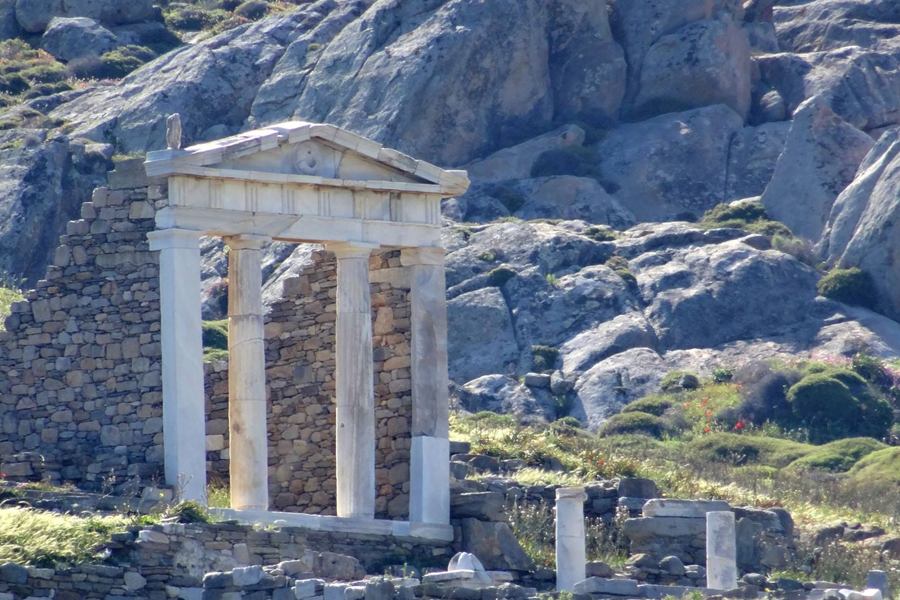
For Greece island hopping tours, the Terrace of the Lions was a gift to Apollo from Naxos. It dates from shortly before 600 BC. Just seven of the original lions remain. The Temple of the Delians, built for Apollo, is classic Doric work. The term Doric marks one plain manner of Greek column design.
- Dry lake: Caretakers keep the sacred lake dry on purpose to stop malaria mosquitoes spreading.
- Old saying: Greeks said a cheerful person sang as if sailing into Delos.
- Imports: Food, fibre and timber all reached the island from outside, since none grew there.
Excavation on Delos ranks with the widest in the Mediterranean. For Greece island hopping tours, its finds appear in the Delos museum and a national museum in Athens. Semos, an ancient writer from the island, produced 8 books on its history.
Where does Parikia fit among Greece island hopping tours?
Greece island hopping tours link island harbours, and Parikia serves Paros as both capital and main port. It lies on the island’s western side. It has 4,500 permanent inhabitants. Narrow cobbled lanes wind past old churches and houses in blue and white.
Its harbour gave Paros its strength and turned it into a great naval power. The town’s story reaches back to ancient times, as monuments around it show. Manto Mavrogenous, a heroine of Greece’s fight for independence, died here. She came from Mykonos, and a statue of her stands in the village.
On the hill above the town stands the Venetian Castle, built in the early 17th century. Its builders reused stones from ancient temples in its walls. A preserved windmill also stands by the port. Both count as trademarks of Parikia. Within Greece island hopping tours, Parikia’s neoclassical mansions, built in a revived ancient style, house public offices.
Among Paros towns linked with Greece island hopping tours, Parikia holds the Archaeological Museum of Paros. It is a small museum of finds from sites across the island. Nearby monasteries include Jesus of the Forest, Saint Anargyroi and Logovardas. Parikia and the northern village of Naoussa draw more tourists than anywhere else on Paros.
- Marble name: Fine white marble from Paros gave rise to the word Parian for marble of similar quality.
- Stone record: Part of the Parian Chronicle, a timeline cut into marble, is kept in the town museum.
- Healing god: Remains of a temple to Asclepius, the Greek god of medicine, lie on a southern hillside.
Houses in Parikia have flat roofs, whitewashed walls and doors and shutters painted blue. Gardens of oranges and pomegranates surround the houses. For Greece island hopping tours, Parikia rises where the ancient capital, also called Paros, once stood.
Which story does Panagia Ekatontapyliani give Greece island hopping tours?
Greece island hopping tours roam the Cyclades, and Parikia on Paros holds Panagia Ekatontapyliani, a Byzantine church complex. Panagia means All-Holy, a Greek title for the Virgin Mary. The long name translates as the church with a hundred gates. The church dates to 326.
The word Byzantine points to the eastern Roman Empire and its art. The complex holds a main chapel with two more chapels around it. It also has a baptistery, a room for baptism, with a cross-shaped water basin. An ancient gymnasium once stood where the first church rose in the 4th century.
Despite its name, the church lacks 100 doors, and nobody knows for sure where the name began. One idea traces the name to an older form meaning the Lower Town church. Its site is close to the shore, down in the lower part of Parikia. Legend says it has 99 known doors and a hidden secret door.
For Greece island hopping tours, the founding story names Saint Helen, whose son was Constantine the Great. She stopped on Paros during her pilgrimage to the Holy Land. Justinian, a later emperor, is credited with building on the site too. Badly hit by an 18th-century earthquake, the church was slowly restored.
- Pilgrim church: Pilgrims devoted to the Virgin Mary regard it as a renowned church of the Aegean.
- Church museum: The complex houses the Ecclesiastical Museum of Parikia; ecclesiastical means of the church.
- Painted walls: Frescoes, paintings made on wet plaster, still cover parts of its walls.
Greece island hopping tours link the Cyclades, where Paros ranks among the major islands. In Greece island hopping tours, the church also goes by a second name, Panagia Katapoliani. Its oldest parts are thought to predate 391, when Christianity became the Roman state religion.
How does Antiparos, the island facing Paros, relate to Greece island hopping tours?
Greece island hopping tours weave through the Cyclades, and Antiparos is a small island at their heart. It lies 1.5 kilometres southwest of Paros, across a strait called Amfigeio. The name Antiparos describes its position, opposite the island of Paros.
Its older name, Oliaros, is thought to be Phoenician, meaning wooded mountain. The island stretches 11 kilometres in length and 4.5 kilometres at its widest point. St. Elias, its highest peak, stands 308 metres high at the centre of the island. At the 2021 census, it had 1,265 permanent residents.
For Greece island hopping tours, the islet of Saliagos holds the oldest settlement in the Cyclades. Diggers found a small marble statue there, the Fat Lady of Saliagos. Despotiko, an empty island to the southwest, is a site of great archaeological value. In early 1884, Theodore and Mabel Bent opened about 40 graves here.
Greece island hopping tours cross islands with Venetian pasts, and Giovanni Loredan built Antiparos Castle in 1440. Loredan also brought settlers to the island at his own expense. The castle forms the historic centre of the main town. The Cave of Antiparos has given people natural shelter from the Neolithic, or New Stone Age, onwards.
- Famous names: Lord Byron and Otto, the first modern King of Greece, carved their names in the cave.
- Joining Greece: Antiparos was formally joined to the Greek state in 1832.
- Ancient writers: The writers Strabo and Pliny identified Antiparos with an ancient place called Prepesintho.
Antiparos gained the status of a community in 1914 and of a full municipality in 2010. The island’s economy is built on tourism, fishing and farming. For Greece island hopping tours, the island is known for white houses, cobbled streets and flowering yards.
What sets Folegandros apart on Greece island hopping tours?
Greece island hopping tours stretch to the southern Cyclades, home of the small island of Folegandros. It shares the southern edge of the group with Santorini, Anafi, Ios and Sikinos. It covers about 32 square kilometres. In 2021 it had 719 inhabitants.
Its three villages are Ano Meria, Chora and Karavostasis, linked by a paved road. For Greece island hopping tours, Chora is the capital, on the edge of a 200-metre cliff. Karavostasis, a small village, serves as the port. Ano Meria keeps an Ecological and Folklore Museum. Folklore means the customs and stories of ordinary people.
Greek myth links the island’s name to one of the sons of Minos. Minos was a legendary king of Crete. Its ancient inhabitants were Dorians. Later the island came under Athenian rule. A city-state called Pholegandros stood where Chora is today. In a city-state, one city rules itself along with its surrounding countryside.
Greece island hopping tours span rugged islands, and the ancient poet Aratus called this one iron Pholegandros. In 1207 the Venetian Marco Sanudo took the island. Venetian rule then lasted for over three hundred years. Ottoman Turks took control in 1566. Greeks won it back during their war for independence, fought from 1821 to 1829.
- Local government: Folegandros belongs to the Thira regional unit, an area of local government.
- Delian League: The island paid tribute to the Delian League, as Athenian lists record.
- Old spelling: The ancient geographer Ptolemy wrote the island’s name as Pholekandros.
Tall cliffs and a large cave mark the island’s varied landscape. The ancient geographer Strabo also wrote about Folegandros. For Greece island hopping tours, the island’s early past remains only thinly recorded. Its name also appears in English as Pholegandros.
How does Sifnos, the island of potters, fit into Greece island hopping tours?
Greece island hopping tours take place across the Aegean islands, and Sifnos is one of them. The island counts as a municipality in the Cyclades group, run by its own council. Until 1836, the village of Kastro had served as its capital since ancient times.
Kastro rises on a high cliff above the eastern shore of Sifnos. Extensive medieval remains still stand in the village. Medieval describes the age after ancient Rome, the Middle Ages. The island’s archaeological museum is also in Kastro. Such a museum displays objects that diggers found at old sites.
Long before Greece island hopping tours, gold, silver and lead made Sifnos very wealthy. Mining began there in the 3rd millennium BCE, a thousand-year span before the Common Era. Modern scholars think part of the mines flooded after miners dug below sea level. In their view, the others lay far from the coast and ran out of metal.
Sifnos gives Greece island hopping tours a place in the early story of money. Minting began on the island around 600 BCE, which puts it among the first Greek mints. A mint is a workshop that stamps metal into coins. Output was modest. Aegina, which used silver from Sifnos, built a far larger export of coins.
- Pottery: Rich clay veins, sunshine and warmth turned Sifnos into an Aegean capital of pottery.
- Local word: On the island, the word Sifnios once served as another word for potter.
- Inland workshops: The oldest potteries lay inland, at Artemon and Ano Petali, placed there to avoid pirate attacks.
Sifnos food adds one more name to Greece island hopping tours: revithada, the island’s chickpea soup. Cooks leave it overnight in a wood-fired oven, an oven heated by burning logs. The soup cooks slowly in clay pots that carry a local name, skepastaria.
Which myth does Serifos bring to Greece island hopping tours?
Greece island hopping tours set in the western Cyclades share their waters with Serifos. This island lies south of Kythnos and to the northwest of Sifnos. The Cyclades form one of the main island groups of the Aegean Sea.
Greek myth gives Serifos a famous arrival from the sea. Danae and her baby son Perseus washed up there in a wooden chest. Her father Acrisius had set them adrift at sea. An oracle had warned him that his own grandson was fated to kill him. Greeks saw an oracle as a sacred voice that foretold events.
Perseus later returned to the island with the head of Medusa, the Gorgon. A Gorgon is a mythical monster. He turned the island’s king, Polydektes, and the king’s men into stone. The king had tried to force Danae into marriage. Centuries before Greece island hopping tours, a common saying held that Serifos frogs made no sound.
Serifos adds a darker chapter to Greece island hopping tours. Under the Roman emperors, it was a place of exile, a forced stay far from home. Chora, the main town, stands on a hilltop crowned by a medieval castle. Cut marble blocks from the island sit in the castle walls. They show that the ancient capital stood there.
- Aspros Pyrgos: This marble watchtower dates from about 300 BC, before Christ, and its walls still rise 2 metres.
- Taxiarchs Monastery: This fortified monastery, built in 1572 near Galani, honours the Archangels Michael and Gabriel.
- Iron boom: Late in the 19th century, iron ore, rock rich in metal, brought Serifos a modest boom.
The iron mines of Serifos finally closed in the 1960s. Tourism and small-scale farming now support the island, and Greece island hopping tours are part of that tourism. Small-scale farming means growing crops or raising animals on modest plots of land.
Why does the Church of Panagia Evangelistria on Tinos matter to Greece island hopping tours?
Greece island hopping tours touch on faith through Tinos, an island of the Cyclades. There stands the Greek Orthodox Church of Panagia Evangelistria, the major Marian shrine of Greece. A Marian shrine is a holy place in honour of Mary, the mother of Jesus.
In Greek, Panagia means All-Holy, and Evangelistria means Bringer of Good News. Tradition says that in 1822 the Virgin Mary appeared in visions to Pelagia, a local nun. A dig on 30 January 1823 then uncovered an icon of the Annunciation. Icons are holy pictures, and this scene shows an angel bringing Mary news of her coming child.
Efstratios Kalonaris, an architect from Tinos, designed the church. He worked in the Renaissance Revival style. That style copies the Renaissance, a great era of art and building in Europe. Greece island hopping tours are a modern way of travel, but this church was inaugurated in 1830. Inaugurated means formally opened.
Greece island hopping tours move between islands by sea, and this church has a sea role. Orthodox believers see it as a protectress of seafarers, the people who travel by ship. They also regard it as a healer of the sick. The church even shares its popular name with the icon inside it.
- Covered icon: Silver, gold and jewels now cover the icon almost completely, hiding the original picture.
- Gifts for charity: Each year the church sells its gifts of silver and gold at auction for charity.
- Sacred island: In 1971 the Greek government named Tinos a sacred island because of its Marian feasts.
For Greece island hopping tours, the key date on Tinos is 15 August, the main feast. It marks the Dormition, or falling asleep, of the Virgin Mary. That day, certain pilgrims crawl all the way to the icon once they land on Tinos.
What does Ermoupoli, the capital of the Cyclades, add to Greece island hopping tours?
Greece island hopping tours in the Cyclades connect with Ermoupoli, a town on the island of Syros. Ermoupoli is the capital of the South Aegean region. Greece splits its land into regions, and each one forms a large unit of local government.
The older formal name, Ermoupolis, means Town of Hermes. In Greek myth, Hermes was a god. The town rises on a natural amphitheatre, a slope curved like the seating of an ancient theatre. Old mansions, neoclassical buildings and white houses step down towards the harbour. Neoclassical design borrows columns and gables from ancient Greek temples.
Refugees from other Greek islands founded Ermoupoli in the 1820s, during the Greek Revolution. That revolution was the Greek war for independence. Syros adds a story of refuge to Greece island hopping tours. In those war years, Syros offered a safe shelter. Newcomers came from Asia Minor, the land of Anatolia, and from Chios, Psara and Spetses.
Under Ioannis Kapodistrias, first governor of the newly formed state, the town reached 13,805 residents. In those years, Ermoupoli became the leading centre of trade and industry in Greece. In the age before Greece island hopping tours, it was also the main port of the country. Industry here means the making of goods, from cloth to ships.
- Neoclassical streets: Neoclassical buildings stand close together across Ermoupoli, giving the town a high density of them.
- Neorion: The Neorion yard on Syros was the first shipyard in Greece, a place for building ships.
- Demetrius Vikelas: This businessman and writer from Ermoupoli became the first head of the International Olympic Committee.
Ermoupoli has always been an important port town on the Aegean Sea. In the 19th century, the harbour of Syros even mattered more than Piraeus, the port of Athens. Greece island hopping tours are journeys between island harbours like this one.
How does the cliff-side Hozoviotissa Monastery on Amorgos relate to Greece island hopping tours?
Greece island hopping tours tie in with Amorgos, a Cycladic island. Its Panagia Hozoviotissa Monastery clings to the steep south coast. This Greek Orthodox monastery stands 300 metres above sea level. Monks share daily life, work and prayer inside such a house.
Local tradition says the icon of Panagia Hozoviotissa reached Amorgos by sea. Orthodox icons are sacred pictures of Christ, Mary or the saints. This one came ashore at Agia Anna bay, close to the monastery. The monastery is thought to date from the 9th century, the period of the icon’s arrival.
The name Hozoviotissa traces back to Hozeva, a place now called Wadi Qelt in Palestine. Emperor Alexios I Komnenos gave the monastery special church rights in 1088. He did so through a chrysobull, a royal decree sealed in gold. Komnenos was a Byzantine emperor, a ruler of the Eastern Roman state, long before Greece island hopping tours.
Greece island hopping tours travel by sea, but this monastery is reached by 271 steps. A landslide broke loose from the cliff above on New Year’s Day 1975. It crashed into the monastery and destroyed the roof of the refectory, the dining hall. Two rocks pierced the floors, and the largest went down through three of them.
- Narrow plan: The building measures 40 metres long and no more than 5 metres wide.
- Eight levels: Stairs built or carved into the rock join the eight floors of the building.
- High door: The entrance is set 10 metres up from the ground, and a hanging ladder once reached it.
Amorgos ties Greece island hopping tours to a protector, Panagia Hozoviotissa, the patron saint of the island. A patron saint is a holy figure trusted to guard one place. The island marks her feast on 20 and 21 November each year.
Which naval past does Hydra, the island without cars, hold for Greece island hopping tours?
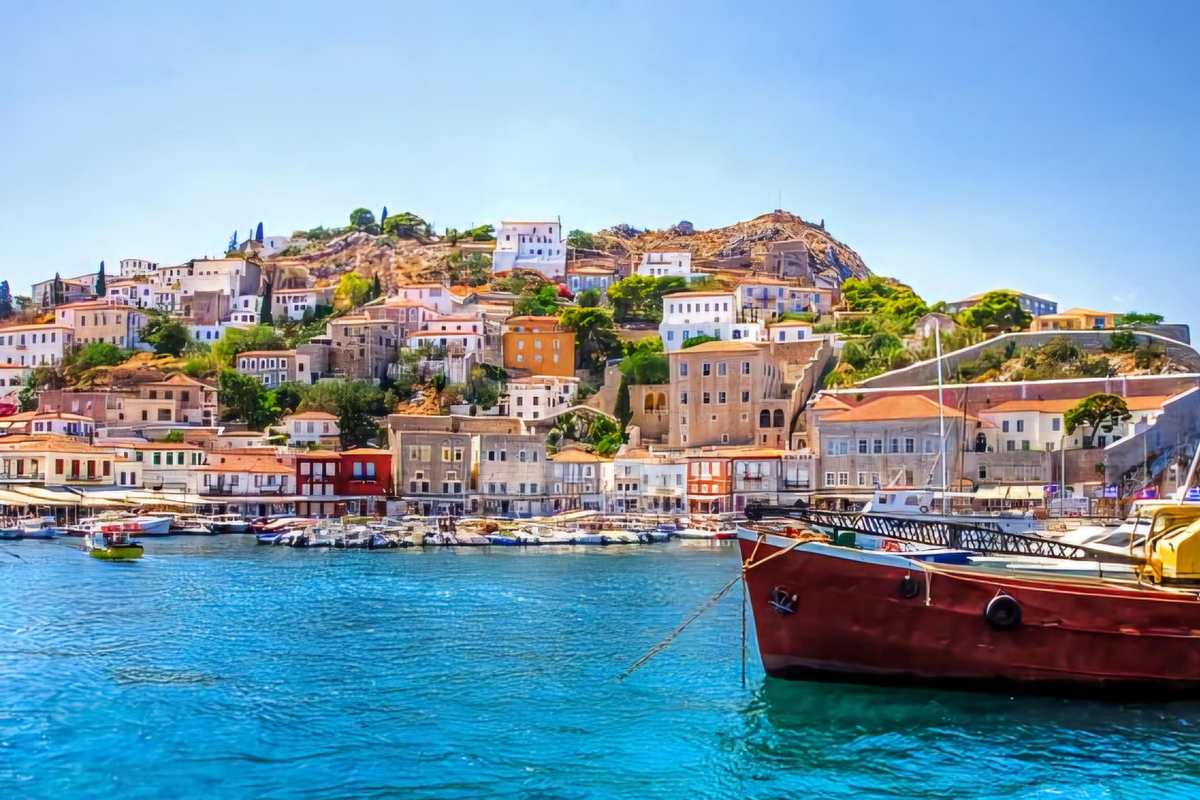
Greece island hopping tours also take place among the Saronic Islands, and Hydra is one of that group. The Myrtoan Sea washes one side of the island, and the Argolic Gulf the other. Gulf here means a broad stretch of sea cutting deep into a coast.
Ancient Greeks, long before Greece island hopping tours, called the island Hydrea. The name stems from the Greek word for water and points to its natural springs. The main town wraps around a harbour shaped like a crescent. A crescent is the curved shape of a young moon. Local people of the island are called Hydriots or Hydriotes.
For Greece island hopping tours, Hydra is a car-free island. The law bars wheeled vehicles from the island. The ban covers cars, motorcycles, scooters, bicycles and electric bikes alike. Horses, mules, donkeys and water taxis serve as public transport on Hydra. A water taxi is a small boat that carries passengers short distances.
Andreas Miaoulis, a Greek admiral, had settled on Hydra himself. An admiral commands a navy at sea. In the War of Independence, he used Hydriot fire ships against the Ottoman fleet. A fire ship is a vessel set alight and sent drifting into opposing ships. These attacks caused heavy losses to the Ottoman side.
- War fleet: Hydra gave about 150 ships, plus supplies, to the Greek fight for independence.
- Tsamadou mansion: This captain’s house beside the harbour entrance now holds a Maritime Academy for seafarers.
- Monasteries: Six Orthodox monasteries stand on the island, among a large number of churches.
Hydra’s cathedral holds a war story for Greece island hopping tours: the tomb of Lazaros Kountouriotis. He ranked as the richest sea captain on the whole island. He spent his whole fortune in support of the Greek War of Independence.
Why is the Temple of Aphaia on Aegina linked to Greece island hopping tours?
Greece island hopping tours and ancient religion meet on Aegina, in the Saronic Gulf. A sanctuary of the goddess Aphaia holds her temple on the island. A sanctuary is ground set apart for worship, and this temple is ancient Greek.
Aphaia was a Greek goddess worshipped at this sanctuary alone. In the past, the building was known as the Temple of Jupiter Panhellenius. Jupiter is the Roman Zeus, and Panhellenius means of all Greeks. The temple is now recognised as a Doric one built for the mother goddess Aphaia. Doric is the plainest style of Greek temple building.
The temple had six columns across each end and twelve along each side. It rested on a platform 15.5 by 30.5 metres. Every outer column except three was monolithic. Monolithic means cut from one single block of stone. Greece island hopping tours are trips from one Greek island to another, and Aegina is one such island.
Aegina links Greece island hopping tours to the Trojan wars of Greek myth. The pediments, the triangle-shaped tops at each end of the temple, shared that theme. They showed the greatness of Aegina through the deeds of its local heroes. Heracles led one war against Laomedon, and Agamemnon led the other against Priam.
- Artists: J. M. W. Turner and other Neoclassical and Romantic painters held this temple as a favourite.
- Painted figures: The pediment sculptures still carry extensive traces of a complex scheme of paint.
- Finished backs: Sculptors finished even the backs of the marble figures, though those sides faced the pediment wall.
Aegina gives Greece island hopping tours an older layer of faith. Late Bronze Age figurines, or small statues, have turned up there in large numbers. The Bronze Age was the era of bronze tools. Female figures called kourotrophoi, or child-nurturers, make up a large share.
What does the sponge-fishing past of Symi mean for Greece island hopping tours?
Greece island hopping tours stretch east to the Dodecanese, where Symi is roughly 24 km north of Rhodes. The Dodecanese is an island chain in the south-eastern Aegean Sea. Symi itself is a mountainous Greek island and a municipality.
The main town of Symi has two parts. Yialos is the lower town, built around the harbour. The upper town carries the names Horio and Ano Symi. Ano is the Greek word for upper. Neoclassical mansions in bright colours line the hills around the main town. They date from the mid-19th century, the peak of the island’s wealth.
Symi brings Greece island hopping tours the story of a sea trade. Shipbuilding and sponges once formed the base of the Symi economy. A sea sponge is a simple sea animal with a soft body, prized for washing. At one stage, no place in the world had a bigger sponge fishing fleet than Symi.
In 1913, Stathis Hatzis of Symi went down 87 metres on one breath of air. Hatzis had no air tank or air pipe, only the breath in his lungs. The island adds this deep diver to the story of Greece island hopping tours. Symi lists him among its notable people.
- Knights: The Knights of St John, a Christian military order, took control of Symi in 1309.
- Ottoman rule: The Ottoman Empire conquered Symi in 1522 but let the island keep its old privileges.
- Union with Greece: In 1948, Symi became part of Greece, the country it belongs to today.
Tourism is now the main industry of Symi, and Greece island hopping tours belong to that trade. In 2021, the permanent population had fallen to 2,603. A permanent population means people who live there all year. More people stay on the island in summer.
What sacred tale links the Patmos Cave of the Apocalypse with Greece island hopping tours?
Greece island hopping tours in the Dodecanese have a sacred side on Patmos. The Cave of the Apocalypse sits midway up its mountain. The cave lies between the villages of Chora and Skala. Apocalypse is a Greek word meaning revelation, or the uncovering of something hidden.
Christian tradition holds that John of Patmos had his visions in this grotto. Grotto is another word for a small cave. John wrote the visions down in the Book of Revelation, part of the Bible. Other names for him are John the Divine, John the Theologian and John the Revelator. A theologian studies God and religious belief.
In the 1st century, long before Greece island hopping tours, Rome exiled followers of Christ to Patmos. Domitian was the Roman emperor at that time. Banishment, or sending people away, was then a common penalty for offences like magic or astrology. Astrology is the belief that stars and planets shape human lives.
Over time, the cave turned into a goal of Christian pilgrimage. Pilgrimage means travel to a holy site for reasons of faith. Pilgrims are the travellers who make such journeys. Greece island hopping tours are a different kind of trip, across the islands for leisure. Today the cave still serves as a Greek Orthodox church.
- Resting place: Tradition places the resting spot of the aged John in a hollow of the cave wall.
- Scroll ledge: A natural ledge in the rock is thought to have held his scroll.
- World Heritage: In 1999 UNESCO, the cultural body of the United Nations, made the cave a World Heritage Site.
Patmos gives Greece island hopping tours a second sacred landmark, Saint John the Theologian’s monastery. Founded in 1088, it crowns the highest point of Patmos. The monastery honours John, the same saint who is linked to the cave.
What do travellers ask about Greece island hopping tours, and what are the answers?
Greece island hopping tours move across the Aegean Sea. Its island groups include the Cyclades, the Dodecanese and the Saronic Islands. The Cyclades form an archipelago southeast of the Greek mainland. An archipelago is a chain or scatter of islands across one sea.
Before Greece island hopping tours, what does the name Cyclades mean?
The name Cyclades points to a ring of islands around Delos, which ancient Greeks held sacred. The word comes from the Greek verb for circling, a relative of the English word cycle. The group holds about 220 islands. Major ones include Amorgos, Ios, Kea, Mykonos, Paros, Sifnos, Syros and Tinos.
For Greece island hopping tours, what is the Dodecanese?
In the south-eastern Aegean, the Dodecanese group joins 15 large islands with 150 smaller ones. They lie off Anatolia, the Asian part of Turkey. Of all these islands, 26 are inhabited. The name means twelve islands in Greek. Rhodes has held first place in the group since ancient times.
Within Greece island hopping tours, what are the Saronic Islands?
The group is named after the Saronic Gulf, which holds these islands just off the Greek mainland. Four main islands have people living on them: Salamis, Aegina, Agistri and Poros. Salamis is the largest of the group. In 480 BC, a Greek fleet beat the Persian navy there, at the Battle of Salamis.
On Greece island hopping tours, what is the meltemi?
Meltemi is the Modern Greek name for the etesians. These strong, dry winds come down from the north over the Aegean Sea. The word etesian goes back to etos, the Greek word for year. The name meltemi seems borrowed from Italian, where mal tempo means bad weather.