
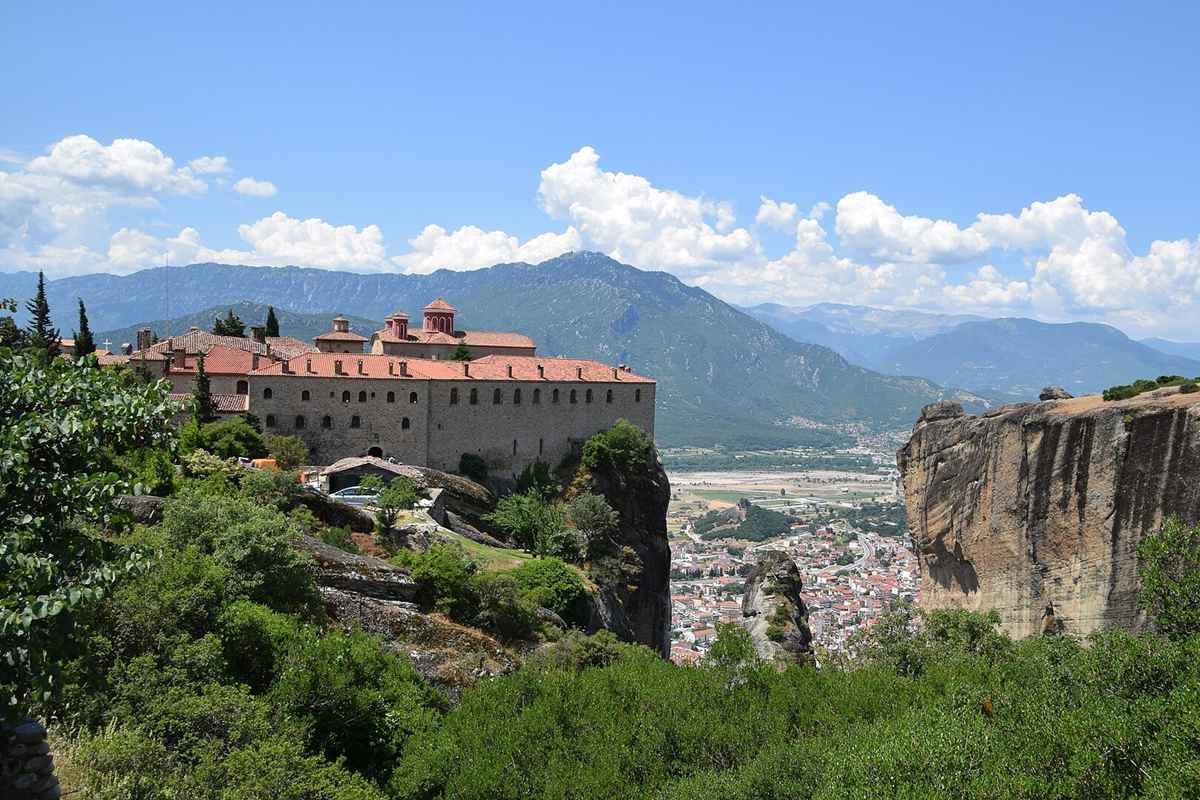
Greece religious tours follow Orthodox faith across mainland Greece and the islands, as trips led by a host. Mainland sections cover Agia Lavra, Saint Andrew in Patras, Agios Dionysios on Mount Olympus and Souroti. Molyvdoskepastos near Konitsa and the Kosmosoteira at Feres follow. Island sections turn to Nectarios of Aegina, the El Greco icon on Syros and Saint Markella of Chios. Related pages are the Footsteps of Paul tour, the Meteora tour from Athens and Greek Easter traditions. Wider trips appear under Greece tours.
Bookings made through the GetYourGuide widgets on this page earn Classical Greece Tours a commission, at no extra cost to the traveller.
What are Greece religious tours?
Greece religious tours move through a country where Christianity dominates religious life, each trip led by a host. The Greek Orthodox Church stands at the centre of that Christian world. It belongs to the wider Eastern Orthodox communion, a family of churches sharing one faith.
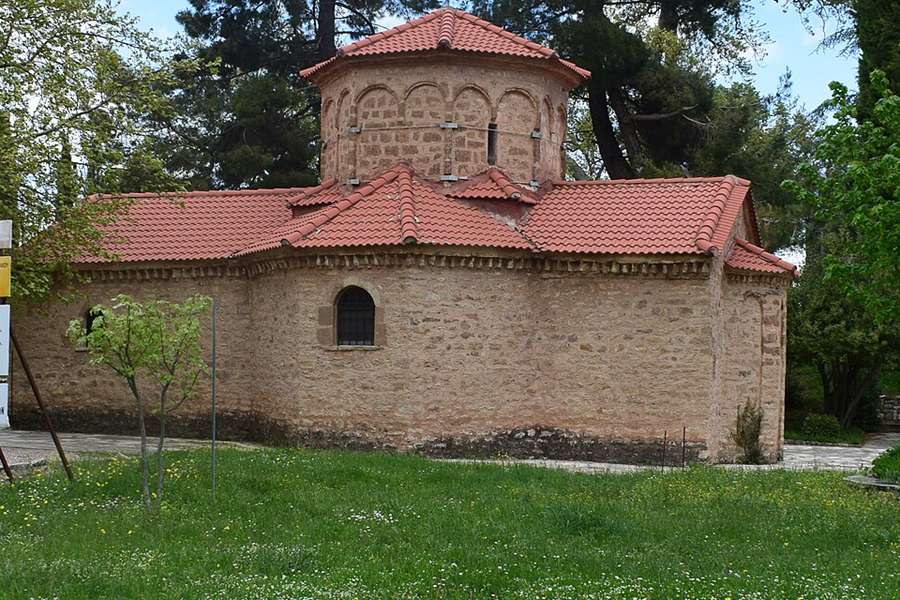
Greece religious tours unfold where Eastern Orthodoxy made up 81 to 90% of the population in 2022. Eastern Orthodoxy is the Christian tradition shared by the Orthodox churches of the East. In a survey run from 2015 to 2017, 76% of Greeks said Christianity defines their nationality. Nationality means membership of a nation.
Since 1850, the Church of Greece has handled Orthodox affairs inside the country. Pupils in primary and secondary schools attend Christian Orthodox lessons, though an exemption system exists. An exemption is a formal release from a rule. Greek Muslims, one of the smaller faith communities, live mostly in the region of Western Thrace.
Greece religious tours take place under a constitution that guarantees freedom of religious belief for all. Roman Catholic Greeks live mainly in the Cyclades and the Ionian Islands. Their presence on those islands is largely a legacy of Venetian rule in the Middle Ages. A legacy is something handed down from earlier times.
- Romaniotes: These Jewish communities of Greece trace their roots back to Antiquity, the ancient world.
- Sephardim: Jews who came from Spain settled chiefly in Thessaloniki during the Ottoman era.
- Armenians: An Armenian presence in Greece reaches back centuries, to the Byzantine period of the eastern Roman Empire.
The Jewish community lives mainly in Athens, Thessaloniki, Volos, Larissa, Ioannina, Chalkis, Corfu and Trikala. Greek Catholics of the Byzantine Rite mostly live in Athens. On Greece religious tours, the word rite means a fixed form of worship and prayer.
Which story ties Agia Lavra to Greece religious tours?
Greece religious tours draw on the story of Agia Lavra, an Eastern Orthodox monastery near Kalavryta in Achaea. The name means Holy Lavra, and a lavra is a large community of monks. The monastery is seen as the symbolic place where modern Greece was born.
Builders raised the monastery in 961 AD on Chelmos Mountain. AD marks a date in the Christian era. The site lies 961 metres above sea level. The Peloponnese, the southern peninsula of Greece, counts Agia Lavra among its oldest monasteries. On Greece religious tours, a monastery means a house where monks share a life of worship.
Fire razed Agia Lavra in 1585, and builders restored it in 1600. The painter Anthimos completed its frescoes in 1645. A fresco is a painting on damp plaster. Flames struck again in 1715 and in 1826, when troops under Ibrahim Pasha of Egypt set it alight. A pasha held a high Ottoman rank.
For Greece religious tours, Agia Lavra is famous for its link with the Greek War of Independence. Here, on 25 March 1821, the cry Eleftheria i Thanatos, meaning freedom or death, was first heard. That day Bishop Germanos of Patras led a doxology, a hymn of praise to God. He then put fighters from the Peloponnese under oath.
- Museum: The robes of Bishop Germanos, books, icons or holy pictures, and a Gospel of Catherine II survive.
- Relics: These holy remains of St Alexios were a gift of emperor Manuel II Palaeologus in 1398.
- Embroidery: Gold or silver thread on pure silk, worked in Smyrna and Constantinople, dates from the 16th century.
In 1850, after modern Greece was reborn, Agia Lavra was rebuilt in full. German forces burned the monastery down in 1943, and it was restored afterwards. For Greece religious tours, a memorial on the hill opposite honours the fighters of 1821.
How does the Cathedral of Saint Andrew in Patras fit into Greece religious tours?
Greece religious tours look to Patras for the Cathedral of Saint Andrew. With the old church of St Andrew nearby, it forms a place of pilgrimage for Christians worldwide. Pilgrimage means travel to a sacred site as an act of faith.
For Greece religious tours, the cathedral’s patron is Saint Andrew, known as the First-called Apostle of Christ. An apostle was one of the first followers sent out to spread the teaching of Jesus. Building began in 1908 under the architect Anastasios Metaxas, with Georgios Nomikos taking over later. The church opened 66 years afterwards, in 1974.
On Greece religious tours, the cathedral measures about 60 m in length and 52 m in width. It holds up to 7,000 people. The ground floor area reaches 1,900 square metres, and the upper level adds 700 more. That level serves as a gynaeconitis, a gallery for women at services.
A gold-plated cross 5 metres long rises over the central dome. A dome is a curved roof like an upturned bowl. Twelve smaller crosses sit on the other domes. The crosses stand for Jesus and His apostles. Byzantine-style wall paintings and mosaics decorate the church. Mosaics are images built up from tiny cubes of glass or stone.
- Relics: A shrine holds the little finger, part of the skull top and pieces of the apostle’s cross.
- Skull: Pope Paul VI had the skull sent from Rome, from St Peter’s Basilica, in September 1964.
- Handover: Cardinal Bea led 15 cardinals, senior Catholic clergy, who handed it to Bishop Constantine on 24 September 1964.
During the Crusades, the Duke of Burgundy took the cross of St Andrew from Greece. Its parts stayed in the Abbey of St Victor in Marseille from the Middle Ages. For Greece religious tours, 19 January 1980 is the date those parts came back to Patras.
Why does Agios Dionysios Monastery on Mount Olympus matter to Greece religious tours?
Greece religious tours turn to Agios Dionysios on Mount Olympus, the leading monastery of the Pieria area. Today it is stavropegic, meaning it answers directly to the Patriarch of Constantinople. A patriarch is the chief bishop at the head of a church.
For Greece religious tours, Agios Dionysios is one of the Olympus monasteries, with Kanalon and Agia Triada, Sparmos. Over time, the name of the founder, Saint Dionysios of Olympus, came to prevail. Prevail here means that his name won out over any other. The church gives the title saint to a person it honours for a holy life.
Saint Dionysios’s chapel lies on the Enipeas River, beneath an overhanging rock. It sits just above a spring, where water rises from the ground. Its small devotional space is where the saint led the liturgy as a hermit. A hermit lives alone for prayer. The liturgy is the main act of Orthodox worship.
For Greece religious tours, the Metochion, a farm holding of the monastery, dates back to 1650. It had farmland, a church, work buildings and a house where the monks lived. In the newer complex, a heavy iron door closes off the older part. Just outside stand the stables, workshops and a cheese factory.
- Marquetry: Inlaid woodwork on church chairs and consoles uses inserts of ivory and mother-of-pearl.
- Requests: Beside a picture of Jesus rising from the dead lies a basket of notes and pens.
- Shed: The chapel also has a small shed that served the saint as a place to sleep.
In troubled times, monks hid treasures in secret vaults around the old and new monasteries. Greece religious tours note three silver skulls in the museum, each holding bone pieces of saints. Arsenius, a Meteora monk, made a gold-embroidered epitaph, a burial cloth, in 1578-79.
What links the Souroti nunnery with Greece religious tours?
Greece religious tours around Thessaloniki point to Souroti, a place just outside the city. There stands a Greek Orthodox nunnery dedicated to St John the Theologian. A nunnery is a house of nuns, women who share a life of prayer under religious vows.
Paisios of Mount Athos helped found the monastery in 1967. Philothei of Souroti has served as its hegumen since that same year. A hegumen is the head of an Orthodox monastic house. Philothei is a disciple, or pupil, of Paisios. For Greece religious tours, the nunnery also runs a publishing house for books in Greek and English.
His bond with the young sisterhood began in 1966, while he was in hospital for lung surgery. A sisterhood is a community of nuns. During the operation, novices from the monastery gave blood to save him. Novices are newcomers training for full vows. After recovering from cancer surgery in 1993, he was moved to the Souroti house.
Paisios asked Philothei to carry his wish for burial at Souroti to the local metropolitan, who agreed. A metropolitan is a senior Orthodox bishop over a region. Paisios died on 12 July 1994. Greece religious tours note his burial beside Arsenios the Cappadocian, whose life story Paisios had written.
- Relics: Paisios himself brought the remains of Arsenios the Cappadocian to rest in this house.
- Birthplace: Paisios came into the world on 25 July 1924 in Pharasa, Cappadocia.
- Baptism: Arsenios the Cappadocian baptised the baby and gave him his own name, Arsenios.
The Ecumenical Patriarchate’s Holy Synod, a ruling council of bishops, declared Paisios a saint on 13 January 2015. On 17 January 2015, faithful from across the Balkans travelled to Souroti on pilgrimage. Greece religious tours recall the five nights of continuous prayer that followed.
How does the Molyvdoskepastos monastery near Konitsa enrich Greece religious tours?
Greece religious tours in Epirus single out Panagia Molyvdoskepastos, a male Greek Orthodox monastery near Konitsa. Panagia, the All-Holy, is how Greek speakers honour the Virgin Mary. The house stands 400 m from the meeting of the Aoos and Sarantaporos rivers.
For Greece religious tours, the site lies 55 km from Ioannina and 20 km from Konitsa. It stands only hundreds of metres from the border with Albania. It stands at the base of Mount Meropi-Nemertsika. Its setting and long history rank it among the leading monuments of the wider Epirus region.
An inscription of 1561 says Emperor Constantine Pogonatos founded the monastery in the 7th century. An inscription means lettering on stone. The archbishop of Pogoniani had his seat here, when the place was called Depalitsa or Dipalitsa. An archbishop is a high-ranking bishop. The catholicon, or main church, dates to the 13th or 14th century.
For Greece religious tours, Molyvdoskepastos under Ottoman rule was a spiritual, cultural and economic centre. A school for scribes opened here during the 14th century. Scribes are people who copy books by hand. Priest-teachers trained both monks and lay people in copying manuscripts. Lay people are believers who are not clergy.
- Estates: The monastery held large dependencies, or metochia, in the Danubian Principalities.
- Pazari: A large market district outside the north-western walls, still called Pazari, supported its finances.
- Revival: In 1988 a brotherhood of monks returned, encouraged by Saint Paisios the Athonite.
Around 1521, villagers of old Pogoniani renovated the main church and added a three-part narthex, or entrance hall. The painter of 1521-2 stayed unnamed and signed that God knew whose labour it was. For Greece religious tours, 1537 brought new paintings by Eustathios Iakovou from Arta.
Why does the Theotokos Kosmosoteira of Feres belong on Greece religious tours?
Greece religious tours in Western Thrace keep a place for the Theotokos Kosmosoteira at Feres, in Evros. It is a Greek Orthodox church. The name means Theotokos the World-Saviour. Theotokos is Greek for God-bearer, an Orthodox title of the Virgin Mary.
Isaac Komnenos, whose father was the Byzantine emperor Alexios I Komnenos, built it as a monastery around 1152. He held the rank of sebastokrator, a high Byzantine court title. He meant the house as his home and his final resting place. The site, called Bera after a Slavic word for marsh, was then empty and overgrown.
Greece religious tours credit Isaac with its rules, the typikon, modelled on the Theotokos Euergetis Monastery. He planned a cenobitic house for 74 monks, all over 30 years old. Cenobitic means that the monks share their meals, work and prayer. Of the 74, 50 were choir brothers, freed from manual work to serve at church services.
Greece religious tours note a double fortified wall, with gates and towers, that once ringed the complex. Three of its corner towers survive in fair condition. Inside stood a water cistern, a mill and a library. A hospital of 36 beds cared for the elderly. Its bathhouse was open to local villagers.
- Bridges: Isaac had two bridges built across the Evros river, and the abbot kept them in repair.
- Mosque years: By 1433 the main church served as a mosque named the Suleyman Pasha Mosque.
- Size: The main church measures 23 by 17 metres and rises 17 metres high.
After the area became part of Greece in 1920, the church was restored and blessed anew in 1940. For Greece religious tours, its 12th-century wall paintings rank as a fine example of the Constantinopolitan School. That school was the painting style of the imperial capital.
Which story does Nectarios of Aegina bring to Greece religious tours?
Greece religious tours unfold in the land of Nectarios of Aegina. His feast day falls every year on 9 November. A feast day is a fixed yearly date of church honour. Crowds from every part of Greece and Egypt came to his funeral.
At the age of 14, Nectarios moved to Constantinople, the city known today as Istanbul. He went there to find work and to carry on his education. Greece religious tours cross the land where Nectarios, aged 20, took a teaching post on Chios in 1866. A teaching post is a paid job as a teacher.
Three years after he became a monk, he was made a deacon under the name Nectarios. A deacon is a church officer ranked below a priest. In Alexandria he became a priest and later served at Cairo’s Church of Saint Nicholas. His work as a bishop in Cairo went on for one year.
Back in Greece from 1891, he worked as a preacher until 1894. In 1911 Nectarios made two women deaconesses, the female form of deacons. Greece religious tours run through a country where a woman became a deacon by his rite in 1986. That rite followed an old Byzantine text, from the age of the Eastern Roman Empire.
- Relics: His relics, the holy remains of a saint, were lifted out of the grave on 2 September 1953.
- Parents: Dimos and Maria Kephalas, his father and mother, were devout Christians with little money.
- Deaconesses: Until the 1950s, a small number of Greek Orthodox nuns took the role of monastic deaconess.
Greece religious tours share a country with the Holy Trinity Convent on Aegina. There Nectarios wrote, published, preached and heard confessions. A confession is a private admission of wrongs to a priest. He was later declared a saint in Saint George’s Cathedral, Istanbul.
What does the El Greco icon of the Dormition on Syros give Greece religious tours?
Greece religious tours belong to the country where an El Greco icon is still venerated on Syros. Its home is the Church of the Dormition. To venerate means to honour with prayer. Dormition means the falling asleep, or death, of Mary.
El Greco made the work near the end of his years on Crete. Its date is thought to be before 1567. He painted it in tempera on a wooden panel. Tempera is paint bound with egg yolk. Greece religious tours cover the country where, experts now say, El Greco learnt his craft on Crete.
His signature appears at the foot of the central candelabrum, a branched candle holder. Greece religious tours cross a country where that signature came to light in 1983. The find led experts to credit El Greco with three more works signed Doménicos. More works then joined his list, such as the Passion of Christ from 1566.
The icon follows the set pattern for this subject closely, a pattern common in the Orthodox Church. Greece religious tours move through the Orthodox world in which El Greco was raised. Even so, the panel loses part of the strict Byzantine plainness and borrows traits from Renaissance engravings. An engraving is a print made from lines cut into metal.
- Style: The panel blends post-Byzantine features with Italian Mannerism, a late Renaissance style of stretched forms.
- Research: The discovery marked a big step in understanding how El Greco trained and began his career.
- Early works: His early paintings come from Crete, from his time in Venice and from his stay in Rome.
The icon is thought to have reached Syros during the Greek War of Independence. Writer Robert Byron called the Dormition type the model for El Greco’s Burial of the Count of Orgaz. Marina Lambraki-Plaka also believes a link between the two works exists.
How does the icon painter Emmanuel Tzanes connect with Greece religious tours?
Greece religious tours unfold in the homeland of Emmanuel Tzanes, a Renaissance icon painter from Rethymno on Crete. Icons are sacred painted images of holy figures. He was also an author and a teacher, and he became a priest before 1637.
When Rethymno came under Ottoman rule in 1646, Tzanes left Crete. He spent eight years on the island of Corfu. There he painted icons, at times working with the painter Philotheos Skoufos. Greece religious tours span a country where his 1649 Saint Jason icon stays in a Corfu church.
Tzanes moved to Venice early in 1655 and stayed in the city until his death. In 1660 Skoufos gave up his post at the Greek church of San Giorgio dei Greci. The name means Saint George of the Greeks. Tzanes then took over as its priest. His best-known work, The Holy Towel, was finished in 1659.
More than 130 of his paintings survive, dating from 1636 to 1689. He painted for Catholic and Greek Orthodox clients alike. His works run from small icons and triptychs up to large paintings and sanctuary doors. A triptych is a three-panel hinged picture. Greece religious tours travel a country whose churches and monasteries hold his surviving works.
- Portraits: His paintings bear dates and frequently include portraits of the clients.
- Legacy: His influence appears in works of the later Heptanese school, the art of the Ionian Islands.
- Subjects: He regularly painted Saint Alypius the Stylite, a holy man who lived on a pillar.
Greece religious tours cross a nation in which the Museum of Zakynthos keeps his 1641 Theotokos Amolintos. Theotokos is Greek for God-bearer, a name given to Mary. Amolintos means spotless. He died on 28 March 1690. As parish priest in Venice, he conducted twenty-six marriages.
Why does Saint Markella of Chios matter on Greece religious tours?
Greece religious tours belong to a country where a church now stands over Saint Markella’s cave on Chios. The Greek Orthodox Church canonised her, which means it formally named her a saint. Her mother raised her as a devout Christian.
The synaxarium of 1810 said that her life and death were unknown. A synaxarium is a church book of saints’ lives for each day. Leo Allatius also named her in 1648 but gave no details of who she was. For Greece religious tours, her birth date near 1500 appears in records only from the 1860s.
Tradition says she escaped into the nearby mountains and took cover in a bush. Local people believe her blood stained the rocks by the shore. At a set time during her feast, they say, the blood shows again on those rocks. Greece religious tours happen in a country where, by tradition, her head floated to nearby Komi beach.
In one story, Italian sailors saw the head on the water, lit by floating candles. Local tradition also says the rock-pool water feels very warm to pilgrims of strong faith. On her nameday, the sea is said to boil. A nameday is the feast of the saint whose name a person bears.
- Icon: Her icon is held in very high honour and is said to work miracles.
- Hymn: Her hymn, called an apolytikion, praises her as a rose of piety and a sprout of Chios.
- Pilgrims: Pilgrims, believers on a journey of faith, come every year for her memorial services.
Markella lost her mother young but kept up her Bible study and her prayers. Greece religious tours are journeys through a country where the 1868 synaxarium noted only her worship on Chios. Tradition says the rocks opened at her prayer to shelter her.
For Greece religious tours, who was John the Russian of Prokopi on Euboea?
Greece religious tours share the country of Prokopi on Euboea. There the relics of John the Russian rest in his church. Relics are the remains of a holy person. Believers hold that his relics are incorrupt, which means they have not decayed.
For Greece religious tours, his story starts around 1690 in the Cossack Hetmanate, in the Russian Tsardom. He joined the army of Peter the Great. He fought in the Russo-Turkish War of 1710 to 1711. Captured in that war, he was sold to an Ottoman cavalry chief who lived in Ürgüp, Cappadocia.
In Ürgüp he worked as a groom, a person who cares for horses, and slept in the stables. Each night he slipped away unseen to St George’s cave-church. There he prayed the All-Night Vigil, a service held through the night. Every Saturday he received Holy Communion, the Christian rite of bread and wine.
In time his master and the whole household came to respect him. His master offered to free him and give him a separate house, but John refused. Even Muslims began to call him a Wali, a saint in Islamic thought. Greece religious tours cover a country where his right hand rests at St Panteleimon Monastery, Mount Athos.
- Death: He died on 9 June 1730, after he had received Holy Communion.
- Burial: His first grave lay inside St George’s church at Prokopio in Cappadocia, now Ürgüp.
- Healing: Traditions say this saint gives special help to sick children and to people with cancer.
Greece religious tours run in a country that became a new home for his relics in 1924. That year the Greeks were expelled from Turkey and carried the relics to Euboea. A wooden church in his name went up in Moscow in 2003–2004.
Where does the Keras Kardiotissas Monastery fit among Greece religious tours?
Greece religious tours share Crete with the Keras Kardiotissas Monastery. It stands near the village of Kera, in the Heraklion region. Today the house serves as a nunnery, a home for nuns. Nuns are Christian women who live under religious vows.
Its official name is the Monastery of Agios Ioannis Kapsas, though people also call it the Keras Monastery. Agios means saint, so Agios Ioannis is Saint John. The house sits on Mount Dikti’s northern side, 650 metres up. Greece religious tours range over a country where this house is dedicated to the Virgin Mary.
The monastery takes its name from an old icon of the Theotokos, the Mother of God. Tradition calls that icon miraculous. It also names St Lazaros, a monk and icon painter of the Iconoclasm era, as its painter. Iconoclasm was a period when religious images were banned in the Byzantine Empire. A newer icon took its place in 1735.
During the Ottoman period on Crete, the monastery served as a local centre of revolt. It suffered attacks in return. In 1720 it became stauropegic, a word meaning free from the control of the local bishop. Greece religious tours take shape in a land where fortified walls ring this Byzantine-style house.
- Murals: The main church, or katholikon, keeps murals, or wall paintings, made in the 14th and 15th centuries.
- Museum: The monastery also keeps a small museum devoted to religion.
- Narthex: The sides of the narthex, or entrance hall, show blind brick arches in the Byzantine manner.
Of the first monastery, only the katholikon still stands. It began as one arched hall, later gaining two narthexes and a small chapel. Greece religious tours are rooted in a land where its icon hangs left of the iconostasis. That word names an icon-covered screen.
What do travellers ask about Greece religious tours, and what are the answers?
The Greece religious tours of today share their country with Saint Titus Cathedral in Heraklion, Crete. Its current building went up in 1869 as a mosque, the Yeni Cami or New Mosque. In 1925 it became a Christian church, and in 2013 a cathedral.
Before Greece religious tours, who were Raphael, Nicholas and Irene of Lesbos?
A legend from the 20th century says the three lived on Lesbos and died there in April 1463. Their story first came to light in 1959. Villagers then said the saints had appeared to them in dreams. Their relics now lie in a rebuilt monastery on Karyes hill, 3 km from Thermi.
Ahead of Greece religious tours, who was Christodoulos of Patmos?
Before Patmos, Christodoulos lived as a monk on Mount Latrus and on Kos. His Monastery of Saint John the Theologian rose where a chapel of Saint John already stood. Tradition puts a shrine of the goddess Artemis on that spot. He later withdrew to Euboea and died there on 16 March 1093.
Regarding Greece religious tours, what is the Arkoudiotissa Cave on Crete?
Arkoudiotissa, a name meaning she-bear, is a cave in the Akrotiri area of Crete. Finds show that Artemis and Apollo were worshipped there in ancient times. In the Christian era, the cave was dedicated to Panagia, the Virgin Mary. Beyond it, St John the Hermit founded the Katholikon, a church largely carved into the cliff.
Within Greece religious tours, what is the Evangelistria Monastery of Skiathos?
Officially, it is called the Monastery of the Annunciation. That feast marks the angel’s message to Mary about the coming birth of Jesus. Kollyvades monks who had left Mount Athos after disputes over ritual founded it under Niphon of Chios. Its wooden iconostasis, a screen of icons, holds icons from the 17th and 18th centuries.
Featured photo: LucT, CC BY-SA 3.0, via Wikimedia Commons (File:Stefanos Monastery, Meteora – panoramio.jpg).