
Greece wildlife tours are trips that centre on wild animals, with a host in charge. Their settings range from the Greek mainland to the islands and the surrounding seas. The topics start with the Greek meadow viper, the fallow deer of Rhodes and the Cretan shrew. Cuvier’s beaked whale, the Skyros wall lizard, the chameleon of Samos and Gyaros follow. Nearby subjects are national parks in Greece, Greece family tours and Greece kayaking tours. Other trips sit under Greece tours.
Bookings made through the GetYourGuide widgets on this page earn Classical Greece Tours a commission, at no extra cost to the traveller.
What are Greece wildlife tours?
Greece wildlife tours explore a country with 115 mammal species on the Red List. That list is a world register that grades animals and plants by their risk of dying out. Dolphins hold the title of national animal of Greece.
Whales, dolphins and porpoises form one order of sea mammals, known as cetaceans. An order is a broad rank used to sort related animals. Greece wildlife tours take place on coasts that line the far eastern Mediterranean basin. Fewer cetacean species live there regularly than in the western basin of that sea.
Greece wildlife tours cover a land of 70 reptile species, by the Red List count. A national atlas of amphibians and reptiles counts 76 instead. Eleven of these reptiles are endemic, which means they live in Greece and nowhere else. Three Greek reptiles carry the endangered grade for species at very high risk of dying out.
Of the Greek mammals, two rank as endangered, twelve as vulnerable and six as near threatened. In Red List terms, vulnerable marks a species facing a high chance of vanishing from the wild. Near threatened marks a species close to qualifying for that grade. Endangered is the higher grade, above vulnerable.
- Ground squirrel: The European ground squirrel, a rodent, carries the endangered grade on the Greek mammal list.
- Porpoise: The Black Sea harbour porpoise, a cetacean, is also graded endangered in the Greek list.
- Fruit bat: The Egyptian fruit bat, from the family of flying foxes, appears on the Greek mammal list.
Greece wildlife tours run in the country of the Hellenic Trench, a long trough in the sea floor. The deep basins of the trench are home to whales and dolphins. Ship traffic in the eastern Mediterranean threatens the endangered ones among them.
Where does the Greek meadow viper fit into Greece wildlife tours?
Greece wildlife tours cover a country that shares the Greek meadow viper with neighbouring Albania. The snake takes its name from the Greek meadows where it lives. Like every viper, it is venomous, so its bite delivers a toxic fluid.
Among the reptiles of Greece wildlife tours, this viper stays small. Its snout-vent length tops out at 40 to 44 centimetres. That measure runs from the nose tip to the vent, the opening under the tail. Females grow larger, while males carry longer tails. The tail itself reaches up to 4 or 5 centimetres.
The belly is white or brownish grey, and a sharp zigzag pattern marks the body. It is commonest at 1,600 to 2,300 metres in the Hellenides, the mountains of Greece. Its other stronghold is the centre of the Pindos range. The Pindos is the long mountain spine of western mainland Greece.
Greece wildlife tours unfold in a land where this snake feeds mainly on insects. Its commonest prey are grasshoppers that buzz their wings, along with bush crickets and wart-biters. All three belong to the Orthoptera, an insect order whose name means straight wings. A wart-biter is a type of bush cricket.
- Status: The Red List of threatened species places the Greek meadow viper in its endangered grade.
- Climate: Its mountain home averages about 6 °C a year, and snow lies there until summer.
- Recognition: In 2020 the European species list of reptiles and amphibians named it a separate viper species.
Greece wildlife tours are set in the home of a viper with three known predators. They are the red fox, the common kestrel and the short-toed snake eagle. A kestrel is a small falcon. A snake eagle is an eagle that feeds mainly on snakes.
What links the European fallow deer of Rhodes to Greece wildlife tours?
Greece wildlife tours link to the European fallow deer through Rhodes, an island near Anatolia. The name Anatolia refers to the Asian landmass of Turkey. The species is historically native to Turkey. Rhodes, the Balkan Peninsula and Italy are possible native homes as well.
Greece wildlife tours draw on an old tradition that people brought fallow deer to Rhodes in the Neolithic. That period, the New Stone Age, saw the first farmers. Fossils of the species on the island reach back to that age. Yet no sign of taming has turned up, so the herd can be seen as native.
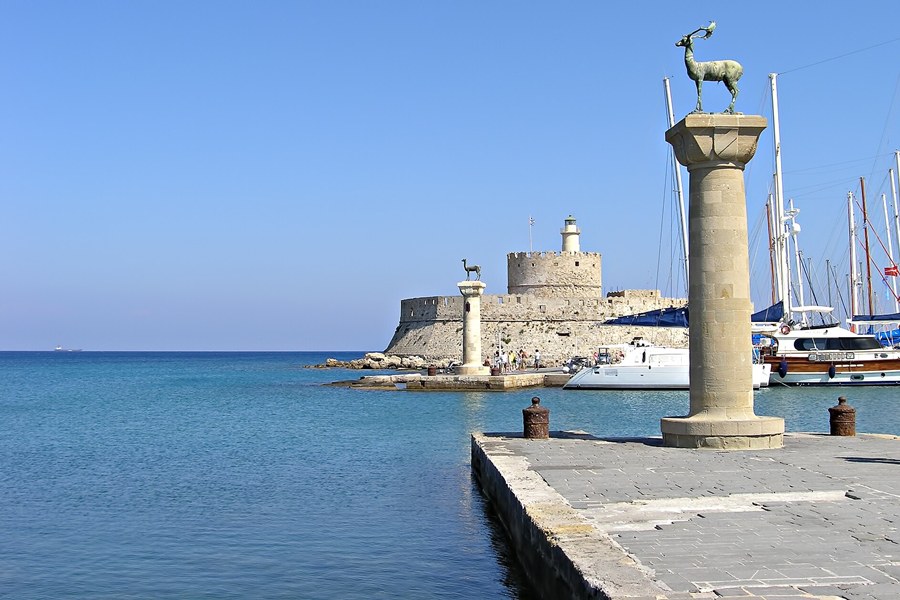
A pair of deer statues, a buck and a doe, guards the harbour entrance of Rhodes town. Buck is the word for a male, and doe for a female. The pair stands where the Colossus of Rhodes rose in ancient times. The Colossus was a giant statue of the sun god Helios.
On the Greek mainland, wild fallow deer survived in the Olympus forests into the 19th century. For Greece wildlife tours, the Vermio Mountains, Evrytania and Boeotia held deer that long as well. Hunters shot the last mainland animals in Acarnania in the 1930s. Acarnania is a region of western Greece, beside the Ionian Sea.
- Island moves: Neolithic and Bronze Age people took the deer to Crete, Chios, Lesbos and Samos.
- Ancestry: Experts trace the Rhodes herd to Balkan deer moved to the island in the Neolithic.
- Summer coat: Common coats are chestnut with white mottles, or pale blotches, in summer and darker in winter.
In the deer story of Greece wildlife tours, Rhodian animals stay smaller on average. Herds of central and northern Europe outgrow them, though the colouring matches. A handful of wild survivors were still seen on the island of Samos in 1700.
What sets the Cretan shrew apart for Greece wildlife tours?
Greece wildlife tours relate to the Cretan shrew, a small mammal found on only three mountains of Crete. Two shrews brought by people pushed it uphill. They arrived around 1500 BCE and 1300 BCE. BCE, short for Before Common Era, counts years backwards.
Greece wildlife tours point to a shrew first described in 1953. Scientists called it a subspecies, or local form, of the greater white-toothed shrew. In 1986 a study raised it to a full species. The reason was its karyotype, its set of chromosomes. The Cretan shrew has 34 pairs, against 40 in the other species studied.
Experts see a possible ancestor in Crocidura kornfeldi, an extinct shrew. It was the first shrew of its group to reach Europe. The Cretan shrew is thought to have reached Crete by rafting in the early Pleistocene. Rafting means drifting over the sea on floating plant matter. The Pleistocene was the age of the great ice sheets.
Crete once held dwarf elephants, eight kinds of Candiacervus deer and the Cretan otter. All of them died out. Candiacervus was a group of small island deer. Within Greece wildlife tours, the shrew stands as a survivor of that lost island fauna. Fauna is the word for all the animals of one area.
- Steady size: The Cretan shrew kept roughly the same size through its long history on the island.
- Predators: Owls and other hunting birds rank as the chief predators of the Cretan shrew.
- Status: Its small, broken-up range and rival shrews earn it an endangered rating.
For Greece wildlife tours, owl pellets give a measure of how rare this shrew is. Pellets are small balls of fur and bone that owls cough up after meals. The data put the lesser white-toothed shrew at more than ten times its number.
What does Cuvier’s beaked whale bring to Greece wildlife tours?
Greece wildlife tours belong to a country whose mammal list names Cuvier’s beaked whale. This is a toothed whale, one that hunts with teeth instead of filtering food from the water. Beaked whales are named for their snout, shaped like a beak.
The French naturalist Georges Cuvier described the species in 1823. He based the work on a single skull from the French shore of the Mediterranean. A naturalist is a scientist who studies animals and plants in nature. To describe a species means to give it a formal name and account.
Adult males are dark grey, with a head that is paler grey or even white. They also grow a tusk-like pair of teeth, one on each side of the lower jaw. A tusk is a long tooth that juts out beyond the lips. Tusk-like means shaped like a tusk.
Among the sea mammals behind Greece wildlife tours, this whale is a specialist squid hunter. A squid is a soft-bodied sea animal with eight arms and two longer tentacles. The species is highly sensitive to loud noise under water, above all naval sonar. Sonar finds objects under water by sending out sound waves.
- Scars: Adult males carry scars along the body, and the marks help experts identify each animal.
- Strandings: Records show more strandings, whales beached on shore, in seas full of noise, the Mediterranean among them.
- Size: Adults measure 4.5 to 8 metres and weigh 1,800 to 3,100 kilograms.
Greece wildlife tours take place along the eastern rim of the Mediterranean. That nearly enclosed sea is one of the homes of the whale beyond the open oceans. Far from Greece wildlife tours, the species roams deep offshore waters of the Atlantic, Pacific and Indian Oceans.
Which story does the Skyros wall lizard give Greece wildlife tours?
Greece wildlife tours gain an island reptile story from the Skyros wall lizard, endemic to Skyros and Piperi. Endemic means it lives there and nowhere else. Both islands lie in the Sporades, an island group of the northern Aegean Sea.
Within Greece wildlife tours, this lizard reaches a snout-to-vent length of about 8.5 centimetres. This measure covers the body alone, from the snout to the vent near the tail. The head is deep, and the tail grows to about twice the body length. Its blotchy sides frequently carry one blue spot just above the shoulder.
On small islets around Skyros, the lizard shows island gigantism. Island gigantism is the growth of an animal to a larger size when it is isolated on islands. Islets are very small islands, here the ones that cluster around Skyros. Isolation means being cut off from other groups of the same animal.
For Greece wildlife tours, its homes are shrubby Mediterranean plant cover, rocky ground and rocky shores. On Skyros and Piperi, no other small lizard lives beside it. Shrubby plant cover here means low, woody bushes spread over dry ground. Rocky shores are coasts of bare stone and boulders rather than sand.
- Name: Its species name, gaigeae, honours the American reptile expert Helen Beulah Thompson Gaige.
- Range size: The lizard occupies less than 20 square kilometres in all, yet it is common there.
- Status: The Red List rates it vulnerable, since introduced predators pose a possible threat to its survival.
The species gives Greece wildlife tours six throat colour forms, shared by females and males. These forms are morphs, fixed colour types inside one species. In these lizards, throat colour shows on the underside of the head, just below the jaw.
How does the common chameleon of Samos tie in with Greece wildlife tours?
Greece wildlife tours tie in with the common chameleon through Samos, its last Greek island. The species has vanished from the other Greek islands in recent years. A chameleon is a lizard that lives and hunts among trees and bushes.
The common chameleon, also called the Mediterranean chameleon, is native to the Mediterranean Basin. Its range also takes in lands around the Red Sea. A basin here means the whole ring of lands around a sea. Adults average 20 to 40 centimetres in length, and females are frequently much larger than males.
In the natural world behind Greece wildlife tours, the chameleon changes colour with light, heat and mood. Camouflage, the use of colour to hide, is not the main purpose. It eats insects, caught by stealth and a fast shot of its long tongue. A pad at the tip grips the prey and sticks to it.
Among the reptiles behind Greece wildlife tours, the chameleon scrambles through trees and bushes. Each foot has five toes, set in groups of two or three for gripping branches. The groups work like tongs that close around a twig. Bushes are low, woody plants with plenty of stems close to the ground.
- Europe: It is the only living chameleon whose natural range reaches into Europe.
- Eggs: Females lay eggs in the soil, and the eggs take 10 to 12 months to hatch.
- Threats: Habitat loss, cats, collection for the pet trade and road deaths threaten local populations.
For the reptile side of Greece wildlife tours, the chameleon mates from mid-July to mid-September. Mating season means the stretch of the year when adults pair up and breed. Breeding means producing young, which in chameleons hatch from eggs.
Why does Gyaros matter to Greece wildlife tours?
Greece wildlife tours take a seal refuge story from Gyaros, an island of the northern Cyclades. Once the island stopped serving as a target range, it grew into a key refuge for wild animals. A target range is an area used for firing practice.
Locals also call Gyaros by the name Gioura. The island covers 23 square kilometres. Its position and the lack of a permanent human settlement make it a safe haven for monk seals. For Greece wildlife tours, a safe haven means a place where animals rest and breed with little disturbance.
Unlike the open coasts of Greece wildlife tours, Gyaros stays closed to the public outside commemorative events. Commemorative events are gatherings held to remember people or past events. Approaching the island or fishing close to it is also forbidden. The Hellenic Coast Guard enforces that ban. A coast guard polices a country’s coastal waters.
In the first century AD, the Roman author Pliny the Elder wrote that Gyaros had a city. He put its circuit at 15 miles and its distance from Andros at 100 kilometres. The poet Ovid names Gyaros among islands that refused to back King Minos of Crete. In Greek myth, Minos ruled Crete as a powerful king.
- Strabo: The geographer Strabo spent a long stay on Gyaros in 29 BC, on his way to Corinth.
- Target range: The Hellenic Navy used the island for firing practice until the year 2000.
- Mice: Pliny also records that a plague of mice once put the islanders to flight.
In the seal story of Greece wildlife tours, protection at Gyaros came with fishing limits and seal monitoring. Monitoring means tracking whether seal numbers rise or fall over time. Fishing limits are rules that restrict where and how boats can fish.
What do travellers ask about Greece wildlife tours, and what are the answers?
The Greece wildlife tours region is home to the Milos viper. Under 4,000 adults of this snake lived in the wild as of 2022. By 2019, die-offs of the noble pen shell had been found in Greece. A die-off is a mass death.
Before Greece wildlife tours, what does the Milos viper eat?
Adult Milos vipers prey on passerine birds, the perching songbirds such as sparrows. Young vipers under 35 centimetres take European copper skinks and Milos wall lizards instead. A skink is a smooth, shiny lizard with short legs. The snake lives mainly on the ground, yet on autumn nights it climbs trees to hunt.
For Greece wildlife tours, where does Hermann’s tortoise live?
The eastern form of Hermann’s tortoise lives across the Balkans, Greece included, and into Turkey. A local form of the southwestern Peloponnese coast now counts as part of that eastern group. A tortoise is a land turtle with a domed shell. Eastern Hermann’s tortoises can reach an age of around 70 to 80 years.
Why does the noble pen shell matter to Greece wildlife tours?
The noble pen shell is a large Mediterranean clam with a shell up to 120 centimetres long. A clam is a sea animal with a shell of two hinged halves. It holds fast with a byssus, a tuft of strong silky threads. Those threads were the source of sea silk, a woven cloth.
Within Greece wildlife tours, how does the Crete spiny mouse breed?
The Crete spiny mouse carries its young for five to six weeks, a long gestation for a mouse. Gestation is the time young spend growing inside the mother. At birth, other females step in to clean and assist the mother. The newborn mice arrive well developed, with their eyes already open.