
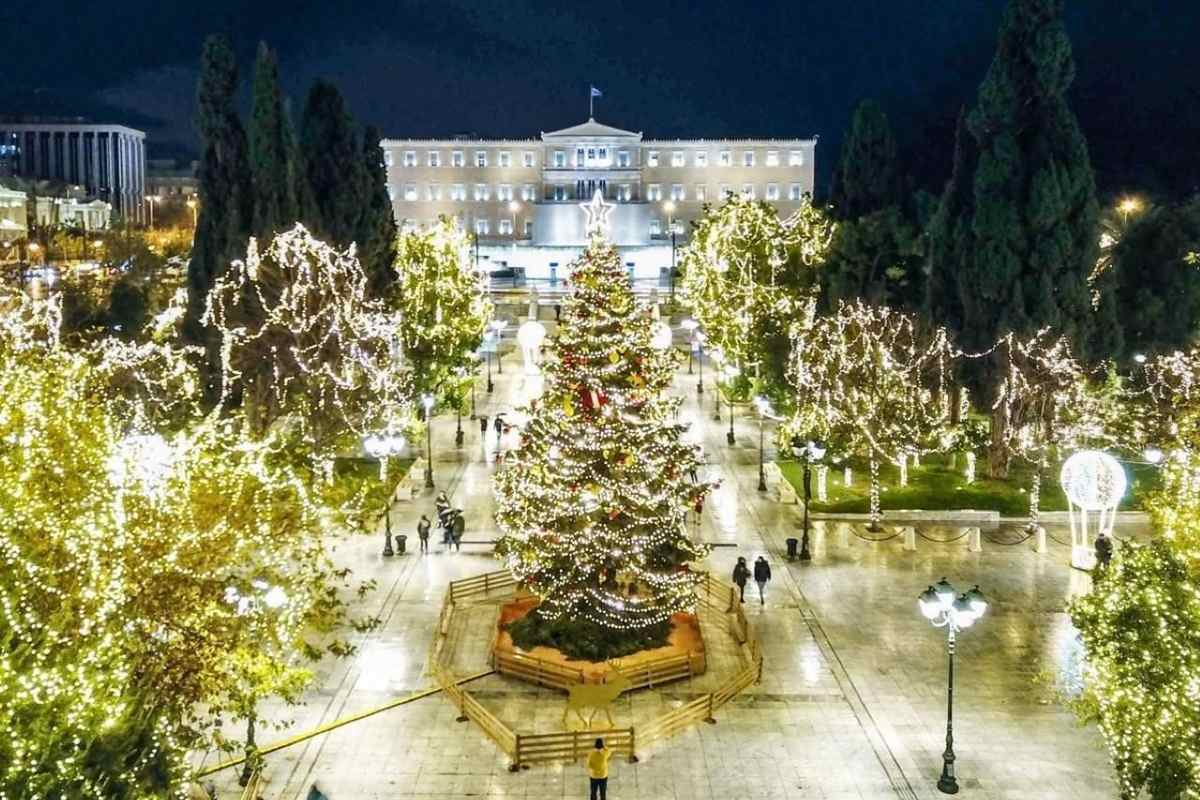
Christmas in Greece tours are small-group trips held across the mainland and the islands through the festive weeks. Topics here start with the kalanta carols and the Nativity hymn of Romanos the Melodist. Christopsomo bread, the Twelve Days and the church calendar come next. Aristotelous Square, the Mill of Elves in Trikala, the pomegranate and the Pontic momogeri follow. Related reading covers Greek traditions, Greek desserts and Greek festivals. More trips appear under Greece tours.
Bookings made through the GetYourGuide widgets on this page earn Classical Greece Tours a commission, at no extra cost to the traveller.
What is Christmas in Greece like?
Christmas in Greece joins church feasts with food and song. For the Eastern Orthodox, Christmas and Epiphany belong to the Twelve Great Feasts. Only Easter ranks above them. The Christmas dish list for Greece and Cyprus names pork or turkey.
The English word Christmas began as a shortening of Christ’s Mass. Its first part comes from Christos in Koine, an older common form of Greek. The Greek word translates the Hebrew for Messiah, and both mean anointed. The short form Xmas takes its X from chi, the first letter of Christos.
Pontic Greeks add their own customs to Christmas in Greece. They are an ethnic group from the Pontos, in modern-day Turkey. On Christmas Eve, school-age children went door to door singing carols. Church bells rang at four in the morning. Families then set a great log, the christokour, in the fire.
After the log was set, families went to the church service. People then spent three days visiting relatives and friends, with dancing and feasting. Children received small gifts. These three days of Christmas were called christoimera. Pontian cultural societies around the world work to preserve and pass on these traditions.
- Christmas bread: The dish list for Christmas in Greece and Cyprus also names Christopsomo, a festive loaf.
- Yule log: The christokour log kept the fire burning through all of Christmas Day.
- Old shorthand: English writers have shortened Christ and its compounds for at least 1,000 years.
Santa Claus, known well beyond Christmas in Greece, takes his name from the Dutch Sinterklaas, or Saint Nicholas. Nicholas was a Greek bishop of Myra in the 4th century. His feast day, 6 December, became a day of gift-giving in a number of countries.
How do the kalanta carols ring out during Christmas in Greece?
Christmas in Greece brings children with triangles to the doors of homes. On Christmas Eve, on New Year’s Eve and again on Epiphany Eve, they go from house to house. There they sing the matching folk carols, known as the kalanta or kalanda.
The word kalanta comes from the Roman calends, kalendae in Latin. Calends was the Roman name for the first day of every month. The English word calendar grows from the same root. On that day, Roman debtors had to settle what they owed, as recorded in account books.
During Christmas in Greece, each of the three great feasts has separate carols. One set greets the Nativity, meaning the birth of Jesus. Another honours Saint Basil and the New Year. A third recalls how Jesus was baptised in the River Jordan. Spring brings the Carols of Lazarus, heard on the Saturday before Palm Sunday.
In older times, carollers at Christmas in Greece received dried fruit, eggs, nuts or sweets. Across the 20th century, money gifts slowly took their place. One carol known across Greece and Cyprus comes from the Peloponnese. Its title, Christougenna, Protougenna, means Christmas, Firstmas. Another, from Constantinople, is called Kalin esperan, archontes, or Good evening, lords.
- Oldest carol: The Byzantine Carol dates by its language to about 1000 AD.
- Home town: Tradition links that carol with Kotyora in the Pontos, now Ordu in Turkey.
- Moon link: Romans saw the calends as the start of a new phase of the moon.
Christmas in Greece also hears carols from larger groups than children alone. Marching bands, choirs and school students raising money for trips or charity all go carolling. Members of folk societies and groups of well-wishers sing the kalanta too, alongside the children.
Which Byzantine hymn did Romanos the Melodist give to Christmas in Greece?
Christmas in Greece meets Byzantine church music in the Kontakion of the Nativity by Romanos the Melodist. A kontakion is a sermon in verse, set to music. This Christmas hymn is still considered his masterpiece. It opens with the words Today the Virgin gives birth.
Long before modern Christmas in Greece, a legend sets Romanos at a Nativity service around 518. During the All-Night Vigil for the feast, he served at Blachernae, in the Church of the Panagia. He was asked to read verses from the Psalms. His reading went so badly that a second reader replaced him.
Ashamed, he sat in a choir stall and fell asleep. In a dream, the Theotokos, or Mother of God, held out a scroll. She told him to eat it. On waking, he climbed the pulpit and chanted the Kontakion of the Nativity without preparation. Tradition calls it the very first kontakion ever sung.
Until the twelfth century, the hymn was sung yearly at the imperial banquet on the feast. Joint choirs of Hagia Sophia and the Church of the Holy Apostles sang it. The larger part of the poem is a conversation between the Magi and the Mother of God. The Magi were the visitors to the newborn Christ Child.
- Resting place: Romanos died in Constantinople, and his grave lay in the Church of the Virgin.
- Patmos manuscripts: Karl Krumbacher published previously unpublished chants of Romanos from manuscripts in a Patmos monastery library.
- Output: A Constantinople record of saints credits him with over 1,000 hymns, or kontakia.
For Orthodox worshippers, including those keeping Christmas in Greece, the Magi’s visit falls on 25 December. Western churches mark it on 6 January. As a rule, Orthodox services today, Christmas in Greece among them, chant only the first kontakion stanza.
What goes into Christopsomo, the festive bread of Christmas in Greece?
Christmas in Greece has its own holiday loaf, Christopsomo, which also goes by the name Christmas fruit bread. Its dough can hold cinnamon, allspice, cloves and cardamom. Mastic, a plant resin, and mahleb, a spice from cherry seeds, can flavour it as well.
Christopsomo is a type of tsoureki, a sweet holiday bread, served for Christmas in Greece. Christmas symbols and a cross are shaped from dough and set into the loaf. Figs flavour the bread. Certain recipes leave the raisins and dried figs to soak in wine overnight. Retsina and mavrodaphne are given as examples of such wines.
Greek cuisine lists this bread of Christmas in Greece among Greek Orthodox Church food customs. Mastic, one of the flavourings, is a resin also known as the tears of Chios. Under Ottoman rule, mastic from Chios fetched its own weight in gold. The Turkish name of Chios, Sakiz Adasi, means gum island.
Mahleb, the other named flavouring, is a spice made from the seeds of the cherry Prunus mahaleb. The cherry stones are cracked open to free a kernel about 5 mm across. That kernel is ground to powder before use. Its taste recalls bitter almond and cherry, and also marzipan.
- Small doses: Mahleb goes into sweet foods and cakes only in small quantities.
- Ancient roots: Recipes calling for the seed or fruit, known as halub, go back to ancient Sumer.
- Other breads: Greek cooks also add mahleb to vasilopita for New Year and to braided tsoureki for Easter.
For Christmas in Greece, Greek cooks sometimes add mahleb to Christopsomo. Mastic has a protected name of its own, Masticha Chiou, meaning Chios mastic. That name enjoys legal protection across the European Union, which ties the product to its home island.
Why do the Twelve Days matter to Christmas in Greece?
Christmas in Greece opens a run of twelve days that ends with Epiphany. Eastern Orthodox churches keep this twelve-day gap between the two feasts. The whole period is fast-free, so no religious fasting rules apply. One celebration leads straight into the next.
The Nativity at the heart of Christmas in Greece runs as a three-day celebration. Its first day also marks the shepherds’ visit at Bethlehem and the coming of the Magi. The second day, the Synaxis, or gathering, of the Theotokos, honours Mary’s part in the Incarnation. In Christian teaching, the Incarnation means God taking human form.
The third day of Christmas in Greece is also the feast of Saint Stephen. He is honoured as the first deacon and first martyr. On 29 December, Orthodox churches keep the Feast of the Holy Innocents. The Afterfeast of the Nativity, a follow-on period, lasts until 31 December. That day is the Apodosis, or leave-taking.
Pontic Greeks called the stretch from 25 December to 6 January the dodekaimeron, or twelve days. In Pontian belief, evil spirits named piziala wandered the Earth during those days. Their traditional language is Romeika, called Pontic Greek in English. Of 778,000 Romeika speakers in 2015, 400,000 lived in Greece.
- Dates: Orthodox churches hold Christmas on 25 December and Epiphany on 6 January.
- Two calendars: On the Julian calendar, the two feasts match 7 and 19 January of the Gregorian calendar.
- Pontic caution: The piziala were thought to encourage sin, so Pontians avoided weddings and night travel.
The twelve-day span of Christmas in Greece has a Western history too. In 567, the Council of Tours named the twelve days a sacred and festive season. The same council set a duty of Advent fasting, to prepare for the feast.
Which calendar sets the date of Christmas in Greece?
Christmas in Greece falls on the international 25 December. Orthodox Christians in Greece use the Revised Julian calendar. At present that calendar matches the Gregorian calendar exactly. On the older Julian calendar, the same day counts as 12 December.
The calendar behind Christmas in Greece came from the Serbian scientist Milutin Milankovic in 1923. He aimed for more accuracy than both the Julian and Gregorian calendars. Its dates agree with the Gregorian ones between 1 March 1600 and 28 February 2800. Century years are leap years only when division by 900 leaves 200 or 600.
Greece studied the question first through a committee of government members and Greek Orthodox Church members. That committee reported in January 1923. For civil use, the Gregorian switch took effect on 16 February 1923, which became 1 March. The Church of Greece then adopted the Revised Julian calendar for church use in March 1924.
Beyond Christmas in Greece, churches on the new calendar use it for the other fixed feasts too. Moveable feasts of the Easter cycle stayed on the old Julian calendar. The monasteries on Mount Athos have not adopted the new calendar at all. No nation has taken it up as an official state calendar.
- Meletian name: Patriarch Meletius IV urged its adoption in a church letter, so it is also the Meletian Calendar.
- 1923 council: Churches of Cyprus, Greece, Romania and Serbia sent representatives to the 1923 council in Constantinople.
- Lost days: The council renamed the coming 1 October as 14 October, dropping thirteen days.
The reform behind Christmas in Greece caused no break between the mainstream Orthodox churches. It did cause disputes inside certain churches, giving rise to the Old Calendarist movement. Old Calendarists formed separate churches and broke ties of worship with the churches that accepted it.
How does Aristotelous Square in Thessaloniki light up Christmas in Greece?
Christmas in Greece has a central stage in Thessaloniki, at Aristotelous Square. The architect Ernest Hébrard designed the square in 1918. Its Celebration of the Angels brings bands, choirs, Greek singers and fireworks. Similar celebrations follow on New Year’s Eve and New Year’s Day.
Its central position makes the square the venue for almost all major celebrations in Thessaloniki. The New Year countdown takes place there too. The Christmas tree and the Christmas boat both count as a tourist attraction while they stand. For Christmas in Greece, decorating a boat as well as a tree follows Greek tradition.
Hébrard gave the square imposing façades, a feature missing from the city before 1917. Two quarter-circle sides shape the square, and important buildings occupy both. In 1997, as European capital of culture, the city formed a committee to redevelop the waterfront and square. Almost all proposals included a marina or a similar extension onto the water.
The square marks the central point of the city of Thessaloniki. Districts such as Rotonda, Navarinou, Diagonios, Hippodromio and Agia Sofia sit around it. Thessaloniki has more cafés and bars per head than any other city in Europe. Around 150 statues or busts stand across the city as a whole.
- Greek name: For Christmas in Greece, the Celebration of the Angels goes by Giorti ton Angelon.
- Big wheel: Waterfront proposals have included a wheel modelled on the London Eye.
- Nikis Avenue: Nikis Avenue, on the waterfront, is one of the restaurant and bar areas of Thessaloniki.
This stage of Christmas in Greece, Aristotelous Square, is almost synonymous with Thessaloniki itself. Today it ranks among the best-known places in all of Greece. The cafés and bars lining it make the square popular with younger people in the city.
What is the Mill of Elves in Trikala during Christmas in Greece?
Christmas in Greece has a seasonal park in the city of Trikala. Each Christmas period, the stone-built Matsopoulos Mill there turns into the Mill of Elves. The mill itself is a historical-industrial building, meaning an old industrial site kept for its history.
Long before Christmas in Greece, Strabo ranked Trikke’s Asklepieion as the oldest and foremost in Greece. An Asklepieion is a sanctuary of Asclepius, honoured in ancient Greek religion as a hero and healing god. The remains of the ancient city, Tricca, lie beside St Nicholas Cathedral and the old town. Recent digs uncovered an ancient theatre there.
In 1348, Stefan Dusan conquered Thessaly and joined it to the new Serbian Empire. In 1359, his half-brother Symeon Uros set up his court in Trikala. Around 1366, he founded the nearby Meteora monasteries. From 1543 to 1854, the Trikke School made the city an important centre of learning.
On 23 August 1881, a treaty passed Trikala and the rest of Thessaly to Greek rule. Trikala’s Greek Orthodox churches include Saint Stephen Church, dating from 1882. The city provides government services to citizens through e-governance, meaning online administration. It is also on course to become the first 5G-ready city in Greece.
- Scholar: Famous scholars such as Dionysius the Philosopher taught at the Trikke School.
- Old churches: Saint Demetrius Church in Trikala dates from 1588, and Saint Marina Church from 1766.
- Byzantine name: The name Trikala itself first appears during the Byzantine period.
Christmas in Greece has no better-known park than the Mill of Elves. Beyond Christmas in Greece, Trikala is known as the first smart city in the country. It brings new technology into the daily life of the municipality.
Why does the pomegranate belong to Christmas in Greece and the New Year?
Christmas in Greece gives way to the New Year, a time when the pomegranate carries meaning. At New Year in Greece, eating pomegranates stands for fertility and abundance, or plenty. The fruit keeps a strong symbolic role for Greeks in modern times.
Beyond Christmas in Greece, custom links the fruit to a new home. When someone buys a house, a guest conventionally brings a pomegranate as the first gift. It is placed under or near the ikonostasi, the home altar. There it signals abundance, fertility and good luck. Pomegranate decorations are common in Greek homes.
The Greeks knew the fruit long before it reached Rome by way of Carthage. The plant first came from lands between the Caucasus and the Iranian plateau, far to the east. Ancient Iranians first domesticated it about 5,000 years ago. In the Northern Hemisphere, its season runs from September to February.
Long before Christmas in Greece, pomegranate remains of the Late Bronze Age were left at Tiryns. Coins from Side, an ancient Greek city, showed a pomegranate. Side was the word for pomegranate in the local language. In the fifth century BC, Polycleitus made a seated Hera of Argos from ivory and gold.
- Hera’s fruit: That statue of Hera held a sceptre in one hand and a pomegranate in the other.
- Frost limit: The plant can take moderate frost, down to about minus 12 degrees Celsius.
- Flowers: Pomegranate flowers are bright red or white, with three to seven petals.
Greek myth gave the fruit a darker image well before Christmas in Greece. Ancient Greek mythology knew the pomegranate as the fruit of the dead. Stories held that it sprang from the blood of Adonis, a figure of Greek myth.
Who are the momogeri, the Pontic mummers of Christmas in Greece?
Christmas in Greece includes a Pontic winter tradition called momogeri, held between 24 December and 7 January. Its performers, also called momogeri, are mummers, meaning costumed folk actors. They stage public plays on the street or inside someone’s home.
This part of Christmas in Greece is lighthearted and satirical, meaning it mocks through humour. Its name is possibly linked to Momus, the Greek god of mockery. Its roots lie in ancient Greek folk performances. Teacher and historian Christos Samoulidis recorded fifty different momogeri plays from the Pontos.
A troupe ranges from fifteen to almost thirty people. The performers are all male, as a rule aged between 15 and 25. Dancers and musicians go along with them. During Christmas in Greece, young boys can also join to sing kalanda, or begging carols. Their English match is a familiar carol wishing listeners a merry Christmas.
The troupe first asks permission to enter a house. Ritual introductions to the members of the household can follow. As a rule, dancing comes first, before the play itself. Payment can be requested once the play ends, or even during it. Householders can also offer food to the performers.
- Characters: Stock roles include a bride, a soldier, an old woman, a devil and Father Christmas.
- Play types: Momogeri plays fall into three kinds: combat, abduction and fainting.
- Abduction plot: In an abduction play, characters seize a young bride, and others find and rescue her.
As part of Christmas in Greece, the combat play shows one man felling another. Mourning, a call for the doctor and a visit from local officials can follow. In the end, the other characters bring him back to life. The doctor even charges the audience a fee.
What do travellers ask about Christmas in Greece, and what are the answers?
Christmas in Greece leads to questions about gift-bringers, Pontic New Year customs, first visitors and carols. European gift-bringer traditions centre on a bearded old man. Those traditions have shaped one another and borrowed from the lives of Christian saints.
Who brings presents during Christmas in Greece?
In European folklore, the old-man gift-bringer is frequently merged with Saint Nicholas and Saint Basil. The North American Santa Claus grew out of these traditions from the 1820s. That American figure then shaped European customs in turn. In Pontic Greek belief, Saint Basil passed by at night, leaving New Year’s gifts for the children.
Around Christmas in Greece, how did Pontic families spend New Year’s Eve?
Pontian families cleaned the house on New Year’s Eve. Their children called at one home after another, singing carols to Saint Basil of Caesarea. They were given sweets, nuts, dried fruit and money. Nuts and pie were eaten at home. The household stayed up late, telling tales and riddles until almost midnight.
Is there a first-visitor custom at New Year during Christmas in Greece?
In Scottish and Isle of Man folklore, the first-foot is the first visitor on New Year’s Day. This visitor is believed to bring good luck for the coming year. Greek, Vietnamese and Georgian new year customs show similar practices. In Serbian folklore, the polaznik is the first Christmas Day visitor.
Which carols and instruments are heard during Christmas in Greece?
Well-known foreign carols such as Silent Night and O Tannenbaum are sung in Greek translation. The New Year’s carol Archimenia ki archichronia means First of the month, first of the year. The triangle is a musical instrument of the percussion family. Its metal is bent into a three-sided shape, open at one end.