
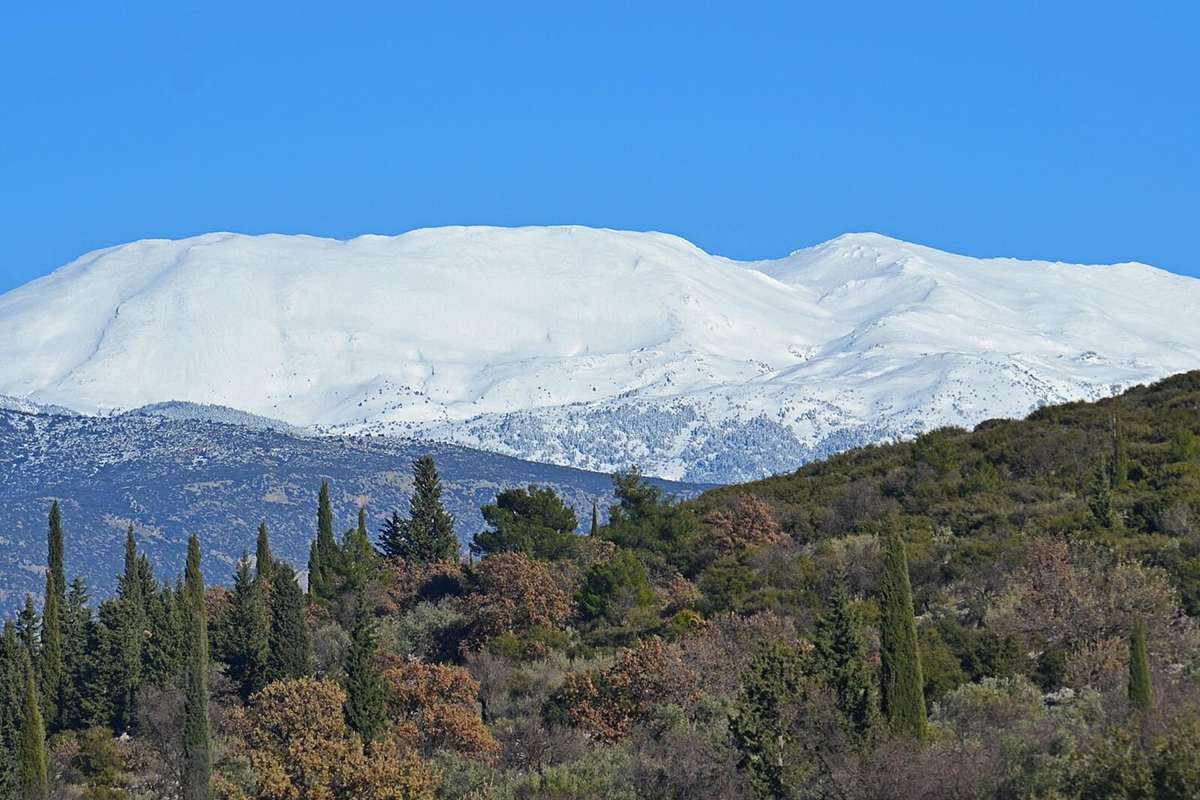
Greece weather in January frames winter outings with a host across Greek cities, islands and mountain villages. The page covers the downtown Athens and Thessaloniki stations and frosty Kato Nevrokopi. It also covers the cold hollows of Parnassus and Mainalo and the ski village of Seli. Mild Kasos, Amorgos and Schoinoussa follow, with the Astros and Sparta stations. The Three Holy Hierarchs share a feast near the end of the month. Related pages cover the best time to visit Greece, Greece weather in November and Greek traditions. More outings appear under Greece tours.
Bookings made through the GetYourGuide widgets on this page earn Classical Greece Tours a commission, at no extra cost to the traveller.
What is Greece weather in January like?
Greece weather in January runs from mild islands to icy mountains. Winter average temperatures locally pass 15.0 °C in the Dodecanese, a Greek island group. In mountain areas, the same averages fall below −3.0 °C. An average blends daytime and night-time readings.
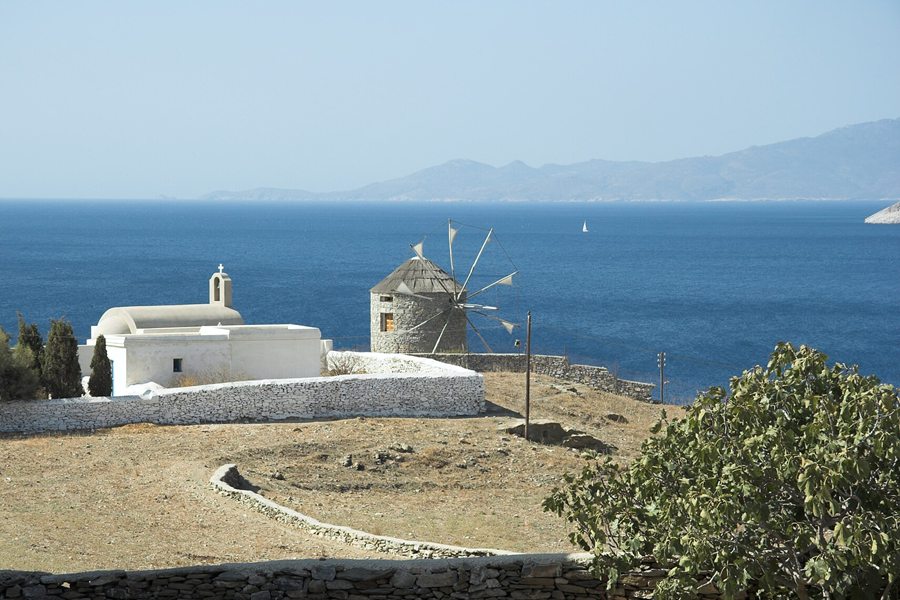
In Greece weather in January, the downtown Athens station records a mean maximum of 13.3 °C. Its figures rest on 1991–2020 normals, long-term averages that serve as a baseline. Its January low sits at 7.1 °C. That low averages the coldest point of every day in the month.
In Thessaloniki, the Aristotle University station sits 32 m above sea level. For Greece weather in January, that station gives a monthly mean of 7.0 °C. A mean blends every day and night reading of the month. The same station holds a January record low of −12.6 °C. A record low is the coldest reading ever logged there.
Across the Csa zone, a hot-summer Mediterranean climate type, winters are wet. Snow that falls there does not last long, above all on south-facing slopes. Winter rain in that zone keeps falling for long spells. The western parts of the zone receive more precipitation than the rest. Precipitation means rain, sleet, hail and snow together.
- Mountains: Greece weather in January on high peaks follows the alpine Csc type, with harsh winters and abundant snowfalls.
- Record high: Downtown Athens holds a January record high of 22.6 °C, the warmest reading for that month.
- Köppen: The Köppen scheme sorts climates into lettered types, such as Csa for hot-summer Mediterranean areas.
Rain also counts in Greece weather in January. Downtown Athens collects 55.6 mm in an average January. A millimetre of rain is a layer one millimetre deep on flat, open ground. Rain gauges, the cups that catch it, give these totals.
Why does Kato Nevrokopi sit at the cold end of Greece weather in January?
Greece weather in January takes a harsh turn at Kato Nevrokopi. This town lies in the northwest of the Drama regional unit. Its name means Lower Nevrokopi. Inside each wider Greek region sit regional units, smaller areas with their own local administration.
The town’s climate is humid continental, a type seen in just a small number of Greek locations. That label describes cold winters and warm summers, far from the mild Mediterranean pattern of the coasts. Temperatures of −20 °C or below have been recorded there more than once. On the Celsius scale, water freezes at zero degrees.
The Kato Nevrokopi station covers the years 2010–2019. For Greece weather in January, its mean daily maximum reaches only 5.2 °C. Its January mean comes to 0.45 °C, which sits just above freezing. A mean temperature blends the warm afternoon readings with the cold ones of the night.
The mean January minimum at the station falls to −4.3 °C. Rain at the station reaches 65 mm in an average January. That total matches 65 litres spread across every square metre of open land. For Greece weather in January, Kato Nevrokopi also counts among the coldest places in the country.
- Winter hazards: Blizzards and thick fogs have been reported in the town during the winter months.
- Blizzard: Driving snow and fierce wind combine in a blizzard, and they cut visibility to almost nothing.
- Fog: Fog is a cloud that forms at ground level and hides the land around it.
Beyond Greece weather in January, the area has a name in farming. It is famous for farm products such as potatoes and beans. A bean is the seed of a plant from the pea family, eaten fresh or dried in stews.
How does Mount Parnassus show the alpine side of Greece weather in January?
Greece weather in January on Mount Parnassus is tracked at a high mountain hollow. A World Meteorological Organization station sits in the Vathistalos doline. A doline is a bowl-shaped hollow in limestone ground. That United Nations body links national weather services worldwide.
The Vathistalos station sits at 1780 m above sea level. Its records run from 2017 to 2023. For Greece weather in January, the station logs an average daily high of 2.1 °C. In other words, even the warmest hour of an average January day stays very close to freezing there.
Its monthly mean in Greece weather in January falls to −3.3 °C. A monthly mean is the average of all day and night readings across the month. The station’s average January low reaches −8.7 °C. A minus sign before a Celsius figure marks a reading below the freezing point of water.
The lowest January reading at Vathistalos stands at −28.6 °C. Such an extreme is called a record low, the coldest value in the station’s log. In Greece weather in January, the hollow also gathers 46.8 mm of rain on average. Each millimetre of that total stands for one litre per square metre.
- Warm extreme: The warmest January reading on record at Vathistalos is 12.0 °C.
- Skiing: In winter, the whole Parnassus range is open to skiing, chiefly from the resorts of Arachova.
- Alpine: An alpine climate is the cold climate of high mountains above the tree line.
The Parnassos ski centre today runs 16 lifts, two of them hybrid lifts. A hybrid lift carries closed cabins and open chairs on one cable. A drag lift, by contrast, pulls skiers uphill while their skis stay on the snow.
What does the mountain village of Seli add to Greece weather in January?
Greece weather in January reaches high ground at Seli, also known as Kato Vermio. The village sits at about 1400 metres. That height makes it possibly the highest populated village in Greece. Altitude, the word for such height, is measured from sea level.
Seli has a humid continental climate, coded Dfb in the Köppen system. In that code, D stands for a cold winter and f for rain in every season. Winters at Seli are very cold by Greek standards. They are snowy as well. The b in the code points to warm summers, the other half of the year.
The Seli Ski Center station sits at 1520 m and holds data for 2010–2019. Its Greece weather in January readings give an average daily high of 1.9 °C. Such a high leaves the warmest hours of the day barely above freezing. A ski centre is a base with lifts and marked runs for skiing.
In Greece weather in January, the station’s average low is −4.4 °C. Its lowest January reading on record stands at −26.0 °C. A record value is the single coldest or warmest reading in a station’s whole data series. The minus sign shows a temperature below zero on the Celsius scale.
- Sea influence: The Mediterranean Sea softens the climate of Seli, so extreme highs and lows are rare.
- Precipitation: For Greece weather in January, the Seli Ski Center station gathers 58.7 mm of precipitation on average.
- Meaning: Precipitation covers rain, snow, sleet and hail that fall from clouds to the ground.
The ski lift at Seli, built in 1934, was the first in all of Greece. That first lift makes Seli the senior ski resort of Greece by age. A ski lift is a powered cable system that carries skiers uphill to the top of a run.
Which record did Mainalo set for Greece weather in January?
Greece weather in January brought Mainalo its record low. On 17 January 2012, a sinkhole on the mountain registered −35.3 °C. A sinkhole is a pit or hollow where the ground surface has sunk into the rock below it.
In the Kehroti doline on Mainalo, a station of the Athens-based National Observatory measures the climate. The station stands at 1,613 m above sea level. Its Greece weather in January belongs to a humid continental climate, coded Dfb. The Observatory is a Greek research body that runs a network of weather stations.
The Kehroti station averages a January daily high of 1.9 °C. Its January mean drops to −4.0 °C. A monthly mean blends highs and lows into one number covering the full calendar month. Greece weather in January at this height therefore stays well below freezing on average.
The average January low at Kehroti reaches −9.8 °C. In Greece weather in January, the station also collects 148.0 mm of rain. Rain totals come from gauges that collect the water falling on the station site. A doline, the landform around the station, is a closed hollow in limestone.
- Warmest January reading: The Kehroti station has a January record high of 11.4 °C.
- Ski resort: Mainalo holds a ski resort at 1600 m, with 7 ski slopes and 4 lifts.
- Ski slope: A ski slope is a marked run down the mountain, graded by difficulty.
The lifts of the Mainalo resort run between 1550 and 1770 m above sea level. A lift carries skiers from the foot of a slope up to its top. Drag lifts pull skiers along the snow, while chair lifts carry them on seats hung above it.
How mild is Greece weather in January around Astros?
Greece weather in January at Astros falls in the cool half of a hot-summer Mediterranean climate. In that climate, the summer months stay hot and dry, while winters run from mild to cool. Köppen labels this climate Csa, where the a marks hot summers.
Astros serves as the seat of the North Kynouria municipality. A seat is the town that hosts the local council and its offices. Its port, Paralio Astros, sits 4 km northeast of the inland town. Paralio means coastal in Greek, so the name marks the seaside part of Astros.
The Hellenic National Meteorological Service supplied the Astros figures, which cover 1974 to 2010. That national service is the official weather office of Greece. For Greece weather in January, the station averages a daily high of 14.0 °C. A daily high is the warmest reading of each day, averaged over the month.
The January mean at Astros comes to 10.1 °C. The average January low sits at 6.2 °C, well above the freezing point. Greece weather in January on this coast therefore stays above freezing on an average night. Frost forms when the air close to the ground drops below zero degrees on the Celsius scale.
- Rain season: Rain at Astros falls chiefly in winter, with relatively little in summer.
- Land: Much of the land around Astros is rocky, bushy and unsuitable for farming.
- Municipality: Each Greek municipality elects a mayor and a council to run local affairs.
Greece weather in January at Astros also brings 76.5 mm of precipitation on average. That figure is the January total from the national weather service table. Precipitation counts all water that falls from the sky, from fine drizzle to hail.
What sets Kasos apart in Greece weather in January?
Greece weather in January stays gentle on Kasos, a Greek island. Its record low temperature is just 2.7 °C. No reading in its records has dropped under zero degrees Celsius. The record low marks the single coldest moment a station has logged.
The island’s climate counts as hot semi-arid, with the code BSh. A semi-arid place is dry, getting less rain than a Mediterranean area but more than a desert. The Fri station, at 4 m above sea level, supplies the January figures. In the code BSh, the B marks a dry climate and the h a hot one.
For Greece weather in January, the Fri station records a mean daily maximum of 16.2 °C. The January mean on Kasos stands at 14.1 °C. The mean folds every reading of the month, by day and by night, into one number. Celsius degrees, written °C, are the standard unit of these tables.
The average January low at Fri is 11.9 °C. For Greece weather in January, Fri gathers 54.8 mm of rain as its January average. A rain gauge, the instrument behind that total, is a funnel set over a measuring tube. Gauges stand in open ground, away from walls and trees that block falling rain.
- Record high: For Greece weather in January, the warmest reading at the Fri station stands at 22.5 °C.
- Hardiness: Kasos sits in hardiness zone 11a, part of a gardeners’ scale based on winter cold.
- Zone 11a: In that scale, higher numbers stand for milder winters with less frost.
In late 1779, bad weather kept the scholar Claude-Étienne Savary on Kasos for a number of days. He was on his way to Crete at the time. Savary was an Orientalist, a student of the languages and lands of the East.
What does the Aigiali station on Amorgos show about Greece weather in January?
Greece weather in January on Amorgos, a Greek island, follows a warm-summer Mediterranean climate. Temperatures there stay mild all year round. Warm-summer means summers that are warm rather than hot, the b type in the Köppen code.
The Aigiali station on Amorgos stands just 3 m above sea level. Its published figures are averages for 2019–2020, a run of two years. Such a short run gives a snapshot of Greece weather in January rather than a long-term normal. A normal, by contrast, spans three decades of records.
In Greece weather in January, the Aigiali station reaches an average high of 14.9 °C. Its average low for the month sits at 10.8 °C. Both numbers are averages built from daily readings, not the values of any single day. The degree Celsius is the unit used across Greek weather tables.
Precipitation at Aigiali comes to 179.2 mm in an average January. That equals 179.2 litres falling on every square metre of the island’s ground. Precipitation is the name for rain, hail, sleet and snow taken together. For Greece weather in January, the Aigiali total covers the two years of station data.
- Minoa: The city name Minoa led to the idea of Cretan settlers, though no archaeological find backs it.
- Windmills: A cluster of windmills crowns a hill above Chora, a Greek word for an island’s main town.
- Cycladic figure: One of the ten largest Cycladic figures, from a cist grave on Amorgos, sits in Oxford’s Ashmolean Museum.
Excavations of burial tombs prove intense life on Amorgos in the first Cycladic period. That period ran from 3200 to 2000 BC. In a cist grave, stone slabs line a small box-shaped pit for the dead. Cycladic figures are marble statuettes made in that early island culture.
How do the two Sparta stations describe Greece weather in January?
Greece weather in January in modern Sparta brings daytime highs of around 15 °C. Modern Sparta is the present-day city, as opposed to the ancient city-state of the same name. Each city-state governed itself together with the farmland around it.
Köppen’s scheme files the warm, sunny climate of Sparta under Csa, a Mediterranean type. A National Observatory of Athens station in the city stands 180 m above sea level. That station supplies the first set of figures for Greece weather in January here. Sunny climates log long hours of bright sunshine through the year.
At the Observatory station in Sparta, the average January high reaches 14.6 °C. The average January low drops to 3.1 °C. The high and the low are monthly averages of each day’s warmest and coolest readings. Greece weather in January in Sparta thus mixes mild afternoons with cold nights.
The Hellenic National Meteorological Service keeps a second station at Sparta Air Base. Its records cover 1974 to 2004. An air base is an airfield used by a military air force for its planes. For Greece weather in January, the air base station gives a monthly mean of 9.6 °C.
- Record low: The Observatory station in Sparta has a January record low of −5.3 °C.
- Rainfall: Rain at the Observatory station totals 124.6 mm across an average January.
- Csa: In this Köppen code, C marks a mild-winter climate and s a dry summer.
January rain at the air base station adds up to 90.7 mm on average. Its data come from the national weather service, while the city station belongs to the Observatory. The two bodies run separate station networks across the whole of Greece.
Why is Schoinoussa a dry corner of Greece weather in January?
Greece weather in January on Schoinoussa belongs to one of the driest places in Greece. The island records the second lowest average yearly precipitation in the country, around 240 mm. Yearly precipitation adds up rain, hail and snow over twelve months.
The National Observatory of Athens classes Schoinoussa as hot semi-arid, under the code BSh. Less than 50 mm of yearly rain separates the island from a true hot desert climate. In the Köppen scheme, a desert receives even less rain than a semi-arid area. The code for a hot desert is BWh, where W stands for desert.
The Schoinoussa station stands at a height of 72 m. For Greece weather in January, its daytime readings peak at an average of 14.3 °C. An average high takes the warmest reading of each day and averages it across the month. Thermometers at weather stations sit inside a shaded, ventilated box called a screen.
The January mean on Schoinoussa comes to 12.4 °C. The average January low holds at 10.5 °C. In Greece weather in January, the island’s nights therefore stay well above freezing on average. A mean, unlike a high or a low, takes in the whole of the day and night cycle.
- Seasons: The island has very mild winters and hot summers, the two sides of its climate.
- Record low: The coldest January reading at the Schoinoussa station stands at just 0.7 °C.
- Steppe: A steppe, the S in BSh, is a dry grassland with too little rain for forests.
For Greece weather in January, rain on Schoinoussa reaches 47.4 mm on average. A gauge on open ground catches that rain in a funnel and measures its depth. Rain depth is given in millimetres, each one a thousandth of a metre.
Which shared feast of the Three Holy Hierarchs falls amid Greece weather in January?
Greece weather in January closes with the 30 January feast of the Three Holy Hierarchs. This shared feast was set up around 1100, under the Byzantine emperor Alexios I Komnenos. A hierarch is a senior church leader, such as a bishop.
The Three Hierarchs are Basil the Great, Gregory the Theologian and John Chrysostom. All three were bishops of the early church with wide influence. They helped shape Christian theology, the study of God and the Christian faith. A bishop leads the Christian community of a city or a wider district.
Greece weather in January also holds a separate feast day for each of the three. Basil is honoured on 1 January, Gregory on 25 January and Chrysostom on 27 January. A feast day is a date on the church calendar that honours a saint. For Greece weather in January, these dates spread the three saints across the month.
In 11th-century Constantinople, disputes raged over which of the three was the greatest. Constantinople, now Istanbul, served as the Byzantine capital. Supporters of John Chrysostom held that he was unmatched in eloquence and in turning sinners to repentance. His Greek name means golden-mouthed. Repentance means sorrow for wrongdoing and a turn towards a better life.
- Eastern titles: Eastern Christianity also names them the Three Great Hierarchs and Ecumenical Teachers, or teachers of the whole church.
- Catholic title: Roman Catholicism honours the three as Doctors of the Church, from the Latin word for teacher.
- Vision: Eastern Churches teach that in 1084 the three appeared in a vision to John Mauropous, bishop of Euchaita.
In that vision, the three said they were equal before God, with no division among them. Their joint feast therefore became a single day for all three. In Greece weather in January, that day comes as the month nears its end.
How cold is Greece weather in January at Aetomilitsa on the Gramos mountain?
Greece weather in January at Aetomilitsa, an Epirus village within the Ioannina regional unit, is cold. Figures from the Hellenic National Meteorological Service give a January mean of −1.65 °C. A mean pools every day and night reading into a single figure.
Aetomilitsa lies on the Gramos mountain. At an altitude of 1,430 metres, it counts among the highest communities in Greece. Altitude measures how far a spot rises above the sea. Under a 2011 overhaul of local government, it became a municipal unit of Konitsa. Before 2011, it was an independent community.
Greece weather in January at Aetomilitsa is wet as well as cold. The village has cold winters with high precipitation and warm, drier summers. Precipitation covers rain, snow and hail that reach the ground. Its January precipitation comes to 144.84 mm. One millimetre means a layer of water one millimetre deep on flat ground.
Greece weather in January at Aetomilitsa has an average daily high of 1.35 °C. An average high marks the peak warmth of an ordinary day. The average January low drops to −5.30 °C. An average low marks the deepest chill of an ordinary night. °C stands for degrees Celsius, the scale on which water freezes at zero.
- Sunshine: The Aetomilitsa table lists 119.09 hours of sunshine for the whole month of January.
- Lake: Moutsalia Lake, formed by a glacier, lies 5 km from the village in a straight line.
- Language: Aetomilitsa has an Aromanian population and is an Aromanian-speaking village.
Greece weather in January at this village fits a warm-summer humid continental climate. On the 0 °C rule, its Köppen code is Dfb. The Köppen system sorts climates by temperature and rainfall. On the −3 °C rule, the village counts as temperate oceanic, code Cfb.
What does the foot of Mount Olympus at Litochoro show about Greece weather in January?
Greece weather in January at Litochoro, a town in the Pieria regional unit, sits near freezing. The Litochoro climate table gives a January mean of 2.2 °C. The town spreads over the lowest part of Mount Olympus and faces the Thermaic Gulf from the west.
Greece weather in January at Litochoro is logged for the town that heads the Dio-Olympos municipality. It took that role in the 2011 local government reform. Litochoro first appears in writing in a report on Saint Dionysius and his trip to Mount Olympus. That trip dates from the 16th century.
Greece weather in January at Litochoro brings an average daily high of 5 °C. The matching January low is −0.5 °C. Below zero on the Celsius scale, water turns to ice. January adds 101 mm of precipitation, against a yearly total of 1088 mm. A yearly total adds up all twelve monthly amounts.
Katerini lies 22 km north of Litochoro, and Thessaloniki 90 km to the north-north-east. The town climbs the eastern flank of Mount Olympus. Ancient myth placed the twelve Olympian gods on that mountain. Myths are inherited stories told by a people about gods and heroes. About 9 km south stands Leivithra, with its acropolis.
- Forests: Pine, cedar and fir forests of Mount Olympus lie south-west and north-west of the town.
- Dion: Dion, with a large archaeological park and a museum, lies about 8 km to the north.
- Gritsa: Gritsa, north-east of the town, serves as the harbour of Litochoro, with only limited space.
Greece weather in January at Litochoro covers a town with two main churches. The church of Agios Nikolaos rises at its heart, while Agios Dimitrios serves the northern side. Further east lies Pláka, a shoreline belt that stretches from the Olympus foothills down to the gulf.
What do the Vytina readings add to Greece weather in January?
Greece weather in January at Vytina is wet. The village weather station logs 193.3 mm of precipitation for the month. It stands high, at 1,013 metres above the sea. Those averages span the three years from 2019 to 2021.
Since the 2011 local government reform, Vytina has belonged to the municipality of Gortynia. Within it, Vytina forms a municipal unit, which is a former municipality kept as a district. Its land area is 139.309 square kilometres. Before that reform, the village of Vytina was the seat of a municipality of its own.
Greece weather in January at Vytina gives an average daily high of 7.6 °C at the station. The matching average low is −1.4 °C, below the freezing mark. Precipitation in Vytina is abundant all year round, not only in January. Abundant means plentiful, or present in large amounts at any time.
Vytina lies 10 km east of Levidi and 15 km north-east of Dimitsana. The municipal unit is divided into communities such as Elati, Kamenitsa, Lasta and Nymfasia. Each community is a small local district built around one or more villages. Greece weather in January at Vytina also covers Pyrgaki and Magouliana, two further communities.
- Historian: Vytina is the birthplace of Dimitrios Paparrigopoulos, whose son Constantine became a historian.
- Park: Since 2010, the new park of the village has borne the name Papa-Anypomonos.
- Vytiniots: Notable Vytiniots include the jurist Vasileios Oikonomidis and the provost marshal Ioannis Dimakopoulos.
Greek National Road 74 crosses Vytina, where Greece weather in January is recorded. That road runs from Tripoli to Pyrgos. A national road is a main highway under the care of the Greek state. People from Vytina are called Vytiniots in English.
How does sea-effect snow shape Greece weather in January around Thebes?
Greece weather in January at Thebes is measured at the nearby Aliartos weather station. That station stands at 180 metres and holds records from 1967 to 2001. Its January mean is 7.1 °C, the average of day and night readings.
Under the Köppen scheme, the Aliartos data place Thebes in group Csa, the hot-summer Mediterranean type. In that code, s marks a dry summer and a marks a hot one. Summers at Thebes are hot and dry, while winters are cool and wet. Its yearly precipitation totals 575.1 mm at the Aliartos station.
Greece weather in January at Thebes gives an average daily high of 11.5 °C. The average January low is 2.9 °C, which stays above the freezing point. During winter, Thebes is sometimes hit by Aegean sea-effect snow. Sea-effect snow forms when cold air crosses warmer sea water and picks up moisture.
More than once, snow at Thebes has lain over 50 centimetres deep. Its inland position also lets Thebes record very low minimum temperatures. A minimum temperature is the lowest reading over a set period. The city limits hold a station that the National Observatory of Athens operates. That station tracks Greece weather in January within Thebes itself.
- Record low: The city station logged a record low of −7.9 °C on 10 January 2017.
- January rain: The Aliartos station records 77.3 mm of precipitation in an average January.
- Summer peak: During a summer heat wave, the city reached a record high of 44.5 °C.
Greece weather in January sits well below the yearly picture at Aliartos. The station gives a yearly mean of 16.8 °C. Its average yearly high is 21.9 °C, and its average yearly low is 10.0 °C.
What does the Elefsina Port station record for Greece weather in January?
Greece weather in January at Elefsina is mild by day, going by a station at Elefsina Port. That station stands just 10 metres above sea level. It gives an average January high of 13.8 degrees Celsius, written °C.
The port station draws on monthly bulletins from the National Observatory of Athens. A bulletin is a brief official summary put out on a regular cycle. Its January mean is 10.2 °C, and its average January low is 6.6 °C. Greece weather in January at Elefsina also brings 60.4 mm of rain.
Greece weather in January at the port has reached a record high of 24.9 °C. Its January record low is −2.0 °C, just below freezing. A record is the top or bottom value ever logged in that month. A second Elefsina station belongs to the Hellenic National Meteorological Service and covers 1958 to 2010.
Using that older record, Elefsina has a hot-summer Mediterranean climate, bordering on a hot semi-arid one. Semi-arid describes land that gets only a little rain each year. Researchers Kassomenos and Katsoulis studied 12 years of data from 1990 to 2001. They named the industry of west Attica as a possible cause of the warm local climate.
- Industry: West Attica holds at least 40% of the industrial activity of Greece.
- Heat record: Until 2021, Elefsina shared the European record high of 48.0 °C, set on 10 July 1977.
- Summer: The older station gives Elefsina an average July maximum of 33.2 °C.
Greece weather in January looked a little cooler in the older record. The 1958 to 2010 station puts the mean daily high for January at 13.1 °C. Its typical January low sits at 5.6 °C, with 48.4 mm of rain.
Why is Greece weather in January so mild at Agios Nikolaos in Crete?
Greece weather in January at Agios Nikolaos, which serves as capital of Lasithi in Crete, is very mild. The town station gives a January mean of 13.0 °C. Its data come from the National Observatory of Athens and cover 2010 to 2019.
The town has a Köppen Csa climate, the hot-summer Mediterranean type. Its winters are very mild and rainy, and its summers are hot and dry. Greece weather in January there brings an average daily high of 15.7 °C. The average January low stays at 10.2 °C, far above freezing.
Greece weather in January at Agios Nikolaos covers a town partly built on ancient ruins. Those ruins belong to Lato pros Kamara, a city of ancient times. That ancient site left limited ruins but an extensive cemetery from Roman times. Dorian occupants of Lato settled here during the late Bronze Age.
Tourist sights in the town include the small lagoon of Lake Voulismeni. A lagoon is shallow water held back from the open sea by land. Around the lagoon sit a small park and trail, with traditional fishing boats, ducks and an amphitheatre. Agioi Pantes, a tiny island, counts as another sight of the town.
- Writer: Daphne du Maurier used the town and its area as the setting of Not After Midnight.
- Film: The films He Who Must Die and The Moon-Spinners were both shot there.
- University: The Hellenic Mediterranean University now runs a tourism department in the town.
Greece weather in January at Agios Nikolaos is logged in a town named for a saint. In English, Agios Nikolaos translates as Saint Nicholas. The stress falls on the second syllable of Nikolaos. Stress is the extra force given to one syllable.
How does Kea, the Cyclades island nearest Attica, fit Greece weather in January?
Greece weather in January on Kea comes from a station set 192 metres above the sea. Its average January high there reaches 11.7 °C. Of all the Cyclades islands, Kea lies nearest to Attica on the mainland.
Greece weather in January on Kea brings an average low of 8.3 °C. January also brings 107 mm of precipitation to the island station. These station averages cover the years 2019 and 2020. Kea has a warm-summer Mediterranean climate. In such a climate, summers are warm rather than hot, and winters are mild and wet.
Kea also has an arid climate and a hilly terrain. Arid land gets scant rain across the year. The municipality, which takes in the island of Makronisos, covers 148.926 square kilometres. Local communities of Kea include Otzias, Pisses, Koundouros and Kato Meria. Greece weather in January on Kea also covers Ellinika and Chavouna, two more communities.
In antiquity, Kea was called Keos, or Ceos in Latin. In the Archaic period, the island was split between four city-states. Their names were Karthaia, Ioulis, Koressos and Poieessa. Each polis, or city-state, governed itself and the fields around it. The Archaic era ended when the Classical age of Greece began.
- Visitors: Athenians have lately rediscovered Kea for weekend breaks and yachting trips.
- Thinkers: The Sophist Prodicus and the physician Erasistratus both came from classical Kea.
- Coins: Coins from the 3rd century BC on Kea show dogs or stars with rays.
Greece weather in January on Kea is logged for an island in the Kea-Kythnos regional unit. Each regional unit forms one district inside a larger Greek region. Kea sits in the Aegean Sea, within the Cyclades archipelago, a chain of islands.
What record did Tris Ekklisies set for Greece weather in January?
Greece weather in January set a record at Tris Ekklisies. This village lies on the Libyan Sea in south Crete. Its station logged a January mean minimum of 14.7 °C. That figure is the highest ever recorded in Greece for January.
A mean minimum is the average of the lowest daily readings across a month. The village lies around 64 km south of Heraklion. It stands at an altitude of around 10 metres. Greece weather in January there is measured by a station of the Cultural Association of Tris Ekklisies. That station stands 15 metres above sea level.
Tris Ekklisies has a sunny, warm Mediterranean climate, code Csa, bordering on a hot semi-arid type. By Greek standards, its winters are extremely mild. Its mean annual temperature is 22.1 °C. The station puts the average January high at 18.1 °C. Its average January low is 13.7 °C.
Greece weather in January at the village has a mean of 15.9 °C. The village sits south of the Asterousia Mountains. Those mountains form a wall between the coast and the Messara Plain to the north. A plain is broad, level ground. The highest Asterousia summit is Kofinas, which rises to 1231 m.
- Name: The village takes its name from three Byzantine-era churches built in the 14th century.
- Record low: The lowest January reading at the station is 5.6 °C.
- Rain: An average January brings 64.7 mm of rain to Tris Ekklisies.
Greece weather in January at Tris Ekklisies also has a record high of 21.5 °C. Archanes-Asterousia is the municipality that includes the village. A municipality is the basic unit of local government in Greece, run by an elected council.
Which customs and readings does Metaxades add to Greece weather in January?
Greece weather in January at Metaxades, a large village in the Evros regional unit, is cold and wet. The cold, wet season there runs from late October to mid April. The village station gives a January mean of 4.0 °C.
Greece weather in January at Metaxades is logged in a lowland settlement at about 120 metres. The village is a traditional settlement, designated for its special architecture. Its average January high is 7.9 °C. The matching low is 0.8 °C. Greece weather in January there also brings 109.6 mm of precipitation.
On New Year’s Eve, the village women rolled out pastry sheets for the vasilopita. The vasilopita is the New Year pie. Children went out early in the morning to sing the sourvala, the New Year carols. They carried the sourvalia, a sturdy rod of cornel wood. On it they threaded sausages, cookies and cured meat.
After church, families gathered around the sofra, a low round wooden table. The head of the house crossed the pie and cut the pieces. The first piece went to Saint Basil, then came Christ, the house, the animals and the fields. Each family member followed, from the oldest to the youngest.
- Bambo: On Epiphany Eve, families boiled the bambo, a thick sausage of finely chopped pork.
- Waters: On Epiphany itself, villagers went to the fountain for the blessing of the waters.
- Auction: An auction of icons in the village square raises money for the church and poor families.
Greece weather in January at Metaxades falls inside a frost season from mid-November to the end of March. Its January record low is −12.0 °C. The Didymoteicho area has an average of 16.2 snowy days. Snow there settles to a height of 10 to 12 centimetres.
Which ancient Eleusis festival fell during Greece weather in January?
Greece weather in January matched the season of the Haloa, an Attic festival celebrated mainly at Eleusis. Dionysus, whose feasts fell in winter, moved its date to late December and early January. The festival also honoured Demeter and Poseidon.
Attic means belonging to Attica, the land around Athens. Behind the name lies the Greek word halos, meaning threshing floor or garden. Threshing is the work of loosening the edible part of cereal grain after harvest. The festival was also called Thalysia or Syncomesteria. Greece weather in January framed a festival focused on the first fruits.
The Haloa took place every year in the Attic month of Poseideon, after the first harvest. Celebrations ran around the threshing floor at the same time across Attica. All women were expected to attend, while men were almost always excluded. Husbands were still expected to pay for their wives’ costs.
Women led rites during the pruning of the vines and the tasting of the wine. Pruning means cutting back vine shoots so that the plant grows well. At that time of year, the soil around the vineyards was cut and hoed. Greece weather in January also matched the end of the first fermentation of the wine.
- Procession: The feast included a procession of Poseidon, worshipped at the Haloa as Phytalmios, god of plants.
- Banquet: The banquet held cereals, fish and possibly fowl, but nothing of flesh.
- Pomegranate: Pomegranate was a forbidden food, seen as fit only for the dead.
During this Greece weather in January festival, the Archons in Eleusis prepared the tables for the women. Archons were the chief officials of a Greek city. Demosthenes stresses that offering any blood sacrifice at the festival was unlawful. Unlawful means against the law.
What do travellers ask about Greece weather in January, and what are the answers?
The Greece weather in January picture differs across four more stations. Great Lavra lies on the south-eastern foot of Mount Athos, at 160 metres. Araxos is about 29 km south-west of Patras. Stylida, in Phthiotis, counts as a town and also as a municipality.
On Mount Athos, how mild is Greece weather in January at Great Lavra?
Winter lows at Great Lavra are mild for its latitude, at around 8 °C in January. Latitude is the angle of a place measured from the equator. The monastery station lies 143 metres above sea level. Its lowest January reading on record is −3.7 °C. Such a record marks the bottom of the logged range.
What does the Araxos station show for Greece weather in January?
The Hellenic National Meteorological Service keeps the Araxos station, with averages from 1955 to 2010. An average January there brings 13.7 days with precipitation. Each such day has measurable rain, snow or hail. January humidity averages 74.2%. Humidity tells how much moisture the air holds.
How wet is Greece weather in January at the Kalarites station?
The Kalarites table gives a January mean of 1.72 °C, close to freezing. January rain there reaches 151.27 mm. Sunshine in January totals 96.6 hours. These hours add up the time with bright, direct sun. Kalarites is the spelling the station uses for the village of Kalarrytes.
Near the coast of Phthiotis, how low has Greece weather in January dropped at Stylida?
The National Observatory of Athens operates the Stylida station, set 55 metres above sea level. The coldest January reading there reached −6.8 °C, well below freezing. An average January brings only 40.7 mm of rain. Rain is measured as the depth of water collected in a gauge.
Featured photo: Chavakismanolis, CC BY-SA 4.0, via Wikimedia Commons (File:Mt. Parnassus-Παρνασσός με χιόνια.jpg).