
Greece adventure tours are active trips with a host across the rivers, cliffs and gorges of Greece. They take in sports such as rafting, climbing, paragliding and canyoning. This page covers the Voidomatis and Achelous rivers, Konitsa and the Aradena bridge on Crete. It also covers the climbing rock of Kalymnos, Leonidio and Varasova, plus four short answers. Related pages cover Greece hiking tours, Greece kayaking tours and the national parks in Greece. Each one also links back to the main hub for Greece tours.
Bookings made through the GetYourGuide widgets on this page earn Classical Greece Tours a commission, at no extra cost to the traveller.
What are Greece adventure tours?
Greece adventure tours belong to adventure travel, a branch of tourism built on exploration. Such travel carries a degree of risk, and that risk can be real or perceived. Perceived risk is danger that feels present to the traveller, even when it is small.
Adventure travellers chase mental states known as rush or flow. Such states arise when a person steps outside a comfort zone, the area of familiar and easy situations. Activities that fit adventure travel include mountaineering, trekking and caving. Mountaineering is mountain climbing. Rafting, paragliding and rock climbing also count, and each one fits Greece adventure tours.
Since ancient times, people have travelled in search of food and the skills of survival. Alongside those needs, they explored sea lanes, new destinations and countries. A sea lane is a regular route across open water. Mountaineering on the Matterhorn in 1865 and rafting on the Colorado River in 1869 pushed adventure further.
Modern adventure travel began to take off once World War II had ended. That rise, long before Greece adventure tours, came with expeditions. A French team mounted the Annapurna expedition in 1950. A British team followed with the Mount Everest expedition in 1953. An expedition is an organised journey by a group with a clear aim.
- Technology: Cheap consumer technology, from satellite positioning to photography, has raised worldwide interest in adventure travel.
- Women: In competitive adventure sport tourism, women now succeed at a higher rate than men.
- Definition: An American trade body counts any tourist activity joining physical activity, cultural exchange and nature.
Adventure travel remains a niche, meaning a small and specialised part of the travel market. It is also a fast-changing sector, with new kinds of activity appearing. Outings with a host for rafting, climbing and paragliding, called Greece adventure tours, sit within that sector.
Why does the Voidomatis river matter to Greece adventure tours?
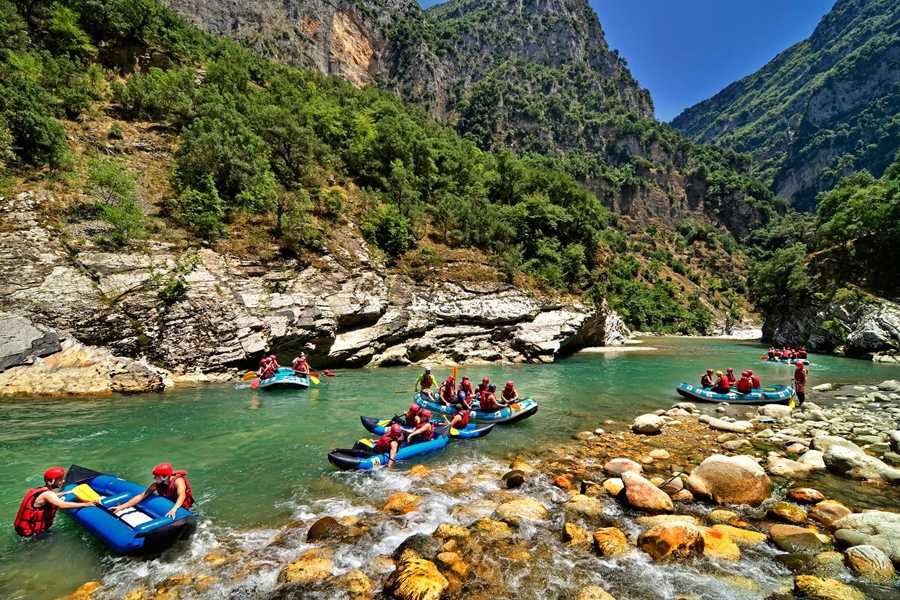
Greece adventure tours share water sports with the Voidomatis, a river known for rafting and kayaking. Rafting is a trip down a river on an inflatable raft, a boat filled with air. Kayaking uses a small, light boat that a paddler moves with a paddle.
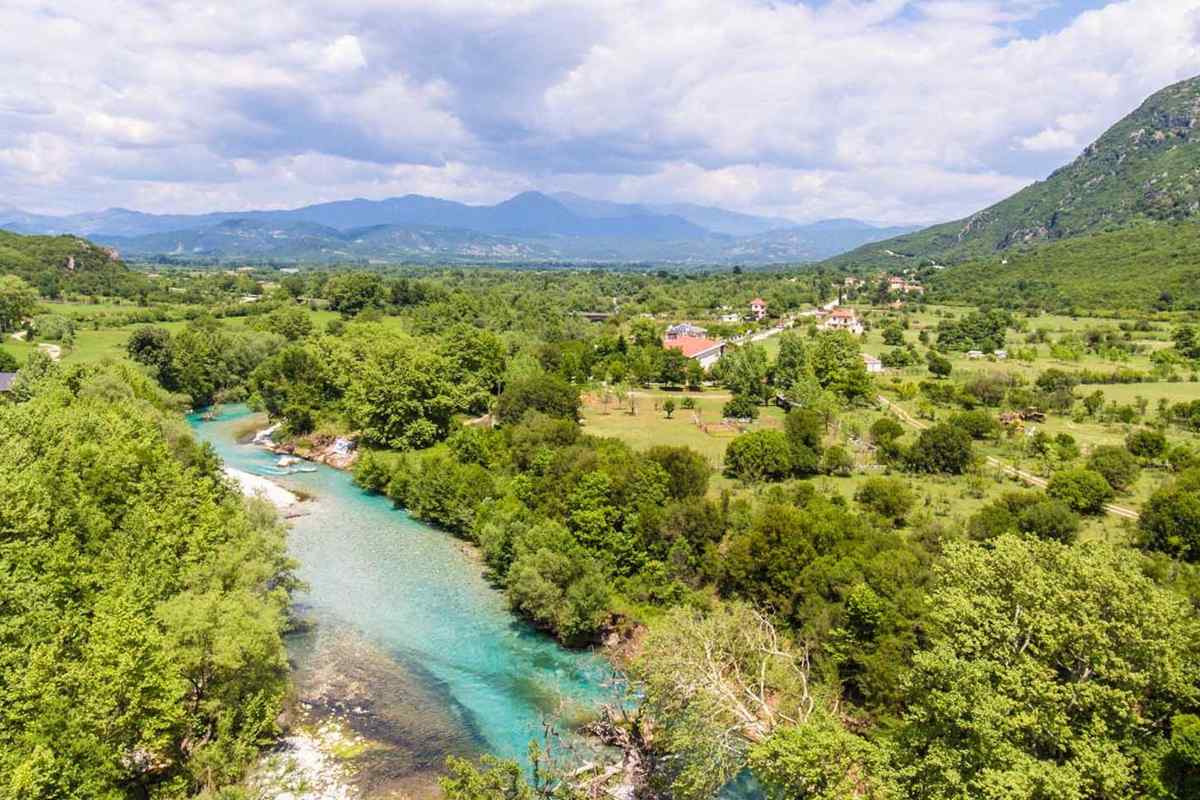
The Voidomatis is a river of the Ioannina regional unit, in the far northwest of Greece. Such a unit is a district forming part of a Greek region. The main sources of the river rise in the village of Vikos. A river’s source is the spot where its water first rises from the ground.
Along its path, the river gathers other streams. These come down from the banks of the Tymfi mountains or out of the Vikos Gorge. Gorges are deep, tight valleys walled in by steep rock. For Greece adventure tours, the river’s lower end lies close to the town of Konitsa.
Voidomatis is a Greek name meaning ox eye. The image comes from the clear blue eyes of oxen. The name points to the waters of the river, which share that clear blue shade. An ox is a large farm animal of the cattle kind, used for pulling ploughs and farm carts.
- Kleidonia: Kleidonia is a village and community within the Konitsa council area, in Ioannina regional unit.
- Riverbank: For Greece adventure tours, Kleidonia sits beside the Voidomatis, on its right bank.
- Kalyvia: The community of Kleidonia also takes in the village of Kalyvia.
For Greece adventure tours, the caves of Kleidi and Megalakkos near Kleidonia hold archaeological remains. The finds reach back 20,000 years and 12,000 years. That places them in the later Paleolithic, or Old Stone Age, when people made their tools from stone.
How does Konitsa fit into Greece adventure tours?
Greece adventure tours count gorges among their settings, and Konitsa lies close to the Vikos-Aoos National Park. The park takes in the Tymfi mountains along with the Vikos and Aoos gorges. National parks are stretches of country kept safe by law for their wildlife and landscape.
For Greece adventure tours, Konitsa lies northeast of the Zagorochoria, a group of villages. The town acts as a hub serving small Pindos mountain villages. It has a public medical centre, schools and shops of its own. A hub is a central place that serves the area around it.
Near Konitsa, places of particular interest helped tourism in the region grow. The Dragonlakes of Tymfi and Smolikas are among them. These are small lakes high on those mountains. The sulphur baths of Kavasila also played a part. A sulphur bath is a bathing spot fed by water rich in sulphur, a yellow mineral.
The name Konitsa has competing explanations. The first theory links the name with Knossos, a city of ancient Epirus close to the present town. Epirus is the mountain region of northwestern Greece. A third theory credits a local lord named Konis. He is said to have built a castle in the town, which then took his name.
- Forts: During the reign of King Pyrrhus of Epirus, forts stood at key points around Konitsa.
- School: A Greek school already worked in Konitsa as the 18th century came to a close.
- Council: For Greece adventure tours, today’s Konitsa council area formed in 2011 by merging 5 older ones.
Agriculture and tourism are the main pillars of the local economy in Konitsa. Agriculture means farming, the raising of crops and animals. Tourism means the trade built around visitors who travel for leisure. Greece adventure tours belong to the tourism side of that economy.
What role does the Achelous River play in Greece adventure tours?
Greece adventure tours and the Achelous, a river of western Greece, have rafting in common. Rafting on the Achelous takes place mainly in spring. Its rafting passages rank as Class 2 to 3. Class here is a grade of difficulty for rough river water.
For Greece adventure tours, those grades come from the International Scale of River Difficulty. The scale sets six grades for white water rafting. White water is fast, rough river water that turns white with foam and spray. A passage, in rafting, is a stretch of river that a raft runs through.
In earlier times the Achelous was known as Thoas, Axenus and Thestius. Herodotus, a historian of ancient Greece, noted the power of the river to reshape a shoreline. A shoreline marks the edge between land and sea. He even compared the river with the Nile, the great river of Egypt, on that point.
The Achelous starts near the village of Anthousa, in the westernmost corner of the Trikala regional unit. Each Greek region breaks down into such units, which serve as local districts. For part of its course, the river forms the boundary between Epirus and Thessaly. Both are historic regions of the Greek mainland.
- Kremasta: The river flows into the Kremasta reservoir, an artificial lake also fed by the Agrafiotis and Megdovas.
- Mouth: For Greece adventure tours, the Achelous meets the Ionian Sea 29 km west of Missolonghi.
- Bridges: The arch bridges over the river include the Karafilio and the Ardanovo.
For Greece adventure tours, canoeing takes place on the lower Achelous, below the Stratos dam. Canoes are slim, light boats driven by paddles. Canoeing there happens mainly in summer and autumn. Dams are barriers built across rivers to store water.
Which facts about the Aradena Gorge suit Greece adventure tours?
Greece adventure tours share a sport with Aradena, a village beside a gorge in Crete. A platform for bungee jumping stands in the middle of the bridge over the gorge. Bungee jumping is a leap from a height while tied to a long elastic cord.
Aradaina, also spelled Aradena, is a village in the Sfakia municipality of the Chania regional unit, Crete. Municipalities are the units of local government across Greece. The village sits at 520 metres above the sea, on the southern slopes of the Lefka Ori. Lefka Ori means the White Mountains in Greek.
For Greece adventure tours, the scholar Vladimir Georgiev offered a meaning for the old name Aradin. He traced it to the word arados, meaning commotion or violent movement. In his view, the word pointed to waves whose noise reached up to the ancient city. Commotion means a noisy and restless disturbance.
Aradena is a mountain village, yet it prospered through shipping and trade. Shipping is the business of moving goods by sea. Trade means selling goods across markets and borders. The people of Aradena docked their ships at Loutro. To dock a ship means to bring it to rest beside a pier.
- Anopolis: For Greece adventure tours, Aradaina lies 3.5 kilometres from Anopolis, a larger village.
- Church: Michael the Archangel has a village church here, built as the 14th century began.
- Bridge: The bridge over the Aradena gorge opened with a ceremony on 28 December 1986.
In the 1950s a feud left the village of Aradena deserted. Feuds are bitter, long-running quarrels between families or clans, passed down over years. For Greece adventure tours, the bridge at Aradena rises 138 metres above the bottom of the gorge.
What gives Kalymnos a climbing name for Greece adventure tours?
Greece adventure tours and rock climbing share a home on Kalymnos, an island in the Dodecanese chain. More than 4,600 climbing routes run up its limestone rock. A climbing route is a set line up a rock face, with a fixed start and top.
Kalymnos has a climate that suits climbing in every season. Climbing tourism, meaning travel made for climbing, took off sharply on Kalymnos from 1997. In that year, the Italian Andrea di Bari began setting up the first routes. To set up a route means to plan and prepare a new line up the rock.
For Greece adventure tours, tourism on Kalymnos has grown important in recent times, above all through rock climbing. Rock climbing is the sport of moving up natural rock faces using hands and feet. Kalymnos also ranks as the wealthiest member of the Dodecanese. The Dodecanese is a chain of islands in the southeastern Aegean Sea.
In the nineteenth century, the British archaeologist Charles Newton dug out the island’s Temple of Apollo. The temple dates from the Hellenistic age, the era of Greek kingdoms after Alexander. Apollo ranked among the Olympian gods and was linked with music and prophecy. Archaeologists learn about earlier peoples from what they left behind.
- Leros: Leros lies less than 2 km north of Kalymnos, linked by islets, or tiny islands.
- Earthquakes: Earthquakes are frequent around Kalymnos and are tied to volcanoes on surrounding islands.
- Pserimos: For Greece adventure tours, Pserimos, an islet between Kalymnos and Kos, covers 11 square kilometres.
For Greece adventure tours, Kalymnos keeps a folk dance called Mihanikos. It portrays how decompression sickness, an illness caused by sponge diving, cripples the body. Sponge diving means gathering sponges from the seabed. Decompression sickness hits divers who rise too fast from deep water.
Where does Leonidio stand among climbing places for Greece adventure tours?
Greece adventure tours and the Peloponnese town of Leonidio share a sport: rock climbing. In recent years, Leonidio has become an important destination for climbing in Greece. Destination here means a place that draws visitors for a set purpose.
For Greece adventure tours, Leonidio lies on the eastern coast of the Peloponnese peninsula. The town opens onto the Myrtoan Sea, a part of the Aegean. Though coastal, the area is mainly mountainous. The Parnon range rises across it, breaking up the land with ridges and high peaks. Ridges are long, narrow crests along mountain tops.
For Greece adventure tours, the River Dafnon is the stream that flows through Leonidio. Three bridges link its banks within the town. A river bank is the strip of land along the edge of a river. A bridge carries a road or path across water from bank to bank.
Leonidio’s port is Plaka, 4 km away from the town itself. A port is a place on a coast where boats load, unload and shelter. Plaka works mainly through tourism. A small fishing fleet is also based in its harbour. A fleet is a group of boats that work together.
- Kynouria: Since the 2011 reform, Leonidio has been a municipal unit, or council district, of South Kynouria.
- Farming: Citrus fruit, pears, tomatoes and olives grow on the fertile plain around the town.
- Language: The Tsakonian language, a local form of Greek, is still spoken in parts of the area.
For Greece adventure tours, every August, Plaka hosts the Tsakonian Eggplant Festival. The festival draws well-known chefs from all across Europe. Eggplant is the purple vegetable called aubergine in Britain. Tsakonian refers to Tsakonia, the region around Leonidio. A chef is a skilled professional cook.
How does Varasova, a limestone mountain, relate to Greece adventure tours?
Greece adventure tours in western Greece share rock climbing with Varasova, a mountain above the Gulf of Patras. Its steep south and southwest faces hold rock climbing routes. A face, in climbing, is a steep, broad side of a mountain or cliff.
Varasova is a mountain of limestone in southern Aetolia-Acarnania, a regional unit of western Greece. It climbs steeply straight up from the shore of the Gulf of Patras. For Greece adventure tours, its summit reaches 917 m. Gulfs are wide inlets where the open sea pushes far into the land.
In ancient times, the mountain itself was called Chalcis. An Aetolian town lay at its foot under the names Chalcis, Hypochalcis or Chalceia. That old town gave its name to Chalkeia, the present administrative unit. Aetolian means from Aetolia, an ancient region of western Greece. Administrative units are areas managed by local officials.
Varasova carries the nickname of the Mount Athos of Rumelia, or of western Greece. The name comes from its churches and monasteries, around 72 in all. They were built in the Byzantine and Ottoman periods. Byzantine points to the empire once ruled from Constantinople. Ottoman points to the empire, based in Istanbul, that later held Greece.
- Klokova: The mountain Klokova rises 8 km to the east of Varasova.
- Plant: The plant Centaurea heldreichii grows on Varasova and nowhere else in the world.
- Monastery: For Greece adventure tours, the cave monastery of Agios Nikolaos near Kryoneri is reachable only by boat.
For Greece adventure tours, local tradition tells a story. The Titans tried to throw the rock into the sea to form a bridge between the coasts. The rock proved too heavy, so they dropped it where it stands. Titans were giant gods of Greek myth.
What do travellers ask about Greece adventure tours, and what are the answers?
The Greece adventure tours scene belongs to a family of sports that holds canyoning. Canyoning means travelling through canyons by walking, scrambling, climbing, jumping and swimming. Abseiling, a slide down a fixed rope, also counts. A canyon is a narrow valley carved by flowing water.
Before Greece adventure tours, what other names does canyoning go by?
In the United States, the sport goes by the name canyoneering. In South Africa, people call it kloofing, from kloof, a local word for a ravine. In the Welsh language, canyoning is cerdded ceunant, which means gorge walking. Welsh is the old Celtic language of Wales, spoken alongside English.
For Greece adventure tours, where did paragliding begin?
Paragliding began in June 1978, through three friends from Mieussy, in the Haute-Savoie area of France. Jean-Claude Bétemps launched from Pointe du Pertuiset, near Mieussy, and flew 100 m. The French name parapente contains pente, the French word for slope. Paragliding is flight under a fabric wing, launched on foot.
How far back does rafting go, as a sport tied to Greece adventure tours?
Whitewater rafting goes back to 1811, when a run down the Snake River in Wyoming was planned. In 1843, lieutenant John Fremont brought the first rubber raft into use in the United States. As an adventure sport, rafting has drawn wide interest since the 1950s, if not earlier.
Before Greece adventure tours, where did rock climbing begin?
The main types of rock climbing trace their roots to Europe in the late 19th century. In all, 43 types of climbable rock have been identified. Competition climbing, held on artificial walls, became an Olympic sport in 2020. Artificial walls are climbing surfaces built by people, mostly indoors.