
Greece weather in February frames outings with a host on the mainland, on Crete and on the islands. Station figures cover Athens, Florina, Kos, Corinth, Loutra, Almyros, Katakolo and Asprovalta. Almond blossom, the myth of Phyllis, the Tyrnavos carnival and the Hypapante feast follow. Related pages cover the best time to visit Greece, Greek festivals and Greece weather in April. More trips appear among the Greece tours.
Bookings made through the GetYourGuide widgets on this page earn Classical Greece Tours a commission, at no extra cost to the traveller.
What is Greece weather in February like?
Greece weather in February shows sharp contrasts between city, coast and high mountain ground. A weather station is a fixed site with instruments that record temperature, rain and wind. The Downtown Athens station in the capital averages a February high of 14.2 °C.
Greece weather in February in the capital is measured at the Downtown Athens station. That station averages a February low of 7.3 °C. The low marks the chilliest moment of a typical day. The station collects 44.4 mm of rain in an average February. The abbreviation mm means millimetres of water in a gauge.
Colder readings also form part of Greece weather in February. At Florina, the station’s February low averages −1.7 °C. A reading below freezing means that still water turns to ice. The minus sign marks a temperature below zero on the Celsius scale. Degrees Celsius, shown as °C, form the metric scale of temperature.
The Xerokampos station in Crete stands 8 m above sea level. It gives a February mean of 14.0 °C. Mean is another word for average. The Ioannina station stands at 475 m. It records 112.5 mm of precipitation as part of Greece weather in February. Precipitation means rain and snow together.
- Record: Downtown Athens holds a February record high of 25.3 °C, the warmest reading for that month.
- Mountains: In the mountain areas of Greece, winter average temperatures fall below −3.0 °C.
- Alpine winters: In the alpine climate of Greece, the high-mountain type, winters are harsh with abundant snow.
Snow also belongs to Greece weather in February. The Florina station counts 6.3 snow days in the month. A snow day is a day on which snow falls at the station. Its records for this figure cover the years 1961 to 2010.
How does the Kos station describe Greece weather in February on the island?
Greece weather in February on Kos is logged by the weather station of the Kos Sewage Plant. Its average February high is 15.5 °C. A sewage plant is a site that cleans waste water. Its grounds also hold the instruments for the island’s climate table.
The Kos station stands 37 m above the sea. A climate table is a grid of monthly figures for one place. The Kos table gives averages for the years 2019 to 2020. An average adds up the readings and divides them by their number. Those two years supply the Kos figures for Greece weather in February.
The Kos station averages a February low of 10.1 °C. That figure marks the coldest point of an average day. For Greece weather in February, the same station records 82.3 mm of precipitation. Precipitation covers rain, hail and snow, measured as a depth of water in millimetres, written mm.
The climate of Kos is a hot-summer Mediterranean type. This climate pairs dry, hot summers with wet, mild winters. Its name refers to the countries that ring the Mediterranean Sea. The words hot-summer mark the warmer branch of that climate. On Kos, Greece weather in February belongs to the mild, wet season of that pattern.
- January: The Kos station records 214.7 mm of precipitation in January, the month before.
- March: In the month that follows, the Kos station averages a high of 17.6 °C.
- Ancient wine: In ancient times, Kos wines enjoyed wide fame, and the island was rich in them.
On Kos, tourism is the main industry. Its beaches form the primary attraction for visitors. Tourism means the business of hosting travellers, from lodging to day outings with a host. Industry here means a field of business that brings in income.
What do Velo station records add to Greece weather in February around Corinth?
Greece weather in February around Corinth is read from the Velo weather station, close to the city. Velo gives the month an average high of 13.9 °C. The high comes from each day’s warmest moment, worked into a monthly mean.
The Hellenic National Meteorological Service runs the Velo station. Meteorological is a word that refers to the study of weather. The service is the national body that keeps weather records for Greece. The Velo climate table covers the years 1988 to 2010. Greece weather in February at Velo rests on that long series.
Greece weather in February at Velo includes a 5.0 °C low on average. A daily low is the coldest reading taken in a day. The station also gives a February mean of 9.4 °C. A mean temperature blends every reading of day and night into one figure. Both figures use the Celsius scale, shown as °C.
In Greece weather in February, the Velo station records 50.9 mm of precipitation. Precipitation is all the water that falls from clouds, as rain, sleet, hail or snow. Each millimetre in a gauge equals one litre across every square metre. A rain gauge is the open container that collects and measures this water.
- Rain days: The Velo station counts 9.0 precipitation days in an average February.
- Humidity: Humidity at Velo averages 69.6% in February, a measure of water vapour in the air.
- January: In the month before, the Velo station records 72.0 mm of precipitation.
After an earthquake in 1858, New Corinth rose north-east of the old city. The new city lies by the Gulf of Corinth. The word gulf names a broad inlet of the sea. Velo figures describe Greece weather in February for this modern city.
Which numbers sum up Greece weather in February at Loutra in Crete?
Greece weather in February at Loutra, near Rethymno in Crete, has its own station record. The Loutra station puts the average February high at 14.73 °C. The figure blends the warmest reading of every day in the month into one number.
Loutra is a village from the Middle Ages in central Crete. It sits within the Rethymno regional unit, a local district of Greek government. The Bay of Rethymno lies 2 km from the village. Rethymno town is 8 km away. This Cretan village gives its name to the Loutra readings for Greece weather in February.
Greece weather in February at Loutra brings a mean of 11.74 °C. The mean is the middle level of the whole day once all readings are averaged. The same station gives an average February low of 8.12 °C. Freezing begins at zero on the Celsius scale, the scale used in these tables. Both figures use two decimal places.
Rain forms a real part of Greece weather in February at Loutra. The station records 91.13 mm of precipitation in February. Precipitation is the name for all water falling from the sky, from drizzle to snow. Measured in a rain gauge, that total stands as a depth of water over flat ground.
- Name: Loutra comes from loutrà, Greek for baths, once used by people of vanished Aliakes.
- Source: Loutra’s climate table is supplied by the Hellenic National Meteorological Service.
- Sunshine: The station logs 124.93 hours of sunshine in an average February.
Summers at Loutra are hot and dry, while its winters are mild and wet, with plenty of precipitation. Mild describes weather that is neither very cold nor very hot. Greece weather in February at Loutra falls inside that mild, wet winter.
How cold does Greece weather in February turn at Almyros, on the Pagasetic Gulf?
Greece weather in February at Almyros is drawn from the weather station at Nea Anchialos Airport. Its February low averages 3.4 °C. An airport station is a weather post beside a runway, where pilots need exact readings.
The Nea Anchialos Airport station has data for the years 1956 to 2010. Data means the stored readings that a station collects over time. Across that span, the station’s February high averages 12.3 °C. That figure gives the warmest point of an average day in Greece weather in February at Almyros.
The airport station records 43.7 mm of precipitation in February. Precipitation counts every drop or flake that comes down, whatever its form. Millimetres, written mm, give the depth this water reaches in a gauge. A gauge is an open cylinder set level on the ground. Greece weather in February at Almyros is measured with such a gauge.
The town name Almyros, also written Halmyros, means salty in Greek. Almyros stands close to the west end of the Pagasetic Gulf. Gulf here names an arm of the sea set deep in the coast. The town is 25 km south-west of Volos. South-west lies midway between the south and the west on a compass.
- Rain days: The airport station counts 10.2 days with precipitation in an average February.
- January: In January, the same station averages a low of 2.8 °C.
- Battle: On 15 March 1311, the Battle of Halmyros was fought in this area.
In the 1300s, the new town of Golos, now Volos, replaced Halmyros as the port. Port here means a harbour town that handles sea trade. Greece weather in February at Almyros is now kept in the records of an airport station.
Why does rain shape Greece weather in February at Katakolo?
Greece weather in February at Katakolo is wet by the measure of its own station. The Katakolo station logs 109.12 mm of rain in a typical February. Rain depth is given in millimetres, each one a thousandth of a metre.
The Hellenic National Meteorological Service is the source of the Katakolo climate table. That state body keeps the official weather records of Greece. In Greece weather in February, the Katakolo station gives an average high of 14.24 °C. That high is the day’s peak reading, averaged over every February day on record.
Its February low averages 7.93 °C at Katakolo. A daily low marks the coldest moment of each day, as a rule close to dawn. On the Celsius scale used here, water freezes at zero degrees. In Greece weather in February at Katakolo, the low stays far above that point.
Katakolo lies 11 km west of Pyrgos. Its summers are hot and dry, and its winters are mild with significant rainfall. Significant here means large enough to matter. Rainfall is the amount of rain that falls in a place over a given time. Greece weather in February at Katakolo sits in the mild, rainy half of that year.
- Castle name: Under the Principality of Achaea, Frankish lords named the fortress Beauvoir or Belveder.
- Lighthouse: The lighthouse of Katakolo went up in 1865, to light the way for ships.
- Hills: Low hills with forests on them surround the village of Katakolo.
Sunshine also belongs to Greece weather in February at Katakolo. Its records show 145.47 hours of bright sun in the month. Sunshine hours count the time when the sun shines strongly enough to register on a recorder. A recorder is the instrument that measures this bright sun.
What does Asprovalta show about Greece weather in February in the north?
Greece weather in February at Asprovalta is logged by a weather station in the town. The Asprovalta station averages a February low of 4.7 °C. Low here means the coldest reading of a day, set out as a monthly average.
The National Observatory of Athens owns the station behind the Asprovalta table. An observatory is a centre for watching the sky and the weather. In Greece weather in February, the station’s average high reaches 12.8 °C at Asprovalta. It stands for the top reading of a typical day in the month.
The station records 51.3 mm of rain in February at Asprovalta. Rain is measured as the depth of water that collects in an open gauge. Each millimetre in that depth is one thousandth of a metre. Greece weather in February at this northern town is measured in the same unit.
The ruins of Pennana stand close to the present town. Pennana was a Roman station on the Via Egnatia road. A road station was a stop where travellers rested and changed horses. A manuscript of Simonopetra, a monastery on Mount Athos, records the founding of Asprovalta. It says the town began in the 16th century under the name Aspra Valta.
- Location: Asprovalta is a town of the Thessaloniki regional unit in northern Greece.
- Climate: The climate of Asprovalta is a sunny and warm type of Mediterranean climate.
- Winter highs: Daytime highs at Asprovalta in the winter months sit around 12 °C.
The coldest February reading on record at the Asprovalta station is −4.1 °C. A record low is the lowest temperature ever logged at a station in a given month. Greece weather in February at Asprovalta has thus dipped below freezing at least once.
How does the almond tree fit into Greece weather in February?
Greece weather in February is winter weather, while almond blossom comes as winter turns to spring. The almond tree thrives where a mild Mediterranean climate brings cool weather in winter. Its flowers open before its leaves, early in spring.
The almond, Prunus amygdalus, is a tree species in the genus Prunus. Genus is the rank that gathers species with close family ties. The almond is a deciduous tree that grows 3 to 4.5 metres tall. Deciduous means that the tree drops its leaves each year and grows new ones.
Almond buds need between 200 and 700 hours colder than 7.2 °C to break dormancy. Dormancy is a resting state in which a bud stays closed and inactive. This cold need is called a chilling requirement. Those hours build up through the cold months, the season of Greece weather in February.
The widely planted almond varieties are self-incompatible. Self-incompatible means that a tree cannot set seed with its own pollen. Such a tree needs pollen from a tree with different genes. Pollen is the fine dust that flowers make for seeds. A variety is a cultivated plant type. Pollen moves at flowering time, after Greece weather in February.
- Fruit: The almond fruit ripens 7 to 8 months after the flowers, in autumn.
- Name: The word almond goes back, through Latin, to the Ancient Greek amygdálē.
- Pollinators: Insects carry almond pollen from one flower to the next.
Almond flowers are fragrant and white to pale pink. Each one measures 3 to 5 cm across and has five petals. A petal is one of the soft, coloured parts around a flower’s centre. Such blossom follows winter, the season of Greece weather in February.
Which myth links Phyllis to Greece weather in February and almond blossom?
Greece weather in February leads up to almond blossom, a sight that Greek myth ties to Phyllis. Where Phyllis lies buried, an almond tree grows from her grave. In the myth, that tree bursts into blossom when Demophon at last returns to her.
Long before Greece weather in February records, myth made Phyllis the daughter of a Thracian king. One account names her father as Sithon. Thracian means from Thrace, a land that bordered the ancient Greek world to the north. She married Demophon, a King of Athens and a son of Theseus.
Demophon reached Thrace while sailing home from the Trojan War. The Trojan War was the Greek siege of Troy in legend. When he left, Phyllis handed him a casket. She said it held a sacrament of Rhea, the mother of the gods. A sacrament is a holy object, and a casket is a small box.
The name Phyllis means leaves, foliage or greenery. Foliage means the leaves of a plant, seen together as one mass. Greenery means green plants, or the fresh shoots that cover them. In ancient Greek, the name was spelled Phullís. Greece weather in February arrives before the season of fresh leaves.
- Ovid: Ovid tells the story in the second poem of his Heroides, a book of verse letters.
- Callimachus: The Greek poet Callimachus also tells the tale in his Aitia.
- Nine Ways: The Nine Ways take their name from her nine trips to the shore to wait for Demophon.
Hazelnuts were long known in Latin as nux Phyllidos. The phrase means the nut of Phyllis. A hazelnut is the small round nut of the hazel shrub. The phrase Greece weather in February covers the last weeks of winter, before the time of blossom.
What does the Tyrnavos carnival add to Greece weather in February?
Greece weather in February belongs to winter, and carnival is a festive season of costumes held before Lent. The Tyrnavos carnival is renowned as the biggest and best in Central Greece. Lent means the Christian weeks of fasting that lead up to Easter.
The festival honours Dionysus, the ancient Greek god of wine. It is a fertility festival, a rite meant to bring growth and new life. Pagan describes old beliefs that come from before Christianity. The feast also marks the start of the Greek Orthodox fast before Easter. Carnival time thus falls in or near Greece weather in February.
In the early 20th century, the governments of the day attacked the carnival. They saw it as an offence against moral standards. Moral standards are shared rules of decent behaviour. Despite the ban, the people of Tyrnavos kept celebrating, even in secret. Those bans hit a feast that falls near Greece weather in February.
After the war, people in disguise joined the carnival chariots. Chariots here are decorated floats in a street parade. Later, the dictatorship banned the carnival once more. A dictatorship is rule by one person or group without free elections. The celebration stopped until 1980, when the custom came back to life.
- Roots: The Tyrnavos carnival has its roots in antiquity, the ancient world.
- Age: The carnival at Tyrnavos is at least 100 years old.
- Soup: Everyone who passes the soup pot must stop and stir it with a long wooden ladle.
Women took an active part in the custom, above all after 1979. That year saw the creation of the Bourani Society, a local club. A society here means a club of people who share one aim. Its carnival comes in the cold weeks around Greece weather in February.
How does the Hypapante feast mark Greece weather in February?
Greece weather in February brings an early church feast on 2 February. Churches mark the Presentation of Jesus on that day, 40 days after Christmas. A feast is a yearly day of religious celebration. Presentation here means the formal bringing of a child before God.
The Eastern Orthodox Church counts this day among its twelve Great Feasts. Great Feasts are the chief holy days of the church year. In Greek, the feast is also called Hypapante, which means meeting. Orthodox means following the established teaching. During Greece weather in February, this Great Feast falls early in the month.
One day of forefeast comes before it, and seven days of afterfeast follow it. A forefeast is a day that prepares for a feast, and an afterfeast prolongs it. When the feast falls in Cheesefare Week or Great Lent, the afterfeast is shortened or dropped. Great Lent is the Orthodox fast that leads up to Easter.
Celebration of the feast goes back to the fourth century in Jerusalem. Each century spans a full one hundred years. Jerusalem is the city where, in the story, the infant Jesus was brought to the Temple. Greece weather in February shares its calendar with this old Christian custom.
- Old calendar: Orthodox churches on the Julian Calendar, the older Roman one, keep the feast on 15 February.
- Babies: In the Orthodox Church, babies are brought to church on the fortieth day after birth.
- Candles: In Jerusalem around AD 450, worshippers began to hold lighted candles at this feast.
In 541, a plague struck Constantinople, the capital of the Byzantine Empire. Plague names a deadly illness that passes quickly between people. In 542, the feast was raised to a more solemn rank. That solemn feast still falls early in Greece weather in February.
What do travellers ask about Greece weather in February, and what are the answers?
The Greece weather in February season shares its days with feasts of the Orthodox Church. The feast of Saint Charalambos, for example, normally falls on 10 February in the church year. A saint’s day is the yearly feast that honours one holy person.
During Greece weather in February, whose feast falls on 1 February?
Saint Tryphon’s feast day falls on 1 February in the Eastern Orthodox Church. That church honours him as patron saint of winegrowers and gardeners. Patron saint here means a holy figure believed to guard a group or a trade. Greeks keep up his celebration each year with special customs of their own.
Which saint does Greece weather in February bring on the tenth day of the month?
That day belongs to Saint Charalambos. In Greek, his name means glowing with joy. Islanders in parts of Greece offer bulls as a sacrifice on his feast. A sacrifice is an animal or gift offered to honour a holy figure. A feast day is the date when the church honours a saint.
Alongside Greece weather in February, what are Meat-Fare Sunday and Cheese-Fare Week?
Meat-Fare Sunday, the eighth Sunday before Pascha, is the last day for eating meat. Pascha is the Orthodox name for Easter. The week after it is called Cheese-Fare Week. Cheese-Fare Sunday closes that week as the last day for dairy products. Dairy products are foods made from milk, such as cheese and butter.
How wet is Greece weather in February at Gavalou, south of Lake Trichonida?
The Gavalou station records 121.4 mm of rain in February. As across much of western Greece, Gavalou gets heavy rain in winter and autumn. Lake Trichonida, the biggest natural lake in Greece, lies north of the town. A natural lake is one formed by nature rather than by a dam.
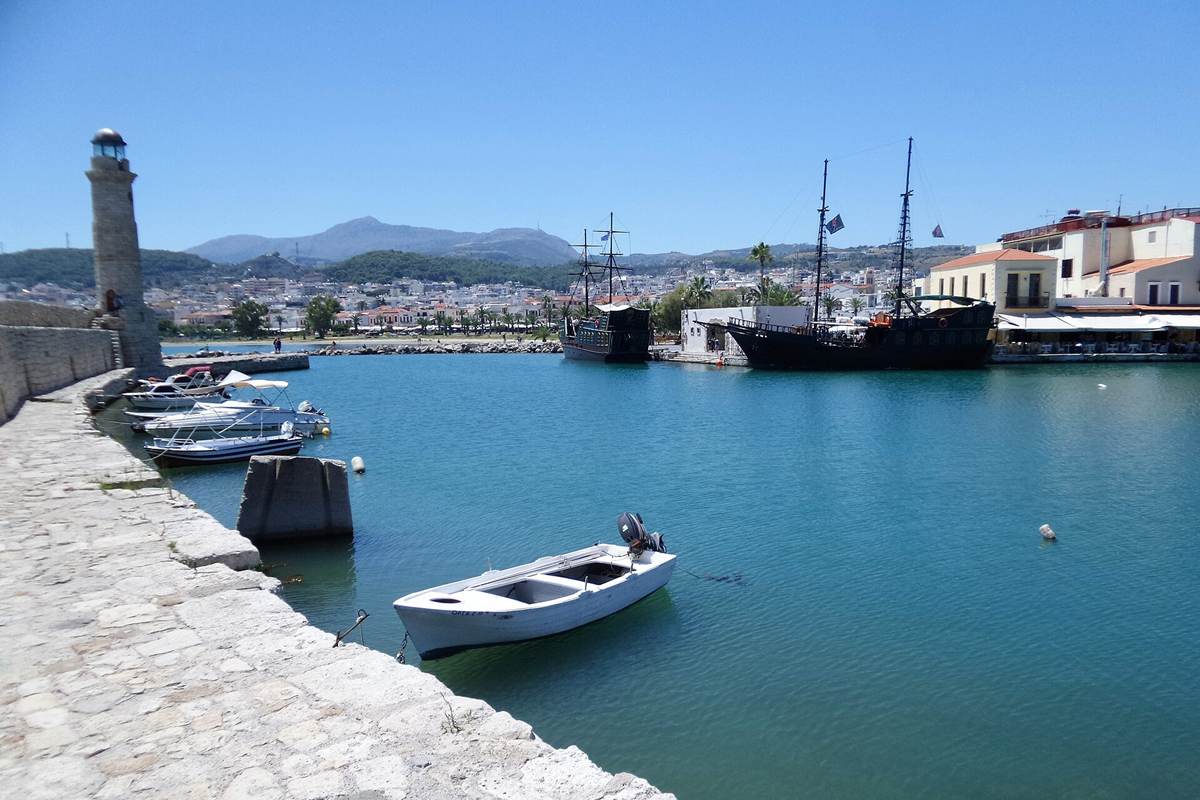
Featured photo: Xxlstier, CC BY-SA 4.0, via Wikimedia Commons (File:Old Venetian Harbour in Rethymno 03.jpg).