
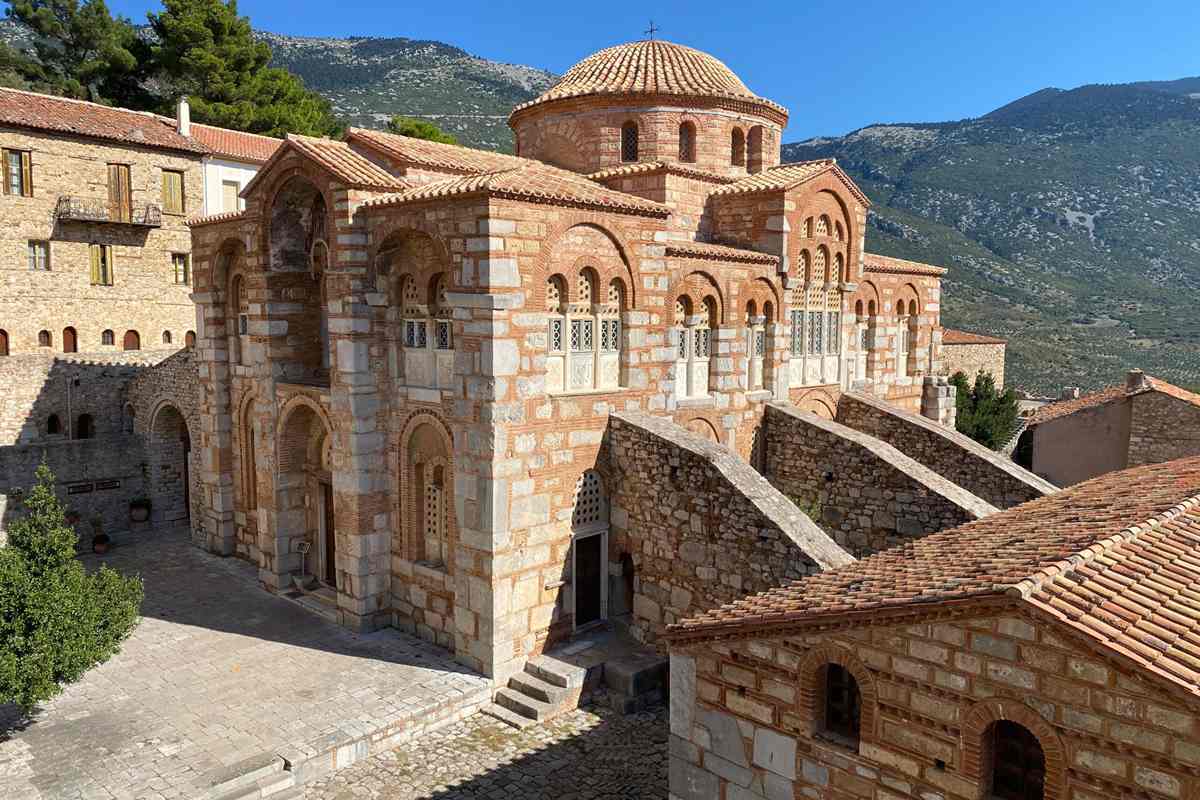
Byzantine churches in Greece rise in Thessaloniki, Athens, Veria, the Peloponnese and the islands. Outings with a host run through these same regions. Thessaloniki holds Hosios David, St Nicholas Orphanos and St Panteleimon. The Athens area holds Daphni and the Little Metropolis. Veria keeps frescoes by the painter Georgios Kalliergis, and Hosios Loukas, Mystras and Nea Moni stand further afield. Wider context comes from a Mainland Greece tour, the UNESCO sites in Greece and Greek traditions. More trips appear under Greece tours.
Bookings made through the GetYourGuide widgets on this page earn Classical Greece Tours a commission, at no extra cost to the traveller.
Which are the Byzantine churches in Greece?
The Byzantine churches in Greece include the Daphni Monastery near Athens, which dates from about 1050. Thessaloniki adds the Church of Prophet Elijah, built in the 14th century. Modern historians coined the term Byzantine for the medieval Roman Empire centred on Constantinople.
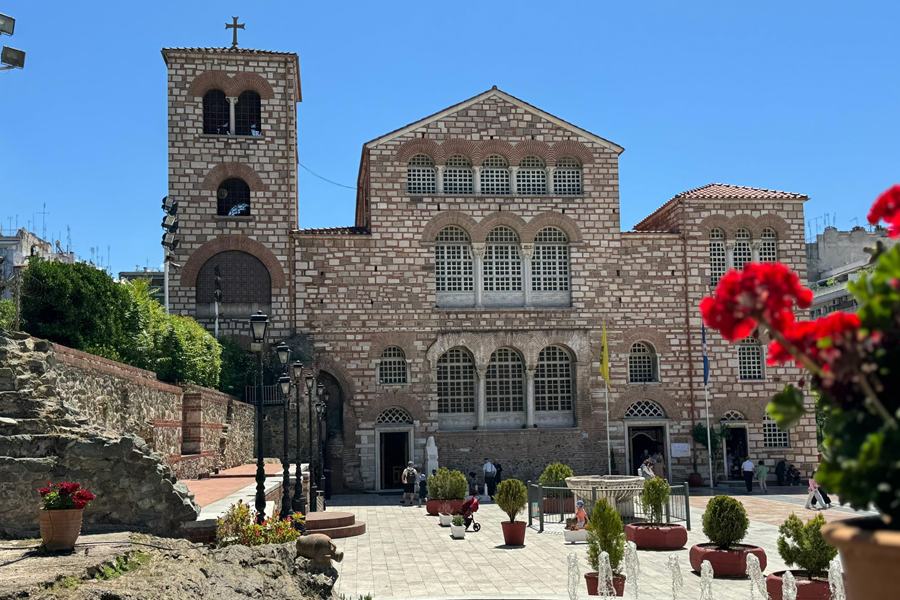
Historians date Byzantine architecture from AD 330, when Constantine the Great founded a new Roman capital at Byzantium. Byzantium later took the name Constantinople. The style ran until the empire fell in 1453. The grandest buildings carried wall mosaics on a gold background as standard. Frescoes, or paintings on wet plaster, were the cheaper choice.
Patricios sorts sacred Byzantine buildings into seven types. The cross-in-square took over as the dominant form. It has a square central block and four arms of equal length. The Athonite type, named after Mount Athos, arose in the tenth century. It adds two side apses, or rounded end rooms, and two narthexes, or entrance halls.
Among the Byzantine churches in Greece, Thessaloniki’s Holy Apostles is an archetypal late building. Archetypal means a model example. Byzantine column tops broke from classical rules, using winding lines and natural forms. One carved column design shows leaves that seem blown by the wind. The finest example stands in the 7th-century Hagia Sophia of Thessaloniki.
- Late churches: Byzantine churches in Greece from the last years before 1453 survive on Mount Athos.
- Round arch: The round arch counts as a basic feature of the Byzantine style of building.
- Worship inside: Christian services took place inside the churches, while classical temple ceremonies happened outside.
The style behind Byzantine churches in Greece lived on between the 16th and the 18th centuries. It gave rise to local post-Byzantine schools, meaning traditions that followed the end of the empire. Bulgaria, Serbia, Romania and Russia shared this long afterlife of the style.
Among the Byzantine churches in Greece, what does Hosios David add?
The Byzantine churches in Greece include Hosios David, set at a distance from central Thessaloniki, nearer the mountains. Its mosaic and fresco decoration was renewed between the 12th and the 14th centuries. In Greek, the title Hosios honours a saint.
Hosios David, one of the Byzantine churches in Greece, has square bays, or compartments, in its corners. Each bay joined the main cross-shaped room through a hallway, and each also opened to the outside. In the middle Byzantine period, earthquakes damaged the structure. Parts of it fell, including the tribelon, a row of three arched openings.
The marble carvings inside the church show swirling patterns of crosses, vines and leaves. In the apse, or rounded recess, a lifelike mosaic shows Christ holding a Greek text. The words speak of hope and salvation and ask for rest for the home. The mosaic also carries symbols of the Evangelists, the writers of the Gospels.
The south barrel vault, a ceiling curved like half a tube, shows the baptism and transfiguration of Christ. The fresco scenes run on with almost no borders between them. That was uncommon for Byzantine churches in Greece and beyond at the time. Three scenes date from the late Byzantine Palaeologan period, around 1300.
- Mosque names: During its time as a mosque, the building was called Suluca Mosque or Murad Mosque.
- Conversion: Scholars place the change from church to mosque in the 16th century, though the date is not certain.
- Minaret: A minaret, the tall tower of a mosque, was added at the south-west corner bay.
Seen from outside, Hosios David is a simple building among the Byzantine churches in Greece. That plain look supports a theory that it did not become a mosque straight after the Ottoman conquest. Earthquakes, cracks, water and Ottoman-era plaster have damaged the frescoes.
For Byzantine churches in Greece, which story does St Nicholas Orphanos tell?
The Byzantine churches in Greece include St Nicholas Orphanos, an early 14th-century church in Thessaloniki. It sits in the far northeast of the old city, just within the eastern wall. Its painted decoration dates the building to the years 1310 to 1320.
The name means Saint Nicholas the Orphan. It first appears in records of the 17th and 18th centuries. The word Orphan is thought to point to the unknown founder. St Nicholas Orphanos ranks among the Byzantine churches in Greece that began as part of a monastery. Remains of its gate survive to the east.
Among Byzantine churches in Greece, St Nicholas Orphanos has original frescoes over almost its whole interior. They belong to the Thessalonican school at the height of the Palaiologan Renaissance, a late artistic revival. Thessalonican means from Thessaloniki. Their painter is thought to have decorated the Hilandar Monastery on Mount Athos in 1314.
The church began as a simple building with a single aisle and a wooden gabled roof. A gabled roof slopes two ways. Aisles were later added on three sides, forming an ambulatory, or walkway around the core. Double openings link the central aisle to the others. Reused late antique capitals, the carved tops of columns, decorate them.
- Templon: The original marble templon, the screen that fences off the altar, still survives inside.
- Graves: Graves have been found beneath the floor of the ambulatory around the church core.
- Restoration: The frescoes came to light during restoration works between 1957 and 1960.
Among the Byzantine churches in Greece, this one has been linked to a Serbian king. He was Stephen Uroš II Milutin, who reigned from 1282 to 1321. He funded churches in the city. An image of St George Gorgos, his patron saint, supports the link.
Byzantine churches in Greece: how does St Panteleimon fit in?
The Byzantine churches in Greece include St Panteleimon, a 14th-century church in the eastern part of old Thessaloniki. It stands near the Rotunda, the round Tomb of Galerius, where Iasonidou and Arrianou streets meet. Its full title is the Holy Church of Saint Panteleimon.
St Panteleimon, among the Byzantine churches in Greece, took its present name after Ottoman rule ended in 1912. For that reason, its original dedication is disputed. In 1548 the building became a mosque. Its Turkish name, İshakiye Camii, means Mosque of Ishak, or Isaac. Camii is the Turkish word for mosque.
The leading scholarly view links the mosque name to the late Byzantine Monastery of the Virgin Peribleptos. That house was also called the Monastery of Kyr Isaac, Kyr being a title of respect. Its founder Jacob served as the city’s metropolitan, or senior bishop, from 1295 to 1315. He then became a monk and took the name Isaac.
A counter-argument holds that the church has no tie to the Peribleptos Monastery. In this view it became a mosque around 1500, named after the city’s kadı, or judge, Ishak Çelebi. The building’s design and decoration date to the late 13th or early 14th century. Those dates back the first view.
- Plan: St Panteleimon follows the tetrastyle cross-in-square type, a four-column plan seen in Byzantine churches in Greece.
- Chapels: A narthex leads in, and a lost ambulatory once joined two chapels that still stand.
- Ottoman traces: The base of the demolished minaret and a marble fountain survive from Ottoman times.
Among the Byzantine churches in Greece, St Panteleimon keeps only a small number of its original wall paintings. UNESCO listed it in 1988 for its well-preserved Byzantine architecture. The listing also noted its witness to the importance of Thessaloniki for early and medieval Christianity.
How does Daphni shape the picture of Byzantine churches in Greece near Athens?
The Byzantine churches in Greece include the church of Daphni, built on a simple Greek cross-octagon floor plan. In its design, the upper church and above all the dome stand for the heavens. The lower area stands for the earth.
The first monastery was built like a fortress, with a basilica at its centre. Its basilica was a church with a long rectangular hall. Enclosing walls protected it, and small cells for monks or nuns lined the inside of those walls. Raids from the north and the sea in the ninth and tenth centuries sent it into decline.
Daphni ranks among the Byzantine churches in Greece rebuilt in a time of renewed wealth. The eleventh and twelfth centuries brought a new octagonal church. A refectory, or dining hall, and a cemetery chapel were added. Traces of old frescoes show a figure with a scroll, thought to be Emperor Basil II.
A square bay sits at the centre of the church under a broad dome. Squinches appear in Byzantine churches in Greece as small half-domes set across the corners of a square space. At Daphni, four squinches turn the central square into an octagon. Tall L-shaped piers, or supports, link them and form the change from square to circle.
- Imported skill: The quality of the building work suggests Basil II brought in workers from Constantinople.
- Local glass: Experts believe the glass for the mosaic tesserae, or small cubes, was produced at Daphni itself.
- Pantocrator: The Christ Pantocrator, or Ruler of All, wears a purple robe and a blue mantle.
The unknown mosaic artist at Daphni, one of the Byzantine churches in Greece, worked around 1100. The pendentives, curved triangles below the dome, hold four scenes from the life of Christ. In the Crucifixion, Mary and St John stand at the foot of the cross.
What do the Byzantine churches in Greece owe to the Little Metropolis in Athens?
The Byzantine churches in Greece include the Little Metropolis on Mitropoleos Square in Athens. Its formal name is the Church of St Eleutherius. Its second name is Panagia Gorgoepikoos. Panagia, meaning All-Holy, names the Virgin Mary, and Gorgoepikoos means she grants requests quickly.
The Little Metropolis, one of the Byzantine churches in Greece, sits on ruins of a temple to Eileithyia. Eileithyia was an ancient goddess. Its name comes from its place inside the residence of the Metropolitan, or senior bishop, of Athens. Its first dedication honoured an icon of the Virgin Mary kept there and held to be miraculous.
Proposed building dates have ranged from the 9th century, under Empress Irene, to the 13th century. In 1436 Cyriacus of Ancona noted one of its inscribed stones lying in the Ancient Agora. That record points to a building date after 1436. The historian Bente Kiilerich suggested an early Ottoman date.
The church follows the cross-in-square layout found in Byzantine churches in Greece, with a three-aisled nave. Four columns first carried its octagonal dome, but piers replaced them in the 19th century. The building measures 7.6 metres long and 12.2 metres wide. Unlike common Byzantine practice, no bricks appear except in the dome.
- Abandonment: The church stood empty for a time once the Greek War of Independence had ended.
- New names: In 1863 it became a church again, first for Christ the Saviour and then Saint Eleutherios.
- Restoration: Work in 1856 returned the church to its first state and removed the bell tower.
Among the Byzantine churches in Greece, it was built almost entirely of spolia, or reused stones. They come from older buildings of Classical Antiquity up to the 12th or 13th century. Of its original frescoes, only an image of the Panagia above the entrance apse survives.
Who was Georgios Kalliergis, and which Byzantine churches in Greece hold his work?
The Byzantine churches in Greece hold the work of Georgios Kalliergis, a Byzantine Greek painter. He was born in Thessaloniki in the 13th century. His best-known frescoes are in the Church of the Resurrection of Christ in Veria. He belonged to the Macedonian School of painting.
Among painters of Byzantine churches in Greece, Kalliergis is one of a small number known by name. Records place him in three centres of Byzantine churches in Greece: Mount Athos, Veria and Thessaloniki. His family name, Kallergis, was linked to a noble family of Crete. The family’s original name, Phokas, changed under Venetian rule.
A poet from Thessaloniki, Manuel Philis, wrote a poem about one of his paintings. A number of historians believe he studied under the painter Manuel Panselinos. In the Nativity of Christ at Veria, the figures of Joseph resemble the work of Panselinos. His work departs from the style of the early Palaeologan Renaissance.
A document found at the Hilandar monastery records him on 9 November 1322. That day he acted as witness when three houses in Thessaloniki were sold to monks from Mount Athos. Kalliergis proudly signed the paintings he made for Byzantine churches in Greece. In one inscription, he names himself the best painter in all of Thessaly.
- Icon: A painting of the Virgin and Child Hodegetria, meaning She Who Shows the Way, is attributed to him.
- Crete link: Cretan painter Manuel Fokas’s Crucifixion fresco strongly resembles the Crucifixion by Kalliergis.
- Shared details: Both Crucifixions show planets in the background and four figures visiting Christ.
The Hodegetria form became a framework for the Cretan School. Angelos Akotantos, Nikolaos Tzafouris, Nikolaos Lampoudis and Andreas Ritzos were among the artists shaped by that style. Both his Crucifixion and that of Fokas influenced Cretan artists. His work dates from around 1315.
What lies beneath Hosios Loukas, one of the Byzantine churches in Greece?
Byzantine churches in Greece include Hosios Loukas, a monastery on the slopes of Mount Helicon. The Greek name means Venerable Luke. This Luke was a hermit, a person who lives alone for faith. He differs from the Evangelist, the author of the Gospel of Saint Luke.
Among Byzantine churches in Greece, Hosios Loukas has a burial crypt below its domed Katholikon. The Katholikon is the main church; a crypt is an underground room. The crypt’s central space has nine groin-vaulted bays, plus a sanctuary ending in an apse. A groin vault forms where two curved ceilings cross. An apse is a rounded recess behind the altar.
The crypt sanctuary has an altar, a chancel barrier and a prosthesis niche. A prosthesis niche is a wall recess for preparing the bread and wine of Christian worship. In Byzantine churches in Greece, a chancel barrier is a low screen that closes off the altar area. An altar is the table where a priest leads the service.
In his lifetime, Luke was believed to be a healer, a levitator, a miraculous feeder and a prophesier. A levitator is a person said to rise into the air without support. A miraculous feeder is said to provide food by a miracle. A prophesier speaks of events before they happen.
- Wall paintings: C.L. Connor calls the crypt paintings the fullest Middle Byzantine programme that still survives.
- Vita: The Vita, or written life, of Saint Luke was the work of an anonymous monk.
- Healing agents: The Vita names lamp oil, moisture from the tomb and dreams near it as healing agents.
Of the Byzantine churches in Greece, Hosios Loukas holds a crypt where Luke’s tomb lies with two others. These two further tombs are believed to belong to abbots. Abbots were the leaders of monasteries and of the monks living there.
Why does Panagia Skripou hold a record among Byzantine churches in Greece?
Byzantine churches in Greece take in the Panagia Skripou Monastery, which stands in the town of Orchomenus, Boeotia. The monastery is the oldest Byzantine monument in Boeotia. The word Byzantine refers to the Christian empire that ruled from Constantinople, the city now called Istanbul.
Inscriptions on the church name its founder as Leo, who held the title of royal Protospatharios. The title meant that he led the spatharios, the guard of the imperial palace in Constantinople. Such inscriptions are words carved on stone. A palace guard is a body of soldiers that protects a ruler and the court.
An inscription on the outside of the sanctuary arch records both the year 874 and the sponsor, Leo. A sponsor pays for a building. The church stands out among Byzantine churches in Greece for its size. Without the narthex, it measures 22.30 by 18.60 metres. A narthex is an entrance hall at the west end of a church.
Among Byzantine churches in Greece, Panagia Skripou has outer walls full of old inscriptions set into the masonry. The name Skripou is thought to come from these, through the Latin word scriptus, meaning inscription. Ancient Romans spoke and wrote in Latin. Masonry is the stone and brick that form a wall.
- Reused stone: The walls reuse ancient pieces from nearby Orchomenus, such as column drums and tombstones.
- Sundial: A vertical sundial, which tells the time by a shadow, adorns the church.
- Frescoes: The oldest frescoes, paintings made on wet plaster, date from the 12th century.
Of the Byzantine churches in Greece built in its time, Panagia Skripou is the largest and richest known. Outside Constantinople, no known monument of that era matches its size and wealth. Constantinople was the Byzantine capital, home to the emperor.
Which royal role did Hagia Sophia at Mystras play for Byzantine churches in Greece?
Byzantine churches in Greece gained a palace church at Mystras, a fortified medieval town in the Peloponnese. As the royal palace church, Hagia Sophia rose inside the palace complex. Fortified means ringed by defensive walls. Hagia Sophia is Greek for Holy Wisdom.
Manuel Kantakouzenos, the first despot of Mystras, built the church in the fourteenth century. The title despot marked a Byzantine prince with a province to rule. His monograms survive on marble plaques of the church. A monogram is a design formed from the letters of a name. A plaque is a flat slab fixed to a wall.
Its first dedication honoured Jesus Christ as the Life Giver, in Greek Zoodotes Christos. Across Byzantine churches in Greece, a dedication names the holy figure or idea that a church honours. Zoodotes joins the Greek words for life and giver. Christos is the Greek form of Christ, a title meaning the anointed one.
In 1365 a seal of Patriarch Philotheus made the church the katholikon of a monastery for men. The founder himself had asked for this change. In Byzantine churches in Greece, the katholikon serves as a monastery’s chief church. Patriarch is the title of a bishop at the head of a great church.
- Frescoes: Inside the building, fragmentary wall paintings survive from the years 1348-1354.
- Pantocrator: The enthroned Pantocrator in the alcove, Christ as ruler of all, is the best preserved original mural.
- Ceramics: Rich ceramic decoration, made of fired clay, covers the drums on the arms of the cross.
Among Byzantine churches in Greece, Hagia Sophia at Mystras holds the grave of a despot’s wife. Cleopa Malatesta was buried there in 1433. Her husband, Theodore II Palaiologos, held the rank of despot. A grave is the place where a body is laid to rest.
How does Monemvasia add a second Hagia Sophia to Byzantine churches in Greece?
Byzantine churches in Greece count another Hagia Sophia in the upper town of Monemvasia. An upper town is the higher part of a settlement. The church is linked with Emperor Andronikos II Palaiologos. Even so, it is thought to be older than his reign.
Among Byzantine churches in Greece, it belongs to the Epirotic octagonal-room type with a dome. It counts among the finest examples of that type. Epirotic refers to Epirus, a region in the north-west of Greece. The dome above the main room is seven metres in diameter, the distance straight across its circle.
After the church was finished, builders added a double portico to the outside of its south façade. A portico is a covered porch whose roof rests on columns. A façade is an outer face of a building. The word comes from French, and the mark under its c shows a soft sound.
The frescoes of Saint Nicholas in the chancel are linked to a theft of his relics. The chancel is the area around the altar. In 1087 Italian merchants took the relics from Myra, in Lycia, and carried them to Bari. On the way they arrived in the harbour of Monemvasia. Relics are a saint’s remains.
- Corner chapels: Each of the four corners of the main hall holds a chapel.
- Venetian era: From 1690 to 1715 it served a monastery of Madonna del Carmine as its main church.
- Ottoman name: As a mosque it was called Fethiye Mosque, which means Mosque of the Conquest.
Among Byzantine churches in Greece, the Monemvasia church was renovated in 1958 under Eustathios Stikas. His work restored its old Byzantine elements. For Byzantine churches in Greece, renovation means repair that returns a building to use. An element is one part of the original design.
Which buildings form Nea Moni on Chios, among Byzantine churches in Greece?
Byzantine churches in Greece reach as far as Chios and its monastery of Nea Moni. It stands on the Provateio Oros mountain, in the island’s interior. In Greek, oros means mountain. A monastery houses monks who share a life of prayer.
The complex holds two smaller churches, one for the Holy Cross and one for St Panteleimon. It also has a trapeza, or dining hall, and kelia, the cells of the monks. A triklinon served as the reception hall, and a kinsterna, or underground cistern, held water. A cell is the small private room of a monk.
The katholikon, the central structure, is made up of the main church, the esonarthex and the exonarthex. Across Byzantine churches in Greece, an esonarthex is an inner entrance hall. An exonarthex is the outer one. The three founders’ remains were first kept in the exonarthex. Remains here means the bones of the dead.
A wall surrounds the complex today; the earlier Byzantine wall was destroyed in 1822. The main church also suffered serious damage in 1822 and again in 1881. Among Byzantine churches in Greece, it now stands in a rebuilt form that differs from the original. Rebuilt means put together again after damage.
- Genoese era: The later rule of Genoa, an Italian sea republic, reduced the wealth of the monastery.
- Monks: Samuel Purchas, a traveller of the late 16th century, recorded 200 monks at the monastery.
- Oldest parts: Only the tower, St Luke’s chapel, the cistern and trapeza parts also survive from the 11th century.
The founding tradition of Nea Moni names three monks: Nikitas, Ioannes and Iosif. At that spot, the three came upon an icon showing the Virgin Mary. In Byzantine churches in Greece, icons are sacred pictures, painted on wooden panels.
What story do the icon and frescoes of Panagia Kera add to Byzantine churches in Greece?
Byzantine churches in Greece on Crete include the Church of Panagia Kera. It stands near the village of Kritsa, in the Dikte Mountains. Panagia is a late Greek word for the Virgin. Eastern Orthodox Christians use it as a title of the Virgin Mary.
Local tradition says the church once held an icon of the Virgin Mary, believed to have miraculous powers. Miraculous means beyond natural causes. During Byzantine Iconoclasm, the icon was removed to Constantinople and later returned. For Byzantine churches in Greece, Iconoclasm was a period that opposed holy images in worship.
In 1498, while Venice ruled Crete, a Greek trader stole the icon. It later reached Rome, where it went to the church of Saint Alfonso on the Esquiline Hill. The Esquiline is one of the hills of Rome. Venice was a trading republic based in north-eastern Italy. A trader buys and sells goods.
The frescoes on the dome and the central nave show scenes from the New Testament. They include the Presentation and the Raising of Lazarus. In Byzantine churches in Greece, a nave is the central space where worshippers stand. The New Testament is the Christian scripture about Jesus. The Raising of Lazarus shows Jesus bringing Lazarus back to life.
- South aisle: The aisle of Saint Anne carries images from the life of the Virgin Mary.
- North aisle: Dedicated to Saint Anthony, this aisle shows the Second Coming, Christ’s return, and Judgement Day.
- Standing: It ranks among the leading churches of Crete for culture and history.
Among Byzantine churches in Greece, Panagia Kera shows on its western wall the Crucifixion of Jesus. The same wall carries the Punishment of the Damned. There, Michael the Archangel announces the Second Coming. In Christian belief, archangels are angels of high rank.
What do travellers ask about Byzantine churches in Greece, and what are the answers?
Byzantine churches in Greece at Mystras include the Pantanassa, now a nunnery. Its founder was Giannis Frankopoulos, who served as chief minister in the Despotate of the Morea. The dedication took place in September 1428. Its carved stone façade mixes Byzantine and Gothic Revival styles.
Among Byzantine churches in Greece, what is the Panagia Varnakova Monastery?
Saint Arsenius the Varnakovite founded the monastery in 1077, in the mid-Byzantine period. It soon became a religious centre of great influence, known as the Holy Lavra of Roumeli. A lavra is a large monastery, and Roumeli is an old name for central mainland Greece. It stands on a small hill by the Vardousia Mountains.
For Byzantine churches in Greece, what is the Galataki Monastery on Euboea?
The Saint Nicholas Galatakis Monastery in northern Euboea is counted as the oldest monastery on the island. Tradition says its founder came from Galata, a district of Constantinople, which gave the name Galataki. Its large church is built in the Byzantine style. Euboea is a large island beside the east coast of mainland Greece.
At Mystras, what is the Hodegetria among Byzantine churches in Greece?
At Brontochion Monastery, the abbot Pachomius made the small Hodegetria church, also called Aphentikon, into the katholikon. The Hodegetria is the first example of the design known as the Mystras type. Its lower floor is a three-aisled basilica, a long hall with aisles. Above it stands a cross-in-square plan. Hodegetria means she who points the way.
Which church at Merbaka joins Byzantine churches in Greece?
Merbaka, a village in Nafplio municipality, has a Byzantine-Gothic Church of the Dormition, the Virgin Mary’s falling asleep. The village name is thought to honour William of Moerbeke, a 13th-century archbishop of Corinth from Flanders. Built into the church is a Latin dedication to the Roman proconsul Quintus Caecilius Metellus Creticus.