
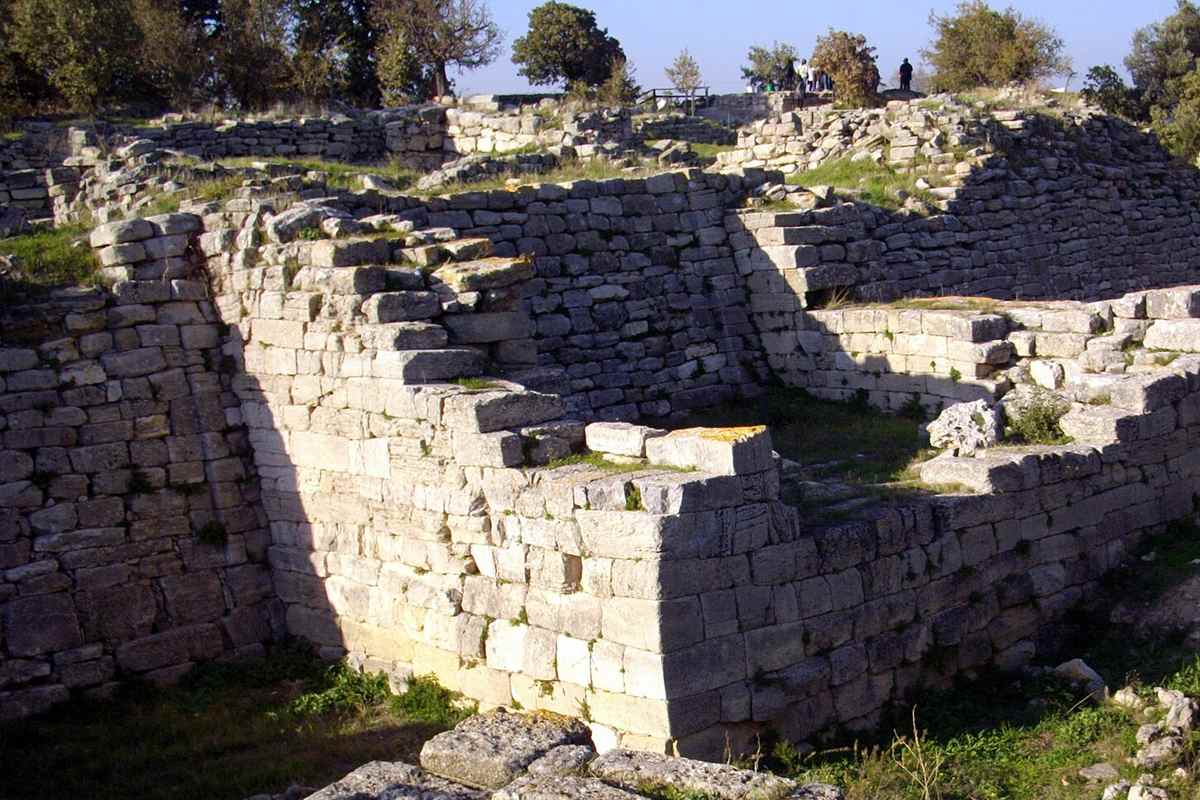
Trojan War places lie on both sides of the Aegean Sea. Small-group and private trips with a tour leader run through mainland Greece and north-west Turkey. The story takes in Troy at Hisarlik, Helen of Sparta and Agamemnon of Mycenae. It turns to Iphigenia at Aulis, Hector, Ajax of Salamis and Palamedes. Frank Calvert, Priam’s Treasure and Carl Blegen follow, with four common questions at the end. Related pages are Mycenae tours, Greek mythology places and Greece and Turkey tours. The full range of trips appears under Greece tours.
Bookings made through the GetYourGuide widgets on this page earn Classical Greece Tours a commission, at no extra cost to the traveller.
What was the Trojan War?
The Trojan War is a legendary conflict of Greek myth. Its date is the thirteenth century BC or the early twelfth. The Achaeans, or Greeks, fought Troy. The fighting began when Paris, a prince of Troy, took Helen away from Menelaus, the Spartan king.
Homer’s Iliad is an epic, which means a long poem about heroes and their deeds. The core of the poem, Books II to XXIII, spans four days and two nights. Those days fall in the tenth year of the siege of Troy. During a siege, soldiers surround a town and block its supplies.
Before the Trojan War, Odysseus of Ithaca proposed a plan for Helen’s suitors. A suitor is a man who hopes to marry a woman. Every suitor had to promise to defend Helen’s marriage, whoever won her hand. The men swore this oath on the cut pieces of a horse. An oath is a solemn, binding promise.
The Iliad’s Catalogue of Ships lists the Greek forces of the Trojan War. It names 28 contingents. A contingent is a body of troops sent by one region or people. They came from Crete, Ithaca, the Dodecanese islands, the Peloponnese and mainland Greece. Their fleet counted 1186 pentekonters. A pentekonter was a ship driven by 50 rowers.
- Doubt: Around 1870, Western Europe broadly agreed that the war never happened and Troy never existed.
- Geology: Two scholars, John C. Kraft and John V. Luce, found the landscape fits the Iliad’s account.
- Old treaty: A treaty from about 1280 BC names a king Alaksandu, and the Iliad calls Paris Alexander.
The historian Thucydides, known as a careful critic, treated the Trojan War as a true event. Even so, he doubted the count of 1,186 ships sent to Troy. Historians are scholars who study and write about earlier times.
What did the digs at Troy reveal about the Trojan War?
The Trojan War is the subject of the Iliad, the main poem set at Troy. It tells the story of the war’s final year. The real site of ancient Troy is the hill of Hisarlik and the fields spreading south of it.
The hill is a tell. A tell is a mound that grows as people build new homes on the remains of old ones. At Hisarlik, these remains cover more than three thousand years of human life. An archaeologist is a scholar who studies such remains to learn about the past.
In the Iliad, the Troy of the Trojan War stands on a steep hill. Massive gates, rectangular towers and huge sloping walls of stone guard it. The Troy VI layer had a citadel, a fortress on high ground. Builders renovated its walls from time to time. Around 1400 BC, their width grew from 1.2 to 5 metres.
Excavators found a lower town below the citadel in the late 1980s. Excavators remove earth layer by layer to uncover old remains. The find showed that Troy VI was over 16 times larger than scholars had assumed. This layer, weighed as a Trojan War setting, held a big city with a large population.
- Troy I: Builders founded Troy I around 3000 BC by a shallow lagoon, on its eastern shore.
- Horses: The Troy VI layer gives the first evidence of horses found at the site.
- Fire: Troy VIIa was destroyed around 1180 BC, leaving signs of enemy attack such as scorch marks.
Two sublayers, Troy VIh and Troy VIIa, show possible signs of violent destruction. A sublayer is a thin band inside a main layer. For this reason, both rank among the candidates for a real setting of the Trojan War myths.
Why does Helen of Troy stand at the centre of the Trojan War?
The Trojan War centres on Helen, known as Helen of Troy and at times as Helen of Sparta. Myth calls her the loveliest woman in the world. Her marriage to Paris, a prince of Troy, was the direct cause of the war.
Two dedications to Helen are written in the Laconian dialect, the Greek of the Sparta area. A dedication is a gift offered at a shrine with an inscription. Dialect here means a regional variety of speech. Both texts begin the Trojan War queen’s name with a digamma. This old letter is thought to sound like a w.
Helen had a sanctuary inside Sparta. Sanctuary here means sacred ground used for worship. It stood near the Platanistas, a spot named for the plane trees planted there. Ancient writers also tie Helen to the choral dances of young women near the Evrotas River. A choral dance is a dance by a group that sings.
Therapne held the Meneleaeia, a festival for Menelaus and Helen, the Spartan pair of the Trojan War. A festival is a set time of feasts and rites. Rites are fixed acts of worship, such as hymns. The festival bore the name of Menelaus, yet it honoured both husband and wife.
- Rhodes: On the island of Rhodes, Helen was worshipped as Helen Dendritis, meaning Helen of the Trees.
- Sandalion: Photius says a place in Lacedaemon, the Spartan state, was named after Helen’s fallen sandal.
- Early images: Pictures of Helen began to appear in the 7th century BC.
Archaeologists have searched beneath present-day Sparta for a Mycenaean palace. Mycenaean refers to Greek life in the Late Bronze Age, when the Trojan War story is set. So far, that search has not succeeded. A palace here means a large royal complex of buildings.
Which role did Agamemnon of Mycenae play in the Trojan War?
The Trojan War cast Agamemnon of Mycenae as commander-in-chief, the top Greek leader. In that role he called the princes to council and led the army in battle. The Iliad tells of his quarrel with Achilles in the war’s final year.
Scholars read the name of the Trojan War commander in different ways. One view says it means very steadfast, unbowed or resolute. Steadfast means firm and loyal, and unbowed means never giving in. Resolute describes a person who holds to a decision. This reading treats Agamemnon as a compound, a word built from two parts.
Before the Trojan War, Aegisthus held the throne of Mycenae for a time. At that time Agamemnon and Menelaus, his brother, found shelter in Sparta. Their host was Tyndareus, King of Sparta. Shelter here means protection from harm. The throne, a king’s chair of state, also stands for royal power.
In Book One of the Iliad, Agamemnon asks the army for a fresh prize. He takes Briseis, a captive who had been the prize of Achilles. A captive is a person taken by force. The resentment between the two men grows deep. Achilles then withdraws from battle and refuses to fight.
- Javelin: At the funeral games for Patroclus, Achilles gives him the javelin prize without a contest.
- Day of glory: His aristeia, a hero’s day of glory, comes in Book Eleven of the Iliad.
- In art: Artists show him with a sceptre and a diadem, a royal headband marking a king.
In Homer’s Odyssey, Agamemnon comes home from the Trojan War. Aegisthus then kills him in a feasting hall. The killing takes place at a feast held, as a pretence, to honour his return. A pretence is a false show meant to deceive.
How does the story of Iphigenia at Aulis open the Trojan War?
The Trojan War stalls in myth at Aulis, before the fleet sets out. There the goddess Artemis kept the allied troops from reaching Troy. Her price was the sacrifice of Iphigenia, the eldest daughter of King Agamemnon. Sacrifice means a life offered to a god.
The name Iphigenia means strong-born or born to strength. It can also mean she who gives birth to strong children. In the Iliad, one of Agamemnon’s three daughters is called Iphianassa. Scholars treat that name as possibly an older variant of Iphigenia. A variant is another form of the same word.
Iphigenia and her mother came to the Trojan War camp at Aulis under a false story. They were told she was to marry Achilles. In one version, Artemis snatches her away at the moment of sacrifice. The goddess carries her to Tauris, in Crimea, and leaves a deer in her place.
The earliest surviving full accounts come from Euripides, an Athenian playwright. His tragedies Iphigenia at Aulis and Iphigenia in Tauris date from the fifth century BC. A tragedy is a serious drama about human suffering and fate. Both plays are set in the Heroic Age of the Trojan War. Playwrights write works for the stage.
- Halae: Athena orders Orestes to bring a wooden cult image of Artemis to Halae and build her temple.
- Homer: Homer never mentions the sacrifice of Iphigenia in plain words.
- Etruscan urns: In the second and first centuries BC, Etruscans decorated cremation urns with scenes of the sacrifice.
The Spartans told a different ending to this Trojan War tale. They said the sacred image of Artemis came to Laconia in their hands. There they honoured the goddess as Artemis Orthia. Laconia is the region around Sparta in the southern Peloponnese.
Who was Hector, prince of Troy in the Trojan War?
The Trojan War had Hector as the greatest warrior for Troy. He was a Trojan prince and a hero of myth. He is a major character in Homer’s Iliad. There he commands the Trojans and their allies as they defend the city.
Hector’s name comes from the Greek verb ekhein, meaning to have or to hold. So the name seems to mean holder or possessor. It can also be read as holding fast. A verb is a word that names an action or a state. Holding fast here means standing firm during the long siege.
Hector was the eldest son born to King Priam and Queen Hecuba. That made him a prince of the royal house. He was also heir to his father’s throne. An heir is the person due to inherit a title or property. According to the Iliad, Hector did not approve of the Trojan War.
In one Trojan War scene, Hector meets his wife Andromache at the city gate. She carries their baby son, Astyanax. The gleaming bronze helmet of Hector scares the child, and he cries. Hector takes the helmet off and embraces them both. A helmet is a hard hat that protects the head in battle.
- Last lines: The Iliad ends with Hector’s funeral and calls him the Breaker of Horses.
- Theban tomb: The Thebans had a tomb for Hector near the Fountain of Oedipus.
- Oracle: Theban tradition says an oracle of Zeus had his bones brought from Troy to Thebes.
An oracle is a message from a god, given through a shrine. Scholars widely see Hector as the figure in the Iliad who draws the greatest sympathy. He draws more than Achilles, the main hero of this Trojan War poem.
What ties Ajax the Great and Salamis to the Trojan War?
The Trojan War poems, Homer’s Iliad and the Epic Cycle, show Ajax the Great as a towering figure. He is also a warrior of great courage. Among the Greek heroes of the war, only Achilles ranks above him.
Hesiod’s poem The Great Eoiae explains the name Ajax. In it, Heracles asks Zeus to grant a son to the parents. Zeus sends an eagle as a sign. A sign here means a message from the gods. The Greek word for eagle is aetos, so Heracles tells the parents to call the boy Ajax.
In the Trojan War his huge shield joins seven cowhides with a sheet of bronze. He was known as the bulwark of the Achaeans. A bulwark is a strong wall of defence, and Achaeans is a name for the Greeks. The centaur Chiron trained him. In myth, a centaur joins a human upper body to a horse’s body.
This Trojan War hero was the tutelary, or protecting, hero of Salamis. There he had a temple, an image and a festival, the Aianteia. An image here means a statue of the hero. Each year young Athenian ephebes, youths in military training, raced on foot and in boats on Salamis.
- Athens: Ajax had a statue in the Athenian market-place, and the tribe Aiantis took his name.
- Descent: Cimon, Miltiades, Alcibiades and the historian Thucydides all traced their family line to Ajax.
- Palace dig: In 2001 Yannis Lolos started work on a Mycenaean palace at Kanakia, a village on Salamis.
The palace at Kanakia appears to have been left empty at the height of Mycenaean power. That was roughly the time when the Trojan War is placed. Mycenaean names the Greek culture of the late Bronze Age, called after the city of Mycenae.
What inventions do the myths credit to Palamedes, a hero of the Trojan War?
The Trojan War myths credit Palamedes with the invention of dice, numbers and letters. He was a prince of Euboea and a son of King Nauplius. His name means the handy one, or the contriving one. Contriving means clever at finding ways to do things.
Accounts of the Trojan War differ on how Palamedes reached Troy. Dares says he brought thirty ships from Cormos. Philostratus says he came alone with his brother Oeax, on a ferryboat. A ferryboat is a boat that carries people across a stretch of water. Dares and Philostratus were ancient authors.
The writer Pausanias describes a Temple of Fortune in Argos. In that temple, Palamedes dedicated the dice he had invented. To dedicate means to give an object to a god as a lasting gift. Dice are small cubes marked with dots, thrown in games of chance. Fortune here means luck, honoured as a goddess.
Hyginus says eleven letters of the Greek alphabet came from this Trojan War hero. An alphabet is a fixed row of letters for writing the sounds of speech. In Book 7 of The Republic, Plato has Socrates say that Palamedes claimed to have invented numbers. The Republic is a dialogue, a written conversation between thinkers.
- Not in Homer: Palamedes plays a major part in other accounts, yet Homer’s Iliad never names him.
- Socrates: In Plato’s Apology, Socrates hopes to talk with Palamedes once he has died.
- Defence speech: The Greek speaker Gorgias wrote a Defence of Palamedes, the hero’s reply to a charge of treason.
In 1625 the Dutch playwright Joost van den Vondel wrote a play called Palamedes. Its story comes from the Trojan War myth. Authorities in Amsterdam read political meanings into it and fined him heavily. Treason means betraying one’s own side.
How did Frank Calvert help locate the city of the Trojan War?
The Trojan War site at Hisarlik owes early digs to Frank Calvert. He was an amateur archaeologist and an English official at consulates in the eastern Mediterranean. He started to explore the mound seven years before Heinrich Schliemann arrived.
Calvert was born on Malta in 1828, into an English Levantine family. Levantine describes Europeans settled in the eastern Mediterranean lands. Malta was then a British naval base. Naval here means linked to a navy’s warships. A consulate is an office where one state looks after its trade and people in another.
Calvert never married. He had a lasting passion for the Homeric epics, the poems linked to Homer. He was firmly convinced that the myths recorded history and were not fiction. For him, the Trojan War had truly taken place. Fiction means stories that are made up. Passion here means a strong and lasting love.
When Schliemann began seeking the Trojan War city in Turkey, the site commonly taken for Troy was Pinarbasi. This hilltop stands where the Trojan Plain ends in the south. Schliemann was about to give up the search. Calvert then suggested digging the mound of Hisarlik. A mound is a large raised heap of earth.
- Family farm: In 1847 his brother Frederick bought farmland of over 2,000 acres, including part of Hisarlik.
- Unpaid post: From 1874 he served as the United States consular agent, without pay, for life.
- Depth: Calvert dug into the mound but never got down to the Bronze Age layers.
Calvert died in 1908. At that point he had never been officially linked with the discovery of Troy. Officially here means in formal records and public honours. Troy, the city of the Trojan War myth, lies within the mound of Hisarlik that he explored.
What is Priam’s Treasure, and how does it link to the Trojan War?
The Trojan War king Priam lends his name to Priam’s Treasure, a cache of gold and other artefacts. Frank Calvert and Heinrich Schliemann found it at Hisarlik in the late 19th century. The greater part now rests in the Pushkin Museum in Moscow.
A cache is a hidden store of valuable things. The find came from the layer known as Troy II. A layer here is one level of ruins within the mound. Priam, king of Troy in the Trojan War story, belongs to Troy VI or VII. Those cities stood hundreds of years later.
The finds included diadems of woven gold, rings, bracelets and earrings. There were also necklaces, buttons, belts and brooches. A diadem is a jewelled band worn on the head. One silver vase held two gold diadems, called the Jewels of Helen. It also held 8750 gold rings, buttons and small objects.
Schliemann, who tied the find to the Trojan War, told a story about the moment of discovery. In it, his wife Sophie carried the treasure away in her shawl. A shawl is a large cloth worn over the shoulders. He later admitted making the story up. At the time, Sophie was with her family in Athens.
- Silver blades: Schliemann claimed that six wrought silver knife blades from the hoard served as money.
- Ottoman deal: Schliemann traded part of the treasure to the Ottoman government for permission to dig again.
- Berlin: In 1881 the Royal Museums of Berlin acquired the remaining pieces.
In 1994 the Pushkin Museum admitted that it held the Trojan gold. That gold is the treasure Schliemann named after the king of Troy in the Trojan War story. Museums care for and display objects of value. Wrought means shaped by hammering.
What did Carl Blegen add to the study of the Trojan War?
The Trojan War city at Hisarlik was dug by Carl Blegen’s team from 1932 to 1938. Blegen was an American archaeologist who also worked at Pylos in Greece. He led the University of Cincinnati excavations at the mound.
Blegen, a future digger of the Trojan War city, was born in Minneapolis, Minnesota. He was the eldest of six children. His parents, Anna Regine and John H. Blegen, had both emigrated from Norway. They came from Lillehammer. Emigrants are people who leave their homeland to settle abroad.
From 1911 to 1913, Blegen was a fellow of the American School of Classical Studies, based in Athens. A fellow here is a scholar paid to study and research. In those years he worked on digs at Locris, Corinth and Korakou. A dig is the careful excavation of an ancient site to study its remains.
At Troy, the city of the Trojan War, Blegen followed the lead of Heinrich Schliemann, the earlier digger. Yet he added a professional approach that Schliemann had not had. Professional here means trained and based on careful methods. Blegen split the nine main levels of Troy into forty-six sublevels in his main report.
- Pottery gap: A later study of his pottery sequence found that a 100-year gap separates Troy III and Troy IV.
- Gold Medal: In 1965 Blegen became the first winner of the Gold Medal of the Archaeological Institute of America.
- Papers: Blegen left a large collection of his documents to the American School in Athens.
Blegen, an excavator of the Trojan War city, died in Athens in 1971, at the age of 84. His grave lies in the Protestant corner of the city’s First Cemetery. His wife Elizabeth Pierce Blegen lies beside him there. A cemetery is a burial ground for the dead.
What do travellers ask about Trojan War, and what are the answers?
The Trojan War hero Protesilaus appears in the Iliad. He was honoured at cult sites in Thessaly and in Thrace. A cult site is a holy place where people worshipped a god or a hero with rites. Honoured here means given worship and offerings.
Who was the first Greek ashore in the Trojan War?
Hyginus explains the name Protesilaus. It comes from protos, the Greek word for first. He was the first to leap ashore at Troy, so he was the war’s first death. He brought forty black ships to Troy. His men came from Pyrasus, Antron, Pteleus and his home, Phylace.
Where did the Greek fleet hide near the end of the Trojan War?
In Virgil’s Aeneid, the Greeks hide their fleet in the bay of Tenedos. The trick lets Troy believe the war is over. Apollodorus says the island’s name comes from Tenes, its ruler in the time of the war. In Turkish the island is Bozcaada, meaning barren or grey island.
Who was Cassandra in the Trojan War?
Cassandra was a Trojan priestess of the god Apollo. Apollo fated her to speak true prophecies that no one believed. A prophecy is a statement about what will happen. In the Iliad, Homer calls her the fairest of Priam’s daughters. Euripides wrote that she had light hair and wore a laurel crown when prophesying.
Which poems beyond Homer tell the Trojan War?
The Epic Cycle was a group of Greek epic poems about the war at Troy. They include the Cypria, the Aethiopis, the Little Iliad and the Nostoi. Unlike Homer’s two epics, these poems survive only in fragments and summaries. A damaged summary in Venetus A, a 10th-century copy of the Iliad, preserves their plots.
Featured photo: ykeiko, CC BY-SA 3.0, via Wikimedia Commons (File:Archaeological Site of Troy, Inner Court Wall トロイ遺跡 – panoramio.jpg).