
Caves in Greece shape trips by boat and on foot across the mainland and the islands. They reach from Chalkidiki and Attica to Samos, Antiparos, Zakynthos and Crete. Topics include Petralona Cave, the Cave of Antiparos and Eileithyia Cave on Crete. Others are the Cave of Pythagoras, Davelis Cave, Pan’s Cave, Kalamakia and Klissoura Cave 1. Related pages cover Waterfalls in Greece, the Mani peninsula tour and Greece kayaking tours. Trips across the whole country gather at Greece tours.
Bookings made through the GetYourGuide widgets on this page earn Classical Greece Tours a commission, at no extra cost to the traveller.
Which are the caves in Greece?
The caves in Greece range from deep mountain caves on Crete to small hollows on the islands. Tafkoura sits on Mount Psiloritis, also called Mount Ida. Its explored depth of 860 metres places it among the deepest in the country.
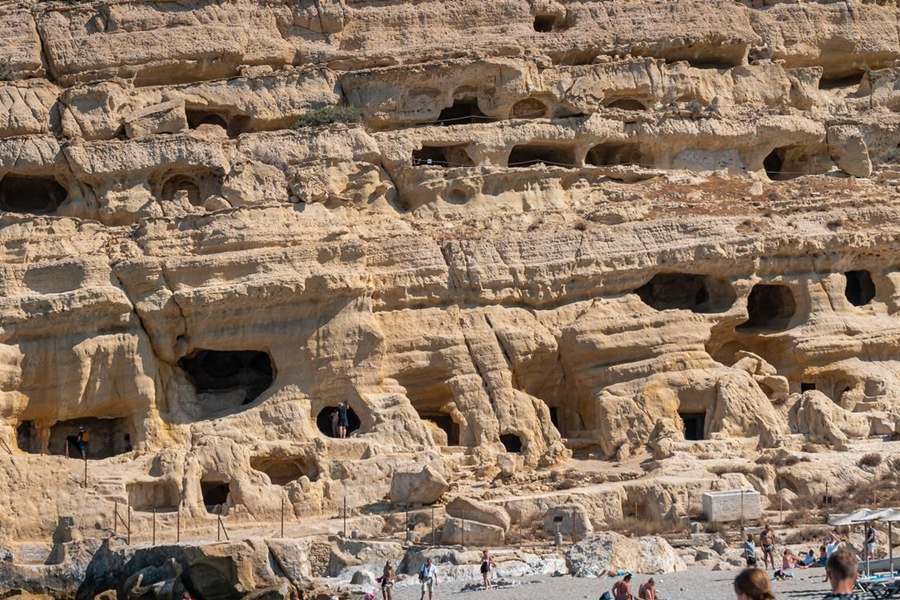
Tafkoura ends in a sump, which is a cave passage filled with water. The cave also keeps unexplored leads, meaning side openings that cavers have not yet followed. Sternes lies in the White Mountains of Crete, known in Greek as the Lefka Ori. Its explored depth is 722 metres, and its explored length is 7,750 metres.
Agios Georgios Cave lies inside the city of Kilkis itself. The city shares its name with the prefecture of Kilkis, a prefecture being a district of local government. On the island of Thasos, Drakotrypa Cave sits close to the village of Panagia. The caves in Greece also reach Lemnos, where the Cave of Philoctetes lies near Kontopouli.
The Hellenic Speleological Society was founded in 1950 and is the oldest caving organisation in the country. Speleology is the scientific study of caves, and a speleologist is a person who explores and studies them. The society’s archive covers over 10,000 caves in Greece, each one explored and recorded.
- Kalymnos: The Cave of the Seven Virgins lies on Kalymnos, in the Dodecanese island group.
- Imathia: Prionia Cave opens on Mount Vermio, within the prefecture of Imathia.
- Magnesia: The Cave of Centaurus lies on Mount Pelion, in the prefecture of Magnesia.
The caves in Greece also count the Cave of the Lion, set in that same Cretan range. Its French name is Trou de Leon. Exploration of the cave ends in a sump, yet cavers are still following its open leads.
What makes Petralona Cave stand out among the caves in Greece?
The caves in Greece include Petralona Cave in Chalkidiki, a karst cave 300 metres above sea level. Karst is limestone ground that water has slowly dissolved into hollows. An early human skull found inside brought the cave to public notice.
Two men were first lowered through a narrow crack into the cave. They reported a long series of chambers and corridors, 8 to 10 metres high. Writers have likened the rock shapes to giant cactus, pink pearls, sturdy columns and delicate curtains. These shapes are speleothems, mineral deposits that form in the caves in Greece and elsewhere.
Among the caves in Greece, Petralona spans 10,400 square metres in area. Its corridors stretch for about 2,000 metres in all. Inside, the air stays at around 17 degrees Celsius through the whole year. From 1968, the anthropologist Aris Poulianos led digs there. An anthropologist studies humans and their past.
The skull clung to the wall of a small side cavern, about 30 centimetres above the floor. Sinter, a hard crust of mineral deposit, held it there. Its lower jaw is missing. Scholars who have studied it largely class it as Homo heidelbergensis. This early human species lived in the Middle Pleistocene, part of the Ice Age.
- Age: The firmest published dates place the skull between 150,000 and 250,000 years old.
- Prey: Horses, ibexes and deer are the main plant-eating mammals whose bones lie in the cave.
- Tools: Certain bones carry marks of sharp tools, showing they were food for Old Stone Age people.
In 2011, the Greek Archaeological Service took over the site and museum. The Ephorate of Palaeoanthropology and Speleology, part of the Ministry of Culture, now leads the digs. Its work aims to show how animals and humans used one of the caves in Greece.
How does the Cave of Antiparos fit among the caves in Greece?
The caves in Greece include the Cave of Antiparos. It sits in the centre of the island that shares its name. It is among the very extensive caves in Greece, with passages spread over a number of levels.
The area around the cave served for pottery making and for the worship of Artemis. Artemis, in Greek myth, ruled over hunting and wild places. The church of Agios Ioannis Spiliotis rises at the entrance to the site. Its name means Saint John of the Cave, since spilia is a Greek word for cave.
This cave keeps marks left by its visitors over time. Signs and scratches mark its stalactites and stalagmites. In the caves in Greece, stalactites grow down from ceilings and stalagmites build up from floors. One altar inscription is linked to the generals of Alexander the Great. Inscriptions are lettering chiselled into rock or stone.
In 1673, the Marquis de Nointel stayed three days in the cave with a large party. He was France’s ambassador to the Ottoman Empire, and a marquis is a French noble rank. The island had fallen to the Ottomans in 1537. Their rule lasted until 1821, apart from a Russian spell from 1770 to 1774.
- Wartime: The German occupation of Greece left part of the cave destroyed.
- Renewal: Funds from the European Union paid for a major renovation in the late 20th century.
- Fittings: The works added barriers, proper steps, lighting, security cameras and loudspeakers for visitors.
Among the caves in Greece, this one also supports its island’s purse. Income from visits makes up a very big portion of the Antiparos council budget. The council is the municipality, the body of local government that runs island services.
Why is Eileithyia Cave a holy place among the caves in Greece?
The caves in Greece include Eileithyia Cave on Crete, a sacred cave of the goddess Eileithyia. People used the site from the New Stone Age, called the Neolithic, until the Roman era. Worship there was strongest in the Late Minoan period.
The goddess Eileithyia watched over childbirth and midwifery, which is the skill of helping mothers give birth. In Mycenaean times she was already known as E-re-u-ti-ja. The word Mycenaean comes from Mycenae, a Bronze Age stronghold in the Peloponnese. Among the caves in Greece, this one holds a central stalagmite shaped like a standing woman.
Pottery from the Neolithic to the Roman periods has been found in the cave. Finds from the Minoan era form the largest group. Minoan describes Bronze Age Crete and its palace culture. Four vases in human form, from the Orientalizing period, came from the sanctuary. That period saw Greek art borrow styles from the Near East.
These vases echo Egyptian pieces showing the goddess Isis as she nurses her baby son Horus. The sanctuary holds the largest group of Egyptian and Egyptian-style objects on Crete. Christoforos Anerrapsis of Candia discovered the cave, one of the holy caves in Greece. Candia is an older name for the city of Heraklion.
- Museum: The Archaeological Museum of Iraklion now displays finds from the cave.
- Myth: A Homeric hymn says jealous Hera held Eileithyia on Crete for nine days and nights.
- Pausanias: Writing in the 2nd century CE, he says Greeks still saw the cave as her home.
Prehistoric settlers lived in the cave until around 400 BCE, with BCE meaning before the Common Era. Scholars broadly agree that the Minoans used sacred caves for religious rites. On Crete, such caves in Greece also served at times for burial.
Which story links Pythagoras to the caves in Greece on Samos?
The caves in Greece include the Cave of Pythagoras on Samos. It lies on Mount Kerketeas, the highest mountain on the island. Island folk tradition says the Greek thinker Pythagoras lived and taught there in the 6th century BC.
The cave sits about 300 metres above sea level, to the west of the village of Marathokampos. A spring at the site is said to have supplied Pythagoras with drinking water. The ancient writer Iamblichus, in his work On the Pythagorean Life, places Pythagoras in a Samos cave.
Among the caves in Greece, the Pythagoras site takes in three caves with branches and rooms. Two chapels also stand at the site. The main Pythagoras Cave is the lowest of the three. Inside, a larger lower chamber sits below a smaller upper chamber. A chapel means a small place of worship, smaller than a church.
Higher up the path stands a chapel of John the Evangelist, called Agios Ioannis Theologos in Greek. Above it is Panagia Sarantaskaliotissa, the Virgin of the Forty Stairs. It dates from the 11th century, when monks sought refuge in the area. Two caves behind it descend to 90 metres, with stalactites and stalagmites like other caves in Greece.
- Window: The upper chamber has a large opening, called a window, that faces south.
- Entrance: The main Pythagoras Cave opens through a narrow entrance in the rock.
- Other name: The higher chapel is also called Panagia Phaneromeni, meaning the Virgin Mary Revealed.
Pythagoras is said to have withdrawn from the city to this cave. Yet it is impossible to confirm that it is the same cave named in the ancient account. Among the caves in Greece, it is the one that carries his name.
What does Davelis Cave on Mount Penteli add to the caves in Greece?
The caves in Greece include Davelis Cave, also called the Cave of Penteli. Mount Penteli holds it on its southwestern slope. Its nickname recalls a popular link with Christos Davelis, a 19th-century brigand. A brigand is an outlaw who robs travellers.
It is one of the caves in Greece set inside an ancient quarry, called Spilia. The quarry sits about 700 metres up the mountain. The worked rock faces still carry the marks of chisels and wedges. Part of an ancient paved track survives, where workers dragged blocks downhill on sledges.
No evidence shows that people worshipped in the Davelis Cave in ancient times. A much smaller cave higher up, at about 800 metres, held a shrine of Pan and the nymphs. Pan was the Greek god of shepherds and flocks. Nymphs were female nature spirits of Greek myth, linked with springs, trees and caves in Greece.
Christian use of the cave goes back to late Roman or early Byzantine times. Inscriptions and rock-cut graffiti of crosses, angels and eagles mark the cave. A small double church went up at the entrance between the 10th and 12th centuries. Its south chapel, for Saint Spiridon, is the older and was cut into the cave wall.
- North chapel: Added later, the Saint Nicholas chapel is built of masonry with a small dome.
- Frescoes: The wall paintings date to the first half of the 13th century.
- Traveller: The English traveller Edward Dodwell came to the site on 22 June 1805.
The quarry and the cave have drawn travellers since the 18th century. The English writer Richard Chandler was among them. Among the caves in Greece, Davelis lies northeast of Athens. Its quarry supplied the Pentelic marble of the Parthenon.
How did Pan’s Cave at Daphni serve as one of the caves in Greece?
The caves in Greece include the cave of Pan at Daphni, in Haidari in Attica. It was sacred to Pan, the god of shepherds and wild places, honoured in caves in Greece. It lies near the Byzantine monastery of Daphni.
The cave is shaped like a cone, about 11.55 metres deep. Its opening, which faces north, is 7.8 metres wide and 3.4 metres high. In ancient times, a wall with a doorway gave access to the cave. A flat forecourt, about 2 metres deep, lay in front of the wall.
The architect and archaeologist Ioannis Travlos began the first modern study on 25 March 1932. The 1932 dig found burnt animal bones and pieces of goat horn. Clay figurines showed Pan, Aphrodite, Silenoi and female figures. Silenoi were spirits of flowing water and fertile earth, and companions of the god Dionysus.
The natural cave seems to have been reshaped once caves in Greece became places of worship. That change came around the 5th century BCE. Active worship ran from the Greco-Persian Wars into the later 5th century BCE. Those wars set Greek cities against the Persian Empire. Traces of mortar show the walls and floor were plastered.
- Rites: The cave is thought to have hosted burnt offerings and animal sacrifices to Pan.
- Cross: A large painted cross on the left wall points to later Christian use.
- Stable: After the monks left, the cave became a temporary shelter for sheep.
Its remote, wooded setting supports the link with Pan. Such spots were easy for passing shepherds and travellers seeking shelter to reach. Among the caves in Greece, it held a smaller cult role than other local sanctuaries in Attica.
Where does Kalamakia sit among the coastal caves in Greece?
The caves in Greece include Kalamakia, a fossil-bearing cave on the Peloponnese’s Mani peninsula. It lies at Areopolis, on the western coast of Mani. People lived in it during the Pleistocene, the age of the great ice sheets.
Among the coastal caves in Greece, it sits within ten metres of the shoreline. Its floor lies about two metres above today’s sea level. Its mouth measures seven metres across and eight metres in height. The cave runs twenty metres deep and lay under the sea for a long Pleistocene spell.
Systematic digging at Kalamakia, one of the Mani caves in Greece, began in 1993. Andreas Darlas and Henry de Lumley identified seven stratigraphic units at the site. Stratigraphic units are separate layers of earth and rock laid down over time. Researchers counted 26669 animal remains, but only 486 were identifiable to a species.
Fallow deer and ibex supply the bulk of the identified bones. An ibex is a wild mountain goat with long curved horns. Galliformes, the group of ground birds that includes partridges, are the commonest birds found. Their presence points to a mild, temperate climate rather than a cold one. A temperate climate has mild summers and mild winters.
- Humans: Fourteen human remains came to light across the excavated site.
- Neanderthals: Neanderthals lived in the cave again and again, sometimes briefly and sometimes for longer.
- Tools: Fine-grained flint was the commonest raw material for the stone tools made there.
Researchers describe a Middle Palaeolithic stone industry at Kalamakia, from the middle Old Stone Age. Its tools are small in size and fairly thin. Neanderthals were an early human species, now extinct. Among the caves in Greece, Kalamakia holds both their bones and their tools.
What do the layers of Klissoura Cave 1 reveal about caves in Greece?
The caves in Greece include Klissoura Cave 1, a cave in the southern Greek region of the Peloponnese. It sits near the Berbadiotis river. People are thought to have used the cave and its area for over 90,000 years.
Klissoura holds a long record from the Palaeolithic, or Old Stone Age, among the caves in Greece. Hunters at Klissoura shifted their aim from large prey to tiny animals that were easier to find. Researchers read this change as a response to a growing population, not to a changing climate.
The bones change from layer to layer. The lower layers hold mainly bones of larger animals, such as deer. Higher layers hold more bones of small, fast animals, such as hares and birds. In caves in Greece and beyond, a layer means one sheet of earth laid down over time.
The Middle Palaeolithic layers reach up to 6.5 metres thick. Their stone tools are chiefly small chips and flakes, along with scrapers and points. The Upper Palaeolithic layers belong to the Aurignacian culture and contain clay hearths and ash. The Aurignacian was an early culture of modern humans in Europe. A hearth is a fireplace.
- Blades: Upper Palaeolithic layers hold finely made blades and bladelets, which are small, narrow blades.
- Methods: Middle Palaeolithic toolmakers used both Levallois and non-Levallois ways of striking flakes.
- Break: Older layer VII is sharply cut off by the newer Aurignacian layer IV at the back.
Archaeologists dug at Klissoura from the late 20th century into the early 21st. Water flow and soil washed down from nearby hills also helped to shape its layers. Among the caves in Greece, its use rose sharply from the Middle into the Upper Palaeolithic.
What do travellers ask about caves in Greece, and what are the answers?
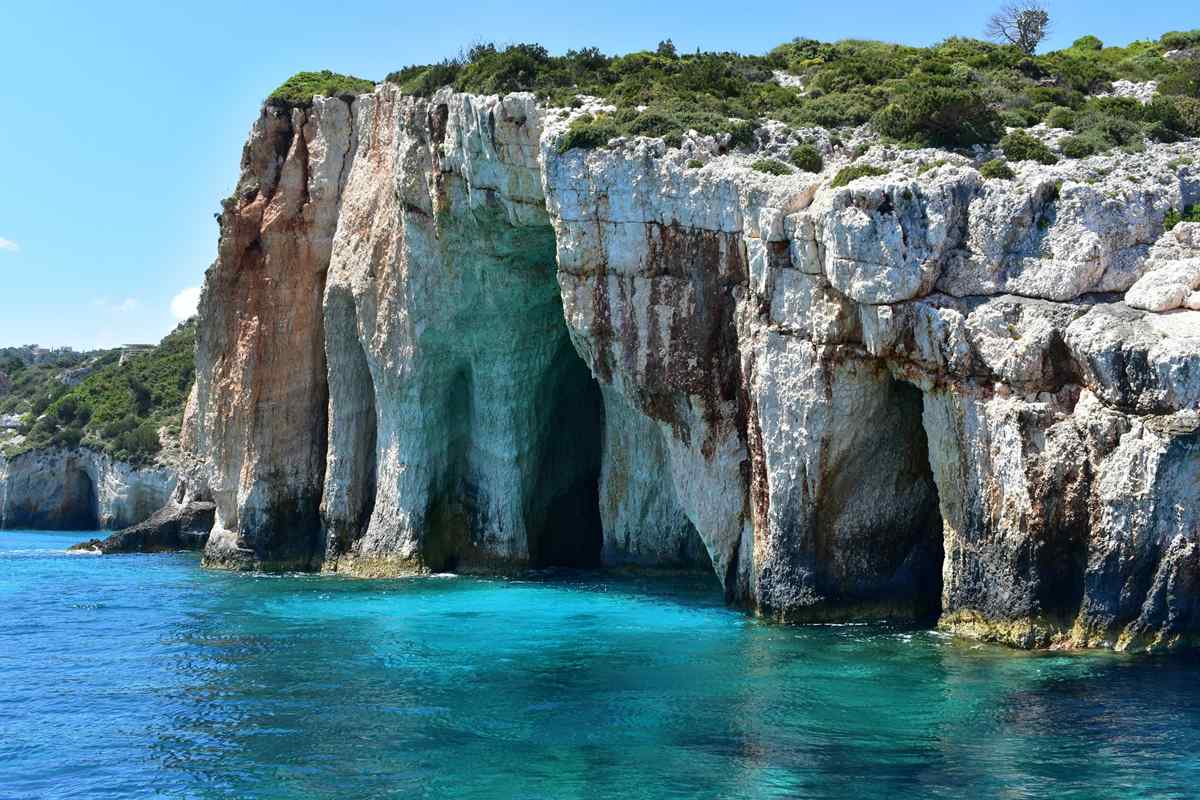
Caves in Greece raise questions about sea caves, Minoan shrines and Stone Age shelters. The Blue Caves of Zakynthos open in white sea cliffs. Kamares Cave and Trapeza lie on the island of Crete. The Kastritsa caves stand near Lake Ioannina.
Among the sea caves in Greece, what are the Blue Caves of Zakynthos?
The Blue Caves are shallow openings worn into the white cliffs of Zakynthos. Rock arches stand among them in large numbers. An arch forms when the sea cuts right through a narrow piece of rock. The caves take their name from the turquoise blue colour of the sea there.
Which Minoan finds give Kamares Cave its place among the caves in Greece?
Kamares Cave sits just aside from a saddle in the Psiloriti mountains, nearly lined up with Phaistos. The cave has yielded Middle Minoan pottery ranked among the finest examples. This Kamares ware has pale designs in a mix of colours on a dark base. Its forms include jugs and cups.
Why do the caves in Greece include a table of Minos at Trapeza?
Trapeza is a sacred cave on Crete, used in the Neolithic and the Bronze Age. Writers call it a burial cave, and at times the table of Minos. The name comes from trapeza, the Greek word for table. Certain Bronze Age pottery found there resembles finds from Knossos and Vasiliki.
How old are the Kastritsa caves among the caves in Greece?
The village of Kastritsa sits on a slope by the south shore of Lake Ioannina. West of the village, a cave on the Kastritsa height shows signs of human life. People lived there in a span from 20,000 years ago down to 10,000 years ago. English archaeologists reported the cave in 1967.