
Ancient Greek coins carry the story of the city-states that struck them, from Athens to Corinth and Aegina. Small-group outings with a host run across the Greek mainland and the Aegean islands. The sections cover coin periods, city badges and hand-struck dies. Later come the tetradrachm, Laurion silver and four short answers on obols, staters and the drachma. Further reading covers Museums in Greece, Ancient Greek sculpture and the Parthenon. More trip ideas sit on the page about Greece tours.
Bookings made through the GetYourGuide widgets on this page earn Classical Greece Tours a commission, at no extra cost to the traveller.
What were ancient Greek coins?
Ancient Greek coins, like other Greek art forms, fall into four periods: the Archaic, Classical, Hellenistic and Roman. The Archaic period began when coinage reached Greek lands in the 7th century BC. It closed with the Persian Wars, in about 480 BC.
The Greek world held over two thousand self-ruling city-states, called poleis. More than half of them struck their own coins. Larger cities of the Classical period made fine ancient Greek coins in silver and gold. One face bore a patron god, goddess or hero. The other face carried a city symbol.
Ancient Greek coins from Rhodes showed a rose, a visual pun on rhodon, the Greek word for rose. Corinth put Pegasus, the winged horse tamed by the hero Bellerophon, on its stater. A stater was one of the main Greek silver coins. Coins of Thebes showed a Boeotian shield, and coins of Melos an apple.
Ancient Greek coins were all made by hand, not by machine. Craftsmen carved the two designs into a die, a block of bronze or possibly iron. A blank disc of gold, silver or electrum sat between two dies. Electrum is a prized blend of silver and gold. The coin maker struck the top die with a hammer.
- Sparta: Spartan law banned local coins and required iron ingots, called pelanoi, to curb greed.
- Inscriptions: Writing on coins began in the Classical period, giving the name of the issuing city.
- Kingdoms: Hellenistic kingdoms struck larger, more mass-produced coins, and more of them in gold.
Ancient Greek coins changed again in the Hellenistic period. Their newest feature was the portrait of a living person, the king himself. The practice began in Sicily, though other Greeks saw it as hubris, meaning arrogance. Kings of Ptolemaic Egypt and Seleucid Syria still adopted it.
Why did the tetradrachm stand out among ancient Greek coins?
Ancient Greek coins included the tetradrachm, a large silver piece worth four drachmae. A drachma was the basic Greek unit of money. In time it served as the chief trading coin of the classical world, reaching far beyond Greek lands.
Akanthos and other northern cities took their silver from mines in the northern Aegean. Their tetradrachms are dated from about 525 BC. Athens had its own by about 515 BC. Aegina, the first major silver-striking state, kept a heavy stater of about 12.2 grams instead. It never used the tetradrachm as a working coin.
Under the tyrant Peisistratos, Athens began to work the Laurion silver mines of southern Attica in earnest. A tyrant was a sole ruler who seized power. Laurion silver let Athens issue ancient Greek coins of 17.2 grams, later called the Attic standard. In 413 BC Spartan forces held Decelea and cut Athens off from Laurion.
Success brought copies and fakes of these ancient Greek coins. Forgers used poor silver or silver skins over base metal cores. Athenian tetradrachms frequently bear test cuts, made to check for solid silver. Nikophon’s law of 375/4 BC set up a coin tester, the dokimastes. This public slave worked in the Agora and at Piraeus.
- Alexander: Alexander’s tetradrachm showed a youthful Heracles wearing a lion skin, with Zeus seated on a throne.
- New Style: Around 185 BC, Athens brought back its own tetradrachm, struck on a broad, thin flan, or blank.
- Long life: The tetradrachm stayed in wide use around the Mediterranean until Diocletian’s reform of AD 296/7.
Ancient Greek coins of this size were too valuable for small daily purchases. Wheat in Athens sold for three drachmai per medimnos, a grain measure. A single tetradrachm paid for about two months of grain for one person. The state spent them on soldiers’ pay.
What do travellers ask about ancient Greek coins, and what are the answers?
The ancient Greek coins carried everyday nicknames. The Corinthian stater was called hippos, meaning horse. The value of each coin rested on the quantity and quality of its metal. That value also reflected the good name of the mint, or coin workshop, that struck it.
Which museum shows the iron spits behind ancient Greek coins?
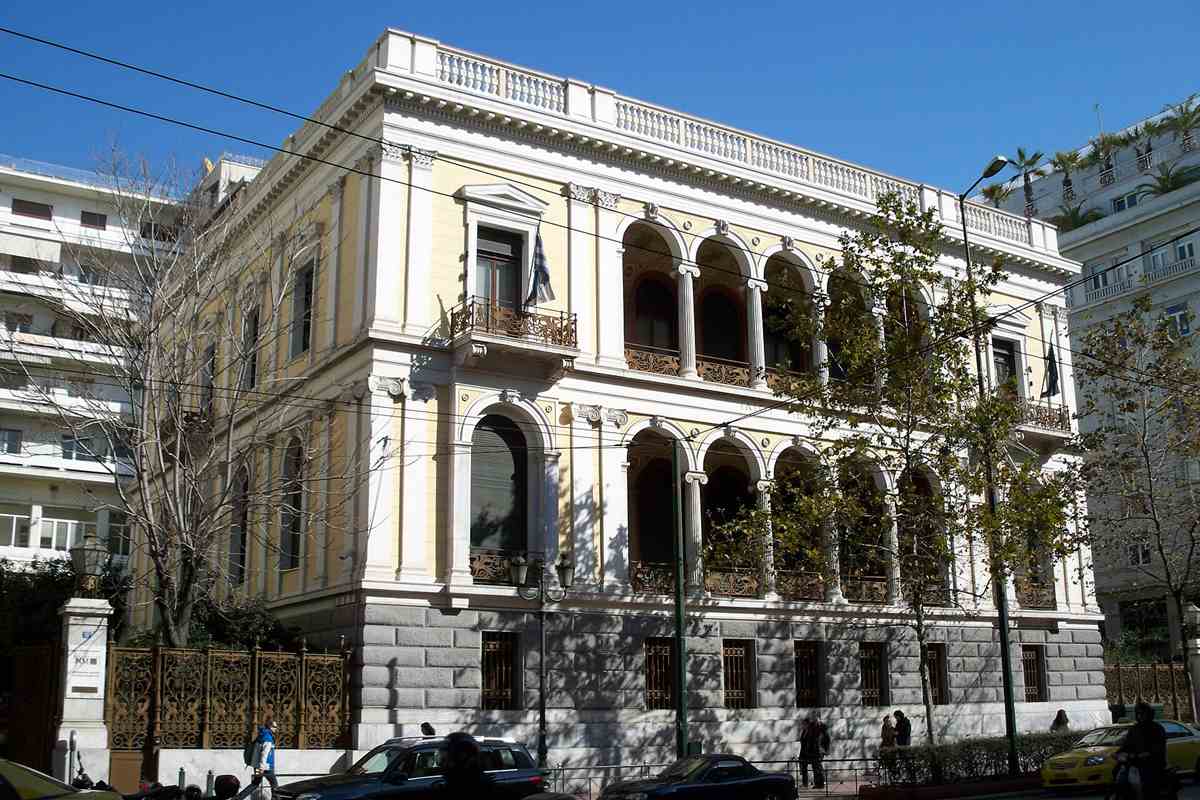
The Numismatic Museum of Athens displays six early metal spits, called obeloi. They come from a hoard of over 150 rod-shaped spits found at the Heraion of Argos. That shrine of the goddess Hera stands in the Peloponnese. The Argos spits were the first ones to be found whole.
How small were the smallest ancient Greek coins?
The obol was a small silver coin, and Athens struck pieces worth two or three obols. By the 4th century BC, mints struck obol fractions worth as little as one-eighth of an obol. That piece equalled a single copper, or chalcus. Bronze obols, first struck in that century, were larger and harder to lose.
What was a gold stater among ancient Greek coins?
The gold stater was struck in only a handful of places. It served mainly for keeping accounts, worth 20 to 28 drachmae by place and time. In Athens the unit stood at 20 drachmae. Its use in coinage seems Macedonian in origin. The best known are the kyzikenoi of Cyzicus.
Which modern currencies take their names from ancient Greek coins?
The Arabic unit called the dirham took its name from the drachma, or from the didrachm. A didrachm was a coin worth two drachmae. Morocco and the United Arab Emirates still name their official money the dirham. The Armenian dram also draws its name from the drachma.
Featured photo: Dimboukas, CC BY-SA 3.0, via Wikimedia Commons.