
Ancient Greek clothing is part of the story told on outings with a host across Greece. The garments here run from the peplos, chiton, himation and chlamys to the exomis, petasos and carbatina shoe. Fibula brooches, gold jewellery, the myrtle wreath at Vergina, Tyrian purple, hairstyles and painted korai follow. Sister pages cover Museums in Greece, Ancient Greek sculpture and Ancient Greek pottery. Further trips across the country start on the Greece tours page.
Bookings made through the GetYourGuide widgets on this page earn Classical Greece Tours a commission, at no extra cost to the traveller.
What was ancient Greek clothing?
Ancient Greek clothing covers a long stretch of history. It begins in the Aegean Bronze Age, around 3000 BCE. It ends with the Hellenistic period in 31 BCE. Through those centuries, Greek civilians dressed in two draped pieces: an undergarment and a cloak.
In ancient Greek clothing, cloth was homemade. Households cut linen or wool into plain rectangles, with little cutting or sewing. Ornamental clasps or pins and a belt held the drape in place. The same pieces passed easily between men and women. As a rule, women’s robes reached the ankles, while men’s stopped at the knee.
Ancient Greek clothing had uses beyond dress. A cloth also served as bedding or as a shroud for the dead. The Greeks had special words for people who patched and restored clothes. Akestes named a man in this trade, and akestria a woman. Finds show that the Greeks dyed cloth black, red, yellow, blue, green and purple.
Greeks embroidered floral and geometric patterns into ancient Greek clothing, and even scenes from their stories. Amorgina were fine, muslin-like cloths, where muslin means a thin, soft weave. They came from amorgis, a type of flax. The flax took its name from the island of Amorgos, though other regions grew it too.
- Textile finds: Small fragments of ancient cloth have turned up at archaeological sites across Greece.
- Yellow cloth: Yellow-dyed garments were linked with the stages of a woman’s life.
- Thessalian wings: Cloaks from Thessaly had a small flap on each side, said to resemble wings.
Four garments formed the core of ancient Greek clothing: the chiton, the peplos, the himation and the chlamys. Political, economic, social and cultural factors decided what each person wore and when. Men went without clothes entirely at athletic events such as the Olympics.
How did the peplos shape ancient Greek clothing for women?
Ancient Greek clothing gave women the peplos, a garment reaching the full length of the body. By about 500 BC, it had become their typical dress. It was a rectangle of woollen cloth, folded loosely down one side and pinned at each shoulder.
In ancient Greek clothing, the top third of the cloth was sometimes folded over into an over-fold. Greeks called this layer the apoptygma, which means a fold turned back. A girdle, or cloth belt, went round the waist. It made a second fold and adjusted the length to the wearer’s height.
Ancient Greek clothing also included the Ionic chiton, made in a different way. Its fabric was folded and stitched down the long edge into a tube. Ionia lay on the west coast of Asia Minor. The Dorian peplos used a heavier wool than was common in Ionia. The Dorians were a main branch of the Greeks.
Spartan women kept wearing the peplos much later than women in other Greek cultures. Their version of this piece of ancient Greek clothing was shorter than the fashion elsewhere in Greece. It also had slits on the side. A slit is a long, narrow cut left open in the cloth.
- Ergastinai: This chosen group of girls wove the huge sacred peplos for the goddess Athena.
- Enkelados: The weavers had to show Athena defeating Enkelados, one of the giants of myth.
- Plynteria: During this festival each year, the peplos on Athena’s statue was changed for a new one.
Women wore forms of the peplos through the Archaic, early Classical and Classical periods of ancient Greek clothing. The belt went either over or under the over-fold. Archaic refers to the earlier age that came before the Classical period of Greece.
What made the chiton a lasting part of ancient Greek clothing?
Ancient Greek clothing relied on the chiton, a tunic fastened at the shoulder. Both men and women in Greece wore it. It came in two forms, the Doric and the later Ionic. Its name came into Greek from a Central Semitic language.
The Doric chiton was a single rectangle of wool or linen. Doric refers to the Dorians, a major group of Greek peoples. The Ionic chiton, a later form of ancient Greek clothing, was draped without an over-fold. Instead, a row of small pins or buttons held it in place from the neck to the wrist.
Herodotus, a Greek historian, explains this change. Athenian men had died on an expedition to Aegina. Their widows killed the lone survivor using the pins of their peplos. After that, Athenian women held this piece of ancient Greek clothing with buttons. The buttons sometimes bore a Gorgon face, the head of a snake-haired monster of myth.
In ancient Greek clothing, the chiton was cut longer than its wearer. The extra fabric was pulled up over a belt, much like a blouse. Worn alone, without a himation cloak, the garment was called a monochiton. One that trailed along the ground had another name, the chiton syrtos. Syrtos comes from a Greek word for dragging.
- Men’s length: Men wore the long chiton in the Archaic period, then shortened it to the knee.
- Spartan racers: Spartan girls ran races in a knee-length chiton that covered only one shoulder.
- Roman tunica: Romans wore the chiton after the 3rd century BC and called it a tunica.
A large belt, known as a zoster, was sometimes worn over the chiton. A sleeved form of this ancient Greek clothing belonged to priests and actors. Its colour or pattern was a frequent sign of the wearer’s social status.
Which role did the himation play in ancient Greek clothing?
Ancient Greek clothing used the himation as a mantle, or outer wrap. It was heavier than the chiton and acted as a cloak or shawl. Worn alone, without a chiton, it served as both an inner garment and a cloak.
The himation was far less bulky than the Roman toga. No actual himation has been recovered by archaeologists. In ancient Greek clothing, making a himation counted as a woman’s job. Women spun wool or linen into yarn, then wove a large rectangle. Fine linen cost more, so the best quality went to the upper class.
Unlike other overgarments of ancient Greek clothing, the himation needed no pins. A man draped it over his left shoulder and wrapped it around his body. His right arm stayed free. The philosopher Theophrastus described a boorish man as one who sits with his himation above his knees. Boorish means rough and ill-mannered.
Men followed unwritten rules for this piece of ancient Greek clothing. A himation that dragged past the ankles was judged to be in poor taste. Women took up the garment around 500 BCE, as the Archaic period ended. Before strangers, a woman’s himation served as a veil as well. A veil is a cloth that covers the head or face.
- Bare shoulder: A man who left his left shoulder exposed in a himation was seen as barbaric.
- Byzantine art: The himation lived on as the dress of Christ, the Virgin Mary and biblical figures.
- Roman uptake: The ancient Romans also adopted the himation because of its wide popularity.
Ancient Greek clothing dressed the gods as well. Athena is described wearing a helmet, a peplos, an aegis and a himation. An aegis is a protective cape linked with Athena and Zeus. The god of wine, Dionysos, is also described in a himation.
Who wore the chlamys in ancient Greek clothing?
Ancient Greek clothing gave men the chlamys, a cloak for war and hunting. It was a seamless woollen rectangle about the size of a blanket, normally with a border. A fibula, or brooch pin, held it in place at the right shoulder.
At first, the chlamys went round the waist in the manner of a loincloth. A loincloth is a strip of cloth worn around the hips and groin. Late in the 5th century BC, men moved it up over the elbows. In Greek art, young soldiers and messengers wear this ancient Greek clothing alone.
Hermes, the messenger god, wears the chlamys as his characteristic garment. Artists show him as a young man in this cloak. In ancient Greek clothing for war, the chlamys was standard between the 5th and 3rd centuries BC. Soldiers sometimes wound it around one arm as a light shield in combat.
The chlamys stayed in use long after ancient Greece. Byzantine emperors and high officials wore it as state dress. Only the emperor put on a purple chlamys with gold tablia. Tablia were large panels of a contrasting colour on the two edges. Among women, only the empress is recorded wearing one.
- Allix: Thessalians used this name for a chlamys fastened with gilt brooches.
- Ephaptis: This similar cloak was the kind infantrymen, or foot soldiers, wore.
- Phoinikis: Greek writers used this word for a chlamys worn on military service.
Byzantine coins show this piece of ancient Greek clothing in large numbers. In bust-length portraits, the fibula brooch is the main clue. A bust-length portrait shows only the head and shoulders. The cloak began to fall from favour in the 12th century.
Which tunic left one shoulder bare in ancient Greek clothing?
Ancient Greek clothing gave workers and lightly armed soldiers a tunic called the exomis. Its name joins the Greek words for outside and shoulder. Slaves and the working classes wore it, and it left the right arm and shoulder bare.
Two rectangles of linen formed this piece of ancient Greek clothing. Their sides were stitched together into a cylinder. Gaps at the top let the arms and head through. A cloth belt gathered it at the waist with a reef knot. A reef knot is a flat, secure knot. The cloth fell over the belt and hid it.
To free the right arm, the seam at the right shoulder was undone. The right hand passed through the opening made for the head. A wider chiton in ancient Greek clothing, the amphimaschalos, covered both armpits. Its name means double-armholed. The comic playwright Aristophanes treated it as a garment of higher status.
Hoplites were heavily armed Greek foot soldiers. In the later 5th century BC, the exomis largely replaced the short chiton as their main tunic. Red, above all crimson, became their favoured colour during and after the Peloponnesian War. That conflict pitted Athens against Sparta. This ancient Greek clothing was sometimes paired with the chlamys cape.
- Roman use: The Romans later took over the exomis from the Greeks and wore it themselves.
- Diphthera: Shepherds, labourers and rural people wore this cloak made from animal hides.
- Encomboma: People knotted this upper garment around the body to keep the tunic underneath clean.
The chitoniskos, a short chiton, was sometimes worn over another chiton. The kolobus was another plain tunic of ancient Greek clothing, made without sleeves. A sleeve is the part of a garment that covers the arm. Chiridota, by contrast, were tunics with sleeves sewn on.
How did the petasos protect people in ancient Greek clothing?
Ancient Greek clothing included the petasos, a hat with a broad brim that came from Thessaly. Its wide brim kept off both the sun and the rain. Along with the pileus, it was the commonest hat in Greece.
Makers shaped this ancient Greek clothing from wool felt, leather, straw or animal skin. Felt is a thick cloth made by pressing wool fibres together. Women’s versions had a high crown, the top part that covers the head. Men’s versions had a lower crown. As a winged hat, the petasos became the symbol of Hermes.
Farmers, travellers and hunters wore the petasos above all. It was considered typical of people from the countryside. Thracians, Illyrians and Etruscans also wore it, besides the Greeks. A long strap let the wearer tie it under the chin. In ancient Greek clothing, it was frequently paired with the chlamys cape.
Athenian cavalry had a metal helmet shaped like a petasos. Certain helmets of this kind are pierced with holes along the brim’s outer rim. The holes are thought to have held a fabric cover. Reliefs and vase paintings show the type. Reliefs are carvings raised from a flat surface. An actual example came from an Athenian tomb.
- Pileus: This close-fitting cap was made from materials such as leather and wool.
- Weather: Greek men wore hats to shield themselves from the elements, meaning wind, rain and sun.
- Kuneh: This word named a peasant’s cap and also served as a term for a helmet.
The petasos spread beyond ancient Greek clothing. In slightly changed forms, it reached the Etruscans, the Roman Empire and the Byzantine Empire. The Etruscans were an ancient people of central Italy. Byzantine names the later Roman Empire of the east, centred on Constantinople.
Which simple shoe did the rural poor wear with ancient Greek clothing?
Ancient Greek clothing for the rural poor included the carbatina, a simple shoe also worn in Rome. Its maker wrapped one piece of rawhide around the foot and bound it in place. Rawhide is animal skin that has not been tanned into soft leather.
With no upper and no separate sole, the carbatina ranks among the simplest footwear in the world. An upper is the part of a shoe that covers the top of the foot. Its Greek name, karbatine, first meant something like made of dried skin. Aristotle used the word for a basic covering on camels’ feet.
In ancient Greek clothing, the usual carbatina had its outer edge cut into thongs. Thongs are thin strips of leather used for tying. The wearer stepped onto the open hide, drew up the sides and knotted the thongs. Simple, cheap and needing frequent replacement, these shoes were seldom decorated.
The Ten Thousand were Greek mercenaries, meaning soldiers who fought for pay. On their retreat to Greece, they relied on carbatinae as emergency footwear. At home, Greeks went barefoot as a matter of course. Philosophers such as Socrates went barefoot too. Leather was the commonest material for sandals, shoes and boots in ancient Greek clothing.
- Iphicratids: The Athenian general Iphicrates made light soldiers’ boots that were easy to untie.
- Kassyma: This extra-thick cork sole made the wearer of a shoe or sandal look taller.
- Baucides: Only women wore these costly shoes, which came in a saffron colour.
Peasants in ancient Greek clothing wore croupezai, wooden shoes named for the noise they made. Photius wrote that people wore them for treading out olives. The poet Hesiod advised his brother Perses to line his boots with felt, like modern socks.
How did the fibula hold ancient Greek clothing together?
Ancient Greek clothing was held in place by the fibula, a brooch or pin that fastened garments. It sat chiefly at the right shoulder of the wearer. Every fibula, whatever its shape, worked on the principle of the safety pin.
Fibulae replaced the straight pins of the Neolithic period and the Bronze Age. Neolithic describes the farming era that closed the Stone Age. In ancient Greek clothing, each fibula had four parts: the body, the pin, the spring and the hinge. Certain fibulae also served as votive gifts, meaning offerings made to the gods.
The violin bow fibula appeared in the 14th century BC. Mycenaeans on the Peloponnese brought it into ancient Greek clothing. Mycenaeans were mainland Greeks of the Bronze Age. Its low, flat arch ran beside the pin, much like the bow of a violin. The design soon spread to Crete, to Cyprus and to Mycenaean trading posts in Sicily.
During the 7th and 6th centuries BC, new bow fibulae emerged in the southern Balkans. Scholars call them Greek, Macedonian or Thracian bow fibulae. Their high arched bow carried large fins or knobs. On certain pieces, the large square catch plate, where the pin closes, bore incised geometric or figural designs. Incised means cut into the metal.
- Peronai: These large straight pins in ancient Greek clothing pointed down at the shoulders to hold a chiton.
- Oedipus Rex: In this play by Sophocles, Oedipus uses dress pins to blind himself.
- Porpe: Greeks used this word for a clasp and for the pin of a buckle.
In ancient Greek clothing, fibulae pinned together the chiton, the peplos and the chlamys. Their makers worked mainly in bronze or iron, and sometimes in silver or gold. Tomb finds of fibulae lean towards precious materials, used as a form of jewellery.
Which jewellery finished ancient Greek clothing?
Ancient Greek clothing gained gold and gem jewellery from 1600 BC. Before that date, Greeks had made beads shaped as shells and animals in large numbers. Small gold ornaments were even sewn onto garments, so that they glittered as the wearer moved.
Around 1500 BC, goldsmiths in Greece cast metal, twisted bars and made wire. These skills flourished in the Mycenaean period but were lost as the Bronze Age closed. Dated forms include the armring of the 13th century BC and the brooch of the 10th. Pins date from the 7th century BC.
Jewellery from 600 to 475 BC is poorly represented in finds. After the Persian wars, the jewellery worn with ancient Greek clothing grew plentiful again. A popular design of that time was a bracelet adorned with snake and animal heads. Such bracelets needed far more metal, so a large share were made of bronze.
By 300 BC, jewellers had mastered coloured pieces for ancient Greek clothing, set with amethysts, pearls and emeralds. The first cameos appeared at about the same stage. A cameo is a stone carved in raised relief, with layers of different colour. The Greeks cut them from Indian sardonyx, a striped agate of brown, pink and cream.
- Gold Olive Wreath: This 4th-century BC piece copies the wreath given to winners of athletic games.
- Special occasions: Jewellery was hardly worn with everyday ancient Greek clothing and appeared mainly at public events.
- Evil eye: Certain pieces were meant to protect the wearer from the evil eye, a harmful glance.
Rank showed even at the ankle in ancient Greek clothing. Plebeian, or common, women wore silver anklets, while patrician women wore gold. Patricians were the noble families. Women also wore a gold coil bracelet on the left arm, called a sphingter.
What does the myrtle wreath at Vergina show about ancient Greek clothing?
Ancient Greek clothing for burial included gold wreaths, such as the myrtle wreath at Vergina. It ranks among the richest finds from the royal Macedonian tombs at that site. Its leaves and flowers are cut from gold, copying the myrtle plant.
Scholars link the wreath to Meda of Odessos. She was a princess from Thrace who became the fifth wife of Philip II. The Greek archaeologist Manolis Andronikos put forward this idea. He excavated the tomb of Philip II in 1977. Experts still debate whether the tomb truly belongs to these royals.
Myrtle is a shrub that keeps its sweet-smelling leaves all year. The plant was sacred to the goddess Aphrodite and stood for love. In ancient Greek clothing, wreaths marked special events, and athletes won them as prizes. Gold foil wreaths, however, were made to be buried with the dead. They were too fragile for everyday wear.
For this piece of ancient Greek clothing, goldsmiths cut each leaf and blossom from a thin gold sheet. They stamped and incised the details, then wired the pieces onto stems. Incised means cut with a sharp tool. Restored, the Vergina wreath holds 80 leaves and 112 flowers. Its main ring is a narrow rod with twisted, flattened ends.
- Grave finds: A large share of surviving gold wreaths of ancient Greek clothing came from graves.
- Thessaloniki: Thessaloniki’s Archaeological Museum displayed the wreath to visitors until 1997.
- Aigai museum: That year it moved to the Museum of the Royal Tombs of Aigai at Vergina.
Measured inside, the main tube has a diameter of 0.16 to 0.18 metres. Measured outside, the figure is 0.23 to 0.26 metres. This wreath comes from the Hellenistic period of ancient Greek clothing, between 300 and 30 BC.
Why was Tyrian purple prized in ancient Greek clothing?
Ancient Greek clothing took its costliest colour from Tyrian purple, also called royal purple or imperial dye. It comes from a secretion of predatory sea snails in the Muricidae family. The name points to Tyre, a city of ancient Phoenicia in modern Lebanon.
The Phoenicians began making the dye for fabric by 1200 BC. The Greeks and Romans kept up production until 1453 AD, when Constantinople fell. In ancient Greek clothing, Tyrian purple was valued because it did not fade easily. Instead, it grew brighter with weathering and sunlight. The shade prized above all others looked like black-tinted clotted blood.
The 4th-century BC historian Theopompus recorded its cost. He said purple dye sold at Colophon, in Asia Minor, for its weight in silver. Asia Minor is the peninsula of modern Turkey. Purple cloth became a status symbol, and sumptuary laws limited who wore it. Sumptuary laws are rules that restrict spending on luxury goods.
Purple for ancient Greek clothing took tens of thousands of snails and heavy labour. In a test in 1908, twelve thousand snails gave just 1.4 grams of dye. Such a small amount covered no more than the edging of one garment. Aristotle described the shellfish and the extraction process in his History of Animals.
- Heracles’ dog: A myth told by Julius Pollux says the hero’s dog found the dye by biting a snail.
- Halourga: This name, meaning sea-purple, covered girdles, undergarments and Laconian cloaks.
- Born in the purple: In Byzantium, a child of a reigning emperor was called porphyrogenitos.
In the language of ancient Greek clothing, the dye was called porphura. Cheaper imitation purple was also made from less costly materials. The true, non-fading dye stayed a luxury trade good, and the Romans used it for ceremonial robes.
Which hairstyles went with ancient Greek clothing?
Ancient Greek clothing went with long hair in the earliest times, and Homer calls the Greeks long-haired. False hair and wigs were worn as well. In times of mourning, though, Greeks cut their hair close to the head.
Spartan boys always wore their hair short. Once they reached puberty, they let it grow long. Puberty is the stage when a child’s body becomes adult. Spartans called their hair the cheapest of ornaments. Both Spartan men and women tied it in a knot over the crown, the top of the head.
Athenian children, by contrast, wore their hair long. In ancient Greek clothing and grooming, a boy’s hair was cut when he became an ephebos. An ephebos was a young man entering adult training. The cutting was a solemn act with religious ceremonies. The hair was then dedicated to a deity, mainly a river god.
Athenian women wore their hair in a crown knot called the korymbos. Hairnets came in gold thread, silk or Elean byssus, a fine cloth from Elis. The craftsmen who made these nets were known as kekryphaloplokoi. Tradition credits the painter Polygnotus with first painting Greek women in mitrae. A mitra was a band of coloured cloth.
- Theatre wigs: Stage wigs gave black hair to tyrants and fair curls to young heroes.
- Sakkos: This hair cap of ancient Greek clothing covered the head entirely, like a sack.
- Kekryphalos: This net cap for the hair was worn by day and by night.
In ancient Greek clothing, a close-cropped head marked a person as a slave. One Greek word for a wig was phenake, which means deception. Women also bound their hair with an ampyx, a headband of worked gold or silver.
Where do korai statues preserve ancient Greek clothing?
Ancient Greek clothing survives in stone on statues called korai. The singular, kore, means maiden. Scholars apply the name to Archaic statues of young women that stand alone. They wear thick and sometimes elaborate drapery, meaning cloth that hangs in loose folds.
Over time, the korai changed their ancient Greek clothing with the fashions. The heavy peplos gave way to lighter garments, the chiton among them. Korai have turned up across Greece, in Athens, Ionia, the Cyclades and Corinth. The biggest dig for korai came on the Athenian Acropolis during the 1880s.
Sculptors painted certain korai to make the garments stand out. Paint also created patterns on this ancient Greek clothing. On the Phrasikleia Kore, the marble was first incised with a light pattern. Rosettes and a meander show in her dress. A rosette is a round, flower-shaped design. A meander is a band of right-angled turns.
Colour also signalled wealth, since dyes were costly. In ancient Greek clothing, bright colours were the more expensive choice. Painters also used colour to show jewellery or gems on a kore. Elite patrons decked their statues with paint and jewels. If the patron was rich, sculptors added actual jewellery and metal to the work.
- Berlin Goddess: Found at Keratea in 1923, this kore kept much of her original colour.
- Modern study: Experts trace lost paint with microscopy, pigment tests, ultraviolet light and low-angle raking light.
- Winckelmann: This pioneer of Greco-Roman art history held, in 1755, that colour spoiled white marble.
Korai of the Acropolis include the Kore of Lyons, from the 540s BC. She shows the Ionian style, a sign of links between Athens and Ionia. She holds a dove, the bird of Aphrodite, and one theory names her as that goddess.
What do travellers ask about ancient Greek clothing, and what are the answers?
The ancient Greek clothing of daily life was woven on the warp-weighted loom. The frame later spread north and west through Europe. Headwear included the kausia, a flat hat from Macedonia. High-status women and goddesses appear in art with the stephane, a metal headband.
Which Macedonian hat belongs to ancient Greek clothing?
Macedonian kings wore a purple kausia with a diadem as part of their royal costume. A diadem is a headband that marks royal rule. The name kausia comes from a Greek word for burning heat, which the hat kept off. Later, poorer people in Rome wore it as protection from the sun.
How was the cloth for ancient Greek clothing woven?
On a warp-weighted loom, the warp threads hang freely from a bar. Warp threads are the lengthwise threads of a weave. Bundles of them are tied to loom weights that keep them taut. Weaving runs downward, from the top bar towards the floor. Greek vase paintings show two weavers, mainly women, working side by side.
Which winged sandals appear in ancient Greek clothing myths?
The talaria are the winged sandals of Hermes, the messenger god of the Greeks. Myth says the smith god Hephaestus made them from imperishable gold. Imperishable means unable to decay. The poem Shield of Heracles is the first text to call the sandals winged. Homer mentions the sandals earlier but gives them no wings.
What metal headband topped ancient Greek clothing for women?
The stephane frequently took the form of a metal arc, higher at the centre than at the sides. It sat on top of a woman’s hair, with or without a veil. The shape resembled a crown. Coins of Greece and Rome show queens wearing a veil with a stephane.
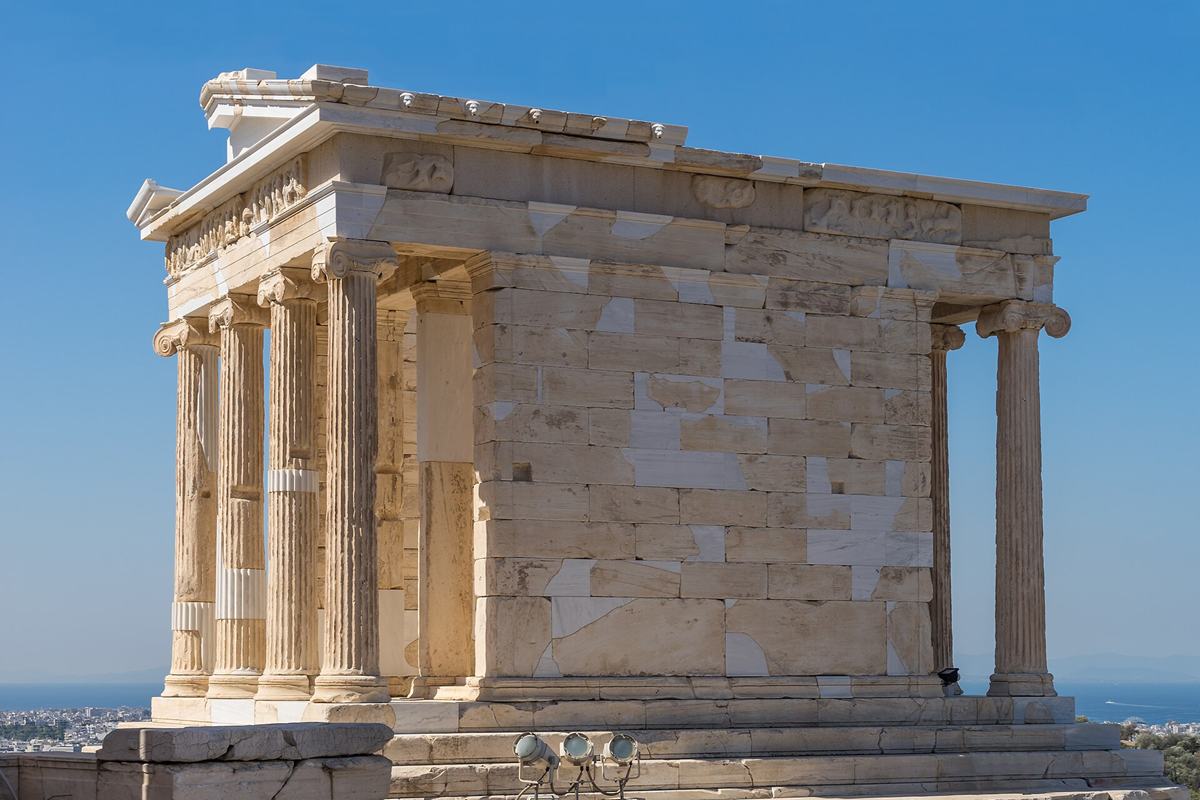
Featured photo: Jebulon, CC0, via Wikimedia Commons (File:Temple of Athena Nikè from Propylaea, Acropolis, Athens, Greece.jpg).