
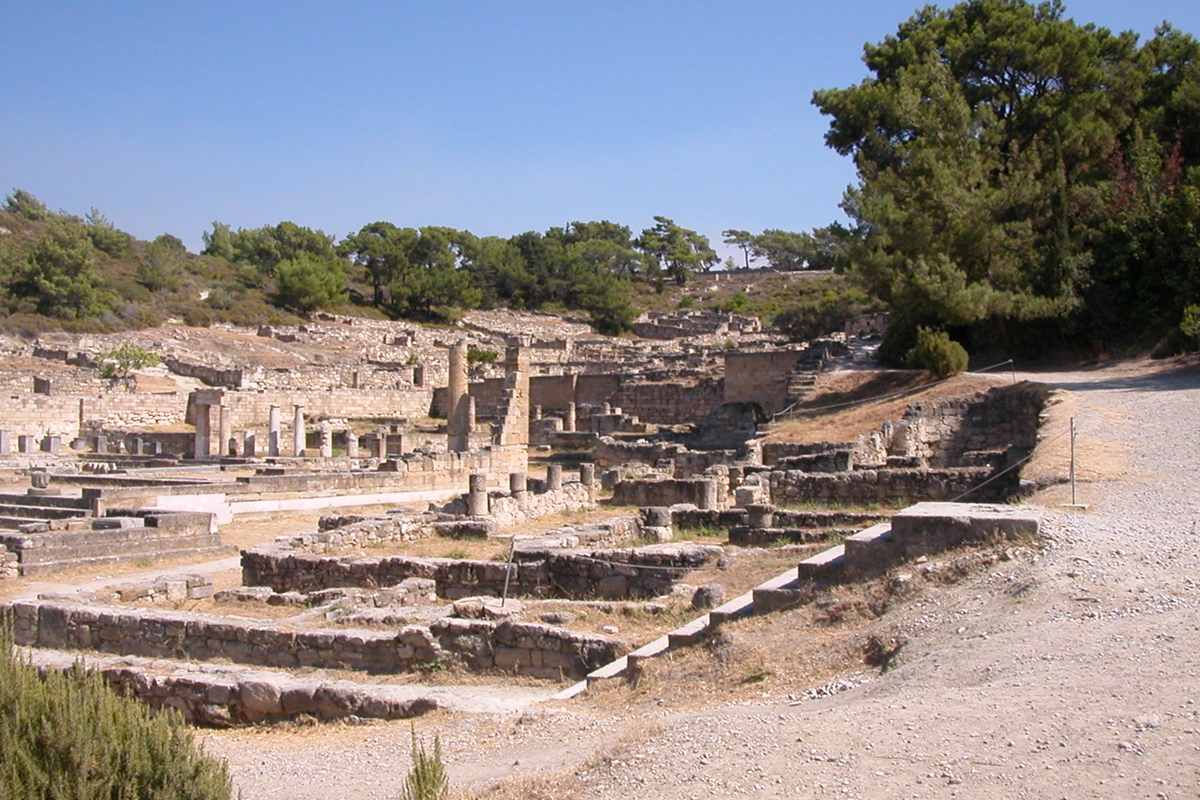
Greek islands with ancient ruins stretch from Crete and the Cyclades to Rhodes, Kos, Samos and Samothrace. Small-group outings on these islands run as hosted trips through Greece. Delos, Akrotiri and Ancient Thera feature below, with Lindos on Rhodes and the Asclepieion of Kos. So do the Heraion of Samos, Gortyn, the Temple of Sangri, Eretria and the Temple of Aphaia. Related pages cover ancient Greek sites, Greece island hopping tours and UNESCO sites in Greece. Mainland and island outings with a host are gathered on Greece tours.
Bookings made through the GetYourGuide widgets on this page earn Classical Greece Tours a commission, at no extra cost to the traveller.
Which are the Greek islands with ancient ruins?
The Greek islands with ancient ruins include Crete, with the ruined Minoan palaces of Knossos and Phaistos. Both ruins are popular sights for visitors today. The Cyclades, an Aegean group of isles, count too, as Bronze Age Cycladic cultures lived there.
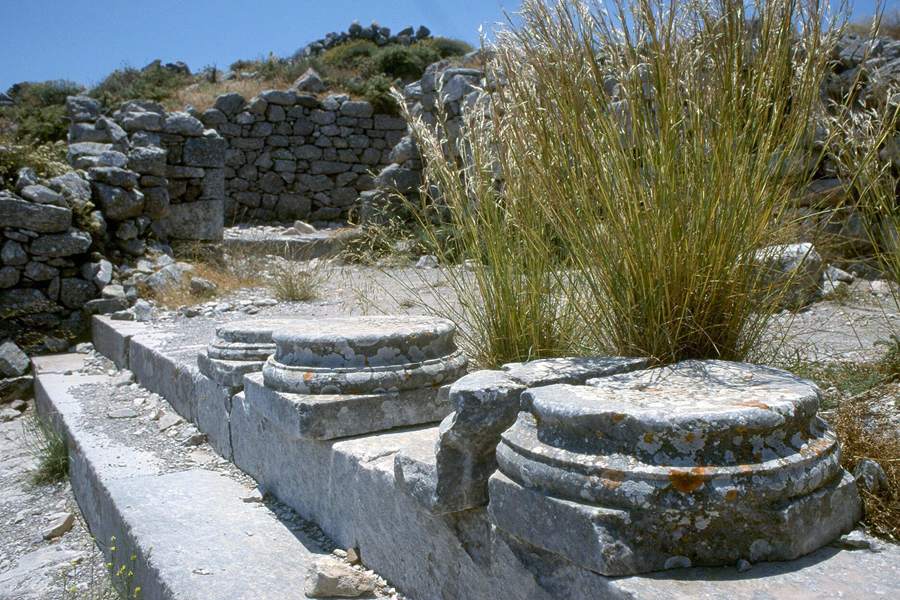
Aegean civilization is a broad label for the Bronze Age cultures of Greece around the Aegean Sea. In that age, people shaped tools and arms from bronze, copper hardened with tin. The term covers the Minoans of Crete and the Cycladic culture of the Cyclades. It also takes in the Helladic cultures of the mainland.
Crete is one of the Greek islands with ancient ruins from the Minoan age. The Minoans raised huge, maze-like buildings for public life and ceremony. Scholars now call these buildings Minoan palaces. Ceremony means formal religious or royal ritual. A labyrinth, or maze, is a winding web of passages and rooms.
Among the Greek islands with ancient ruins, the Cyclades were home to the early Keros-Syros and Grotta-Pelos cultures. Both were strong powers in trade and culture. Cycladic art includes small figurines with folded arms. A figurine is a little carved figure of a person. These figures won favour with collectors once they came to light in the twentieth century.
- Obsidian: Obsidian from Melos, a black volcanic glass, spread over the whole Aegean, proof of very early trade.
- Cretan pottery: Vessels made on Crete appear to have been exported to Melos, Egypt and mainland Greece.
- Minoan roots: The Minoan civilization grew out of the local Neolithic, or New Stone Age, culture around 3100 BC.
Across the Greek islands with ancient ruins, Bronze Age cultures differed clearly from region to region. Near the end of the Bronze Age, these cultures drew together into one shared way of life. Scholars call this the Aegean koine, from a Greek word for common.
What do Greek islands with ancient ruins owe to the old rites of Delos?
The Greek islands with ancient ruins take in Delos, an island once cleansed of all its dead. Six years into the Peloponnesian War, every body was removed from its ground. The Delphic Oracle, the shrine of Apollo at Delphi, gave the instruction.
Straight after this cleansing, Delos held the first five-yearly festival of the Delian games. Five-yearly means held once in each span of five years. Four years later, every inhabitant was moved off the island. The people went to Adramyttium in Asia, as one more act of purification. Purification means making a place ritually clean.
In 146 BC Rome destroyed Corinth, the leading trading centre of Greece. Delos then took over part of that role. Among the Greek islands with ancient ruins, Delos keeps a Hellenistic market, from after Alexander’s time. Called the Agora of the Competaliasts, it lies by the Sacred Harbour. Its paving shows postholes for market awnings.
On Delos, among the Greek islands with ancient ruins, the Terrace of the Lions lined the Sacred Way. It first held 9 to 12 marble lions. The lions crouch and snarl as guardians. One lion was carried off to Venice. It now sits above the main entrance of the Venetian Arsenal, the city’s old shipyard.
- House of the Dolphins: Its name comes from a hall mosaic of erotes, small winged love gods, riding dolphins.
- Temple of Isis: Early in the Roman period, a plain Doric temple to Isis rose on a high hill.
- Water supply: Delos stretched its limited water with cisterns, or storage tanks, wells, drains and an aqueduct.
Of the Greek islands with ancient ruins, Delos keeps only a tiny modern population. In 2001 the Greek census found just 14 people living on the island. Taken by the state, a census counts every resident of the country.
How does Akrotiri place Santorini among Greek islands with ancient ruins of the Bronze Age?
The Greek islands with ancient ruins include Santorini, where the Bronze Age town of Akrotiri lies. Radiocarbon dating places the great eruption on the island between 1620 and 1530 BC. This method reads the decay of carbon in old remains to find their age.
Among the Greek islands with ancient ruins, the end of Akrotiri is also dated through tree rings. Rings from 1597, 1560, 1546 and 1544 BC show unusual growth. Such growth matches a large volcanic blast in any one of those years. A tree ring is the layer of wood that a tree adds in one year.
Digging on Santorini, which counts among the Greek islands with ancient ruins, began in 1867. The French geologist F. Fouque led that work. Local people had found old objects at a quarry. Much later, mapping the full size of the buried city took two seasons, in 1967 and 1968.
Akrotiri’s wall paintings are much better preserved than those known from Knossos on Crete. Those at Knossos survive almost only as small fallen fragments. Fresco means painting done on plaster walls. The Spring Fresco was the first to be found perfectly preserved. It still stood in the spot where it was first put up.
- Tunnels: Spyridon Marinatos tested tunnels through the pumice, a light, frothy volcanic stone, but later dropped the method.
- New leader: Christos Doumas became head of the dig in 1975, after the death of Marinatos.
- Golden goat: A golden goat came to light in 1999 near the building known as Xeste 3.
At Akrotiri, among the Greek islands with ancient ruins, the painters used pigments that look mineral based. A pigment is a coloured powder mixed into paint. Mineral pigments come from ground rocks and earths. These mineral colours helped the paintings survive so well.
What do the finds of Ancient Thera tell about Greek islands with ancient ruins under the Ptolemies?
The Greek islands with ancient ruins include Ancient Thera, a hilltop city on Santorini. Its main street ran for almost 800 metres. That street was between two and four metres wide, which was broad for its time. Imposing buildings stood along its length.
The Ptolemaic garrison at Thera began with only three officers and about 300 soldiers. A garrison means soldiers posted to guard a town. The Ptolemies were a Greek-speaking royal house that held Egypt once Alexander the Great had died. Their fleet left Thera around 145 BCE. BCE means the same as BC.
Among the Greek islands with ancient ruins, Thera keeps very early inscriptions. They were cut as the 9th century BC turned into the 8th. They stand with the earliest known examples of Greek alphabetic writing. The Greek alphabet grew out of the Phoenician alphabet. Certain inscriptions still use an older form of the Greek letters.
Kouros, plural kouroi, names a carved figure of a nude young man. Thera had no marble quarries. So both the marble and the carving style of its kouroi came from Naxos. The finest of these statues dates from the start of the 6th century BC. It is known as the Apollo of Thera.
- Two harbours: Among the Greek islands with ancient ruins, Thera used two seaports, at today’s Kamari and Perissa.
- Cemetery: N. Zapheiropoulos uncovered the city’s necropolis, or burial ground, at Sellada between 1961 and 1982.
- Sacred grotto: The sacred area held a grotto, or small cave, dedicated to Hermes and Heracles.
Thera has added a find of 760 coins to the record of the Greek islands with ancient ruins. The coins date from the 6th century BCE. They show modest trade. Those links reached Athens and Corinth to the west, and Ionia and Rhodes to the east.
Which temple of Athena makes Lindos stand out among Greek islands with ancient ruins on Rhodes?
The Greek islands with ancient ruins also cover Rhodes and its temple of Athena Lindia. The temple stood on the acropolis of Lindos, then the capital of the island. An acropolis is the high, walled citadel of a Greek town. Athena Lindia means Athena of Lindos.
Of the temples on the Greek islands with ancient ruins, this one rose over a natural cliff cave. That cave was possibly an older cult place. A cult, in ancient religion, is the worship given to one god or goddess. The first temple dates to the 6th century BC. Cleobulus is thought to have built it.
Fire burned the first temple in 342 BC, and a new temple replaced it. The new building measured 7.75 by 21.65 metres. Inside stood a new cult statue, a standing Athena holding a shield. A cult statue is the main sacred image of a god inside a temple.
Among the Greek islands with ancient ruins, Lindos has its own founding legend. In it, Danaus dedicated a statue to Athena Lindia. He thanked her for help in building a ship. Danaus is a figure from Greek myth. Strabo, a geographer, told it differently. He wrote that the daughters of Danaus founded the temple.
- Royal visitors: Alexander the Great and later kings sacrificed here and gave weapons after their victories.
- Golden rain: Myth said gold rained on Rhodes, among the Greek islands with ancient ruins, when Athena was born.
- Excavators: The Italian scholars Maiuri and Jacopi excavated the sanctuary between 1910 and 1932.
On Rhodes, the cult of Athena differed from her cult elsewhere in Greece. Its rite required burning the entrails of sacrificed animals on the altar. Entrails are the inner organs of an animal. Altars were raised blocks where gifts to the gods were made.
Why do Greek islands with ancient ruins include a healing temple on Kos?
The Greek islands with ancient ruins extend to Kos, where an asclepieion once stood. An asclepieion was a temple of healing, sacred to Asclepius. In Greek myth, Asclepius was the first doctor who was also a demigod, part human and part divine.
Of the Greek islands with ancient ruins, Kos has strong ties to early medicine. Hippocrates is said to have trained in medicine at an asclepieion on Kos. Near the town’s institute named after him lie the ruins of the Asclepieion. There, Herodicus taught Hippocrates medicine. Later ages gave Hippocrates the title father of medicine.
Among the Greek islands with ancient ruins, Kos holds one of over 300 asclepieia found in ancient Greece. Asclepieia is the plural form. Their typical practice was incubatio, also called temple sleep. A patient slept inside the temple, hoping for a dream visit from Asclepius or one of his children.
On Kos, among the Greek islands with ancient ruins, Rudolf Herzog found the Asclepieion on 9 October 1902. The Greek historian Iacob Zarraftis helped him find it. Herzog was a German archaeologist, a classical philologist and a historian of medicine. A philologist studies old languages and texts. He excavated the site from 1902 to 1904 or 1905.
- Early visit: A travel grant in 1897 and 1898 took Herzog to Mediterranean sites, above all Kos.
- Growth: The Kos Asclepeion was built and enlarged during the 3rd and 2nd centuries BC.
- Asclepiads: Doctors who claimed direct descent from Asclepius called themselves Asclepiads.
After waking, each patient told the dream to a priest. The priest read its meaning and set a cure. That cure was frequently a visit to the baths or a gymnasium. A gymnasium was a training ground for exercise and sport.
Why does the Heraion keep Samos on lists of Greek islands with ancient ruins today?
The Greek islands with ancient ruins span Samos and its Heraion, a sanctuary of Hera. Herodotus counted its temple among the three great engineering feats of Samos. His other two were the water tunnel of Eupalinos and the stone mole of the harbour at Pythagoreio.
A harbour mole is a stone arm that juts into the sea to shelter a port. At the Heraion, the Rhoikos temple had twenty-one columns along each long side. Digs in 1989 showed that work on it began between 600 and 570 BC. Its completion came around 560 BC, the same digs revealed.
Among the Greek islands with ancient ruins, Samos had a temple that stood for only about a decade. The Rhoikos temple came down around 550 BC. Either an earthquake toppled it, or builders took it apart. Marshy ground and poor foundations had made it dangerously unstable. Foundations are the buried footings that carry a building’s weight.
Samos is among the Greek islands with ancient ruins where the Geneleos group stood on the Sacred Way. It joined six figures on one base. It takes its name from Geneleos, the sculptor who carved it. Near the temple, finds include pomegranates and poppy pods made of terracotta and ivory. Terracotta is baked clay.
- Exotic gifts: Votives include skull pieces from an Egyptian crocodile and a hartebeest, an African antelope.
- First visitor: In 1704 Joseph Pitton de Tournefort came to Samos, later publishing engravings of the ruins.
- First digs: Kavvadias and Sofoulis led the first trial digs from 1890 to 1892 for the Archaeological Society.
Samos, among the Greek islands with ancient ruins, keeps a Sacred Way paved with costly stone slabs. Builders laid them when the road was repaved in the third century AD. A sacred way was a road for religious processions to a shrine.
What made Samothrace a magnet for initiates among Greek islands with ancient ruins in Thrace?
The Greek islands with ancient ruins stretch north to Samothrace, where the Great Gods had their sanctuary. Famous initiates there included the historian Herodotus and the Spartan war leader Lysander. Initiates were people let into secret religious rites, known as mysteries.
Both Plato and Aristophanes mention the temple complex in their works. In Roman times the emperor Hadrian visited the sanctuary. The Roman scholar Varro described its mysteries in writing. Among the Greek islands with ancient ruins, Samothrace sets this sanctuary on three narrow terraces. They lie on the west slopes of Mount Hagios Georgios.
The entrance is the Ptolemy II gateway, also called the Ptolemaion. It once spanned the eastern brook and served as a bridge. An earthquake later destroyed it. Inside the Hieron, the main cult building, the roof spanned 11 metres without inner supports. No other building in the ancient Greek world had a wider unsupported span.
Plutarch, a Greek writer, says this is where Philip II of Macedon first met Olympias, later his wife. Both were being initiated into the mysteries at the time. Macedon was an ancient kingdom in the north of Greece. Before the rite, each initiate was dressed in white and given a lamp to carry.
- Sailors’ gifts: On Samothrace, among the Greek islands with ancient ruins, sailors left seashells and fish hooks.
- Great portico: A portico, or roofed colonnade, 104 metres long rises above the theatre.
- Summer festival: The main yearly festival, with envoys from across the Greek world, seems to have fallen in mid-July.
Worship at this sanctuary on the Greek islands with ancient ruins lasted through the Roman period. The cult then faded from history near the end of Late Antiquity. Late Antiquity means the closing centuries of the ancient Roman world.
Which laws and legends tie Gortyn to Greek islands with ancient ruins on Crete?
The Greek islands with ancient ruins reach Gortyn, in the south of Crete. The city lies in the valley of Messara, south of Mount Psiloritis, near the Libyan Sea. The nearby village of Agioi Deka is the seat of the municipality.
Crete, among the Greek islands with ancient ruins, had Gortyn as its strongest and richest city. That was in the Hellenistic era, after Alexander the Great. Gortyn took hegemony of the island. Hegemony is a Greek word for leadership over others. Its rule stretched across the whole valley, from Messara to Levina.
Gortyn’s law code turned up at the Odeon of Trajan, a Roman emperor. An odeon was a hall for music. Parts of the inscriptions went to museums, the Louvre among them. A modern building at the Odeon houses a large share of the stones. A copy, returned from the museum in Taranto, is now in the Greek parliament.
Myth ties Gortyn, among the Greek islands with ancient ruins, to Zeus. Disguised as a bull, Zeus carried Europa away from Lebanon. The pair met under a plane tree, and the tree can still be seen at Gortys. A colossal statue of Europa riding a bull was found in the amphitheatre. It is now in the British Museum.
- Pythian Apollo: A temple of Pythian Apollo lies 600 metres from the Agora, the old market square.
- Egyptian gods: A temple of the Egyptian deities held cult statues of Isis, Serapis and Anubis.
- Roman theatre: Two entrances lead into the theatre, whose orchestra, or dance floor, forms a half circle.
Among the Greek islands with ancient ruins, Gortyn even features in Homer’s Odyssey. In Book III, storms drove Menelaus and his ships off course onto the Gortyn coast. A sharp reef wrecked a large part of the fleet, yet the crews were spared.
What makes the Temple of Sangri on Naxos unusual among Greek islands with ancient ruins in the Cyclades?
The Greek islands with ancient ruins also feature Naxos, home of the Temple of Sangri. Its ground plan is almost square, at 13.29 by 12.73 metres. In that early age, Greek temples were, as a rule, long and narrow.
The Temple of Sangri, among the Greek islands with ancient ruins, faces south. Its facade, or main front, sits on that side. The normal place was east, with west a rare choice. The temple also rose without a foundation platform, called a crepidoma. Its columns had no stylobate, the stone course that carries a colonnade.
Five columns in antis formed the facade. In antis means set between the projecting ends of the side walls. The columns follow the Samian style, but they have no fluting, the vertical grooves. Samian means in the manner of the island of Samos. Their leafy capitals were painted on, not carved in the round.
Among the Greek islands with ancient ruins, Sangri holds the oldest known marble roof in ancient architecture. It covered the pronaos, the porch in front of the main hall. Its beams rested on the smooth architrave above the columns. Seven beams, almost four metres long, served as the purlins, or roof supports.
- Early study: In 1949 the temple was examined by Nikolaos Kondoleon, long before the main excavation began.
- Soft light: Soft light seems to have reached the inner hall through gaps between the roof tiles.
- Excavators: Vassilis Lambrinoudakis and Gottfried Gruben dug and studied the temple from 1976 to 1985.
On Naxos, among the Greek islands with ancient ruins, about 1600 parts of this temple survive. Exact measurements of these parts showed where each one first stood. That made the task of rebuilding the temple easy. Rebuilding old remains in this way is called reconstruction.
Where does Eretria on Euboea stand among Greek islands with ancient ruins in early Greek history?
The Greek islands with ancient ruins include Euboea, home of ancient Eretria. Homer’s Iliad names Eretria among the Greek cities whose ships sailed for Troy. That ancient epic poem tells of the long Greek war against Troy.
Among the Greek islands with ancient ruins, Eretria once controlled Andros, Tenos and Ceos. That was in the 8th century BC. Eretria also took part in Greek colonisation overseas. With its neighbour Chalcis, it founded Pithekoussai and Cumae in Italy. Such colonies were new towns planted abroad by settlers from a home city.
In 490 BC war reached Eretria, among the Greek islands with ancient ruins. Persian forces under Datis, an admiral, looted and burned the city. The great temple of Apollo, built around 510 BC, was destroyed too. In 1900, parts of its pediment, the gable over the columns, came to light. Among them was an Athena torso.
From 318 to 312 BC King Cassander lived at Eretria. He had Philoxenus of Eretria paint the battle of Issus. The Alexander Mosaic in the Naples museum is a copy of that painting. A mosaic builds a picture from small set stones. Later, Menedemos ruled the city and started a school of philosophy named after Eretria.
- City walls: On Euboea, among the Greek islands with ancient ruins, Eretria’s walls and gates ran 4 kilometres.
- Theatre: Its cavea, or seating bowl, sits on a man-made mound braced by retaining walls.
- Tomb finds: Bronze vases and clay figures of Erotes, or Cupids, from a local tomb are in New York.
Eretria was rebuilt shortly after the Persian attack. In 479 BC its 600 hoplites fought at the Battle of Plataea. Hoplites were heavy foot soldiers armed with shield and spear. Under the Romans, the city held athletic games for children and youths, called the Romaia.
Why do the Aphaia marbles tie Aegina, among Greek islands with ancient ruins, to Munich?
The Greek islands with ancient ruins also include Aegina and its Temple of Aphaia. The temple stands on a peak about 160 metres high on the east of the island. It lies about 13 kilometres by road from the main port.
Among the Greek islands with ancient ruins, Aegina keeps a temple built around 500 BC. It replaced an older temple from around 570 BC. Fire destroyed that first temple around 510 BC. Its broken parts went into the infill of the new temple terrace. Abundant traces of paint remain on these buried fragments.
In 1811 Charles Robert Cockerell and Baron Otto Magnus von Stackelberg removed the fallen pediment sculptures. The marbles were sold the next year to Crown Prince Ludwig of Bavaria. He later became King Ludwig I. The sculptures are now in the Glyptothek of Munich, a museum of ancient statues. The Danish sculptor Bertel Thorvaldsen restored them.
On this temple of the Greek islands with ancient ruins, each pediment centred on Athena. Around her, fighters, fallen warriors and weapons filled the narrowing corners. Sphinx figures, called acroteria, stood on the corners of the roof. A sphinx is a creature with a lion’s body and a human head.
- Sphinx column: At the northeast of the sanctuary rose a 14-metre column crowned by a sphinx.
- Sanctuary size: In its final form, the sanctuary covered an area of about 80 by 80 metres.
- Second dig: Dieter Ohly led a large German excavation from 1966 to 1979 at the site.
On Aegina, among the Greek islands with ancient ruins, the hilltop first served as an open-air sanctuary. That was in the Bronze Age, before any wall was built. It honoured a female deity of fertility and farming. Fertility is the power to bring new life.
What do travellers ask about Greek islands with ancient ruins, and what are the answers?
Greek islands with ancient ruins also include Aptera, an ancient city in western Crete. Hephaestia lies on the northern shore of Lemnos. Skarkos, on Ios, dates from the early Bronze Age. On Rhodes, Kamiros was named after a mythical founder, Cameirus.
For Greek islands with ancient ruins on Rhodes, who founded Kamiros in myth?
His father was Cercaphus, a king of Rhodes and one of the Heliades. The Heliades were the sons of Helios, the sun god. Cameirus had two brothers, Lindus and Ialysus, the eldest. After a great flood, the three brothers divided the land. Each then founded a city bearing his own name.
Which legend gave Aptera its name among Greek islands with ancient ruins on Crete?
In Greek myth, Aptera saw a contest between the Sirens and the Muses. The Muses ruled over the arts. After losing, the Sirens shed the feathers from their wings, turned white and cast themselves into the sea. Aptera literally means without wings. The name of the nearby islands, Leucae, means white.
Before visiting Greek islands with ancient ruins on Lemnos, what is known of Hephaestia?
Hephaestia took its name from Hephaistos, the Greek god of metalwork. It served as the capital of Lemnos from the 8th to 6th centuries BCE. Diggers found its necropolis, or city of the dead. It held bronze objects, pots and over 130 ossuaries. Ossuaries are small chests that stored human bones.
How well preserved is Skarkos on Ios among Greek islands with ancient ruins?
Systematic digs at Skarkos ran from 1984 to 1997. Its buildings stood two storeys high, with walls of four metres. The village spreads over 1.1 hectares. One hectare equals ten thousand square metres. No other Keros-Syros site is larger or better preserved. Experts put its population at 200 to 300 people.
Featured photo: Godromil, Public domain, via Wikimedia Commons (File:Isola di Rodi – Kameiros – Veduta verso l’Acropoli.JPG).