
Greek olive varieties grow in groves from Crete to Thasos. Small-group tastings and grove walks with a host run in Chania, Heraklion, Kalamata, Halkidiki and Lefkada. This page covers Koroneiki, the Kalamata olive, Chania Kritis PGI, the Throumba olive and Chalkidiki. It also covers the sea of olives below Delphi, Cephalonia, the Messara Plain and Mani. Table olives, extra virgin oil and pomace oil follow. Related pages: Olive oil tours in Greece, Greek food and Greece food tours. For trips across the country, see Greece tours.
Bookings made through the GetYourGuide widgets on this page earn Classical Greece Tours a commission, at no extra cost to the traveller.
What are the Greek olive varieties?
Greek olive varieties are the named cultivars, or farmed plant types, of the olive tree grown across Greece. Worldwide the olive has hundreds of cultivars. Greece ranks fifth among olive oil producers. Each cultivar serves the oil press, the table or both.
Greek olive varieties stem from a crop among the oldest that humans have domesticated, or tamed for farming. The olive tree split into its varieties partly through nature and partly through human help. Olive cultivars are sorted first by the place where each one began. The majority of cultivar names come from place names.
Each year, Greece produces more than 1,079,000 tons of olive oil. Greek farming puts notable emphasis on olive oil, which makes Greece a global leader in the field. Inside the country, olive oil plays an important part in the Greek diet. It forms the base of a large number of dishes in Greek kitchens.
Among Greek olive varieties, each cultivar has its own flavour, texture and shelf life. These traits suit one olive to bread and salads and another to home cooking. As the fruit ripens, it changes colour from green to violet and then to black. The taste of the oil depends on the stage of ripeness at picking.
- Scientific name: Botanists give the tree behind all Greek olive varieties the scientific name Olea europaea.
- Staple trio: Olive oil ranks with wheat and the grape as one of three staple food plants in Mediterranean cooking.
- Exports: Greek olive oil leaves the country for markets throughout the world.
A report by William Henry Moffett, the American consul in Athens, appeared in print in 1889. Moffett wrote that Greece had olives and grapes in abundance, with a quality not excelled. Yet he also wrote that Greek olive oil and wine did not bear transport.
Why does Koroneiki stand out among Greek olive varieties?
Greek olive varieties for oil centre on Koroneiki, a cultivar from Greece pressed mainly for olive oil. In Greece, 50-60% of the acreage under olive groves belongs to Koroneiki. That share makes it the leading Greek variety for oil.
Around the world, Koroneiki ranks among the commonest cultivars for high-density growing, after Arbequina and Arbosana. High-density growing means planting olive trees close together in tight rows. A 2009 study in California found Koroneiki among the commonest olives in the state. Arbequina and Arbosana shared that ranking with it.
Within the Greek olive varieties, Koroneiki carries a string of regional names. In Icaria, Crete, Samos and parts of the Peloponnese and Zante, it goes by Kritikia. The name Kritikia means Cretan in Greek. Ladolia is another name, used in parts of Crete, Messini, Milos, Patrai, Samos and Zante. Ladolia contains ladi, the everyday Greek word for oil.
Psilolia is the name heard in parts of Messini, Milos, Patrai and across the Peloponnese. The Greek word psilos means thin or fine. Lianolia is the label used for the same tree in parts of Crete. Among Greek olive varieties, Koroneiki bears small fruits with a high quality oil yield.
- More growers: Israel, Italy, Morocco, Portugal, Spain and Tunisia all grow the cultivar.
- Farther afield: Mexico, New Zealand, Saudi Arabia, the United States and Uruguay also plant Koroneiki.
- Further countries: France, Egypt, Cyprus, China, Chile, Brazil, Australia and Albania grow it too.
In Greek script, the cultivar’s name is written Κορωνέικη. Beyond Greece, growers in Corsica and in Tunis spell it Coroneiki. That spelling still names one of the Greek olive varieties. The Peloponnese adds one more name, since parts of that region call the cultivar Vaciki.
How does the Kalamata olive earn its place among Greek olive varieties?
Greek olive varieties include the Kalamata olive, named after Kalamata, a southern Peloponnese city. In legal use, the word Kalamata refers to a region of Greece where these olives grow. Black Kalamata olives give the city a wide reputation.
Among Greek olive varieties, Kalamata holds PDO status inside the European Union. PDO is short for protected designation of origin. There, the name belongs only to olives and olive oil from around Kalamata. A handful of countries beyond the EU and the United States apply the name to olives grown anywhere.
Kalamata olives now grow in places around the world, among them the United States and Australia. The trees do not tolerate cold. They are also prone to Verticillium wilt, a fungal disease that blocks a plant’s water vessels. Among Greek olive varieties, it also carries the name Kalamatiani in the Peloponnese.
Producers prepare Kalamata olives by a long or a short method. The short method removes the bitter taste by soaking the olives in water or weak brine. Brine is salty water, and the cure calls for a fresh change every day. Next comes a bath of brine mixed with wine vinegar, topped by olive oil and slices of lemon.
- Slitting: Producers cut a slit in each olive to speed up processing.
- Long method: The olives are slit and set in strong brine to draw out the bitterness.
- Aftertaste: A trace of polyphenol, a bitter plant compound, stays in the fruit and leaves a slight bitterness.
Among Greek olive varieties, this one also goes by Kalamon. That name is used in Greece, Crete, Cyprus, China, Perugia in Italy and South Africa. Around Kalamata, once called Kalámai, the name Aetonychalea is recorded. Nychati is used at Kalamata and across the Peloponnese.
Which protected oil links Chania to Greek olive varieties?
Greek olive varieties from western Crete meet in Chania Kritis PGI, an extra virgin olive oil. Producers press it from Koroneiki and Tsounati olives. PGI stands for protected geographical indication, a label that binds a product to its home area.
The oil is defined by its regional origin, its quality and its traditional methods of production. The PGI covers Chania prefecture on Crete, which takes in Kydonia, Kissamos, Selino, Sfakia and Apokoronas. A prefecture is an administrative district. PGI oils hold exceptional qualities that come from their place of origin and way of production.
The colour of the oil is a bright green-yellow. Its aroma is fruity, and its taste is balanced and bittersweet. Bittersweet describes a flavour that mixes bitter notes with sweet ones. On Crete, groves of Greek olive varieties hold a significant place, as do vineyards. The same holds across other regions of Greece.
Food from plants formed the core of traditional Cretan cuisine. Oil from Greek olive varieties supplied the main share of fat in that diet. It went into salads as well as hot dishes, while northern European countries leaned on animal fat. Islanders kept this way of eating until the 1960s, when meals turned toward more meat.
- Old tree: The Olive tree of Vouves stays productive because it carries Tsounati shoots grafted, or joined, onto it.
- Local name: On Crete, the Kalamata olive also goes by the name Calamon.
- Seasonal food: People on Crete ate seasonal, local produce that saw minimal processing or none.
Scientists isolated the bacterium Olivibacter sitiensis from olive oil mill wastes at Sitia on Crete. Such mills press Greek olive varieties into oil. The rod-shaped microbe is able to break down diphenol, a type of chemical compound. Its second name, sitiensis, points to Sitia.
What sets the Throumba olive of Thasos apart among Greek olive varieties?
Greek olive varieties on the island of Thasos include the local Throumba variety. Its name is protected as a designation of origin, an EU mark tying food to place. The throubes black olive becomes edible once it ripens in the sun, shrivels and falls.
Phenolic compounds, a group of bitter plant chemicals, make freshly picked olives hard to eat. These compounds peak in young fruit, in Greek olive varieties as elsewhere. As the olive matures, they turn into other organic products. Once ripening sets in, their levels drop sharply. That drop makes certain cultivars edible at once.
On Thasos, tourism ranks first among economic activities. Farms on the island produce honey, almonds, walnuts and wine alongside Greek olive varieties and their oil. Islanders also earn a living from fishing and from keeping sheep and goats. Greek Macedonian cuisine, the cooking of northern Greece, names olive oil of Thasos among its selected local products.
Throumba olives of Thasos, another of the Greek olive varieties, also appear on that list. Islanders once worked mainly in farming and stockbreeding. They built inland villages, linking a number of them to harbours by stairways called skalas. As tourism grew, people moved toward the shore. Twin settlements arose this way, Maries inland and Skala Maries on the coast.
- Highest peak: Ypsario rises to 1,205 metres, a little east of the island’s centre.
- Forest: Pine forest covers a large part of the eastern slopes of Thasos.
- Capital: The main town, also called Thasos, is officially Limenas Thasou, or Port of Thasos.
Thasos covers 380 square kilometres and has about 13,000 residents. Thasos forms a regional unit by itself, under the region named East Macedonia and Thrace. Before a reform of local government in 2011, it belonged to Kavala Prefecture.
Why are the green olives of Chalkidiki a notable name in Greek olive varieties?
Greek olive varieties on Chalkidiki, a peninsula in coastal Macedonia, yield its notable olive oil and green olives. The cuisine of Greek Macedonia counts green olives of Chalkidiki among its selected local products. Honey and wine also come from the peninsula.
Agourelaio, an olive oil of Chalkidiki pressed from Greek olive varieties, appears on the same list. Its name joins the Greek words for unripe and for oil. Pinakoti, a loaf from Athos, is another product named there. Mount Athos is the eastern leg of the peninsula, a self-governing area known for its monasteries.
The name Chalkidiki recalls Chalcis, a city on Euboea that sent colonists here in the 8th century BC. Colonists from Chalcis and from Eretria built towns like Mende, Toroni and Scione. Ancient city-states were self-ruling cities that also governed their surrounding country. In Ottoman times, gold mining gave the peninsula its importance.
Summer visitors began arriving in the late 1950s, when Thessaloniki families started to holiday in the coastal villages. In the 1980s, booming tourism pushed farming, with its Greek olive varieties, out of first place. Winters on the peninsula are cool and wet, and summers hot and fairly dry. The climate is mainly Mediterranean.
- Mountains: The Cholomontas range in the north-central part rises to 1,165 metres near Taxiarchis.
- Visitors: By the 1960s, tourists from Austria and Germany came to Chalkidiki more frequently.
- Sithonia: The middle leg of the peninsula has its highest point on Mount Itamos, at 817 metres.
Mount Athos keeps its own monastic cuisine. Monks there cook with bread, wine, vegetables, olive oil and olives from Greek olive varieties. An imperial charter of Emperor Basil I, dated 885, reserved the Holy Mountain for monks. Laymen and farmers had no right to settle.
How does the sea of olives in the Pleistos valley fit Greek olive varieties?
Greek olive varieties fill the Pleistos valley in central Greece. Its groves, called the sea of olives by locals, cover all non-urban parts of the valley system. The semi-arid floor suits dendriculture, the growing of trees as a crop.
Managing the groves of Greek olive varieties appears to have changed the valley’s water channels. The Pleistos lost its link to its wetlands and now irrigates olive trees. A ditch by the Itea road turns into a controlled channel through the groves, past farmhouses and footbridges. On the west side, the Skitsa River flows straight to Itea.
The river makes no meander, or looping bend, so the floor has no plain and little agriculture. Rolling hills suit tree farming instead. Dirt roads reach the trees of Greek olive varieties. A number of them climb the scree, a slope of loose, broken rock. Delphi lies below the cliffs, so tending the trees from there poses no problem.
The Pleistos rises on Mount Parnassos below Arachova, at about 700 metres. Its course runs west between Parnassos and Kirphe, south of Delphi, to the Gulf of Itea near Kirra. In this karst land, shaped by water dissolving limestone, much of the river runs underground. The river carries water mainly in winter and dries out in summer.
- Bright bed: The limestone riverbed reflects the light and gives the look of a running stream.
- Young rift: The valley is a young rift, a crack where the crust pulls apart, north of the Corinthian Gulf.
- Ancient poison: Solon of Athens reportedly poisoned water from the Pleistos with roots of hellebore, a toxic plant.
North of the Crissaean plain, a forest of Greek olive varieties, lies the town of Amfissa. The town stands between two mountains, Giona to the west and Parnassus to the east. Ancient geographers Strabo and Pausanias both mentioned the river Pleistos.
Which Greek olive varieties grow on Cephalonia?
Greek olive varieties on Cephalonia are led by Koroneiki and theiako, the island’s two main cultivars. Smaller numbers of the ntopia and matolia cultivars grow there as well. Olive oil production ranks as a major pillar of the local economy.
Until the 18th century, Cephalonia produced just enough oil for its own residents. Venetian rulers then pressed islanders to plant more olive trees, especially after Venice lost the Peloponnese and Crete. Output grew until the first exports to Venice began. In Greek, the name ntopia simply means local.
Before the Ionian earthquake of 1953, the island counted 200 working oil presses. Thirteen presses still operate there today. Kefalonian olive oil from these Greek olive varieties has a green tone and a rich, greasy feel. Its acidity is low, meaning a small share of free fatty acids.
Animal breeding and the growing of Greek olive varieties are the primary farm occupations on Cephalonia. Grain and vegetables fill the bulk of the remainder. Flat plains take up under 15% of Cephalonia, which is largely rugged and mountainous. Much of it suits only goats. Arable land, fit for ploughing, makes up under a quarter of the total.
- Olive setting: A Mycenaean tholos, or beehive tomb, near Tzanata lies among olive trees, cypresses and oaks.
- Ancient date: The tomb dates from around 1300 BC, when such tombs held kings and high officials.
- Country life: Until the 1970s, the majority of Cephalonians lived in rural areas.
The Tzanata tomb, near Poros in southeastern Cephalonia, is the largest tholos tomb yet found in northwestern Greece. Today two-thirds of Cephalonians live in urban areas. The remaining third lives in rural towns and villages near farmland, home to the island’s Greek olive varieties.
Why is the Messara Plain on the map of Greek olive varieties?
Greek olive varieties grow across the Messara Plain in southern Crete, the island’s largest plain. This alluvial plain, built from river-laid silt, stretches about 50 km from west to east. Farmers there raise olive trees, vineyards and horticultural crops, or garden produce.
Part of the harvest goes to the domestic market. A substantial share of the oil from these Greek olive varieties is exported to European markets. Loures sits on the plain’s northern fringe. Its people tend Greek olive varieties and vineyards and raise livestock. Loures belongs to the municipality of Gortyn.
The plain measures about 7 km from north to south. Since 1500 BC, a buildup of alluvial sediment has extended it by up to 6 km. Messara clays supplied a large share of the raw material for Minoan pottery. The word Minoan names Crete’s culture of the Bronze Age, its era of bronze tools.
Ruins of Phaistos and Hagia Triada crown a hill at the plain’s west end. Near its middle lie the remains of Gortys, a city of antiquity. Loures appears in Venetian censuses of the 16th century as Lures. Foothills of the Asterousia Mountains edge the plain to the south, and Psiloritis foothills to the north.
- Old census: Pietro Castrofilaca’s census of 1583 recorded 109 inhabitants at Loures.
- Former district: Until 2011, Loures belonged to the former municipality of Kofinas.
- Breeding: Cretan horses come from crosses of native and Arabian breeds imported in the 17th century.
The plain is home to the Messara horse, a native breed also called the Cretan horse. Its name comes from the plain itself. These horses carry out light farm work and transport. Loures, set among Greek olive varieties, breeds them extensively.
How does Messenia shape the story of Greek olive varieties?
Greek olive varieties underpin farming in Messenia, a region of the Peloponnese. Its leading farm products are figs, black raisins, olive oil and Kalamata table olives. The capital and largest city is Kalamata. Agriculture forms the base of the local economy.
Small amounts of stockbreeding products round out the harvest: beef, milk, sfela cheese and honey. Fish come from the Gulf of Messenia. Small and medium firms process and standardise farm products, Greek olive varieties among them. Kalamata makes important exports of local goods, notably raisins, olives and olive oil. Sfela is a white, semi-hard local cheese.
Until a local government reform on 1 January 2011, Messenia was a prefecture with the same territory. The prefecture held four provinces: Kalamon, Messini, Pylia and Trifylia. Kalamata was the seat of Kalamon province, a name shared by one of the Greek olive varieties. All four were abolished after the 2006 local elections.
In the lowlands, temperatures run a little warmer than in Athens. Snow is uncommon in winter except on the mountains. The name Messenia goes back at least to the Bronze Age. The Iliad is the oldest work of European literature. A number of Messenian towns appear in it among seven cities that Agamemnon offered Achilles.
- Growing towns: Around Kalamata and Messene, population rose from 30,000 before World War II to nearly 80,000.
- Visitor draw: Tourism here builds on ancient sites, with the Palace of Nestor counted among the main ones.
- Castles: Venetian castles at Pylos, Koroni, Methoni and Kalamata also draw visitors.
Kalamata ranks second in the Peloponnese for population and trade. Messini, with 5,744 residents in 2021, is the next largest town in Messenia. Around Messini, among the local Greek olive varieties, the Kalamata olive also goes by Calamata.
What role do the olive groves of Mani play among Greek olive varieties?
Greek olive varieties in Mani grow on terraced lower slopes and on the coastal plain of Messenian Mani. Farmers there mainly avoid herbicides, or weedkillers. The groves also give habitats to a wealth of spring-flowering annual plants. Annual plants live a single year.
In the early 19th century, large quantities of olive oil came from the land north of Oitylo. Decades later, olive growing spread widely further south. Citrus fruit, thought to date from around 1960, became widely grown. Olive cultivation increased too, dominating farm labour. Sheep and goat rearing declined in the same period, and cotton growing ceased.
Pressed oil and cured fruit of Greek olive varieties count among the distinctive ingredients of traditional Maniot cuisine. Citrus fruits, above all oranges, also feature. Horta, the Greek word for wild greens, joins aromatic herbs, lupins, broad beans and lentils. Lalangia are fried strips of dough, and diples are honey rolls.
Past exports from Mani included honey, beeswax, quails and oil from Greek olive varieties. Two products came from the holm oak. Valonea, from its acorn cups, served in tanning leather, and prinokoki, from its galls, gave a scarlet dye. Wheat, barley and sorghum were widely grown, and lupins were rotated with barley and wheat.
- Grove wildlife: The European green toad lives in groves of Greek olive varieties in Mani, among other habitats.
- Scrubland: Maquis, a dense evergreen scrub, is widespread on the lower mountain slopes.
- Silk: Mulberry plantations in the northeast, near Skoutari, supported a silk industry.
In abundant years, Mani grew enough beans and chickpeas to export them to Italy. A large part of the peninsula lies in Laconia, in the west of that region. Typical maquis plants there include the strawberry tree, mastic and kermes oak.
Which Greek olive varieties take root in Laconia?
Greek olive varieties in Laconia include the Kalamata olive under local names. In Laconia, also spelled Lakonia, it goes by Chondrolia and by Nychati di Kalamata. The name Calamata is used there and around Sparta. Laconia borders Messenia, which lies to its west.
No river in Laconia runs longer than the Evrotas. Its valley is mainly agricultural, with groves of Greek olive varieties beside citrus groves and pasture. In 1992, a devastating fire ruined the finest crops of Greek olive varieties in northern Laconia. The blaze reached Sellasia, Oinountas and nearby areas. Firefighters, helicopters and planes battled it for days.
In early 2006, floods along the river ruined crops of Greek olive varieties and citrus. Homes and villages suffered too. That summer, a fire devastated part of the Mani Peninsula. Laconia takes in Cape Malea, Cape Tainaron and a large part of Mani. Two roads join Laconia and Messenia, one over the Taygetus and one through Mani.
Taygetus, at 2,407 m, is the highest mountain in Laconia and the Peloponnese. Medieval people called it Pentadaktylos, meaning five fingers. Pine trees cover much of its slopes. Sparta records the highest summer average maximum temperatures in Greece, with July and August highs near 36 °C.
- Island: Elafonisos, between the Laconian mainland and Kythira, belongs to Laconia.
- Early settlers: Excavations at the Alepotrypa cave found evidence of Neolithic, or New Stone Age, settlement in southern Laconia.
- Towns: Sparta had 16,782 residents in 2021, ahead of Gytheio with 4,070 and Molaoi with 2,850.
Calamon is one more name for the Kalamata olive in Laconia, as at Lamia and Messini. The town of Sparta averages 5 days a year above 40 °C. Its record high, set in August 2021, is 45.7 °C. In January, Sparta’s highs sit around 14 °C.
How does the village of Mavrovouni live from Greek olive varieties?
Greek olive varieties support Mavrovouni, a village of about 500 people in the Mani Peninsula, south of Gytheio. Its economy rests on oil from Greek olive varieties, fishing and tourism. The name Mavrovouni means “the black mountain” in the Greek language.
The village lies about 2 km south of Gytheio, in Laconia. It stands on a steep hill of dark rock. A belt of low sandy hills runs from Kumaros hill, above Gytheio, toward the Vardhounia river. Its plain is alluvial, built from river silt. The surrounding district is rich in wines, oranges and Greek olive varieties.
Long before Greek olive varieties shaped its economy, the hill was settled in the early Bronze Age. Early Helladic ceramics, from that era of mainland Greece, were found there. In the Mycenaean period, seven chamber graves were carved into the rock below the summit. South of them are traces of a tholos, pointing to a local prince.
The modern village dates from 1782, when Tzanetos Grigorakis became bey. He built the castle of Goulades on the hilltop. A bey was a regional ruler in Ottoman times. Loggerhead sea turtles visit the beach every year and dig nests to lay their eggs. The beach runs for about 5 km.
- Old pottery: A sherd with a cable pattern came from a pithos, a large storage jar.
- Ancient town: The Mycenaean settlement stood on a hill 300 metres northeast of the graves.
- Wind: Strong winds blow for hours each summer day, which suits windsurfing on the beach.
An international project protects Mavrovouni beach because of the turtles’ yearly visits. Like other Maniots of the area, the villagers became Christians only in the 9th century. The historian Thomas Gordon wrote that the Zapata, an Albanian tribe, held the wooded hills of Mavrovouni.
What takes the bitterness out of table olives from Greek olive varieties?
Greek olive varieties, like all olives, bear raw fruit that is very bitter and astringent. Astringent means it dries the mouth. Curing and fermentation make the olives fit to eat. The process removes oleuropein, a bitter compound that reaches 14% of dry matter in young olives.
The Sicilian or Greek style of fermentation suits Greek olive varieties picked green, semi-ripe or ripe. It skips lye, a strong alkaline solution. The olives go straight into brine of 8–12% salt. The brine is changed on a regular basis to draw out bitter compounds. Yeasts on the untreated fruit outnumber the lactic acid bacteria.
Since yeasts make little acid, producers add lactic, acetic or citric acid. Except for California style and salt-cured olives, each method involves a major fermentation. Lactic acid is the key product, since it lowers pH, the scale of acidity. It acts as a natural preservative. Fermented table olives, Greek olive varieties included, keep without refrigeration.
Water curing uses plain water or weak brine, renewed every day. Producers sometimes crack the olives lightly with a blunt tool to speed fermentation. Salt curing suits only ripe olives, packed in layers with salt until they shrivel like raisins. So-called oil-cured olives are salt-cured first and then soaked in oil.
- Spanish style: The Spanish or Sevillian method produces around 60% of the world’s table olives.
- Artificial black: California-style curing blackens green olives by soaking them in lye and exposing them to air.
- Probiotic potential: Mixed fermentations of bacteria and yeast have possible probiotic, or gut-friendly, qualities.
Traditional cures use natural microbes on the fruit to start fermentation. These microbes yield organic acids, glycerol and esters that shape taste. In 2023, only Spain and Greece produced more table olives than Italy. Greek olive varieties thus ranked second for table olives that year.
Why is extra virgin oil the top grade for Greek olive varieties?
Greek olive varieties yield oil that is more than 75% extra virgin. Extra virgin is the highest grade of virgin olive oil. It comes from cold mechanical extraction, with no solvents or refining. Solvents are chemicals that dissolve oil out of a material.
Virgin means machines alone produced the oil, and no chemical treatment was used. Extra virgin oil must also meet chemical and organoleptic, or sensory, criteria. It needs low free acidity and little or no sensory defect. In a large number of producing countries, extra virgin oil makes up less than 10% of output.
Extra virgin oil goes mainly into food raw, as a condiment and in salad dressings. Its flavour stays stronger when heat does not spoil it. It also suits sautéing, or quick pan frying. Above 210–216 °C, its unrefined particles burn and the taste deteriorates. Its smoke point, where it begins to smoke, lies around 180–215 °C.
A higher grade of extra virgin oil depends largely on favourable weather. Drought during flowering can drop the oil to virgin grade. Greek olive varieties, like other olive trees, crop well every couple of years. Bigger harvests come in alternate years. Underripe olives give an unpleasantly bitter oil, and overripe ones can show fermentation defects.
- Polyphenols: Virgin oils from Greek olive varieties, as from others, hold the highest levels of polyphenols.
- Filtering: Producers filter oil to remove solid particles that shorten its shelf life.
- Cloudy oil: Fresh olive oil left unfiltered has a slightly cloudy look in the bottle.
Unfiltered oil from Greek olive varieties, as from any olive, deteriorates faster unless used soon after pressing. Refined olive oils suit deep frying, thanks to a higher smoke point and milder flavour. Refined light olive oil has a smoke point of up to 230 °C.
What is olive pomace oil, and how does it relate to Greek olive varieties?
Greek olive varieties, like other olives, leave a residue called pomace after pressing or centrifugation. This leftover paste still yields a small amount of oil. Olive pomace oil starts as crude oil drawn from that pomace with solvents or other physical treatments.
For Greek olive varieties, as for all olives, oil production begins by crushing the fruit into paste. The paste is then malaxed, meaning slowly churned, so tiny oil droplets gather together. A traditional press or a modern centrifuge then separates the oil from watery matter and pulp. A centrifuge spins material fast to split it by weight.
Crude pomace oil is refined into refined olive pomace oil. Blended again with virgin olive oil for taste, it becomes olive pomace oil. The result is fit to eat, yet it cannot be sold simply as olive oil. Its flavour is more neutral than pure or virgin oil, but its fat composition matches regular olive oil.
Pomace from Greek olive varieties, as from any olive, keeps a small share of oil. Further pressing cannot release it. Only chemical solvents extract it, in specialised chemical plants rather than oil mills. Since ancient Roman times, people have burned pomace as a fuel at home and in industry.
- Cooking use: A high smoke point makes pomace oil widely used in restaurants and home kitchens in certain countries.
- Old uses: Traditionally, olive pomace served as compost or was developed as a possible biofuel.
- New research: Valorisation, or adding value, aims to turn olive pomace into animal feed, food additives and phenolic extracts.
Handling olive waste is an environmental challenge. In the European Union, mill wastewater runs to millions of tons each year. The bloc, with Greece among its producers, accounts for nearly 60% of global olive oil. Greek olive varieties supply part of that output.
What do travellers ask about Greek olive varieties, and what are the answers?
Greek olive varieties enter a world trade shaped by the International Olive Council. This intergovernmental body unites states that produce olives or olive products. It officially governs 95% of international production and influences the rest. Intergovernmental means formed by national governments.
In the story of Greek olive varieties, where does the word olive come from?
English took the word olive from Latin oliva, a name for both the fruit and the tree. Latin took it from an archaic Proto-Greek form, elaíwa, which became elaía in Classical Greek. Proto-Greek is Greek’s reconstructed ancestor. In a large number of languages, the word for oil also stems from this tree’s name.
On labels of Greek olive varieties, what does PDO mean?
In EU and UK law, a Protected Designation of Origin, or PDO, ranks as a Geographical Indication. This label links a product to its place. The EU regulates the use of different PDO labels for olive oils. eAmbrosia, the European Commission’s official register, lists every registered EU PDO.
For oil from Greek olive varieties, what does acidity measure?
In olive oil, acidity does not mean chemical acidity in the sense of pH. It is the percentage, by weight, of free oleic acid. Acidity measures hydrolysis, or the breakdown by water, of the oil’s triglycerides, its main fat molecules. As oil degrades and oxidises, more fatty acids are freed and acidity rises.
Among oils from Greek olive varieties, what is lampante oil?
Lampante virgin oil comes from olives by mechanical, virgin methods. Even so, it is not fit to eat until it is refined. The name comes from lampa, the Italian word for lamp, after the oil’s use in oil lamps. The oil serves industrial purposes, or refining makes it edible.
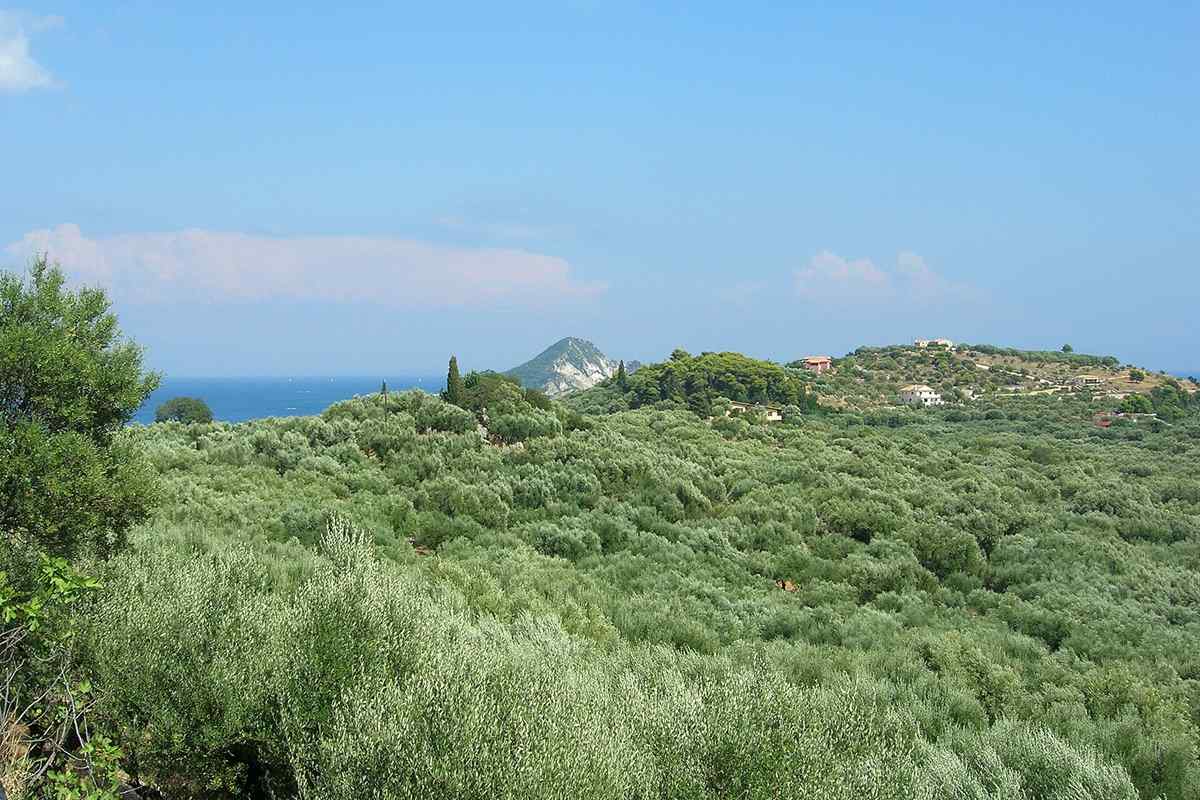
Featured photo: Jimzoun, CC BY-SA 4.0, via Wikimedia Commons (File:Keri Peninsula with olive groves and view into Keri Bay.jpg).