
Ancient Greek women wrote poems, served goddesses and lived under laws on marriage and inheritance. Trips on this theme travel across Greece with a host. This page covers Athenian daily life and the poets Sappho, Praxilla, Anyte, Telesilla, Corinna and Erinna. It also covers Aspasia, Queen Artemisia, Phryne, Diotima, Theano and Olympias. Religious roles include the priestess of Athena Polias, basket bearers and maenads. Heiress law and the women’s quarters of the house appear too. Related pages are Greek heroes, Museums in Greece and the Oracle of Delphi. Further trips sit under Greece tours.
Bookings made through the GetYourGuide widgets on this page earn Classical Greece Tours a commission, at no extra cost to the traveller.
What was life like for ancient Greek women?
Ancient Greek women in classical Athens had no formal schooling. Their mothers taught them, at home, the skills needed to run a household. Girls then married for the first time at around fourteen, and their husbands were much older men.
The main duties of married ancient Greek women were bearing and raising children, weaving cloth and making clothes. Weaving means lacing threads together on a frame called a loom. Those duties took women outside the house as well. They walked to the well to fetch water, and they went out to wash clothing.
After a divorce in classical Athens, the husband had to hand back the dowry. A divorce is the legal end of a marriage. A dowry is the goods and money a bride brought with her. Otherwise he paid 18 percent interest each year. Ancient Greek women thus kept a living and stayed free to remarry.
Athenian custom held that respectable women stayed out of public view. Even naming a citizen woman risked shame. Here a citizen woman means a free woman from an Athenian family. The orator Demosthenes, a famous public speaker, names only 27 ancient Greek women in his surviving works. Against that figure, he names 509 men.
- Naming day: Athenian babies received their names at the dekate, a ceremony held ten days after birth.
- Doll: The gravestone of Plangon, an Athenian girl of about five, shows her holding a doll.
- Courts: Juries in the Athenian law courts were made up entirely of men.
Religion was the one area of public life where ancient Greek women took part freely. Christopher Carey, a modern writer on Greek history, judged religion the only such area. In it alone, he wrote, a woman came near anything like the influence of a man.
Who was Sappho among ancient Greek women?
Ancient Greek women include the poet Sappho of Lesbos. She was one of the first Greek poets to write as one particular person. Earlier poets such as Homer and Hesiod presented themselves more as channels for the gods. Only her Ode to Aphrodite is certainly complete.
Ancient writers list three brothers of Sappho: Eurygios, Larichos and Charaxos. A text now called the Brothers Poem, found in 2014, names the last two. That poem survives only as a fragment, a broken remnant of a fuller work. Eurygios, the remaining brother, appears in no surviving line of her own.
Ancient sources record ten different names for the father of Sappho. The earliest and commonest is Scamandronymus. Before her time, Lesbos was already linked with poetry and music. Myth tied the island to the figures of Orpheus and Arion. The seventh-century BC poet Terpander gave the island a further link with song.
In 1879 the first newly found fragment of Sappho turned up at Fayum. Later, Bernard Pyne Grenfell and Arthur Surridge Hunt began to dig an ancient rubbish dump at Oxyrhynchus. It yielded fragments that nobody had read before. New fragments of this poet among ancient Greek women continue to be found.
- Instrument: Among ancient Greek women poets, Sappho is chiefly linked with the barbitos, a deep-pitched instrument like a lyre.
- Monody: With the poet Alcaeus, she pioneered sung monody, a new style of single-line melody.
- Mode: She reportedly wrote in the mixolydian mode, a musical scale that ancient listeners heard as sorrowful.
Much of the poetry of Sappho focuses on the lives and experiences of ancient Greek women. Her verse also explores personal emotions, above all desire, jealousy and love. An emotion is a strong feeling, such as joy, fear or grief.
What do the sources say about Aspasia among ancient Greek women?
Ancient Greek women of classical Athens included Aspasia, a metic, or free resident born elsewhere. She came from Miletus, an Ionian Greek city, as the daughter of a man called Axiochus. Her bond with the statesman Pericles began between 452 and 441 BC.
Among ancient Greek women in Athens, Aspasia had a son with Pericles, called Pericles the Younger. The writer Plutarch says the comic poet Hermippus once prosecuted her for impiety. Impiety means a lack of respect for the gods. A comic poet wrote comedies, the funny plays of the Athenian stage.
Pericles died in 429 BC, and ancient sources say that Aspasia then married the politician Lysicles. Politicians take part in running public affairs and government. Lysicles himself died a year later, in 428 BC. After that point, nothing at all is recorded about the rest of her life.
The comic poet Aristophanes refers to Aspasia only once in his surviving plays, in Acharnians. Four philosophers, Antisthenes, Plato, Aeschines and Xenophon, wrote Socratic dialogues that feature her. Such a dialogue is a written conversation in which the thinker Socrates speaks. Three of them show her as an educated, skilled rhetorician, an expert in persuasive speech.
- Biography: The modern biography by Madeleine Henry needs only nine pages for the known facts of her life.
- Painting: Henry Holiday showed Aspasia and another of the ancient Greek women at the Pnyx, the assembly site.
- Plutarch: His Life of Pericles, from the second century AD, is the longest ancient account of her.
Aspasia is one of the best-documented ancient Greek women in the whole Greek and Roman world. Yet almost nothing about her own life is known for certain. Beyond her name, her father’s name and her birthplace, her story rests on claims nobody can now test.
Which songs did Praxilla of Sicyon add to the poetry of ancient Greek women?
Ancient Greek women poets include Praxilla, who wrote lyric verse in the fifth century BC. She came from Sicyon, a city on the Gulf of Corinth. Five quotations from her poems survive, along with three paraphrases, retellings in later writers’ words.
In the fourth century AD, the historian Eusebius dated her floruit to 451/450 BC. A floruit is the peak period of a person’s working life. Her longest surviving fragment runs to just three lines. Two of the fragments are skolia, songs sung at drinking parties, and another is a hymn to Adonis.
In the hymn, Adonis is now among the dead. He is asked which things of the living world he will miss. He names the sun, the stars and the moon, and then cucumbers, apples and pears. Zenobius, a collector of proverbs, quoted these lines to explain an old saying: sillier than Praxilla’s Adonis.
The Greek word for cucumber, sikyos, is possibly a pun on Sicyon, her home city. A pun plays on two words with a similar sound. The sculptor Lysippus also came from Sicyon. He made a bronze statue of this poet among ancient Greek women. Bronze is a hard metal made mainly of copper and tin.
- Metre: A verse rhythm called the Praxilleion bears her name, and one fragment uses it.
- Cup: Part of one of her poems appears on a red-figure cup made about 470 BC.
- Canon: Antipater of Thessalonica placed her first in his list of nine ancient Greek women poets.
Praxilla, one of the ancient Greek women poets, was well known in classical Athens. Two surviving plays by Aristophanes, The Wasps and Thesmophoriazusae, parody her work. A parody copies the style of a writer in order to make fun of it.
How did Anyte of Tegea bring the countryside into verse by ancient Greek women?
Ancient Greek women poets include Anyte, who was active around 300 BC in the Hellenistic age. She came from Tegea in Arcadia. Anyte brought rural themes into the epigram, a short poem, and those themes became standard in Hellenistic verse.
The writer Julius Pollux, in the second century AD, gives Tegea as her home. Another tradition, kept in the Greek Anthology, places her at Mytilene on Lesbos. Her Doric dialect points to Tegea, and so do her lines on Tegea and the Arcadian god Pan. Doric was the Greek speech of one regional group.
The travel writer Pausanias tells the one story about her life that survives. The healing god Asclepius came to her in her sleep. He told her to go to Naupactus and visit a blind man there. She went as told, and the man was cured. He then built a temple to the god Asclepius.
Of all ancient Greek women poets, only Sappho has more surviving verse than Anyte. Of her five surviving epitaphs, just one marks the death of a young man, as tradition expected. The other four honour women who died young. An epitaph is a verse in memory of someone who has died.
- Animals: Anyte is best known for epitaphs written for animals and for pastoral epigrams on country life.
- Theocritus: Her country poems possibly shaped the later pastoral verse of Theocritus.
- Mercury: A crater on the planet Mercury carries the name of this poet among ancient Greek women.
Early in the twentieth century, the Imagist poets held the verse of Anyte in high regard. The Imagists were a group who favoured clear, sharp pictures in words. The translator Richard Aldington gave this Arcadian among ancient Greek women the name woman-Homer.
What part did Queen Artemisia play in the history of ancient Greek women?
Ancient Greek women of the Persian Wars include Artemisia, a queen in Caria. Caria was then a province of the Persian Empire. She took the throne after her husband died, because her son Pisindelis was still a youth. Pisindelis later succeeded her as ruler.
The writer Thessalus tells of an earlier clash between Kos and this queen among ancient Greek women. In 493 BC the Persian king demanded earth and water from its people, a sign of surrender. They refused, so he handed the island to Artemisia. Lightning destroyed her fleet, but she later returned and conquered Kos.
Artemisia, one of the ancient Greek women to command warships, fought at Salamis in 480 BC. An Athenian ship chased her there, and friendly ships blocked her way ahead. She rammed a ship from Calyndos, carrying its king, Damasithymos, and it sank. The Athenian captain, Ameinias, then turned away to chase other ships.
The writer Polyaenus says that Artemisia carried two different flags on her ship. She raised Persian colours when chasing a Greek ship. When a Greek ship chased her, she raised Greek colours instead. Colours here means the flags that mark a ship’s side. The Persian king Xerxes watched the battle from a throne at the foot of Mount Aigaleo.
- Armour: After the battle, Xerxes sent Artemisia a complete suit of Greek armour, Polyaenus reports.
- Ephesus: Xerxes later sent her to Ephesus to look after his sons born outside marriage.
- Sparta: The Persian Portico, a roofed colonnade in Sparta’s marketplace, bore a figure of Artemisia.
Among ancient Greek women of her day, Artemisia appears in Athenian comedy too. Aristophanes named her in Lysistrata and in Thesmophoriazusae. Plutarch adds that she found the body of Ariamenes, brother of Xerxes, among the wrecks. She returned it to the king.
Why did the kanephoros office honour young ancient Greek women in processions?
Ancient Greek women who were young and unmarried held the honour of kanephoros, which means basket bearer. The office let a girl lead the procession to a sacrifice at a festival. The highest such honour was leading the procession of the Panathenaic Festival in Athens.
In Athens the role went to a virgin among ancient Greek women of aristocratic or Eupatrid families. Eupatrid means of good fathers. Her purity and youth were thought vital to the rite. She carried a basket called a kanoun. It held barley or first fruits, a knife for the sacrifice and ribbons to adorn the bull.
The comedy Lysistrata lists a series of sacred duties open to girls among ancient Greek women of Athens. In that play, kanephoros comes last, after three earlier roles. The speaker recalls wearing a necklace of dried figs as a basket bearer. The passage suggests an age between 11 and 15 for such a girl.
Bearing a basket in a sacrificial procession possibly goes back to the Minoan period. Minoan refers to Crete’s civilisation of the Bronze Age. Outside the Parthenon, only about 44 images of girls with a kanoun survive from 550 to 330 BCE. While in office, the kanephoros wore a distinctive full-length cloak.
- Route: The basket bearer crossed the city in procession to the altar on the Acropolis.
- Beyond Athens: Kanephoroi served Zeus in Piraeus, Zeus Basileus at Lebadeia and Hekate on Delos.
- Myth: Myth links the role to Boreas, the north wind, who carried off Oreithyia.
Among ancient Greek women of Athens, a kanephoros advertised the central place of her family in society. She also signalled that she was ready for a dynastic marriage. Dynastic describes a ruling family and its line of heirs.
Where does Telesilla of Argos stand among ancient Greek women?
Ancient Greek women of Argos had a poet in Telesilla, who was active in the fifth century BC. She is known for a part in defending her city in 494 BC. Historians still dispute whether that episode really happened.
Plutarch reports that this poet among ancient Greek women was sickly. An oracle told her to become a poet, and she was cured. Greeks consulted an oracle to hear the will of a god. Plutarch also says she came from an aristocratic family, a family of high birth. Martin West suggests that she held a family priesthood.
In 494 BC the Spartan king Cleomenes beat the Argive army at Sepeia. Argive means of Argos. Plutarch and Pausanias say Telesilla then gathered the old men and slaves. She also rallied the ancient Greek women of Argos. They held the city until the Spartans withdrew. Plutarch adds that a festival called the Hybristica marked her victory.
Herodotus describes the battle at Sepeia but never mentions a defence led by Telesilla. Scholars remain split on whether her story is true. Nine fragments of her poetry survive, quoted or retold by later writers. Only one of them runs longer than a single word. Fragments are the scraps of a lost work that still exist.
- Gods: Five of her surviving fragments concern the gods Artemis and Apollo.
- Metre: A glyconic metre, a type of verse rhythm, is named the Telesillan after her.
- Stele: Pausanias records her stele, a carved stone slab, before the temple of Aphrodite in Argos.
Pausanias and Plutarch both say that ancient Greek women held Telesilla in particular regard. Eusebius ranks her as famous as the poet Bacchylides. Her stele in Argos showed her holding a helmet, with her poems lying on the ground around her.
What is known of Corinna of Tanagra among ancient Greek women poets?
Ancient Greek women poets include Corinna of Tanagra, a town in Boeotia. Ancient sources make her a contemporary of Pindar, who was born around 518 BC. Modern scholars do not all accept that date, and her lifetime remains under debate.
The Suda, a Byzantine encyclopedia of the tenth century, names her parents as Acheloodorus and Procratia. It also gives her the nickname Myia, meaning the fly. Tradition pits this poet among ancient Greek women against Pindar in poetry contests. She beat him in at least one contest, and other sources claim five such wins.
Papyri from Egypt keep three long passages by this Boeotian among ancient Greek women. Papyri are sheets made from a water plant. These ones date to the second century AD. One poem sets the mountains Cithaeron and Helicon against each other in a singing contest. Helicon loses and hurls down a boulder in anger.
Plutarch says Corinna saw myth as the proper subject of poetry and scolded Pindar for neglecting it. Pindar answered by filling his next ode with myths. She told him to sow with the hand, not with the sack. Her poetry leans to irony and humour, in contrast with the serious Pindar.
- Statue: The writer Tatian says the sculptor Silanion made a statue of Corinna.
- Ovid: The Roman poet Ovid gave his lover the pen name Corinna in his Amores.
- Pompeii: Wall paintings from Pompeii seem to show her legendary win over Pindar.
The scholar Marilyn Skinner places Corinna within a tradition of poetry by ancient Greek women. Her version, however, differs sharply from the one shaped by Sappho. Skinner also suggests that choirs of young girls sang her songs at religious festivals.
Why is Phryne of Thespiae remembered among ancient Greek women?
Ancient Greek women of the fourth century BC include Phryne, a hetaira born under the name Mnesarete. She came from Thespiae in Boeotia but seems to have lived mostly in Athens. She grew up poor and became one of the richest ancient Greek women.
The Greek word hetaira is commonly translated as courtesan. In classical Athens it named one kind of sex worker among ancient Greek women. Phryne was the daughter of Epicles. She is thought to have been born in the 370s BC. Plutarch traces her nickname to her pale, toad-like skin, since phryne means toad in Greek.
Comic playwrights show her picking capers as a poor girl. Capers are small flower buds eaten as food. Alexander the Great razed, or flattened, Thebes in 335 BC. Phryne then offered to pay to rebuild its walls, on one condition. An inscription on them had to credit her for the work.
Her trial is dated to roughly 350 to 340 BC. A man called Euthias brought the case, and the orator Hypereides defended her. The charge was asebeia, a kind of blasphemy, or disrespect to the gods. An old summary of the case lists three counts against her. One was bringing in a new god.
- New god: The writer Harpocration names the god she was accused of bringing in as Isodaites.
- Model: Praxiteles reportedly modelled his statue the Aphrodite of Knidos on her.
- Painting: Jean-Léon Gérôme painted her trial in 1861 as Phryne Before the Areopagus.
Among ancient Greek women, Phryne had a defender in Hypereides, a wealthy and well-known orator. Six of the speeches credited to him concern hetairai. Hetairai is the plural of hetaira. An orator was a trained public speaker who argued cases before juries.
Was Diotima of Mantinea a real person among ancient Greek women?
Ancient Greek women of philosophy include Diotima of Mantinea, a character in the Symposium, a dialogue by Plato. The dialogue sets her around 440 BC. In it, Socrates says she taught him the philosophy of love when he was young.
Socrates calls her a prophetess, one of the ancient Greek women who spoke for the gods. She is said to have delayed the Plague of Athens, a deadly outbreak of disease. The dialogue also calls her a foreigner and wise. Her label Mantinean seems chosen to echo mantis, the Greek word for a prophet.
In her account, the young Socrates had mixed up love with the person who is loved. Love, she argues, is neither wholly lovely nor wholly good. She traces Eros, the god of love, back to two parents, Resource and Poverty. In Greek those two names are Poros and Penia.
Among ancient Greek women, Diotima is known only from the Symposium of Plato, the one independent source. All later mentions of her derive from Plato. Modern scholars largely see Diotima as a character he invented. The idea goes back to Marsilio Ficino in the 15th century, the first to call her fictional.
- Name: Diotima means honour the god, in contrast to Timandra, honour the man.
- Aspasia: Certain scholars of the 19th and early 20th centuries tied her to Aspasia, the companion of Pericles.
- Real woman: Mary Ellen Waithe argued that Diotima was possibly an independent historical woman.
Early in the 20th century, the German scholars Walther Kranz and Ulrich von Wilamowitz-Moellendorf believed Diotima was real. More recently, Irina Deretić and Nicholas Smith have also argued that she was real. They count her among the real ancient Greek women of her time.
Which office gave ancient Greek women the highest priesthood in Athens?
Ancient Greek women reached the highest religious office in Athens as High Priestess of Athena Polias. The post passed down by inheritance and was open only to married women. Each holder kept the office for the rest of her life.
The office gave its holder a voice in state affairs. Those were otherwise closed to ancient Greek women in Athens. Records show priestesses shaping key events and backing candidates for office. Athena Polias was one of three divine patrons of the Acropolis. The High Priest of Poseidon-Erechtheus and the Priestess of Athena Nike served the other two.
In one recorded clash, the priestess barred a King of Sparta from entering the temple. She claimed that his entry broke the rules. In 480 BC, before a battle against the Persians, the priestess in office gave a warning. She said the holy snake of the goddess had left the temple. Athens was then evacuated.
The best-documented holder was Lysimache, who served from 430 BC to 365 BC. She was the daughter of Drakontides of Bate. Her family, the Eteoboutadae, passed the office from one generation of its ancient Greek women to the next. The post did not demand celibacy, and Lysimache married and bore four children. She was widowed in office.
- Plyntrides: Lysimache oversaw the Plyntrides, who washed the clothing of the goddess in a ritual.
- Brother: Her brother Lysikles served as city treasurer of Athens in 416-415 BC.
- Lysistrata: Aristophanes wrote Lysistrata in 411, and she is thought a model for its heroine.
Each holder of the office received a public statue and inscriptions in her honour. Twenty-five names of these ancient Greek women survive, spanning the 5th century BC through the 3rd century AD. Of the portrait statues, only that of Lysimache escaped destruction.
How did the epikleros law shape the lives of ancient Greek women?
Ancient Greek women whose father died with no sons were called epikleroi, the plural of epikleros. In Athens a woman held no property in her own name. So an epikleros had to marry her father’s nearest male relative, to keep the estate in the family.
Applied to ancient Greek women, the word epikleros means attached to the family property. Athenian law on such heiresses was credited to Solon, the city’s early lawgiver. The first claim fell to the father’s brother. After him came the next nearest male relatives on the father’s side, one step at a time.
Her betrothal, or formal engagement, needed a court judgement called epidikasia. For citizen ancient Greek women, the archon’s court heard the case. The archon was a senior official of Athens. When her sons came of age, they took the inheritance. Her eldest son counted as the heir of his mother’s father and was named after him.
A relative who refused a poor epikleros had to find her a husband instead. He also had to give her a dowry scaled to his own wealth. Modern estimates suggest that about one father in seven died without sons of his own. The historian Cynthia Patterson called the epikleros distinctive but not rare.
- Gortyn: Gortyn called the heiress patroiokos and let her marry freely if no relative qualified.
- Sparta: Spartan kings found husbands for heiresses whose fathers had not promised them in marriage.
- Mytilene: Aristotle said a quarrel over heiresses started the Mytilenean revolt against Athens in 428 BCE.
Among ancient Greek women, the epikleros slowly faded from law. By the 4th century BCE the practice was falling into disuse. It then disappeared during the Hellenistic period, which followed the death of Alexander. Disuse means no longer being practised.
Who were the maenads, the ancient Greek women devoted to Dionysus?
Ancient Greek women who followed the god Dionysus were known as maenads. They formed the leading members of his band of worshippers, called the thiasus. Their name grows out of the Greek verb for raving, and it translates as raving ones.
In their rites, maenads dressed in fawn skins and carried a thyrsus. A thyrsus was a long staff bound with ivy or vine leaves and topped by a pine cone. A rite is a set religious ceremony. Painters showed maenads with Dionysus on kraters, the large bowls Greeks used to mix water and wine.
Plutarch says Macedon called these ancient Greek women Mimallones and Klodones. The words come from the craft of spinning wool. In southern Greece they went by Bacchae, Bassarides, Thyiades and Potniades. Later sources also describe maenads as priestesses of the cult of Dionysus. A cult here means the organised worship of one god.
During a war around the mid-third century BC, a band of Thyiades lost their way. They reached Amphissa, a city near Delphi, and fell into a deep sleep in the market place. Amphissa’s women circled the sleepers to protect them. When they woke, the ancient Greek women of the town arranged a safe journey home.
- Snow: Thyiades were once snowed in on Parnassos, and their rescuers’ clothes froze solid.
- Dance: Legend has Dionysus dancing down from Parnassos alongside maidens of Delphi.
- Boeotia: In Boeotia, girls bore the thyrsus, joined the dances and took part in the closed rites.
In the third century BC, the city of Magnesia wished to found a maenad cult for Dionysus. The Delphic Oracle told its people to fetch maenads from the holy plain of Thebes. Those ancient Greek women were to come from the line of Ino.
What role did the Arrhephoria give young ancient Greek women on the Acropolis?
Ancient Greek women of Athens served Athena as girls in the Arrhephoria, a feast for the goddess. Its name joins two Greek words, one meaning unspoken or secret, the other meaning to carry. The girls who served were called arrhephoroi.
The feast was also called Hersiphoria, after Herse, a daughter of Cecrops. In myth, Cecrops was the first king of Athens. The arrhephoroi were chosen from the noblest families of the city. Their title seems to mean dew carrier. In Greek thought, dew was linked with fertility, the power to bring new life.
Girls aged between seven and eleven served as arrhephoroi for a year. They tended the sacred olive tree. With help from other women, they also wove a new robe for the goddess. Proud parents marked the service of these young ancient Greek women with dedications on the Acropolis. A dedication was a gift offered to a god.
Pausanias says the priestess gave these ancient Greek women loads to carry on their heads. Neither the priestess nor the girls knew what the loads held. Archaeologists have traced a secret stairway near the Erechtheion. It led off the Acropolis past a small shrine of Eros and Aphrodite, cut into the rock.
- White: As arrhephoroi, girls dressed in white and began weaving for the offering to Athena.
- Kallynteria: In this related ritual, Athenians cleaned the shrine of Athena and relit her eternal flame.
- Plynteria: Robes and jewellery from the statue of Athena were rinsed in salt water at the coast.
Attica, the land of Athens, is believed to be among the first places to hold such festivals. The stages taught young ancient Greek women skills for later life. After weaving for Athena, a girl next learned to bake bread.
What was the gynaeceum, the part of the house kept for ancient Greek women?
Ancient Greek women had their own quarters in the home, called the gynaeceum. It was a building, or a part of a house, kept for women. As a rule it lay in the innermost rooms. Its counterpart was the andron, the quarters for men.
The name comes from the Greek gynaikeia, the part of the house reserved for women. Another term, gynaeconitis, meant the women’s apartments in a house. Women spent the greater part of their days in these rooms. Builders set them away from the streets and from the public areas of the home.
The wife of the house joined the unmarried women and female slaves there at night. She did so whenever she was not with her husband. When the household entertained visitors, the ancient Greek women of the home stayed away. They remained in this secluded part of the house. Secluded means hidden away and kept apart.
Archaeologists have studied the remains of houses at Zagora and Olynthus. Over time, builders added doors, cut sight lines between rooms, and built courtyards and second floors. These changes, scholars argue, kept ancient Greek women apart as the city-state grew. Looms and olive presses found in such houses point to the work women did at home.
- Constantinople: A section of the Byzantine imperial palace, the gynaikonitis, was reserved for women.
- Guardians: The growing city-states adopted guardians of women, known as gynaikonomoi.
- Megaron: The single-room megaron grew into a house of rooms around a central courtyard.
Archaeologists locate the gynaeceum by first tracing the andron and signs of the symposium. The symposium was a men’s gathering for wine and talk. With those rooms found, the quarters of ancient Greek women fall into place on the plan.
What made Olympias of Epirus stand out among ancient Greek women?
Ancient Greek women of royal birth include Olympias, a princess of the Molossians. The Molossians were an ancient Greek tribe of Epirus. By Philip II, king of Macedonia, she became the mother of Alexander the Great. She lived from about 375 to 316 BC.
Her sister Troas, another of the ancient Greek women of the Molossian house, married their uncle Arybbas. A rumour says Olympias claimed descent from Helenus, a Trojan prince and son of King Priam. On that account, Andromache, the wife of Hector, was also her ancestor. Priam was the last king of Troy.
In 358 BC her uncle Arybbas made a treaty with Philip II. The Molossians became Macedonian allies. A marriage between Olympias and Philip sealed the alliance in 357 BC. Among ancient Greek women, she now ranked as queen consort, the wife of a reigning king. In 356 BC a race horse of Philip won at the Olympic Games.
To mark that win, his wife, then known as Myrtale, received the name Olympias. That summer her first child was born, the future Alexander the Great. Plutarch tells of a dream she had before the wedding night. In it a thunderbolt fell upon her womb and lit a great fire.
- Exile: Olympias once went into voluntary exile in Epirus, taking Alexander with her.
- Letters: During the campaigns of Alexander, this mother among ancient Greek women wrote to him regularly.
- Medal: A medal inscribed Olympias, once linked to the queen, is in the Archaeological Museum of Thessaloniki.
Plutarch claimed that she was a devout member of a snake-worshipping cult of Dionysus. In 317 BC she allied with the regent Polyperchon. She acted to keep the crown of Macedon for her grandson, Alexander IV. A regent rules for a king who cannot yet reign.
Which writings tie Theano to ancient Greek women in philosophy?
Ancient Greek women in philosophy include Theano, a Pythagorean thinker of the sixth century BC. Pythagoreans followed the teachings of Pythagoras. Ancient writers call her his wife or his student. Others make her the wife of a man named Brontinus.
Her birthplace and the name of her father are both uncertain. The writer Porphyry says she came from Crete as the daughter of Pythonax. Another account places her at Metapontum in Magna Graecia, the Greek-settled south of Italy. A third tradition, kept by Diogenes Laertius, makes her a native of Crotone.
The Suda credits this philosopher among ancient Greek women with five works, now lost. Their titles include Advice to Women, On Pythagoras and On Virtue. A brief fragment of another work, On Piety, survives in the Anthologium, a collection by Stobaeus. Modern scholars regard all these writings as pseudepigrapha, works written later under her name.
The On Piety fragment explains a teaching of Pythagoras about number. According to the passage, he never claimed that number was the source of things. He taught that things arose according to number. Nine sayings and seven letters under her name survived through medieval copies. The letters advise ancient Greek women on raising children and on treating servants.
- Syriac: A collection of 65 sayings in Syriac, the Advice of Theano, carries her name.
- Golden ratio: Claims that she wrote on the golden mean or golden ratio lack evidence from her time.
- Dates: The letters date, in all likelihood, to the 2nd to 5th centuries AD.
Among ancient Greek women thinkers, Theano received credit in antiquity for a body of Pythagorean writings. These included letters and short fragments of philosophical treatises. A treatise is a long and formal piece of writing on one subject.
Why did ancient readers rank Erinna so high among ancient Greek women poets?
Ancient Greek women poets include Erinna, whose fame rests on The Distaff. This lament in 300 lines of hexameter mourns her childhood friend Baucis, who died soon after marrying. Hexameter is a six-beat line of verse. In antiquity, critics ranked Erinna second only to Sappho.
Scholars date Erinna to the earlier part of the fourth century BC. The Suda instead calls her a companion of Sappho. Ancient sources disagree on her home, naming Teos, Telos, Tenos, Mytilene and Rhodes. Teos is one of the rare places in the Greek world where inscriptions show girls were educated.
Epigrams in the Greek Anthology suggest that this poet among ancient Greek women died young. The poet Asclepiades says she died at 19, soon after finishing The Distaff. Today parts of 54 lines of the poem survive, and only one line is complete. They come from a papyrus of the second century AD.
A large fragment of The Distaff came to light in 1928 at Oxyrhynchus in Egypt. The poem is a literary form of the goos. That was the lament that ancient Greek women of a dead person’s family sang over the laid-out body. Unusually, Erinna wrote it in a blend of Aeolian and Doric Greek.
- Games: The two girls played a game that Julius Pollux calls chelichelone, or torty-tortoise.
- Epigrams: Of three epigrams under her name, one describes a portrait showing a girl named Agatharchis.
- Crocus: In his Garland, Meleager compared her work to the sweet, maidenly coloured crocus.
Eva Stehle values her poetry as a rare source on family bonds. It sheds light on mothers and daughters among ancient Greek women. The find of 1928 renewed scholarly interest in Erinna. Simeon Solomon later painted Sappho and Erinna in a Garden at Mytilene.
Why does Regilla stand out among ancient Greek women at Olympia?
Ancient Greek women and the Olympic Games meet in the story of Regilla, priestess of Demeter Chamyne. In that office she was the only woman officially present at the Games. In Greek belief Demeter ruled over grain and harvest, and Chamyne was one of her titles.
Regilla was a wealthy and influential Roman aristocrat. An aristocrat belongs to a noble family of high rank. She was also a distant relative of Roman emperors and empresses. Her husband was Herodes Atticus, whom she wed at about 14 years old. He was 40 at the time of their wedding.
Her religious honours began in Athens, where she became a priestess of Tyche, the goddess of fortune. The word priestess names a woman who tends the altar of a deity. In 153 she also took up a long-established office at Olympia. That office made her priestess of Demeter Chamyne, a role held by ancient Greek women.
Alone among ancient Greek women at the Games, she sat on or near the altar of Demeter Chamyne. That altar rose beside the north side of the stadium, opposite the stand of the judges. Regilla also used her own wealth to build a great nymphaeum at Olympia. A nymphaeum is a monumental public fountain.
- Inscription: A bull statue at the fountain names Regilla as the giver of the water to Zeus.
- Museum: The bull and the statues of the fountain stand today in the Archaeological Museum of Olympia.
- Athens streets: Two streets in Athens carry the names of Regilla and her husband.
Of the two streets, Rigillis Street holds the residence of the Prime Minister of Greece. Rigillis is simply the modern Greek spelling of her Roman name. The street thus honours one of the ancient Greek women of Olympia in the capital.
How did Arsinoe II rise from princess to goddess among ancient Greek women?
Ancient Greek women of royal birth included Arsinoe II. She was the first daughter of Ptolemy I Soter, founder of the Hellenistic state of Egypt. Hellenistic describes the Greek-led world created after Alexander the Great conquered the Persian Empire.
Arsinoe grew up in Alexandria, the new city to which her father moved his capital. A capital is the city from which a ruler governs. Alexandria lies on the Mediterranean coast of Egypt. Around the age of 15, she married King Lysimachus, who was then about 60 years old.
In 281 BC, Lysimachus died in battle, and Arsinoe fled to Cassandreia. That Macedonian city stood on the Chalkidiki peninsula in northern Greece. Among ancient Greek women of royal rank, she later married her own brother, Ptolemy II. Both then took the epithet Philadelphoi, meaning sibling-lovers. An epithet is a descriptive title added to a name.
The poet Posidippus records that she won three chariot races at the Olympic Games. Chariots were light two-wheeled carts drawn by teams of horses. Her cult in Alexandria gained a yearly priesthood, the Canephorus of Arsinoe Philadelphus, by 269 BC. The Greek word kanephoros means basket-bearer, a role filled by ancient Greek women in processions.
- Sea shrines: Sanctuaries to her rose in ports ruled by the Ptolemies, among them Delos and Thera.
- Shipwrecks: These sanctuaries tied her closely to protection from shipwrecks at sea.
- Good sailing: At Cape Zephyrium near Alexandria she was worshipped as Aphrodite Euploia, Aphrodite of good sailing.
After her death, Ptolemy II founded a cult of Arsinoe Philadelphos. It raised her among ancient Greek women to divine rank. A cult, in this sense, is the formal worship of a god or a deified person. To be deified is to be made a deity.
What role did Cleopatra of Macedon play among ancient Greek women in Epirus?
Ancient Greek women of the Macedonian court included Cleopatra, a princess who later became queen regent of Epirus. A regent governs in place of an absent or underage ruler. She was the only full sibling of Alexander the Great.
Cleopatra grew up in her mother’s care at Pella. Pella served as the royal capital of Macedon, her father’s kingdom in the north of Greece. To win an ally, her father gave her hand in marriage to Alexander I of Epirus. He was also her uncle, being the brother of her mother Olympias.
In 334 BC her husband sailed across the Adriatic Sea to fight in Italy. He left Cleopatra behind as regent of Epirus. In Epirus, a widow headed the household while her sons were too young. Ancient Greek women elsewhere had no such role. Epirus itself is a mountainous region of north-western Greece.
Her name appears on a list of Theorodokoi in a newly founded alliance of the Epirote peoples. Theorodokoi were officials who welcomed sacred ambassadors from other cities. Among ancient Greek women, she alone appears on that list. Sacred ambassadors travelled between Greek cities to announce religious festivals and bring offerings to the gods.
- Grain: An inscription from Cyrene records grain sent to her, with the surplus shipped on to Corinth.
- Condolences: Athens sent an embassy to the widowed Cleopatra to offer condolences on her loss.
- Last proposal: In 308 BC she accepted a marriage offer from Ptolemy and fled from Sardis.
Alexander doubted that the Macedonians were ready to accept rule by one of the ancient Greek women. Even so, the main sources stress his support for her freedom to act. Scholars call this freedom agency, meaning the power to act by one’s own choice.
Which riddles tie Cleobulina of Lindos to the ancient Greek women poets?
Ancient Greek women of the sixth century BC included Cleobulina, a poet. She was also known by the name Eumetis. Two later ancient writers, Athenaeus and Diogenes Laertius, say she came from Lindos on the island of Rhodes.
Among ancient Greek women, Cleobulina had a famous father, Cleobulus, listed with the Seven Sages of early Greece. The Seven Sages were early thinkers famed for their wise sayings. In his Dinner of the Seven Wise Men, Plutarch says she moderated her father’s rule. To moderate a rule is to make it milder and fairer.
Plutarch also writes that, as a young girl, she was a companion of Thales of Miletus. Thales was a pre-Socratic philosopher, a thinker from before the time of Socrates. Diogenes Laertius gives a different account and makes her the mother of Thales. Among ancient Greek women poets, her very existence remains a matter of debate.
One of her riddles was well known in antiquity, and Aristotle quoted it twice. A riddle is a puzzle in words that hides its answer. The comic poet Cratinus wrote a play linked to her name. He belonged to Old Comedy, the earliest stage of comic drama in Athens.
- Riddles: Three riddles attributed to her survive from antiquity to the present day.
- Study: In 1690 the scholar Gilles Menage wrote a whole study about her.
- Eusebius: The chronicler Eusebius says she was especially renowned in the year 451-450 BC.
In modern art, Judy Chicago’s work The Dinner Party gives her a seat beside Sappho. There she joins other ancient Greek women poets and female artists of antiquity. The installation, a large artwork set up in a room, was made between 1974 and 1979.
How did Elpinice of Athens use her voice among ancient Greek women?
Ancient Greek women of classical Athens included the noblewoman Elpinice. She belongs to the rare group of ancient Greek women shown speaking in public. Plutarch records her in his lives of her brother Cimon and of the statesman Pericles.
Her father was Miltiades, ruler of the Greek colonies on the Thracian Chersonese. The Chersonese is the long peninsula now called Gallipoli. Her mother, Hegesipyle, was a daughter of King Olorus of Thrace. Thrace was a land north of the Aegean Sea. Elpinice was the sister of Cimon, an important political figure in Athens.
Plutarch shows Elpinice, among ancient Greek women of Athens, negotiating with Pericles more than once to help Cimon. At one point Cimon had been ostracised, sent away by a vote of the Athenians. Before a later trial of Cimon, she asked Pericles to help him. Pericles smiled and told her she was an old woman for such tasks.
After Athens crushed a revolt on Samos, Pericles held a burial for the fallen soldiers. Samos is an island in the eastern Aegean. While everyone else praised him, Elpinice spoke against him. She said he had lost brave citizens in a war on an allied and kindred city. Kindred means related by blood or descent.
- Burial: At her death she was laid to rest with her birth family, not her husband’s.
- Portrait: The painter Polygnotus of Thasos is said to have used her face for the Trojan woman Laodice.
- Namesake: Herodes Atticus, who claimed descent from her family, named a daughter Elpinice after her.
Plutarch reports rumours that she was once married to her brother Cimon himself. Athenian law let ancient Greek women wed a half-brother only when their mothers differed. A half-brother is a brother who shares only one parent with his sister.
Which subjects did Hypatia of Alexandria teach among ancient Greek women scholars?
Ancient Greek women in science include Hypatia, a Neoplatonist philosopher, astronomer and mathematician of Alexandria in Egypt. She is the first female mathematician whose life is reasonably well recorded. Neoplatonism was a later philosophy that grew from the teaching of Plato.
She was the daughter of the mathematician Theon of Alexandria. Alexandria was a Greek-speaking port city on the coast of Egypt. In her day, it ranked second only to Athens as a centre of philosophy in the Greco-Roman world. Greco-Roman refers to the shared culture of Greece and Rome.
Damascius, a later philosopher, says she lectured on the works of Plato and Aristotle. He adds that she walked through Alexandria in a tribon, giving lectures to passers-by. A tribon was a cloak linked with philosophers. Among ancient Greek women teachers, she drew students from all over the Mediterranean.
Among the writings of ancient Greek women, hers include a commentary on the Arithmetica of Diophantus. That Arithmetica ran to thirteen volumes. A commentary explains and discusses another author’s text. She also built astrolabes and hydrometers, though she invented neither. An astrolabe measures the height of stars, and a hydrometer measures the density of liquids.
- Letters: Seven letters from her pupil Synesius to Hypatia survive, though none of her replies do.
- Likeness: No ancient picture or statue of Hypatia has survived to the present.
- Novel: Charles Kingsley’s 1853 novel Hypatia cast her as the last of the Hellenes, or Greeks.
In the twentieth century, Hypatia came to be seen as an icon for women’s rights. She was also named a forerunner of the feminist movement. Feminism, a word coined long after ancient Greek women lived, names the campaign for equal rights for women.
What did Nossis of Locri write about the lives of ancient Greek women?
Ancient Greek women stand at the centre of the poems of Nossis. She was a Hellenistic poet from Epizephyrian Locris in Magna Graecia. Twelve four-line epigrams credited to her survive in the Greek Anthology, a large ancient collection of short poems.
Epizephyrian Locris is modern Locri, in Calabria in southern Italy. Magna Graecia, or Great Greece, was the name for the Greek cities of southern Italy. One of her epigrams traces a line of ancient Greek women: her mother Theuphilis and grandmother Cleocha. An epigram is a short poem with a sharp point.
Four of her epigrams are dedications for portraits of ancient Greek women. A dedication offers a gift, here a portrait, to a god. Other Hellenistic dedications speak as a neutral observer. Nossis instead writes in the voice of someone personally close to the giver. The person making that gift is called the dedicant.
Two-thirds of her surviving poetry is about ancient Greek women. The later poet Antipater of Thessalonica called her female-tongued. In his epigram about women poets he gave her this title. She wrote in a literary Doric dialect. Each Greek region spoke its own dialect, and Doric was one of these local varieties.
- Sappho: Her epigrams draw on Sappho, the poet of Lesbos, whom Nossis claims to rival.
- Companion: In her closing poem she pictures herself as one of Sappho’s companions.
- Nine poets: Antipater of Thessalonica named her among nine female poets in one epigram.
She wrote an epitaph for the dramatist Rhinthon, which places her work in the early third century BC. Epitaphs were brief texts written to honour the dead. A dramatist is a person who writes plays for the theatre stage.
What gift did Rhodopis, a freed slave among ancient Greek women, leave at Delphi?
Ancient Greek women in Egyptian Naucratis included Rhodopis, a hetaira, or high-class courtesan. Herodotus says she gave one tenth of her wealth to the sanctuary at Delphi. The gift took the form of iron spits, the long rods used for roasting meat.
Naucratis was a Greek trading port on the Nile delta in Egypt. Herodotus says Rhodopis was Thracian by birth. Thrace covered the lands between the northern Aegean and the Black Sea. As a slave, she first belonged to Iadmon, a man from Samos. Aesop, the teller of fables, served the same master.
In Naucratis, Charaxos, brother of the poet Sappho, bought her freedom. As a free hetaira she grew rich through her trade in the port. Later writers note that Sappho called her Doricha. The name Rhodopis, by contrast, means rosy-faced. Sappho was a celebrated lyric poet of the island of Lesbos.
Hers is one of the gifts of ancient Greek women recorded at Delphi. Herodotus says it still stood in his day, near the Altar of the Chians. The Chians were the people of Chios, an island in the eastern Aegean. A broken inscription from Delphi, dated to around 530 BC, has been restored to read Rhodopis dedicated.
- Phryne’s statue: Plutarch says the statue of Phryne, a later courtesan among ancient Greek women, stood near her gift.
- Cinderella: A tale of an eagle stealing her sandal is sometimes called the earliest Cinderella story.
- Pyramid tale: Herodotus doubted that she built a pyramid, since she lived centuries after them.
No Greek text older than his account of Rhodopis uses the word hetaira for this trade. Hetaira means companion, and it named a woman paid for her company. The written record of the term for ancient Greek women thus starts with her.
What does the legend of Agnodice tell about ancient Greek women and medicine?
Ancient Greek women gained a heroine of medicine in the legend of Agnodice. She is said to have been the first female midwife or physician in ancient Athens. Modern scholars doubt that she was a real historical person. A midwife helps women give birth.
Her story survives in a single ancient source, the Fabulae of the Roman author Hyginus. The Fabulae is a Latin handbook of myths. In his tale, ancient Greek women in Athens were barred from studying medicine. So Agnodice cut her hair short and dressed as a man. She then trained under Herophilus in Alexandria.
Back in Athens, she helped women in labour, who felt too ashamed to consult male healers. Jealous doctors then accused her of seducing her patients. At her trial before the Areopagus, she lifted her clothes to show that she was a woman. The Areopagus was the old council and court of Athens.
The wives of leading Athenians, whom she had treated, came to her defence. In response, the law was changed to let ancient Greek women practise medicine. Hyginus calls her an obstetrix, a Latin word for a woman who assists at births. The word survives in obstetrics, the branch of medicine that deals with childbirth.
- Herophilus: Her teacher is identified with Herophilus of Chalcedon, credited with discovering the ovaries.
- Later debates: Since the sixteenth century, her story has been invoked in arguments over who practises medicine.
- A modern Agnodice: The seventeenth-century midwife Elizabeth Cellier presented herself as a new Agnodice.
Hyginus tells her tale in a list of inventions, after the healing arts of Chiron, Apollo and Asclepius. Only two of his inventors are female. Beside the goddess Demeter, Agnodice is the sole mortal among the ancient Greek women he lists.
Which medical text links Metrodora with the health of ancient Greek women?
Ancient Greek women’s health is the subject of a medical text credited to Metrodora. Its title is On the Diseases and Cures of Women. Along with Cleopatra the Physician, she is one of only two ancient women with a surviving medical text.
Metrodora is known from a single Byzantine manuscript, now in the Laurentian Library in Florence. Byzantine names the later, Greek-speaking half of the Roman Empire, ruled from Constantinople. Scholars dispute her dates, placing her anywhere from the first to the sixth century AD. Two scholars, Irene Cala and Giulia Maria Chesi, suggest that she worked in Alexandria.
The manuscript dates from the late tenth or early eleventh century AD. It was written by three different hands and holds 263 leaves, or sheets. Hands here means scribes, the people who copied it. Aristotle Kousis first published this text on the health of ancient Greek women in 1945.
The text opens with the womb, which it treats as the main source of women’s diseases. This section draws heavily on On the Diseases of Women, a treatise in the Hippocratic Corpus. The Hippocratic Corpus is a set of early Greek medical writings. Later chapters cover diseases of the breasts and cosmetics for ancient Greek women.
- Latin version: A Latin translation, wrongly credited to Cleopatra, was published by Caspar Wolf in 1566.
- Womb name: Scholars have linked her name to the Greek word metra, meaning womb.
- Common name: Others note it is the female form of the common male name Metrodorus.
A mural outside the Vall d’Hebron University Hospital in Barcelona shows women scientists from history. Metrodora appears there as a writer on the health of ancient Greek women. The word mural comes from the Latin murus, meaning wall.
Why is Queen Eurydice I a turning point for ancient Greek women in Macedon?
Ancient Greek women of the Macedonian royal house include Eurydice I, wife of King Amyntas III. She is the first known royal woman who took political action and won real influence. Macedon was an ancient kingdom in the north of Greece.
Amyntas III married the young princess in about 390 BC. Her name, borne by other ancient Greek women too, means wide justice. She bore three sons, Alexander II, Perdiccas III and Philip II, and all three became kings. She also had a daughter, Eurynoe. Through Philip, she was the grandmother of Alexander the Great.
When a rival claimant named Pausanias threatened the throne, Eurydice acted. She asked the Athenian general Iphicrates to protect the crown for her two younger sons. Among ancient Greek women of the royal houses, her appeal for foreign help had no known precedent. The orator Aeschines later called her the loyal defender of her sons.
Among ancient Greek women of her rank, she was active in religious cults. She possibly paid for the temple of Eucleia at Vergina. Eucleia was a goddess of good fame. She also made a dedication to or for women citizens, thankful for the education she gained. She had learned to read only late in life.
- Philippeion: Leochares made her portrait statue in ivory and gold for the Philippeion at Olympia.
- Tomb: Manolis Andronikos found and identified her tomb at Vergina, ancient Aigai, in 1987.
- Theft: In the summer of 2001, robbers entered the tomb and took seven marble figurines.
Two inscriptions found at Vergina, one dated to 340 BC, name Eurydika, daughter of Sirras. They record her offerings to the goddess Eukleia. Eurydika and Eukleia are other spellings of Eurydice and Eucleia. Vergina stands on the site of Aigai, the old royal seat of Macedon.
What made Hipparchia of Maroneia the one named Cynic among ancient Greek women?
Ancient Greek women in philosophy include Hipparchia of Maroneia, a Cynic thinker. She was the wife of Crates of Thebes. Among ancient Greek women, she alone has her own entry among the 82 philosophers of Diogenes Laertius. Cynics rejected wealth and custom to live simply.
Her brother Metrokles was also a Cynic philosopher. With Crates, Hipparchia lived in Cynic poverty, out in the streets of Athens. The couple made their home together in the stoas and porticoes of the city. A stoa was a long roofed hall with columns, open along one side.
Crates called their marriage dog-coupling, or cynogamy. The name Cynic grew out of kyon, the Greek term for a dog. Living without shame was a Cynic ideal called anaideia. Hipparchia had at least two children, a daughter and a son named Pasicles. No record tells how or when she died.
The Suda says she wrote philosophical treatises and letters to Theodorus the Atheist. The Suda is a large Byzantine encyclopaedia. None of these writings has survived. Theodorus once quoted a line from Euripides about a woman who left her loom. She answered that she gave to philosophy the time ancient Greek women spent at the loom.
- A named Cynic: Other women chose the Cynic life, yet her name alone has come down to the present.
- The cloak: In two Cynic letters, Hipparchia sends Crates a cloak that she had made herself.
- Epitaph: An epigram ascribed to Antipater of Sidon was possibly written for her tomb.
Her fame rests on two facts: she practised philosophy, and she lived on equal terms with her husband. Both were unusual among ancient Greek women and in Rome alike. Equal terms means that neither partner ruled over the other.
Why does Thaïs of Athens appear in the story of ancient Greek women and Alexander?
Ancient Greek women on Alexander’s march to Asia included Thaïs, a Greek hetaira. Ancient reports place her origins in the city of Athens. A hetaira was a courtesan who offered witty company and conversation as well as love.
In 330 BC, after a drinking party, Alexander burned down the palace of Persepolis. Thaïs was at the party, and her speech persuaded him to do it. A drinking party of this kind was called a symposium. Persepolis held the main residence of the defeated Achaemenid kings. The Achaemenids were the ruling family of the old Persian Empire.
In 480 BC, the Persian king Xerxes had burned the old Temple of Athena on the Acropolis. The Acropolis is the citadel hill of Athens. Plutarch and Diodorus present the fire at Persepolis as repayment for that act. Diodorus finds it remarkable that one of the ancient Greek women of Athens repaid it, and in sport.
At the time, Thaïs was the lover of Ptolemy I Soter, one of Alexander’s generals. Generals led whole armies in the field. Athenaeus says she married Ptolemy after Alexander died. Ptolemy went on to become king of Egypt. Among ancient Greek women of the court, she bore him three children, two boys and a girl.
- Lagus: Her son Lagus won a chariot race at the Lycaea, a festival in Arcadia.
- Eirene: Her daughter Eirene, a royal among ancient Greek women, married Eunostos, king of Soloi on Cyprus.
- Dryden: John Dryden’s 1697 poem Alexander’s Feast shows her as Alexander’s mistress.
The Russian author Ivan Efremov made her the heroine of his 1972 novel, Thaïs of Athens. It follows her from meeting Alexander to her time as queen of Memphis in Egypt. The real date of her death is unknown.
Who was Xanthippe, the wife of Socrates, among ancient Greek women of Athens?
Ancient Greek women of Athens include Xanthippe, the wife of the philosopher Socrates. She was the mother of their son Lamprocles. She was born around 440 BC, roughly 30 years after her husband. Little is known about her life.
The ancient writers who name her do so mainly to shed light on Socrates. Her name is built on hippos, the Greek word for horse. Horse names of this kind tended to mark a noble background. For that reason, a group of scholars places her among the aristocratic ancient Greek women of Athens.
She and Socrates apparently married after 423 BC, and she bore Lamprocles around 415 or 414 BC. Plato names her only once among the ancient Greek women of his works, in the dialogue Phaedo. There she sits beside Socrates on the night before his execution. A dialogue is a written work set out as a conversation.
The picture of her as a difficult wife comes from the writer Xenophon. In his account, Socrates says he chose her for her argumentative spirit. In one tale told by ancient writers, she pours a jug of water over his head. Plato, by contrast, shows no sign of this shrewish figure. A shrew is a bad-tempered, scolding woman.
- First defence: Christine de Pizan’s Book of the City of Ladies, from 1405, gave the first positive portrait.
- Shakespeare: In The Taming of the Shrew, Shakespeare names her as a proverbially bad wife.
- Doubts: The German scholar Christoph August Heumann first questioned the harsh ancient stories about her.
From the nineteenth century, feminist authors portrayed her with sympathy, as in Amy Levy’s poem Xanthippe: A Fragment. Modern feminist thought treats her as a symbol of women’s subjugation, from ancient Greek women onward. Subjugation means being kept under another’s control.
Why did Plutarch place Timoclea of Thebes among virtuous ancient Greek women?
Ancient Greek women of courage appear in Plutarch’s Virtues of Women, Timoclea of Thebes among them. Plutarch also tells her story in his Life of Alexander. It is set in 335 BC, when Alexander’s army took Thebes.
The capture of Thebes was a very bloody affair. Among the ancient Greek women caught in it was Timoclea. A Thracian captain in Alexander’s army assaulted her and asked about hidden money. She led him to her garden and said the money lay in her well. As he stooped to look, she pushed him in.
She then threw heavy stones down until he died. Soldiers seized her and brought her before Alexander. She told him her brother was Theagenes, the last commander of the Sacred Band of Thebes. He had fallen in 338 BC, in the battle at Chaeronea. Admiring her courage, Alexander freed her and her children without punishment.
Plutarch’s main source for this tale of ancient Greek women’s courage was Aristobulus of Cassandreia. He knew Alexander well. His account survives only in quotations by later writers. Besides Timoclea, the only other mercy recorded at Thebes was for the poet Pindar. Alexander ordered that the house and descendants of Pindar be left alone.
- Fontainebleau: In the 1540s, Primaticcio’s team painted her story in frescoes, wall paintings on wet plaster, at Fontainebleau.
- Domenichino: Domenichino’s painting of about 1615, later in the Louvre, was copied in prints for two centuries.
- Lost play: A play called Timoclea at the Siege of Thebes was staged before Elizabeth I in 1574.
Thomas Heywood also included her in his 1624 book Gynaikeion. Its title describes it as nine books of history about women. In that book, Timoclea stands beside other ancient Greek women of legend and history. Gynaikeion is Greek for the women’s rooms of a house.
How did Aristodama of Smyrna earn honours rare for ancient Greek women?
Ancient Greek women of the third century BC included Aristodama of Smyrna, a travelling poet. Her honours from Greek cities count among the earliest known for any of the ancient Greek women. Such poets moved from city to city to perform their verse.
Her birthplace is given as Smyrna, now Izmir, on the west coast of Turkey. Smyrna was a Greek city of Ionia, the coastal region of Asia Minor. None of her works has survived. Two inscriptions, found at Lamia and Chaleion on the Greek mainland, tell her story. Inscriptions are words carved into stone.
The first decree comes from Lamia, a city in central Greece. Lamia made her a proxenos, an honour rare among ancient Greek women. It also gave her land and inviolability. A proxenos represented a friendly foreign city and cared for its visitors. Inviolability meant safety on land and sea, in war and in peace.
A second decree came from Chaleion, a city of Locris, and a copy was kept at Delphi. Chaleion honoured her for readings of an epic about its Aetolian ancestors. An epic is a long poem on heroic deeds. The city crowned her with a garland of sacred laurel.
- Family: Her father was Amytas, and she had a brother named Dionysius.
- Brother’s rewards: Lamia gave Dionysius proxenia, citizenship and inviolability alongside his sister.
- House: She also received a house and land, both placed under the same protection.
Her honours show the chances for education and advancement open to ancient Greek women in the Hellenistic age. Hellenistic covers the centuries after Alexander the Great. She won these honours on her own merit, and no husband appears in either text.
What made Phila, daughter of Antipater, one of the noblest ancient Greek women?
Ancient Greek women of the Hellenistic courts included Phila, daughter of Antipater, the regent of Macedonia. Ancient writers rank her with the noblest and worthiest women of her age. A regent rules a kingdom on behalf of an absent or young king.
Her judgment stood out so early among ancient Greek women that Antipater consulted her on politics. In 322 BC he gave her in marriage to the general Craterus. The match rewarded Craterus for his help in the Lamian War. That war was a revolt of Greek cities against Macedon, named after the town of Lamia.
After Craterus died a year later, she married the young Demetrius Poliorcetes, son of Antigonus. Poliorcetes means the Besieger, a name won through his sieges. Among the royal ancient Greek women of her day, she held great sway over her youthful husband. From Cyprus she sent him letters and rich presents during the siege of Rhodes.
Demetrius later sent her to her brother Cassander in Macedonia to make peace between the two men. In 295 BC, Ptolemy I of Egypt besieged her in Salamis on Cyprus. She was forced to surrender, but Ptolemy treated her with honour. He sent her and her children safely to Macedonia.
- A king’s mother: Her son by Demetrius, Antigonus Gonatas, later became king of Macedonia.
- Stratonice: Her daughter Stratonice married Seleucus I Nicator and later his son Antiochus I.
- Temple: To please Demetrius, the Athenians dedicated a temple to Phila under the name of Aphrodite.
Phila used the influence open to royal ancient Greek women for peace and to protect the oppressed. She also tried to calm the violent passions of those around her. She died at Cassandreia in 287 BC, when Demetrius lost his throne.
What do travellers ask about ancient Greek women, and what are the answers?
The ancient Greek women who wrote history include Pamphile of Epidaurus. Active in the first century AD, she is the first known female Greco-Roman historian. She lived in Greece under the emperor Nero and wrote in Greek. Her main work filled thirty-three books.
How much survives of Pamphile, the historian among ancient Greek women?
Ten fragments of her Historical Commentaries survive, quoted by the writers Diogenes Laertius and Aulus Gellius. The Suda calls her a woman of Epidaurus, while Photios says she was Egyptian by birth or descent. In her preface, she says she wrote down what she heard from her husband and learned guests.
Which Thessalian figure among ancient Greek women foretold eclipses of the moon?
Aglaonice was a Thessalian witch, known from a scholion on the Argonautica and from Plutarch. A scholion is an old note written in the margin of a text. Both sources say she predicted eclipses of the moon and claimed to draw the moon down. A crater on the planet Venus now bears her name.
Which of the ancient Greek women won chariot races at the Olympic Games in 264 BC?
Bilistiche won the tethrippon and synoris races at the Olympic Games of 264 BC. The tethrippon was a four-horse chariot race, and the synoris used a pair. Pausanias says she came from the coast of Macedonia, while Athenaeus makes her a woman of Argos. After her death, Ptolemy II deified her as Aphrodite Bilistiche.
Why did Athens set up a tongueless lioness for one of the ancient Greek women?
Leaena, whose name means lioness, is a figure of later tradition. Later writers made her the mistress of Aristogeiton, slayer of the tyrant Hipparchus. She kept silent under torture by the tyrant Hippias. The Athenians then raised a tongueless bronze lioness at the Propylaea, the gateway of the Acropolis.
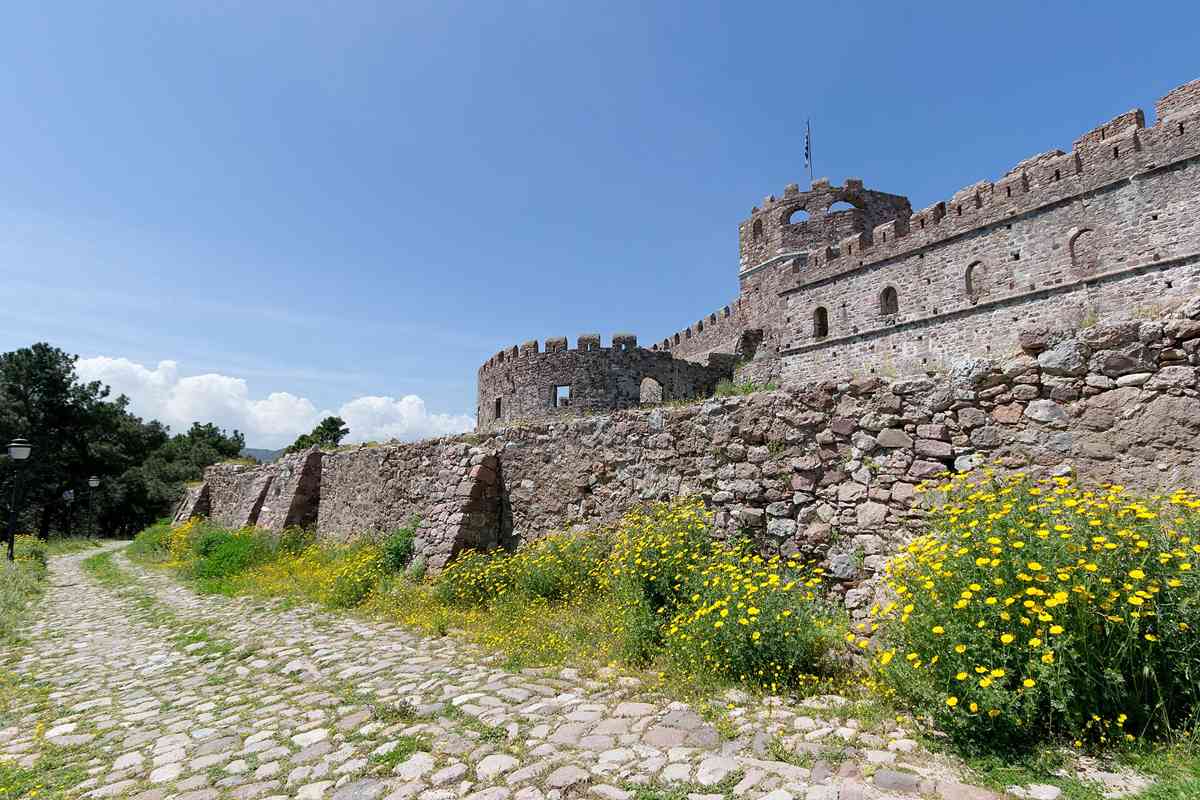
Featured photo: Katsiaryna Naliuka, CC BY-SA 3.0, via Wikimedia Commons (File:Fortress of Mytilini, Lesvos 1.jpg).