
Mycenaean civilization sites spread across the Argolid, Messenia, Laconia and Boeotia. Trips on this theme take place in the Peloponnese and in central Greece, led by a host. The sections cover Mycenae, Tiryns, the Treasury of Atreus, Grave Circle A and the Palace of Nestor. Others turn to Linear B, Gla, Orchomenus, the Vaphio tomb and the end of the palaces. Related pages are Mycenae tours, the Minoan civilization and the Mycenae and Epidaurus day trip. Other ideas sit with the wider range of Greece tours.
Bookings made through the GetYourGuide widgets on this page earn Classical Greece Tours a commission, at no extra cost to the traveller.
What was the Mycenaean civilization?
The Mycenaean civilization belongs to the Late Helladic period of mainland Greece, about 1700 to 1050 BC. Its people wrote Linear B, a syllabic script in which each sign stands for a syllable. That script preserves the earliest written form of the Greek language.
Settlements of the Mycenaean civilization appeared in Epirus, in Macedonia and on islands of the Aegean Sea. Others rose on Cyprus and along the south-west shore of Asia Minor. The term Asia Minor refers to the large peninsula now held by Turkey. The Aegean lies between the Greek mainland and that peninsula, as part of the Mediterranean.
Palaces in the full sense date from about 1400 BC. In that age, Cyclopean walls of huge rough blocks rose at Mycenae and nearby Tiryns. The economy of the Mycenaean civilization worked without coins or any other money. Scholars call it a palace economy: the palace gathered goods and labour, then shared them out again.
The palaces brought in metals, ivory and glass as raw materials. In return they sent out oil, perfume, wine, wool and pottery. Olive oil ranked as a chief export, since people used it for a range of purposes. The best-known building project of the era was a network of roads across the Peloponnese.
- Gods: Mycenaean religion already honoured deities later found among the Olympians, the chief gods of Greece.
- Mycenae: The palace there controlled lands two or three times bigger than other palace states.
- Iolcos: This town in Thessaly was the northernmost centre of the Mycenaean civilization.
At present, scholars still lack a satisfying explanation for the fall of the Mycenaean civilization. The two leading theories point to population movement and to internal conflict. Internal conflict here means fighting within one palace state or between rival palace states.
What made Mycenae a leading centre of the Mycenaean civilization?
The Mycenaean civilization saw Mycenae grow into a major power between about 1550 and 1450 BC. The city crowns a hill in the Argolid district of the Peloponnese. Scholars give the name Mycenaean Age to the span from about 1400 to 1200 BC.
Mycenae’s population rose sharply in the Middle Helladic period. That label covers the Bronze Age stage just before the Mycenaean civilization. About 1800 BC, the first graves appeared on the western flank of the acropolis, the fortified hilltop. The dead lay in pits or in cist graves, boxes lined with stone slabs.
Late in the Mycenaean civilization, Mycenae’s power in war, trade and politics is thought to have reached Crete. The same reach covered Pylos in the western Peloponnese, plus Athens and Thebes. On Crete, Mycenaeans held the palace of Knossos until its destruction around 1370 BC. Knossos had earlier been a palace of the Minoans, Crete’s own Bronze Age people.
The summit palace centred on a megaron, a long hall that served as a throne room. A raised hearth sat in the middle, below an opening in the roof. Four columns, set in a square around the hearth, held up that roof. Entry to the hall led from a courtyard with a columned porch, or portico.
- Earlier palaces: Older palaces are thought to have stood on the summit before being cleared or built over.
- Pausanias: In the second century AD, this Greek traveller noted the walls and the Lion Gate.
- Silver: Chemical tests show the silver of objects found at Mycenae came from a number of places.
Mycenae, unlike other sites, rose again in part after the Mycenaean civilization fell. Pottery shows that the town regained part of its wealth, then burned once more. The site stayed thinly settled until the Hellenistic era, the age that followed Alexander the Great.
How did Tiryns defend itself in the Mycenaean civilization?
The Mycenaean civilization built a walled citadel at Tiryns, in the Argolid. The town saw its greatest growth in the Late Helladic period, which is the Mycenaean period itself. Homer, the earliest author to name Tiryns, praised the great size of its walls.
The lower city of Tiryns spread over the plain around the foot of the acropolis. Up on the hill, a strong cross wall split the citadel into two parts. The southern part held the palace buildings of the Mycenaean civilization. The northern part served only to protect the highest ground. Walls ran around the whole summit.
At the entrance, a tower stood on the left and an arm of the wall on the right. Attackers had to cross a narrow corridor between them. That layout let defenders strike from above and from both sides. In a third building phase, the gate was moved further out.
Rooms on the sides of the palace seem to have had a second floor. Rich decoration covered the walls of the outer porch. Three doors led into the anteroom, and one more opened into the main room. A mark in the floor, midway along the east wall, shows where the royal throne stood.
- Springs: Three springs fed the citadel, one reached through a secret entrance in the west.
- Dam: Engineers of the Mycenaean civilization raised a large dam outside Tiryns, a notable building project.
- Later temple: After the hall burned in the 8th century BC, a plain Doric temple rose there.
The disaster at the end of the Mycenaean civilization struck Tiryns. Even so, people kept living in the palace area into the early Archaic period. That occupation lasted until the mid-8th century BC. Archaic here means the early period of the Greek city-states.
Why is the Treasury of Atreus a landmark of the Mycenaean civilization?
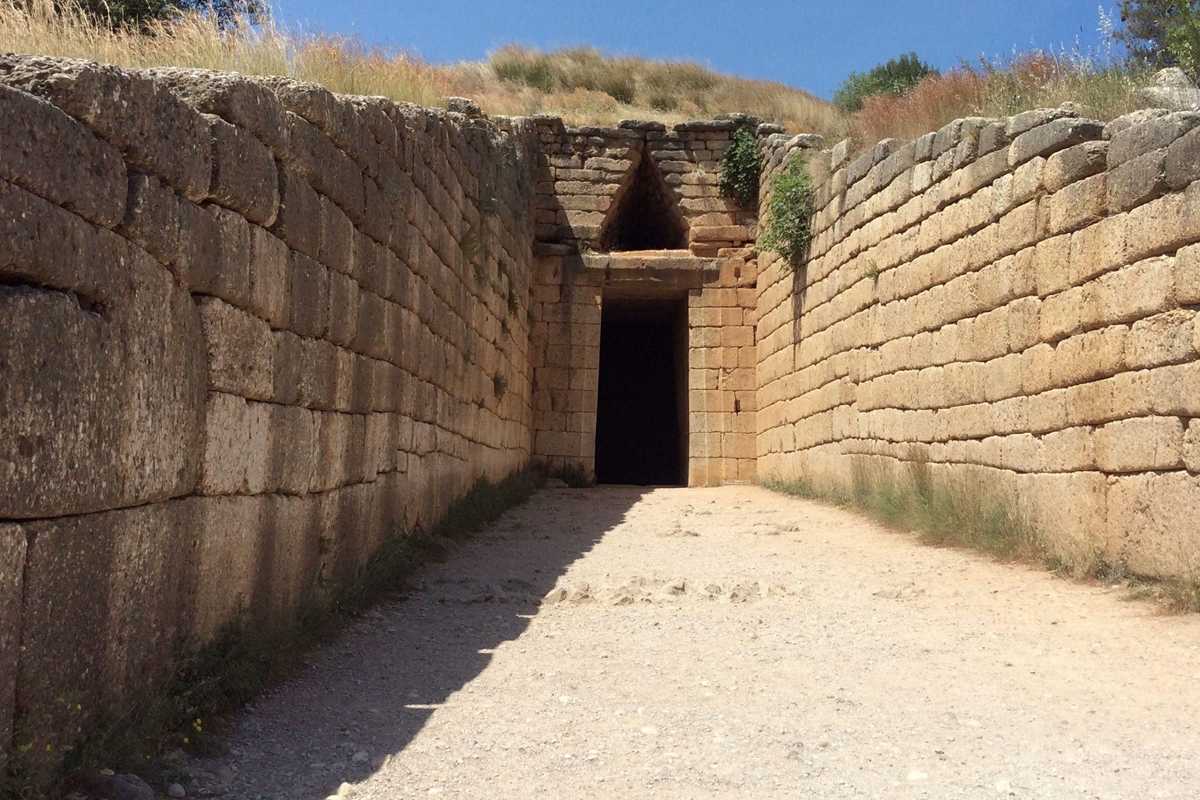
The Mycenaean civilization left the Treasury of Atreus, a great tomb at Mycenae. Its round burial chamber sits under a dome of stone. Such a domed tomb is called a tholos. Scholars now date it to about 1400 to 1250 BC.
The front of the doorway passage rises 10.5 metres. The doorway itself stands 5.4 metres high and 2.7 metres wide. Above the stone lintel sits an empty space shaped like a triangle, called a relieving triangle. It steers the weight of the dome away from the centre of the lintel.
Marble from the Mani peninsula adorned the front of this Mycenaean civilization tomb. Its red stone later took the name lapis Taenarius, after Cape Taenarum. Lapis is Latin for stone. Two gypsum panels carved with bulls decorated either the front or the side room. Nail marks inside the dome hint at hanging ornaments; one suggestion is golden rosettes.
For over a thousand years, no stone dome stood taller or wider. That record lasted until the Roman period. Its builders used corbelling, so each stone ring sits slightly further inward than the ring below. Alan Wace put the weight of stone in the entrance passage at over 1200 tons.
- Poros stone: This soft limestone is thought to come from hills north-west of Mycenae, towards Nemea.
- Terrace: A level platform about 27 metres long and 27 metres wide was laid out before the tomb.
- Workforce: Elizabeth French suggested the crew of the Mycenaean civilization palace on the acropolis also built this tomb.
Pausanias came in the 2nd century CE, yet he did not tie the tomb to Atreus. Atreus was a mythical king of Mycenae. The present name has an uncertain origin. It is thought to date from the 18th century, long after the Mycenaean civilization.
Who lay in Grave Circle A at the dawn of the Mycenaean civilization?
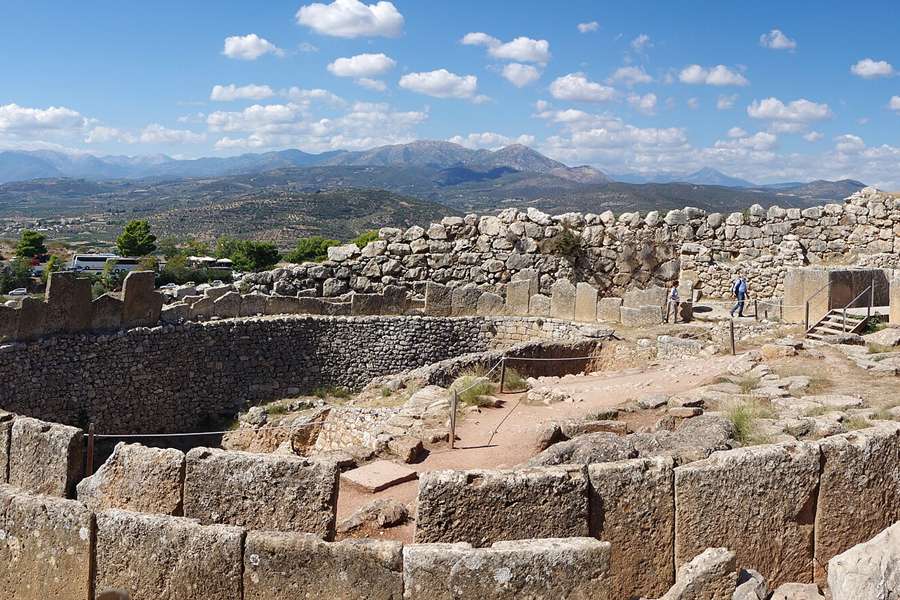
The Mycenaean civilization laid powerful early rulers to rest in Grave Circle A at Mycenae. The circle holds six shaft graves, which are deep pits cut into the ground. These burials date from the 16th century BC, before the traditional date of the Trojan War.
At first the circle lay outside the walls of Mycenae. No ring wall surrounded it during the burials. Around 1600 BC, a small palace without walls is believed to have crowned the hill. The royal graves still lay outside it. In the 13th century BC, an extended circuit of walls finally enclosed the graves.
Late in the Mycenaean civilization, 13th-century rulers turned the burial ground into a monument. This was an attempt to claim the heroic past of an older ruling family. Builders levelled the ground to form a precinct for ceremonies and set the grave markers upright again. A double-ring enclosure wall, known as a peribolos, closed off the area.
The bulk of the objects in Grave Circle A carry Minoan decoration from Crete. Fighting and hunting scenes, by contrast, show a clear Mycenaean style. At the time, the Mycenaeans had not yet conquered Minoan Crete. A sceptre, or royal staff, from Grave IV marks a person of very high rank.
- Stelae: Stone slabs stood over the graves, and three of them show chariot scenes.
- Depth: The six shafts of the Mycenaean civilization circle range from 1.0 to 4.0 metres deep.
- Grave goods: Scholars told men from women in the graves by the objects buried with them.
One view links the graves to an earlier ruling house of Mycenae, which Greek myth calls the Perseids. Later myth told of a time when two kings ruled Mycenae together. Archaeologists suggest that paired graves in this Mycenaean civilization circle match those two kings.
What did the Palace of Nestor at Pylos record about the Mycenaean civilization?
The Mycenaean civilization left the Palace of Nestor near Pylos, in Messenia. That region lies in the south-western Peloponnese. No other Bronze Age palace on the Greek mainland survives so completely. Its archive of clay tablets ranks as the best kept in the Mycenaean world.
Staircases inside the palace point to a building of two storeys. Wall paintings at Pylos favour sea themes, with octopuses, fish and dolphins. The palace at Tiryns shares this taste for marine scenes. A large court lined with columns lies in front of the central megaron. A second, smaller megaron also stands inside the complex.
The Pylos tablets list a specialised workforce. Each worker belonged to a set category and did one task in production. Textile work shows this pattern above all. Every rural community, or damos, had to send a fixed number of men to the army. The tablets also name two queens and a king, written wa-na-ssoi and wa-na-ka-te.
The palace of Pylos burned around 1180 BC. The heat of that fire baked the Linear B tablets hard and so preserved them. Their texts record rushed preparations for defence against a coming attack. These last records of the Mycenaean civilization at Pylos give no detail of the attackers.
- Enkhelyawon: The tablets name this man without a title, yet scholars think he was a king.
- Harbour: Pylos had a harbour able to take large Bronze Age ships like the Uluburun wreck.
- Museum: A large part of the finds from the Mycenaean civilization palace sits in the Archaeological Museum of Chora.
During World War II, a systematic dig at the Mycenaean civilization palace was impossible. Systematic here means planned and steady, season after season. Excavation resumed in 1952. Between 1952 and 1966, the team uncovered the palace and explored further areas around the acropolis.
How did scribes of the Mycenaean civilization use Linear B?
The Mycenaean civilization kept its records in Linear B, a script of roughly 200 signs. Syllabic signs give sounds, each one a syllable. Ideograms, the second group, stand for whole objects or goods, such as a cow, wool or a spear.
Linear B served mainly for running the palaces of the Mycenaean civilization. Its texts come chiefly from palace sites. Thousands of clay tablets survive, yet the handwriting reveals a small group of scribes. A scribe was a trained writer who kept official records. Experts count 45 scribes at Pylos and 66 at Knossos on Crete.
Two shapes of tablet survive. Palm-leaf tablets carry lines that run parallel to the long side. Larger page-shaped tablets are divided into a series of lines. Sounds such as l, m, n, r and s at the end of a syllable go unwritten. So a-to-ro-qo stands for anthropos, the word for a person.
Linear B signs also appeared on trade goods such as amphoras, where their use spread more widely. An amphora is a two-handled storage jar for wine or oil. When the palaces fell, the script of the Mycenaean civilization vanished with them. The Greek Dark Ages that followed offer no clear proof that anyone still wrote.
- Inscriptions: About 6,058 Linear B inscriptions are known, including 170 on vessels.
- R and L: One series of signs covers both r and l, so ti-ri-po spells tripos, a tripod.
- Standard signs: International meetings of scholars, starting in Paris in 1956, standardised how the signs are shown.
The earliest Linear B records of the Mycenaean civilization come from Knossos, around 1400 BC. The script built on Linear A, the older writing of the Minoans. Linear A records an unknown language. Nobody knows whether signs shared by both scripts carried the same sounds.
Who was Michael Ventris, the decoder of the Mycenaean civilization script?
The Mycenaean civilization’s script yielded in 1952 to Michael Ventris, an English architect. He found that Linear B wrote an archaic, or very old, form of Greek. Ventris had pursued the puzzle as a personal calling since his teenage years.
Ventris began school in Gstaad, in Switzerland, where lessons ran in French and German. He later chose architecture as a career and enrolled at the Architectural Association School. Conscription in 1942 cut those studies short. Conscription means a compulsory call-up into the armed forces. He finished the course with honours in 1948, after the war.
In the air force, Ventris chose to train as a navigator rather than a pilot. Training in Britain and Canada let him qualify early in 1944. He then flew as aircrew in the bombing of Germany. No evidence shows that he ever served in a code-breaking unit, despite a popular belief.
Shortly before World War II, Carl Blegen found about 600 tablets at Pylos. Pylos was a palace of the Mycenaean civilization on the Greek mainland. Photographs of them by the archaeologist Alison Frantz later helped Ventris crack the script. In 1948, Sir John Myres invited a group of academics to help copy out Linear B texts.
- Home: Ventris and his wife designed their own family house at 19 North End, Hampstead.
- Partnership: Between 1953 and 1956, Ventris and John Chadwick published joint papers on the Mycenaean civilization script.
- Earlier attempts: Arthur Evans tried for decades to read Linear A and Linear B, with little success.
On 6 September 1956, Ventris, then 34, drove at night to his in-laws’ home for his wallet. On the way back he died instantly in a collision at Hatfield, in Hertfordshire. His decipherment had already founded a new field of study on the Mycenaean civilization.
What was Gla, the great Boeotian fortress of the Mycenaean civilization?
The Mycenaean civilization raised Gla on a rocky outcrop in Boeotia, in central Greece. Its walls enclose about 900 by 575 metres at the widest points. Scholars once saw a palace inside, but recent evidence points to a military base with large stores.
Gla rose at about the same time as a great engineering work. Dams and canals drained Lake Kopais, southern Greece’s biggest lake, to create a fertile plain. Two large canals met about 1 kilometre north of the fortress. Together they ran for over 50 kilometres, carrying water from the Cephissus and Melas rivers.
The chief building inside is L-shaped and is frequently described as a palace. It stands on a man-made terrace and has three wings of small rooms. Yet it lacks features typical of other Mycenaean civilization palaces. It has no throne room, round hearth or bathroom, so the palace label is doubted.
Destruction or neglect wrecked the drainage system once the Mycenaean civilization ended, or soon after. By Classical times, centuries later, the lake had filled again. Gla itself suffered a targeted attack: only its four gates and a monumental building, the Melathron, burned. The site was then abandoned for good.
- Arne: Gla is sometimes linked to Arne, a city in Homer’s Catalogue of Ships, though George Mylonas disputed it.
- Open space: Permanent buildings fill less than a quarter of the ground inside the walls.
- Kitchen finds: Skewer trays for cooking meat turned up at Gla, as at Mycenae and Pylos.
The scholar Jorrit Kelder places Gla within the state of nearby Orchomenos, another centre of the Mycenaean civilization. Its massive walls were always visible, even before excavation. In a good number of places, they rise straight from the cliffs at the edge of the outcrop.
Which Mycenaean civilization treasures survive at Orchomenus in Boeotia?
The Mycenaean civilization left a great tholos tomb at Orchomenus in Boeotia, called the Tomb of Minyas. Scholars think it was built around 1250 BC for members of the local royal family. The tomb was later plundered in ancient times.
Writers call this Boeotian town Minyan Orchomenus. That name sets it apart from a later city called Orchomenus in Arcadia. Arcadia lies in the heart of the Peloponnese. The town sits at the foot of Akontion, close to snow-capped Mount Parnassos. Orchomenos ranked among the palace centres of the Mycenaean civilization in Central Greece.
The entrance was built of dark grey marble from Levadeia and once had a wooden door. Holes in the walls show that bronze rosettes once decorated the entrance and the chamber. Rosettes are flower-shaped ornaments. The ceiling of the side chamber carries spirals and floral motifs carved in relief.
Standard histories list Orchomenos among the cities destroyed in the Bronze Age collapse, when the palace world fell. Greek legend blamed a war with neighbouring Thebes. Jesse Millek has challenged this view. He argues that the evidence shows the site was abandoned at that time. Remains of the Mycenaean civilization here are fragmentary, partly through erosion and later rebuilding.
- Excavation: From 1970 to 1973, Theodore Spyropoulos uncovered the Mycenaean palace and a prehistoric cemetery.
- Lintel: The stone beam above the entrance, still in place, is six metres long.
- Later worship: The tomb stayed visible for centuries and became a place of worship in Hellenistic times.
Anastasios Orlandos, an architect and archaeologist, partly restored this Mycenaean civilization tomb. In 1994, Greece’s culture ministry restored the tomb once more. That later work mainly improved drainage and strengthened the walls of the side chamber.
What did the Vaphio tomb near Sparta hold from the Mycenaean civilization?
The Mycenaean civilization built a tholos tomb at Vaphio in Laconia. It lies beside the Eurotas river, on its right bank, about 8 kilometres south of Sparta. Its grave goods include the famous pair of gold Vaphio Cups.
A walled approach about 30 metres long leads to the vaulted chamber. That round room measures about 10 metres across, and the grave itself was cut into its floor. The tomb suffered heavy damage in the decades after its excavation. During conservation in 1962, workers rebuilt the walls until they stood about 6 metres high.
Finds of the Mycenaean civilization at Vaphio include a large number of carved gem seals and amethyst beads. Other objects were made of gold, silver, bronze, iron, lead, amber and crystal. Of the 43 seals, a number have parallels in Cretan finds. The princely man in the grave apparently wore them at his wrists, like a charm bracelet today.
On the Quiet Cup, a cow lures a bull and the pair mate. The bull’s rear leg is then roped. On the Violent Cup, bulls are stampeded into nets, while one breaks free and shoves its catchers aside. Ellen Davis suggested that at least one cup was a mainland work of the Mycenaean civilization.
- Dating: Pottery in the tomb dates to around 1500 to 1450 BC.
- Museum: The main objects were moved to the National Archaeological Museum of Athens.
- Vapheio cup: Experts on the Mycenaean civilization now use this name for the cup shape, in pottery and metal.
The art historian Kenneth Clark wrote that the men on the cups look insignificant beside the huge bulls. The Violent Cup also recalls Plato’s Critias, where bulls are caught for sacrifice without iron tools. Critias is a dialogue that describes the legendary island of Atlantis.
Who was the Griffin Warrior of the early Mycenaean civilization?
The Mycenaean civilization owes part of its early form to men like the Griffin Warrior. He was buried near Pylos about 3,500 years ago. He died before the palaces were built, and his grave is full of objects made in Crete.
Researchers chose a handful of spots in an olive grove not far from the Palace of Nestor. One spot held three stones that seemed to form a corner. In 2015, a shaft of 2 metres by 1 metre came to light there. It suggested a grave. Excavation of the tomb ran from the fifth month of 2015 until October.
This Mycenaean civilization grave held jewellery, sealstones, carved ivories, combs, and gold and silver goblets. Sealstones are small carved gems used to stamp a mark into clay. Dozens of seals show combat, goddesses, reeds, altars, lions and men leaping over bulls. Two squashed gold cups lay there, with a silver cup trimmed in gold.
One sealstone, only 3.6 centimetres long, was stuck in limestone. A year of cleaning revealed a finely carved combat scene. Its details can be seen in full only through a photomicroscopy lens, a camera lens for tiny objects. Team member Stocker noted that no magnifying tool from that period has ever been found.
- Face: A computer reconstruction of his skull shows a broad face, close-set eyes and a strong jaw.
- Warrior or priest: His robust bones and weapons suggest a warrior, though ritual objects hint at a priest.
- Dating problem: The grave held no pottery, the usual clue for dating Mycenaean civilization burials.
James Wright headed the American School at Athens, a research body for classical studies. In his view, no tomb this rich had been found since the 1950s. DNA tests and chemical isotope studies aim to trace where this Mycenaean civilization warrior came from.
How did the Dendra panoply protect a warrior of the Mycenaean civilization?
The Mycenaean civilization produced the Dendra panoply, a complete suit of bronze armour. It dates from the Late Helladic period, the final Bronze Age stage. Leather thongs join its 15 separate pieces of bronze sheet. It guarded the body from the throat to the knees.
Each piece is beaten bronze sheet, backed with leather. Ox-hide thongs fasten the plates loosely, which allows the body to move. Bronze loops sit on the front plate and on each shoulder. The finished panoply forms a heavy, awkward tube of armour. It fully shields the neck and torso.
Parts of body armour from the late Mycenaean civilization also turned up at Thebes. They include a cuirass, shoulder guards, breast plates and lower plates. A cuirass guards both the chest and the back of the body. Bronze bands came to light at Mycenae and at Phaistos, a palace on Crete. Bronze scales appeared at Mycenae and Troy.
A Linear B sign for armour of this type shows the neck guard clearly. A high bronze collar was a typical feature of armour in the Near East. Bronze greaves, or leg guards, found so far cover only the shins. Diane Fortenberry suggests they were worn over linen ones, as much for status as for protection.
- Warrior Vase: Figures on this vase from Mycenae, about 1200 BC, wear a different kind of armour.
- Replica tests: In 1988 Diana Wardle studied a replica made by art students in Birmingham.
- Display: The Mycenaean civilization armour is on show at the Archaeological Museum of Nafplion.
In 2012, Barry Molloy used another replica to study how the armour moved with the body. In 2018, the archaeologist Spyros Bakas rebuilt the panoply with great care. His work explained its parts and the fighting ability of a Mycenaean civilization soldier.
Why did warriors of the Mycenaean civilization wear boar’s tusk helmets?
The Mycenaean civilization used helmets faced with ivory from boars’ tusks from the 18th or 17th century BC. They stayed in use until the 10th century BC. Makers fixed slivers of tusk in rows onto a leather base padded with felt.
Book ten of the Iliad describes such a helmet. Meriones armed Odysseus for a night raid on the Trojans. He gave him a bow, a quiver, a sword and a leather helmet. White boar tusks ran in rows around its outside, in alternate directions in each row. Homer says it was an heirloom, passed down through generations.
Makers used the two lower tusks of a boar, which average 20 centimetres long. The upper tusks are smaller and curve too much for the job. A single tusk gave up to four plates. An average helmet needed the tusks of 40 to 50 boars, while elaborate examples needed more than 140.
Scholars see two main forms. The early form has loose horizontal plates and turned up at Aegina, Eleusis, Argos and Thebes. The later form packs vertical plates tightly in rows. From around 1450 BC, helmets of the Mycenaean civilization commonly gained a neck guard. It was made of leather straps, at times reinforced with tusk plates.
- Crests: The earliest pictures, from Thera, now Santorini, around 1500 BC, show a helmet with a crest.
- Finds: More than 50 Mycenaean civilization finds, chiefly from graves, come from the mainland, islands and Crete.
- Crete: Finds are rarer on Crete, possibly because the island lacked wild boars.
These helmets of the Mycenaean civilization gave less protection than metal ones. Even so, leaders are thought to have worn them as a status symbol or a mark of identity. In this form, the helmet was a Greek invention, not a borrowing.
What did the title wanax mean in the Mycenaean civilization?
The Mycenaean civilization placed a king called the wanax at the top of society. He presided over a central state administration with a strong hierarchy. A hierarchy is a strict ladder of ranks. Wanax is one of two Greek titles traditionally translated as king.
The word anax, or wanax, meant a tribal chief, a lord or a military leader. Linear B spells it wa-na-ka, and the female form wa-na-sa. That female form later became anassa in classical Greek. The Greek word anaktoron, meaning a royal dwelling or palace, comes from the same root.
In Mycenaean times, a basileus seems to have been a lower official. In one case he headed a group of craftsmen. After the collapse of the Mycenaean civilization, basileus replaced wanax as the word for king. By Homer’s day, anax was already an old-fashioned title, best suited to heroes and gods.
Evidence from Pylos suggests that the wanax owned weapons marked as royal. Officials carried out the bulk of the work in his name. Only two known inscriptions show the wanax acting directly within the administration. Jars of olive oil in royal storehouses also bore the royal label. The wanax organised lavish feasts for the elite, with plenty of drinking.
- Names: Names such as Anaximander, king of the estate, and Astyanax, overlord of the city, carry the word.
- Brother kings: The Hittite king of Anatolia called a Mycenaean civilization wanax brother, a sign of equal rank.
- Mortal ruler: Scholars find no firm proof of a divine king and view the wanax as a mortal ruler.
The Tawagalawa Letter went from the Hittite king to an unnamed wanax of the Mycenaean civilization. It concerned a man called Piyamaradu, who had acted against the Hittite king. The letter asked the wanax either to return him or to reject him.
Which name did Hittite texts give the Mycenaean civilization?
The Mycenaean civilization appears in Hittite texts as Ahhiyawa, a nation to the west. The Hittites ruled a Bronze Age empire in Anatolia, now central Turkey. Recent research widely concludes that Ahhiyawa meant the Mycenaean world, or at least part of it.
The earliest reference is a letter on treaty breaches by Madduwatta, a Hittite vassal. A vassal was a ruler who served a stronger king. That letter calls the land Ahhiya. Scholars link the Greek name Achaean to Ahhiyawa and to the Egyptian term Ekwesh. Both are believed to name the Mycenaean civilization or a part of it.
Emil Forrer, a Swiss expert on the Hittites, studied the Bogazköy tablets. He tied the Achaeans of early Greece to the Land of Ahhiyawa. In 1932, Ferdinand Sommer published a book called The Ahhiyawa Documents. Proposed seats of Ahhiyawa power include Rhodes, Mycenae and Thebes. One view has the centre moving from Thebes to Mycenae.
Another Hittite account says that ships from Ahhiyawa were to avoid harbours under Assyrian control. This formed part of a trade embargo, a ban on trade, against Assyria. On Crete, a Linear B text from Knossos of around 1400 BC mentions a-ka-wi-ja-de. It seems to refer to a state of the Mycenaean civilization on the Greek mainland.
- Odyssey: In book fourteen, Odysseus tells a false tale of an Achaean attack on the Egyptian Delta.
- Egypt: The earliest text on the Mycenaean civilization, from Thutmosis III, records Tanaju envoys bringing gifts around 1437 BC.
- Danaya: An inscription of Amenhotep III lists Danaya cities across the larger part of southern mainland Greece.
Scholars hotly debated how closely Ahhiyawa matched the Achaeans, beyond a likeness in sound. The argument went on even after Linear B proved to be an early form of Greek. Linear B was the script of the Mycenaean civilization palaces.
How did the Late Bronze Age collapse bring down the Mycenaean civilization?
The Mycenaean civilization lost its palace economy in the Late Bronze Age collapse. Across the Aegean, that system broke apart into small, isolated village cultures. These belonged to the Greek Dark Ages, which lasted from about 1200 to 800 BC.
No palace of the Mycenaean civilization survived. The one possible exception is the Cyclopean walls on the Acropolis of Athens. Thebes saw its palace sacked again and again between 1300 and 1200 BC, then burned down. Robert Drews argues that Thebes regained real standing in Greece only by the late 12th century BC.
Mycenae was first destroyed by an earthquake in 1250 BC, as crushed bodies in fallen buildings show. In 1200 BC, another earthquake wrecked much of Tiryns, a citadel of the Mycenaean civilization. Scholars broadly agree that earthquakes did not ruin either city for good. Guy Middleton notes that physical destruction alone cannot fully explain the collapse.
Across the Peloponnese, up to 90% of small sites were abandoned, a sign of major depopulation. Depopulation means a sharp fall in the number of people. At Pylos, tablets mention watchers guarding the coast. At Athens, protected routes to water sources suggest long droughts, as the scholar Demand notes.
- Affected sites: Signs of collapse appear at Knossos, Lefkandi, Nichoria, Teichos Dymaion, Iolkos and other Greek sites.
- Pottery trade: Jesse Millek has shown that trade in Mycenaean pottery had already ended by 1250 BC.
- Trade theory: Spyros Iakovidis finds no evidence of a violent or sudden decline at Mycenae.
Proposed causes include climate change, invasions by seaborne raiders called the Sea Peoples, and the spread of ironworking. None has won agreement among scholars. The Greek Dark Ages that followed the Mycenaean civilization ended with the rise of Archaic Greece.
What do travellers ask about Mycenaean civilization, and what are the answers?
Mycenaean civilization finds still turn up by chance. In 2008, a Linear B tablet appeared on a hill slope in Laconia. It lay near the Byzantine chapel of Agios Vasileios. A survey that same year found two more tablet fragments.
Which palace of the Mycenaean civilization lies near Sparta?
Agios Vasileios holds a Mycenaean palace about 10 kilometres south of Sparta. It overlooks the plain west of the Eurotas. The palace was first built between 1400 and 1300 BC. Fire destroyed it later; it was partly rebuilt and then destroyed again. Finds include twenty bronze swords and figurines of clay and ivory.
What is the Tripod Tablet of the Mycenaean civilization?
PY Ta 641, called the Tripod Tablet, is a clay tablet written in Linear B. Carl Blegen found it in the Archives Complex of the Palace of Nestor in June 1952. It lists tripods and other vessels used in ritual feasts. Its pictures of the vessels matched the reading that Ventris had predicted.
Who was Carl Blegen, the excavator of the Mycenaean civilization at Pylos?
Carl Blegen was born in Minneapolis, Minnesota, the eldest of six children. From 1927 to 1957, he held a chair in classical archaeology at Cincinnati’s university. As assistant director of the American School in Athens, he dug at Zygouries, Phlius and Prosymna. He died in Athens on 24 August 1971, aged 84.
Which gods did the Mycenaean civilization worship?
The Mycenaeans are thought to have entered Greece with gods led by a sky god. Linguists call him *Dyeus in early Indo-European, a name that became Zeus. Their religion honoured a number of gods and took in foreign gods with ease. Minoan goddesses such as Britomartis and Diktynna were adopted too.