
Greek tragedy is the theme of small-group and expert-led journeys across Athens, the Peloponnese and Delphi. The topics start with Thespis, the City Dionysia and the Theatre of Dionysus. Aeschylus and the Oresteia follow, then Sophocles with Oedipus Rex and Antigone, and Euripides with Medea. Related pages cover the Epidaurus tour, Greece cultural tours and the Greek gods. Further trips appear under Greece tours.
Bookings made through the GetYourGuide widgets on this page earn Classical Greece Tours a commission, at no extra cost to the traveller.
What is Greek tragedy?
Greek tragedy is one of three main stage genres from Ancient Greece and Greek-settled Anatolia, now Asian Turkey. Its two partners are comedy and the satyr play. A satyr play is a short, light drama with a chorus of satyrs, the woodland followers of Dionysus.
The word tragodia joins the Greek words for goat and song, so it means “song of the goats”. Those goats are the satyrs who sang in the chorus of Greek tragedy. A chorus is a group of performers who sing and dance as one body, apart from the actors.
Just 32 full-length tragedies survive today. Every one of them comes from the same three writers: Aeschylus, Sophocles and Euripides. More than 300 further tragedies are known only from fragments. In Greek tragedy studies, a fragment is a short surviving piece of a lost play. One example is a single quoted line.
Greek tragedy was not merely a show. It served as a collective ritual of the whole polis, the Greek word for a self-governing city-state. A ritual is a fixed ceremony that a community performs together. Ancient critics claimed that Athens spent more on theatre than on its fleet of warships.
- Aristotle: The philosopher explained the purpose of tragedy through mimesis, meaning imitation, and catharsis, meaning cleansing.
- Public life: Plays aired ideas and troubles from Athenian democracy, politics and cultural life.
- Legacy: The genre shaped the later theatre of Ancient Rome and of the Renaissance in Europe.
Scholars still cannot explain exactly how Greek tragedy began. Its birth remains an open puzzle of classical scholarship. That field studies the languages, writings and history of ancient Greece and Rome. Each theory about the very first tragedies remains unproven and open to debate.
Why does Thespis stand at the start of Greek tragedy?
Greek tragedy links its early story to Thespis, an Athenian poet and actor of the 6th century BC. A tragic poet wrote serious verse plays for the stage. Thespis did both jobs, so he wrote the words and also performed them before an audience.
Thespis worked as a singer of dithyrambs. A dithyramb was a choral hymn to the god Dionysus. Each song told a story from mythology and carried choric refrains. A refrain is a line that a chorus repeats again and again. Mythology means the old tales of gods, heroes and monsters handed down over time.
Thespis then brought in a new style of performance. In it, one singer or actor spoke the lines of each separate character in the story. He marked the change from one character to the next by switching masks. A mask hid the face of the performer and showed the role he was playing.
Themistius, who wrote in the 4th century AD, credits Thespis with two further parts of Greek tragedy. In his account, Thespis invented the prologue and the spoken part of a play. A prologue is the opening speech that sets out the story. Thespis also carries the widely used title “Inventor of Tragedy”.
- Touring: Thespis invented theatrical touring, moving his costumes, masks and props between cities by horse-drawn wagon.
- Lost works: No Greek tragedy by Thespis has survived in a form that experts can verify.
- Doubtful titles: Four play titles bear his name, but modern scholars judge them to be forgeries, or fakes.
In 1939, the National Theatre of Greece created a branch to tour the country with plays. A branch is a separate unit of a larger theatre. Its name, “The Wagon of Thespis”, honours the man who first took Greek tragedy on tour.
How did the City Dionysia shape Greek tragedy?
Greek tragedy competed for prizes at the City Dionysia, a festival held in Athens for the god Dionysus. Tradition says the festival began after Eleutherae chose to join Attica. That town lay on the frontier between Attica, the land of Athens, and Boeotia.
The Eleuthereans, meaning the people of Eleutherae, then carried a statue of Dionysus to Athens. The Athenians at first refused to take the statue in. Greek tragedy honoured Dionysus, who ruled over wine and the theatre in Greek belief. Such a statue served as a holy image, standing in for the god during worship.
The archon, a chief official of Athens, began preparing as soon as he was elected. He picked two assistants called paredroi and ten epimeletai, or curators, to help run the festival. Dithyramb contests shared the programme with Greek tragedy. Famous poets such as Simonides and Pindar offered their musical and lyric skills to these contests.
Next came the proagon, a word meaning “pre-contest”. At this event, each playwright named the works he was about to stage. During the Peloponnesian War, a long conflict of Athens and Sparta, the proagon included another custom. Children orphaned by soldiers’ deaths in battle were paraded through the Odeon, a roofed hall for music.
- Purification: Before the plays, the Theatre of Dionysus was ritually cleansed with the sacrifice of a bull.
- Actors’ prizes: Until 449 BC only the plays won prizes, and actors became eligible after that.
- Voting: Judges placed tablets in an urn, and five were then drawn at random to settle the result.
Old plays also came back to the festival. During the fourth century BC, at least one revival appeared at the City Dionysia each year. In Greek tragedy, a revival is a fresh staging of a play first shown years before.
What role did the Theatre of Dionysus play in Greek tragedy?
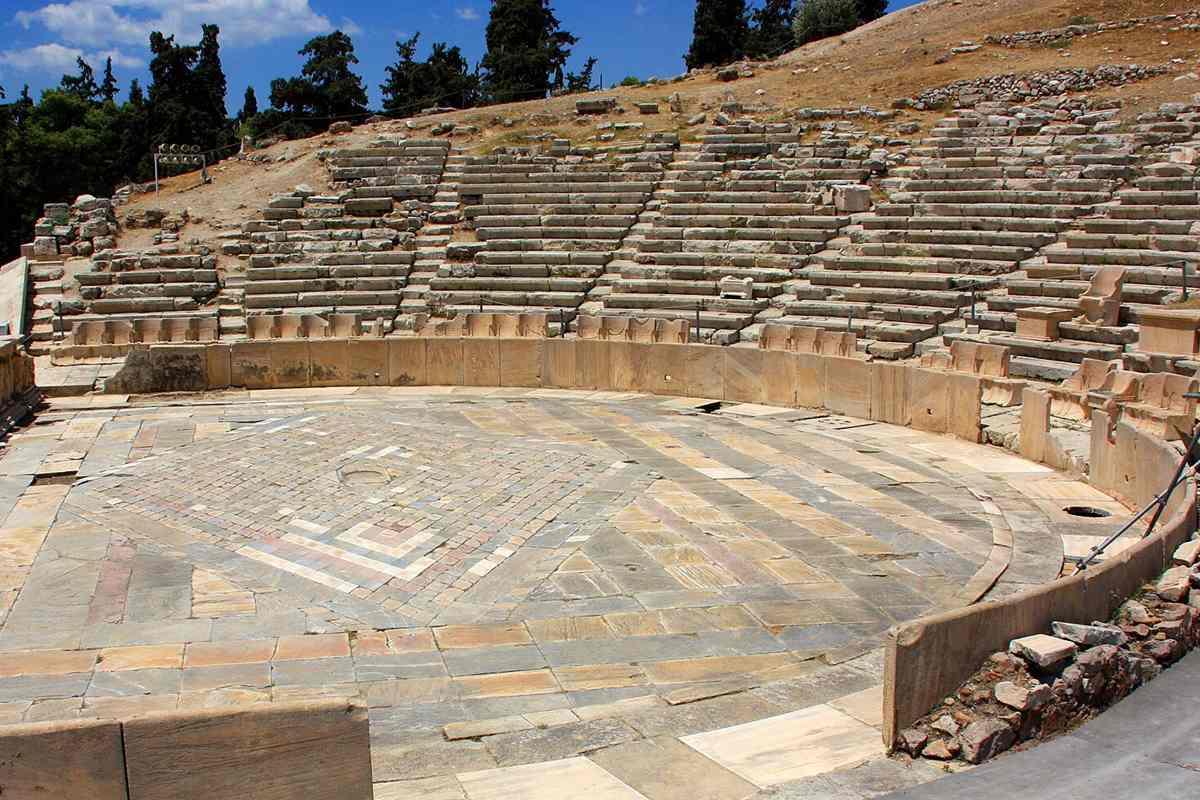
Greek tragedy reached its audience in classical Athens through the Theatre of Dionysus. This open-air theatre is widely regarded as the oldest theatre. Its name honours Dionysus, the wine god whose yearly festival brought the plays to the stage.
Two temples stood in the sanctuary, or holy ground, beside the theatre. The Older Temple held the xoanon of Dionysus, a cult image carved from wood. A later New Temple was said to contain a figure of Dionysus made by the sculptor Alkamenes. That figure was chryselephantine, a term for works crafted from gold and ivory.
Scripts of Greek tragedy give clues about how this stage looked. The Oresteia by Aeschylus needs actors to come and go through a palace door. That points to a skene, a stage building or backdrop behind the acting area. This skene was a wooden structure of no more than two floors, topped by a roof.
Builders also set post-holes into the terrace wall of the theatre. The holes acted as sockets for movable scenery. A terrace here is a flat platform built into the slope of the Acropolis hill. Scenery means the painted panels and set pieces that show the audience where each scene takes place.
- Roman era: After the Roman general Sulla conquered Greece and partly destroyed Athens in 86 BC, the theatre declined.
- Byzantine years: In the Byzantine era, the age of the Eastern Roman Empire, the theatre fell into decay.
- Rediscovery: Experts identified, excavated and restored this stage of Greek tragedy only in the nineteenth century.
Lycurgus, a leading Athenian statesman, served as epistates, an official in charge of the theatre. In that role, he turned the building into the stone structure seen today. Through his work, Greek tragedy gained a lasting home of cut stone.
Which marks did Aeschylus leave on Greek tragedy?
Greek tragedy, as scholars know it, begins with Aeschylus, an Athenian playwright of the fifth century BC. Academic study of the genre starts with his plays. Earlier tragedy is understood mainly by reading backwards from the works he left behind.
Pieces of his lost plays survive as quotations in the works of later writers. A quotation is a passage repeated word for word in another text. More fragments continue to appear on papyri found in Egypt. Papyrus was an ancient writing material made from the stems of a water reed. Papyri is its plural form.
Aeschylus once faced a charge of impiety, called asebeia in Greek, which meant disrespect towards the gods. The charge claimed that he revealed secrets of the Eleusinian Mysteries on stage. These were secret rites of the goddess Demeter at Eleusis. The jury found him not guilty, out of respect for the war service of Aeschylus and his brothers.
Aeschylus travelled to Sicily in the 470s BC at the request of Hiero, ruler of Syracuse. Syracuse was a major Greek city in eastern Sicily. On one of these trips, Aeschylus staged a Greek tragedy called The Women of Aetna. The play honoured Aetna, a city founded by Hiero.
- Soldier: Beyond Greek tragedy, Aeschylus served as a soldier in the clash at Plataea in 479 BC.
- Refuge: He once sought safety at the altar on the dancing floor, or orchestra, of the Theatre of Dionysus.
- Death: Aeschylus died at Gela, a Greek city in Sicily, in 456 or 455 BC.
Prometheus Bound is listed among the surviving plays of Aeschylus. A long debate surrounds its authorship, meaning the question of who truly wrote it. Certain scholars argue that his son Euphorion composed this Greek tragedy instead of Aeschylus himself.
What happens in the Oresteia, the Greek tragedy trilogy of Aeschylus?
Greek tragedy owes the Oresteia to Aeschylus, who wrote it in the 5th century BC. A trilogy is three tragedies telling one connected story. This one follows the cursed House of Atreus, a royal family of myth. Its story moves through murder, revenge and a trial.
The three plays are Agamemnon, then The Libation Bearers, and finally The Eumenides. Each play forms one chapter of the larger tale. A libation is a drink offering, such as wine, poured out for the gods or the dead. Eumenides means “the Gracious Ones”, a polite name for the Furies, goddesses of vengeance.
Agamemnon opens with a watchman looking out over the sea. He has waited a year for a signal of a Greek victory at Troy. At last he spots a distant bonfire, which tells him that Troy has fallen. Troy was the city besieged by the Greeks in the Trojan War.
In The Libation Bearers, Agamemnon’s son Orestes comes back to Argos. His cousin Pylades travels with him. This Greek tragedy also changes its chorus. The old men of Argos from the first play give way to a chorus of foreign slave women. Argos is a city in the Peloponnese, the large peninsula of southern Greece.
- The robes: Clytemnestra talks her husband Agamemnon into walking on the robes spread out for him.
- The trial: In The Eumenides, the last Greek tragedy of the set, Athena orders all future trials settled in court.
- Lost ending: A satyr play called Proteus followed the trilogy, yet only one line of it survives.
The trilogy weighs revenge against justice. Across its three plays, this Greek tragedy moves from a personal vendetta to organised litigation. A vendetta is a feud in which one family takes revenge on another. Litigation means settling a dispute in a court of law.
Who was Sophocles, and what did he give Greek tragedy?
Greek tragedy playwright Sophocles came from Hippeius Colonus, a rural deme in Attica, the region around Athens. He was a wealthy member of that small community. Each deme was a district of Attica that managed its own local matters.
His first Greek tragedy victory came in 468 BC, at the Dionysia. He beat Aeschylus, then the top name in Athenian drama. The writer Plutarch says that this contest broke with custom. Judges were normally chosen by lot, meaning drawn at random. This time, the archon asked Cimon and the other generals present to pick the winner.
Sophocles led the paean in 480 BC, after the Greek victory over the Persians at Salamis. A paean is a choral chant sung in honour of a god. In 443/2 BC, he served as one of the Hellenotamiai. These treasurers of Athena helped manage the finances of the city.
Outside Greek tragedy, in 441 BC he was elected one of the ten generals of Athens. These generals, called strategoi, were executive officials who ran the affairs of the city. He served as a junior colleague of Pericles and joined the Athenian campaign against Samos. Samos is an island in the eastern Aegean Sea.
- Scenery: Aristotle credits Sophocles with bringing skenographia, or scenery painting, into Greek tragedy.
- Asclepius: Tradition says that in 420 BC he received the image of Asclepius, god of healing, into his house.
- Family trade: His father made armour, the protective gear worn by soldiers in battle.
Sophocles died during the winter of 406/5 BC, aged 90 or 91. Over his lifetime, Greece passed from triumph in the Persian Wars to the bloodshed of the Peloponnesian War. That later war set Athens and Sparta, with their allies, against each other.
Why is Oedipus Rex the best-known Greek tragedy?
Greek tragedy includes Oedipus Rex, an Athenian play by Sophocles. It also goes by the titles Oedipus Tyrannus and Oedipus the King. Its hero, Oedipus, is a mythical king of ancient Thebes, a city in Boeotia north-west of Athens.
Today, Oedipus Rex is widely seen as the best-known Greek tragedy of them all. It is also ranked among the greatest works of Western literature. Aristotle wrote the Poetics, a study of poetry and drama. In it, he judged this play the tragedy that best fitted his rules for building a drama.
The play is thought to have opened around 429 BC, though that date is highly uncertain. At its first performance at the City Dionysia, it won only second place. The City Dionysia was the great festival of Dionysus in Athens. Second place meant that the judges ranked another set of plays above it.
The famous title is anachronistic, meaning it comes from a later age than the play itself. Rex is simply the Latin word for a king. Latin was the language spoken by the ancient Romans. A title in that tongue did not belong to this Greek tragedy in its own time.
- Order of writing: Sophocles wrote Oedipus Rex roughly a dozen years after his play Antigone.
- Final words: The chorus closes with the Greek saying that no man counts as fortunate until death.
- Masks again: A 1957 English version, directed by Tyrone Guthrie, used masks for the whole cast.
In the age of Greek tragedy, the word tyrant named a ruler holding power without a rightful claim. That label did not always carry a negative or cruel meaning. The later title Oedipus Tyrannus translates as Oedipus the Tyrant. Rightful means lawful and proper.
Where does Antigone fit among the Theban plays of Greek tragedy?
Greek tragedy received Antigone from Sophocles, who wrote it in either 442 or 440 BC. The play was first staged at the festival of Dionysus that same year. It belongs to the Theban plays, a group of dramas set in the city of Thebes.
Scholars think that Antigone is the second-oldest of all his surviving plays. Only Ajax, written around the same period, is older. Ajax is another Greek tragedy by Sophocles, named after a great Greek hero of the Trojan War. A surviving play is one whose full text still exists today.
Before the play opens, the brothers Eteocles and Polynices have died fighting each other for the throne. Their quarrel was a civil war, meaning a war between groups within one state. The action follows their sister Antigone. She tries to bury the body of Polynices, defying a ruling by her uncle Creon.
In this Greek tragedy, the chorus is a group of elderly Theban men. At first, they defer to the king, which means they give way to his authority. As the action unfolds, the elders counsel Creon to be more moderate. Moderate means calm and restrained, without going to extremes.
- Chorus leader: Koryphaios leads the chorus and also serves as an assistant to King Creon.
- Niobe: The chorus likens Antigone to Niobe, a goddess of myth who was turned into rock.
- Tiresias: The blind prophet Tiresias warns Creon that the gods reject every sacrifice and prayer from Thebes.
This Greek tragedy has inspired later composers too. Carl Orff wrote an opera called Antigonae, which premiered on 8 August 1949. Its first night took place within the Salzburg Festival. An opera is a drama set entirely to music, with singers in the roles.
Which traits set Euripides apart in Greek tragedy?
Greek tragedy in classical Athens included the plays of Euripides. He was a tragedian who lived from around 480 to 406 BC. A tragedian is a writer of tragedies. Classical Athens means the city from the fifth century BC into the fourth.
Ancient counts of his Greek tragedy output differ. Certain ancient scholars credited him with ninety-five plays. The Suda, a Byzantine encyclopedia, gives ninety-two at the highest. An encyclopedia is a book of facts arranged by topic. Nineteen plays under his name survive more or less complete. Experts doubt that one of them, Rhesus, is truly his.
Euripides once danced and carried a torch in the rites held for Apollo Zosterius. Rites are religious ceremonies, and Zosterius was a title of the god Apollo. His schooling went beyond sport. He studied painting and philosophy under the teachers Prodicus and Anaxagoras. Philosophy means careful thinking about knowledge, truth and right action.
Plutarch tells a story about Euripides in his Life of Nicias, a biography. After the failed Sicilian expedition, Athenians sang his lyrics to their foes in exchange for food and drink. The Sicilian expedition was a large Athenian campaign against Syracuse during the Peloponnesian War. Lyrics are the words of songs.
- Survival: More plays by Euripides survive intact than those of Aeschylus and Sophocles combined.
- Victories: In Greek tragedy contests he won only five victories, one of them after his death.
- On the comic stage: The comic poet Aristophanes wrote Euripides into at least three of his comedies as a character.
Aristotle judged Euripides to be the tragic poet beyond all others in Greek tragedy. The remark is thought to refer to his apparent preference for unhappy endings. An unhappy ending is a close in which the main characters suffer instead of finding relief.
How has Medea travelled from Greek tragedy to the modern stage?
Greek tragedy gave the world Medea, a play by Euripides that is based on a myth. It was first staged as part of a trilogy. The other two plays of that trilogy have not survived, so Medea stands alone today.
The title character is Medea, a former princess of Colchis. Colchis was a kingdom on the eastern shore of the Black Sea. She is also the wife of Jason, a hero of Greek myth. Jason led the Argonauts in search of the Golden Fleece. The Argonauts took their name from their ship, the Argo.
The chorus of Medea stands for the women of Corinth. Corinth lies near the isthmus, a slim land bridge between the Peloponnese and central Greece. No other Greek tragedy lets a kin-killer remain unpunished through to the final scene. A kin-killer is someone who murders a member of their own family.
In the 4th century BC, South-Italian vase painters showed scenes linked to the play. The best-known example is a krater in Munich, a wide bowl for mixing wine with water. Munich is a city in southern Germany. Roman writers later adapted this Greek tragedy, among them Ennius, Lucius Accius, Ovid and Seneca the Younger.
- Companion plays: Medea shared its festival slot with Philoctetes, Dictys and a satyr play called Theristai.
- Aegeus: In a later scene, Medea meets Aegeus, the king of Athens, a figure from Athenian myth.
- At Epidaurus: The director Peter Stein staged a production of Medea at Epidaurus in 2005.
Medea has stayed part of the tragic repertoire, meaning the plays that theatres keep performing year after year. It also ranks as a classic of Western literature. During the 20th century, no other Greek tragedy reached the stage more frequently than Medea.
Why does Phrynichus hold a place at the dawn of Greek tragedy?
Greek tragedy owes an early debt to Phrynichus, the son of Polyphradmon. He learned his craft as a pupil of Thespis and ranks among the earliest Greek tragedians. Certain ancient writers even regarded him as the real founder of the tragic art.
Phrynichus gained his first victory in a drama contest in 511 BC. His best-known work was The Capture of Miletus, also called The Sack of Miletus. It is thought to date from soon after the Persians conquered Miletus during the Ionian Revolt. Miletus was a colony of Athens, so the mother city held it especially dear.
This Greek tragedy moved its Athenian audience to tears. The poet was then fined for reminding the people of familiar misfortunes. As a result, the play was banned from being staged again. Phrynichus wrote two of the three known tragedies drawn from recent history. Both dealt with episodes from the Persian Wars.
In 476 BC Phrynichus won again with the Phoenissae. The title refers to the Phoenician women who formed its chorus. A chorus was a group of performers who sang and danced as one body. The play celebrated the defeat of Xerxes I at Salamis four years before. Themistocles provided the funds as its choregos, or producer.
- Actor: Phrynichus set a separate actor apart from the chorus leader, laying the ground for dialogue in Greek tragedy.
- General: Aelian wrote that his warlike verses so stirred Athens that its people made him a general.
- Family: His son Polyphrasmon also worked as a playwright, like his father before him.
The titles of his other plays include Actaeon, Alcestis, Antaeus and Tantalus. They show that he drew on myth as well as current events. Phrynichus is said to have died in Sicily. Fragments of his Greek tragedy work survive in Nauck’s collection of 1887.
How does The Persians open the surviving record of Greek tragedy?
Greek tragedy survives in its oldest form in The Persians by Aeschylus. He wrote it during the Classical age of Greece. The play formed the second part of a trilogy, a set of three linked plays. The other two are lost.
The first play of that trilogy was called Phineus. It presumably told how Jason and the Argonauts rescued King Phineus from the harpies. Harpies were monstrous creatures of Greek myth. After the trilogy came a satyr play, a light piece called Prometheus Pyrkaeus. It showed the theft of fire by the titan in a comic way.
This Greek tragedy takes place in Susa, then one of the capitals of the Persian Empire. A chorus of old men of Susa opens the play. Atossa, the Queen Mother, soon joins them to wait for news of her son, King Xerxes. She then tells a dream, thought to be the first dream sequence in European theatre.
A messenger then gives a graphic account of the Battle of Salamis. At the tomb of her dead husband Darius, Atossa asks the chorus to summon his ghost. Darius condemns the hubris behind his son’s attack on Greece. Hubris means reckless pride. In this Greek tragedy he also foretells a Persian defeat at Plataea in 479 BC.
- Ending: The final part has Xerxes alone with the chorus, singing a lyrical lament called a kommos.
- Sicily: An old margin note says Hiero of Syracuse invited Aeschylus to restage The Persians in Sicily.
- Applause: At an Athens production in 1965, the audience rose as one and interrupted the actors with cheers.
The play returned on 25 July 2020, for the 2,500th year since the Battle of Salamis. The Greek tragedy was played at the open-air theatre of Epidaurus. Actors spoke in Ancient and Modern Greek, and the show was streamed live abroad.
Where does The Bacchae stand among the works of Greek tragedy?
Greek tragedy counts The Bacchae by Euripides among its greatest works. The play is regarded as his masterpiece. It premiered after his death, at the Theatre of Dionysus in 405 BC. It then won first prize at the City Dionysia festival.
The Bacchae formed part of a tetralogy, a set of four plays shown together. The other works were Iphigeneia at Aulis and Alcmaeon in Corinth. The son or the nephew of Euripides is assumed to have directed the staging. In ancient Greece, theatre was a form of religious expression and worship.
This Greek tragedy tells the myth of King Pentheus of Thebes and his mother Agave. Dionysus, a cousin of Pentheus, punishes them for rejecting his cult. Here, cult refers to set rites in honour of a single god. The god arrives in Thebes disguised as a foreign holy man. The Thebans deny that he is divine.
The chorus of The Bacchae is woven into the plot. The god himself is no distant presence but a character, indeed the protagonist. The protagonist is the main figure of a drama. Tiresias, the blind and aged seer, calls for Cadmus, the founder and former king of Thebes. A seer is a person believed to see the future.
- Earthquake: Chained in the palace stable, the god breaks free and flattens the palace with an earthquake and fire.
- Snakes: Dionysus decrees that Cadmus and his wife Harmonia will be turned into snakes.
- Exile: At the close of the Greek tragedy, Agave and her sisters are sent into exile.
Until the late 19th century, its themes were thought too gruesome to study. Nietzsche’s Birth of Tragedy, published in 1872, awakened fresh interest in the play. In the 20th century, performances of this Greek tragedy grew fashionable, above all in opera.
Who paid for a Greek tragedy, and what did the choregos do?
Greek tragedy in Athens relied on a choregos, a wealthy citizen who took on a public duty. He paid to prepare the chorus and met other costs that the city did not cover. In Modern Greek, the same word means a grantor.
For each Greek tragedy, the archon, a senior city official, appointed the choregoi. Choregoi is the plural of choregos. The archon began the process months before each festival. Every candidate had to be an Athenian citizen of great wealth. By law, a choregos for a boys’ chorus had to be over forty. That rule protected the young performers.
The figure of the choregos can be traced back to the 7th century BC. The title appears in the Maiden-songs of Alkman, a poet of archaic Sparta. Once chosen, a nominee had the option of a process called skepsis. Through it he claimed an exemption or named a better-qualified Athenian for the role.
The choregos did not direct the Greek tragedy he funded; that role fell to the playwright. Instead he appointed a chorodidaskalos, a chorus trainer, who was frequently the playwright himself. If his chorus won, the choregos hosted a feast. It resembled a modern cast party. A cast party is a celebration for the performers after a show.
- Sharing: A reorganisation in 406 BC spread the cost among the wider community.
- Prize: By the fourth century BC, the prize for a choregos had become a personal award.
- Oxford: In 1626 William Heather named an Oxford music post choragus, a title still in use.
Victorious choregoi, the backers of Greek tragedy and other choral shows, were honoured with monuments. The choregos Lysicrates is remembered today for the monument still standing in Athens. Ruins of a 5th-century BC monument to Nicias came to light in Athens in 1852.
How did Lycurgus of Athens guard the legacy of Greek tragedy?
Greek tragedy found a protector in Lycurgus, an Athenian statesman and logographer, or speech writer. One of his laws ordered copies of the Greek tragedy texts by Aeschylus, Sophocles and Euripides. The copies were to be kept in the public archives.
Lycurgus lived from about 390 to about 325 BC. He is not to be confused with the Spartan lawgiver of the same name. After Athens lost at Chaeronea in 338 BC, he became the leading figure in its politics. He took control of the city’s finances and raised its revenues sharply.
He enforced his laws with the strictest care. One law forbade women to ride in chariots at the celebration of the mysteries. The mysteries were secret religious rites. When his own wife broke this law, she was fined. Another law ordered bronze statues of three poets of Greek tragedy: Aeschylus, Sophocles and Euripides.
In his early life he studied philosophy in the school of Plato. He later became a disciple of Isocrates. He was one of the ten Attic orators, the public speakers of Attica, in the Alexandrian Canon. Aristophanes of Byzantium and Aristarchus of Samothrace compiled that list in the third century BC.
- Age: Modern scholars call the years from 338 to 324 BC the Age of Lycurgus.
- Speech: His only surviving speech, Against Leocrates, was delivered in 330 BC.
- Director: He died in 325/4 BC while director of the Theatre of Dionysus, the stage of Greek tragedy.
In 307/6 BC the orator Stratocles ordered a bronze statue of Lycurgus in the Ceramicus. Ceramicus is the Latin spelling of Kerameikos, a district of Athens. In the 1980s, the burial mound of his family came to light in the Kerameikos.
What is the deus ex machina in Greek tragedy?
Greek tragedy is closely linked with the deus ex machina, Latin for god from the machine. It is a plot device in which a sudden, unlikely event solves a problem that seemed unsolvable. The Latin phrase is a direct copy of the Greek apo mechanes theos.
The term grew out of the customs of ancient Greek theatre. There, actors who played gods were brought on stage by a machine. One form was a crane, called the mechane, which lowered actors from above. The other was a riser that lifted them up through a trapdoor in the floor.
Aeschylus introduced the idea, and it served to settle the conflict and close the drama. He used it in his Greek tragedy Eumenides. The device became an established stage machine with Euripides, however. More than half of his surviving plays end with a god from the machine. Certain critics even claim that Euripides invented it.
In the Alcestis of Euripides, the heroine agrees to give up her life to spare her husband, Admetus. At the end, Heracles appears and seizes Alcestis from Death. Audiences of Greek tragedy felt wonder and astonishment when the gods appeared. That feeling frequently added to the moral effect of the drama.
- Comedy: The device appeared in comedies too, though it is linked above all with Greek tragedy.
- Parody: Aristophanes mocked the crane in Thesmophoriazusae by bringing Euripides himself on stage with the mechane.
- Aristotle: Aristotle, in the Poetics, first used a Greek term matching the Latin deus ex machina.
In writing, the device is considered undesirable. It can point to a lack of creativity in the author. It damages the internal logic of a story. Its unlikely turns can also challenge the reader’s suspension of disbelief, the willingness to accept invented events.
Why was the skene so important to the staging of Greek tragedy?
Greek tragedy was performed in front of the skene, the structure at the back of the stage. In Greek, skene meant a tent or a hut. The first one is thought to have been a tent or a light, temporary building of wood.
At first, this backdrop of Greek tragedy was a very light frame, or just cloth on a rope. Over time it became a permanent building. Its roof was sometimes used for speeches. Later the skene was raised above the orchestra, the dancing floor. This created a proskenion, meaning the space in front of the skene.
In the mid-5th century BC or so, Greek theatres began to add a skene. Set behind the orchestra, it broke what is thought to have been the original theatre-in-the-round layout. In such a layout, the audience sits on every side of the acting space. The skene also served as a hidden stage for Greek tragedy.
At times, part of the action went on inside, out of sight. Spectators judged what was happening from the noises within. It was a convention of classical drama, Greek tragedy included, that characters never died on stage. As a rule, they retreated into the skene to die. A convention is a custom that writers and audiences accept.
- Stone: In the 4th century BC, the skene became a permanent stone structure, and the stage rose.
- Roof: The roof of the skene was called the theologeion, which means god-speaking.
- Actors: Between the 3rd and 1st centuries BC, main actors mainly performed from the raised stage.
The Greek word for actor, hypokrites, means answerer. The actor took an individual part and answered the chorus. This brought acted scenes, or episodes, into drama. The skene also stored costumes and held the periaktoi, painted panels that formed the background.
Why does Eva Palmer-Sikelianos matter to the revival of Greek tragedy?
Greek tragedy found a modern champion in Eva Palmer, an American born in 1874. Her birthplace was Gramercy Park in New York City. She was known for her study and promotion of Classical Greek culture, weaving, theatre, choral dance and music.
At Bryn Mawr College, Palmer studied literature and theatre. She studied music theory and Greek choral arrangements on her own. In Neuilly, near Paris, she and Raymond and Penelope Duncan built a loom to copy authentic Greek robes. On a loom, threads are woven into cloth. She then wore dresses and leather sandals of her own making.
In Athens she studied Greek church music and its notation under Konstantinos Psachos. Notation means written signs for music. Together they commissioned a harmonium, a keyboard organ, called the Evion Panharmonium. Her husband was the Greek poet and playwright Angelos Sikelianos. For their second Delphic Festival, held in 1930, the couple chose the Greek tragedy The Suppliants.
Yale University asked her to teach the Greek choruses she had directed in Prometheus Bound. She turned the offer down. In New York she joined the Federal Theater Project, a New Deal scheme to employ out-of-work artists. There she worked on a staging of the Greek tragedy The Persians by Aeschylus.
- Film: Dimitrios Gaziadis filmed the Greek tragedy at the 1927 festival as Prometheus in Chains.
- Dance: Palmer taught Ted Shawn’s dance troupe her view of the Greek chorus and made costumes on her loom.
- Lectures: After the first festival, Palmer lectured at schools and universities in America.
She began writing her autobiography in 1938. Its title, Upward Panic, names the rising exhilaration at the climax of tragic drama, music and dance. Exhilaration means intense joy. Palmer and Sikelianos believed the pursuit of these arts led people towards peace and mutual understanding.
Which roles did Alexis Minotis play in the modern revival of Greek tragedy?
Greek tragedy shaped the career of Alexis Minotis, a Greek actor, director and theatre manager. He was born Alexandros Minotakis on 8 August 1900, in Deliana, Chania, on Crete. He is widely considered one of the greatest actors of Greece.
His first stage roles came in his native Crete, in the Oedipus Tyrannus of Sophocles. He played the Chorus Leader and later the Messenger. From 1925 until 1930 he worked closely with the actress Marika Kotopouli in her own theatre. With her company he appeared on Broadway in Electra in 1930-31.
He also played Hamlet, the first staging of that play in Greece. In 1940 he married the actress Katina Paxinou. Paxinou was a Greek film and stage actress. As a director, he staged ancient Greek tragedy texts such as Hecuba, Antigone and The Phoenissae. Prometheus Bound and Oedipus at Colonus were among them too.
In 1952 he appeared on Broadway again, in Oedipus Tyrannus with the National Theatre of Greece. In 1956 he first appeared in Oedipus at Colonus. That Greek tragedy production won great acclaim. Minotis then went on a long international tour with the company. He was also the author of books about the theatre.
- Death: Minotis died in Athens on 11 November 1990, at the age of 90.
- Farewell: His body lay in state for two days beside the Little Metropolis church in Athens.
- Archive: The Paxinou-Minotis Museum in Athens keeps his personal library and theatrical archive.
His funeral took place at public expense, from the Metropolitan Cathedral of Athens. He was laid to rest in the First Cemetery of Athens. Katina Paxinou, who starred in the Greek tragedy Electra by Sophocles, rests there as well.
What do travellers ask about Greek tragedy, and what are the answers?
Greek tragedy used a wheeled stage platform, the ekkyklema. Between 323 and 30 BCE, a similar device called the exostra, or out-shover, was also in use. Of the tragic poet Agathon, only six play titles and thirty-one fragments survive today.
What was the ekkyklema in Greek tragedy?
The ekkyklema, whose name means roll-out machine, was a small wheeled platform. No later than the mid-fifth century BC, it was showing events imagined inside the skene. The skene was the stage building behind the acting area. In tragedy, it frequently showed the bodies of characters killed out of sight.
Why did actors in Greek tragedy wear the buskin?
The buskin was a high-heeled boot, called kothornos in Greek and cothurnus in Latin. Athenian tragic actors wore it to look taller. The buskin at times appears as a symbol of tragedy. It is set against the sock, the low shoe of comic actors. Hunters and soldiers wore buskins to protect their lower legs.
Which lost poet of Greek tragedy wrote a plot of his own?
Agathon was an Athenian tragic poet whose works are lost. He lived from about 448 to about 400 BC. Aristotle says the characters and plot of his play Anthos were his own invention. None came from myth or history. He was the first to write choral parts that seem separate from the main plot.
Before reading Greek tragedy, what does hamartia mean?
Hamartia comes from the Greek verb hamartanein, which means to miss the mark or to err. Aristotle first used the word for drama in his Poetics, a study of poetry. In tragedy, it is the protagonist’s error that sets off a chain of actions. Those actions end in a reversal from happiness to disaster.
Featured photo: Rrburke, CC BY-SA 3.0, via Wikimedia Commons.