
Alexander the Great in Greece is a theme for hosted trips from Pella and Vergina down to Olympia. The sections cover Pella, the royal tombs at Aigai, the school at Mieza, Dion and Chaeronea. They also cover his parents Philip II and Olympias, his half-sister Thessalonike and the Philippeion. For wider routes, see the Mainland Greece tour, Ancient Greece tours and Museums in Greece pages. Every region of the country is listed under Greece tours.
Bookings made through the GetYourGuide widgets on this page earn Classical Greece Tours a commission, at no extra cost to the traveller.
Where can Alexander the Great in Greece be traced?
Alexander the Great in Greece can be traced from Pella in the north to Corinth in the south. He was born at Pella on the sixth day of Hekatombaion. Hekatombaion was a month in the old calendar of the Greeks.
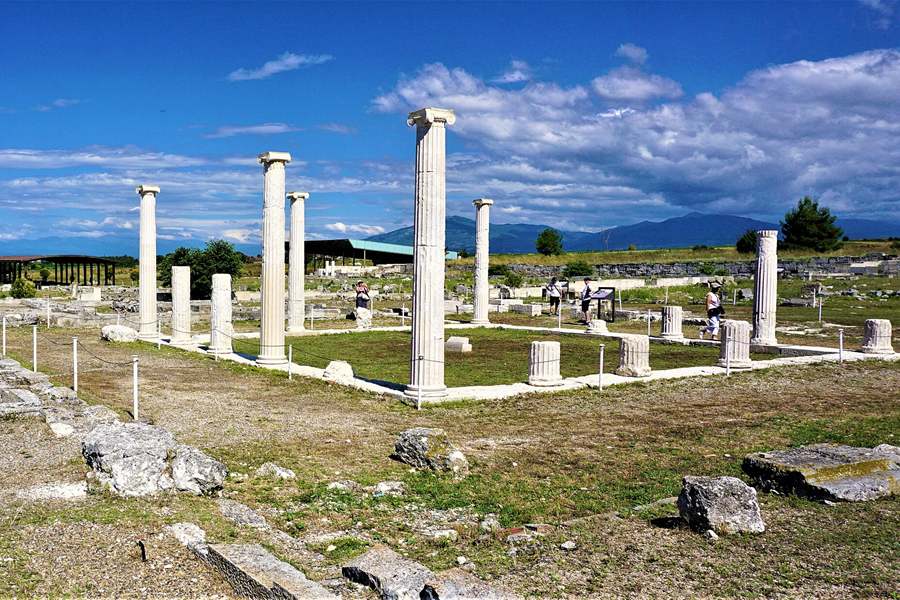
Alexander was born in 356 BC, the year his father’s racehorse won at the Olympic Games. After his father’s death, one stop for Alexander the Great in Greece was Thermopylae, a narrow coastal pass. There he became the recognised head of the Amphictyonic League. That league joined Greek peoples who lived close to one another.
Earlier on that march, Alexander met the Thessalian army holding the pass between Mount Olympus and Mount Ossa. He ordered his riders to cross over Mount Ossa instead. Further south, at Corinth, he took the title of Hegemon, a Greek word for leader. Like his father, he was also named commander for the coming war against Persia.
In 337 BC, Alexander the Great in Greece headed west, leaving Macedon with his mother, Olympias. He left her with her brother, King Alexander I of Epirus, at Dodona. Dodona was then the capital of the Molossians. The Molossians were an ancient Greek tribe living in Epirus, in the north-west.
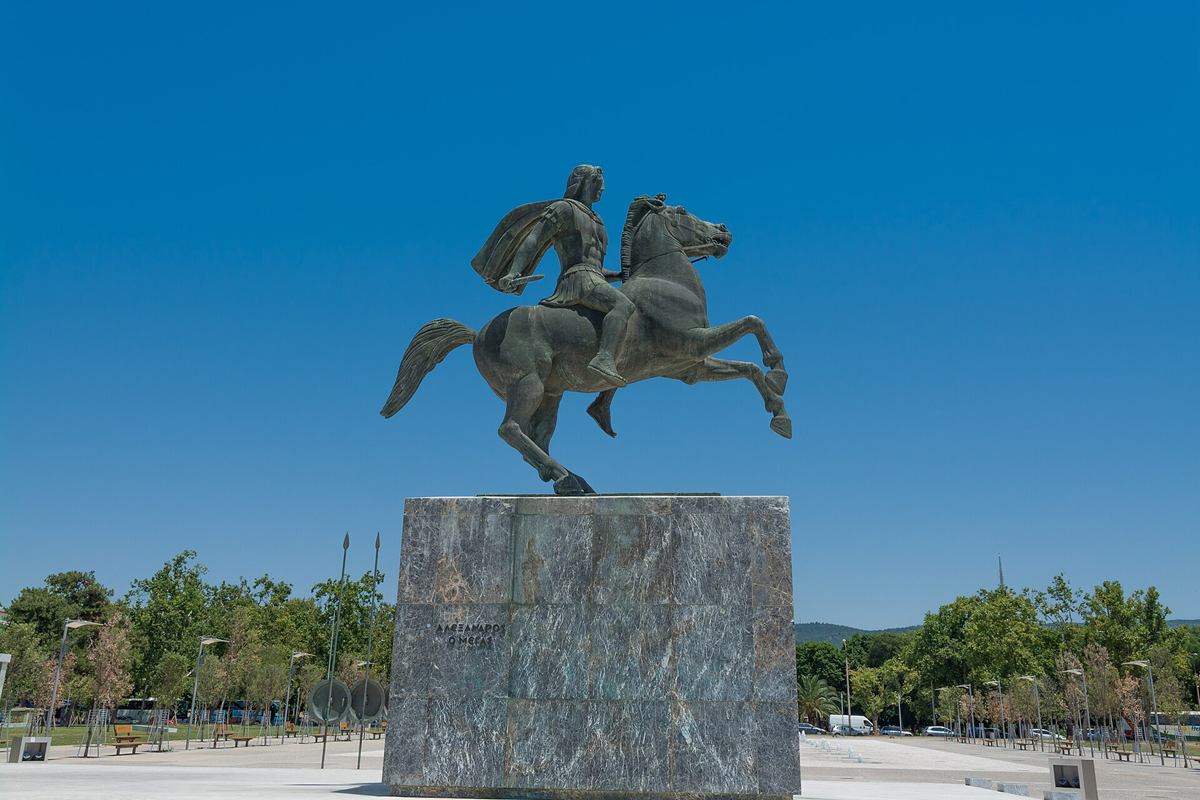
- Statue: Thessaloniki’s waterfront holds a horse-and-rider statue of Alexander, with his horse Bucephalus standing on two legs.
- Marathon: The Alexander the Great Marathon runs each year in mid-April from Pella to Thessaloniki.
- Amphipolis: His campaign against revolts in the north started from Amphipolis in 335 BC.
Legends of Alexander the Great in Greece and far beyond were gathered into the Alexander Romance. A romance, in this sense, is a long tale of heroic adventure. The work was translated into almost every European vernacular, meaning an everyday spoken language.
Why does the story of Alexander the Great in Greece open at Pella?
Alexander the Great in Greece begins at Pella, the royal capital of ancient Macedon where he was born. Its ruins sit 1 km from the present-day town of Pella. The modern town lies within Central Macedonia, a northern Greek region.
Walls already ringed Pella when Philip II, the father of Alexander, was king. Under Philip, Pella gained great weight in international affairs. Aristotle later became the tutor of Alexander the Great in Greece. He is thought to have spent time at Pella as a boy. There he formed his first links with the royal house.
The earliest sections of the palace go back to Philip II’s day, between 350 and 330 BC. Those dates fall within the life of Alexander the Great in Greece. The palace’s south front was a portico stretching no less than 153 metres. A portico is a roofed walkway lined with columns. It stood on a raised base 2 m high.
Excavators have also traced a palaestra and a bath house built while Cassander reigned. He ruled Macedon later. The agora, or market square, held the centre of Pella. It was laid out late in the 4th century BC, in that century’s last quarter. It spread over about 7 hectares, equal to ten blocks.
- Palaestra: A palaestra was an open court where wrestlers and other athletes trained.
- Tomb: In 2006 a Pella farmer came upon the biggest tomb yet discovered in Greece.
- Decline: Around AD 180, the writer Lucian described Pella as insignificant and thinly peopled.
In 338 BC, Philip came back to Pella and married Cleopatra Eurydice, niece of his general Attalus. At that point Alexander the Great in Greece was heir to the throne of Macedon. An heir is the person due to inherit a throne.
What do the royal tombs at Vergina reveal about Alexander the Great in Greece?
Alexander the Great in Greece leads to Vergina, home of ancient Aigai and the graves of Macedonian kings. Researchers have concluded that certain grave goods in Tomb II possibly belonged to Alexander. His half-brother Philip III had inherited much of his property.
Philip II, parent of Alexander the Great in Greece, had a funeral unmatched in Greek historic times. He lay on a richly made bed of gold and ivory. On his head rested his precious golden oak wreath. Like a new Hercules, he was then given to the pyre, a pile of burning wood.
Inside Tomb III, a fine silver hydria stood on a stone pedestal. A hydria is a Greek water jar with handles. This one held cremated bones, with a golden oak wreath placed on top. The walls carried a narrow frieze, a long decorated band, painted with a chariot race.
The wider cemetery of tumuli stretches for over 3 km. It holds over 500 grave mounds of great wealth. One tomb from around 340 BC is identified as that of Eurydice, mother of Philip II. She was the grandmother of Alexander the Great in Greece. Inside stands an imposing marble throne.
- Couch: A wooden couch in Tomb III shows Dionysos beside a flute-player and a satyr, a woodland spirit.
- Tomb IV: Found in 1980, Tomb IV had an impressive entrance with four plain Doric columns.
- Tumulus: This word names an earth mound raised over one or more graves.
The trail of Alexander the Great in Greece at Aigai includes one more grave, the Ionic Tomb. It carries the name of its excavator, Konstantinos Rhomaios, and held a marble throne. Its armrests rest on sphinxes, creatures with a lion’s body and a human head.
How did Alexander the Great in Greece learn at Mieza?
Alexander the Great in Greece studied at Mieza, a school in a green landscape rich in water. The philosopher Aristotle taught him there as a boy. The site lies at Isvoria, near the town of Naoussa in Central Macedonia.
When Alexander was 13, his father Philip began looking for a tutor. He considered scholars such as Isocrates and Speusippus. Speusippus offered to give up his charge of the Academy to take the post. The Academy was the school of Plato in Athens. In the end, Philip chose Aristotle to teach Alexander the Great in Greece.
In return for the lessons, Philip agreed to rebuild Stageira, the home town of Aristotle. Philip himself had razed, or flattened, that town earlier. He also agreed to free former citizens who had been enslaved and to pardon exiles. A number of pupils at Mieza became friends of Alexander and later his generals, known as the Companions.
Lessons for Alexander the Great in Greece are thought to have covered ethics and politics. He also read the plays of Euripides and the poems of Homer. Two lost works by Aristotle are On Kingship and On behalf of the Colonies. Scholars suggest he wrote both for the young prince.
- Iron Age: First used in the Iron Age, the site became a school after the mid-4th century BC.
- Gallery: Builders created a C-shaped covered gallery, which is a roofed walkway, at the school.
- Tutor: A tutor is a private teacher who instructs one pupil or a small group.
Around the age of 16, Alexander the Great in Greece returned to Pella from his studies at Mieza. His father Philip then appointed him regent of Macedon. A regent is a person who governs a kingdom while its king is away.
Which role did Dion play for Alexander the Great in Greece and his father?
Alexander the Great in Greece comes into focus at Dion, the Macedonian sanctuary of Zeus in Pieria. Philip II and his son Alexander both celebrated military victories at Dion. Pieria is the district below the slopes of Mount Olympus.
The poet Hesiod made Thyia, a daughter of Deucalion, the mother of two sons by Zeus. The sons were Magnes and Makedon, who gave their names to the Magnetes and the Makedones. In spring the army held purification rites at Dion, along with victory feasts. A purification rite is a ceremony that cleanses people before the gods.
Once Macedon and its neighbouring lands were secure, Philip celebrated his Olympic Games at Dion. The Latin name of the town is Dium. In Hellenistic times, the age after Alexander the Great in Greece, Dion was famous far and wide. People knew it for its strong walls and splendid monuments.
The Romans took Dion in 169 BC. A heyday is a time of great success and wealth. Dion enjoyed a second heyday in Roman times, under 2nd-century and 3rd-century AD emperors. Those emperors were fond of Alexander the Great in Greece, son of Philip II and king of Macedon.
- Bishopric: During the 4th century and the 5th century AD, Dion was the seat of a bishop.
- Surveys: Field surveys between 1928 and 1931 revealed an early Christian basilica, or church, and a Macedonian tomb.
- Sanctuary: This word means a holy precinct where people worshipped a god.
After the sanctuary was destroyed, its dedications were buried in pits. Among them were royal inscriptions and treaties of Macedon, the kingdom of Alexander the Great in Greece. These buried texts have been discovered recently. Dedications were gifts that worshippers presented to the gods.
What did Alexander the Great in Greece do at Chaeronea?
Alexander the Great in Greece fought at Chaeronea in Boeotia in 338 BC, aged 18. His father, Philip II, commanded the right wing of the Macedonian army. He placed his son in command of the left wing. Boeotia lies in central Greece, north-west of Athens.
The historian Diodorus put the Macedonian army at about 30,000 foot soldiers and 2,000 horsemen. Foot soldiers are called infantry, while horsemen are called cavalry. Diodorus tells that the young prince, keen to show his father his skill, broke through the opposing line. His companions fought beside Alexander the Great in Greece in that attack.
Historians Hammond and Cawkwell place Alexander the Great in Greece at the head of the Companion Cavalry. The Companions were the elite horsemen of Macedon. Yet no ancient account of the battle mentions cavalry at all. Gaebel and other scholars suggest that Alexander commanded part of the Macedonian phalanx instead.
After the victory, Philip formed the League of Corinth. It made every member state an ally of Macedon and of the others. A league is a formal union of states with shared aims. Philip set up this alliance of Greek city-states at Corinth, but Sparta stayed outside it.
- Peace: League members agreed never to wage war on each other, except to put down revolution.
- Wing: A wing is one end of an army’s battle line, either the left or the right.
- Phalanx: A phalanx was a dense block of foot soldiers armed with long spears.
Before the battle, in 338 BC, Philip joined his son, and together they marched south through Thermopylae. That march brought Alexander the Great in Greece into Boeotia, where the opposing armies met near Chaeronea. Thermopylae lies between steep mountains and the sea.
Who was Philip II to Alexander the Great in Greece, as father and king?
Alexander the Great in Greece was the son of Philip II, who ruled the ancient kingdom of Macedon. Philip himself was the youngest son of King Amyntas III and Eurydice of Lynkestis. Lynkestis was a small kingdom in Upper Macedonia.
Philip was held in Thebes from around 368 to 365 BC. Thebes was then the leading city of Greece. There the general Epaminondas trained him in warfare and diplomacy. Diplomacy is the skill of handling relations between states. All this came before the birth of Alexander the Great in Greece.
His brother, King Perdiccas III, had named Philip regent for the infant heir. Philip instead took the kingdom for himself. As king, he made notable changes to the Macedonian army and its training. Soldiers under Philip gained the chance of promotion through the ranks. Exceptional service also brought rewards and bonus wages.
Philip was also made archon, or leader, of the Thessalian League. That league joined the cities of Thessaly, the wide plain south of Mount Olympus. The kings of Macedon practised polygamy, taking more than one wife at a time. Olympias, mother of Alexander the Great in Greece, was one of those royal wives.
- Exiles: From around 352 BC, Philip sheltered Persian exiles who opposed King Artaxerxes III.
- Perinthus: During the campaign against Perinthus, Alexander is reported to have saved his father’s life.
- Thebes: Thebes is an ancient city of Boeotia, north-west of Athens.
In 336 BC, Philip entered the town theatre at Aigai without protection, to appear approachable to Greek diplomats. Diplomats are officials sent to deal with other states. He was killed there. His death left the throne of Macedon to Alexander the Great in Greece.
How does Alexander the Great in Greece connect to his mother, Olympias?
Alexander the Great in Greece had a mother from Epirus, the princess Olympias. She was born around 375 BC into the royal family of the Molossian people. Passaron, in today’s region of Epirus, is thought to be her birthplace.
Her family, the Aeacidae, claimed descent from Neoptolemus, the son of the hero Achilles. They took their name from Aeacus, a mythical king of the island of Aegina. Aegina sits in the Saronic Gulf, not far from Athens. Through this line, Alexander the Great in Greece was linked by descent to Achilles.
Plutarch, an ancient Greek writer, says Olympias was first named Polyxena. She took the name Myrtale before her marriage to Philip, on entering a mystery cult. A mystery cult was a secret religious group whose rites were open to members alone. The name Olympias was the third of the four names she bore.
During her son’s conquests, Olympias was recognised as the de facto leader of Macedon. In 330 BC she returned to Epirus, home of the Molossian kin of Alexander the Great in Greece. There she acted as regent for her cousin Aeacides. Her brother, Alexander I, king of Epirus, had died on a campaign in southern Italy.
- Stratonice: Her fourth and final name was Stratonice, linked to her victory over Eurydice in 317 BC.
- De facto: De facto is a Latin phrase meaning in practice, even without a legal title.
- Epirus: Epirus is the mountainous region of north-western Greece, beside the Ionian Sea.
Pydna was a fortress town of ancient Macedon where Olympias came under siege. A siege is the blockade of a town by an army. After Pydna fell, the troops declined to hurt the mother of Alexander the Great in Greece.
What ties Alexander the Great in Greece to his half-sister, Thessalonike?
Alexander the Great in Greece had a younger half-sister, Thessalonike, whose name lives on in Thessaloniki. Thessaloniki is thought to be the first city named after a Macedonian woman. Her father was Philip II, and her mother came from Thessaly.
Her birth is said to have matched the day Macedon won the battle of Crocus Field. That battle took place in Thessaly, against the Phocians of central Greece. Philip is said to have ordered that she be called victory in Thessaly. Her name joins Thessaly with nike, the Greek word for victory.
Stephanus of Byzantium, a Greek author, writes that Philip handed the newborn girl to a woman called Nice. Nice was given the task of raising the infant princess. As an adult, the half-sister of Alexander the Great in Greece became queen of Macedon. She had three sons, called Philip, Antipater and Alexander.
A popular Greek legend links Thessalonike, sister of Alexander the Great in Greece, with the sea. In certain versions, Alexander washed her hair with water that made her immortal. Immortal means never dying. After his death, she became a mermaid, a sea creature that is half woman and half fish.
- Question: In the legend, the mermaid asks every passing crew whether King Alexander is alive.
- Answer: The right reply says that he lives, reigns and conquers the world.
- Gorgon: Any other answer turns her into a raging Gorgon, a monster of Greek myth.
In 315 BC, Thessalonike took shelter inside the fortress of Pydna as Cassander’s army advanced. With her were Olympias and Roxana, the widow of Alexander the Great in Greece. The boy king Alexander IV, son of Roxana and Alexander, was also inside the fortress.
Which monument honours Alexander the Great in Greece and his family at Olympia?
Alexander the Great in Greece is honoured at Olympia by the Philippeion, a round family monument. It stands in the Altis, the sacred precinct of Olympia. Work began under Philip II and ended under Alexander after his father’s death in 336 BC.
Inside stood statues of the royal family made of ivory and gold. This technique is called chryselephantine, meaning made of gold and ivory. The figures showed Philip, Alexander and Olympias, along with Philip’s parents, Amyntas III and Eurydice I. The monument thus held three generations of the royal house of Alexander the Great in Greece.
The Philippeion was a tholos, a round building with a ring of columns. Its outer colonnade held 18 columns of the Ionic order. The Ionic order is a column style with scroll-shaped tops. The whole building measured 15 metres across. A colonnade means a line of columns carrying a roof.
Alexander himself commissioned the gold and ivory statues for the building. These were the only statues of humans at the site. Their materials matched those of the nearby statue of Zeus, king of the gods. The figure of Alexander the Great in Greece was therefore made of the same materials as that statue.
- Inner columns: Inside, nine engaged columns of the leaf-topped Corinthian order stood partly built into the wall.
- Today: None of the statues survive, and only part of the building still stands.
- Commission: To commission a work of art is to order it from an artist and pay for it.
The statues aimed at the deification of the Macedonian royal family. Deification means treating people as gods. The Philippeion itself then served as a place of worship. Its cult honoured the whole family of Alexander the Great in Greece.
What do travellers ask about Alexander the Great in Greece, and what are the answers?
Alexander the Great in Greece links to a giant marble lion that stands near Amphipolis. His son was Alexander IV, and his horse was Bucephalus. Cassander was a later king of Macedon. Amphipolis is an ancient city of Macedon beside the River Strymon.
Which general does the lion of Alexander the Great in Greece honour at Amphipolis?
Archaeologists Oscar Broneer and Dimitris Lazaridis linked the Lion of Amphipolis with Laomedon of Mytilene. Laomedon was an important general of Alexander. Greek soldiers found the first pieces during the First Balkan War of 1912-13, while draining the Strymonas riverbed. With its base, the seated lion rises more than 8 m.
What became of Alexander IV, the boy heir of Alexander the Great in Greece?
Alexander IV, sometimes called Aegus, was the son of Alexander and his wife Roxana. He was born after his father’s death. From 316 BC, the boy and his mother were held in the fortress of Amphipolis. Glaucias watched over them. A peace treaty of 311 BC recognised his right to rule when grown.
Which king followed Alexander the Great in Greece and restored Thebes?
Cassander governed Macedonia from 317 to 297 BC. He focused on stronger northern borders and economic growth. He also oversaw the burial of Philip III and his wife Eurydice at the royal cemetery of Aigai. People then saw his rebuilding of Thebes, destroyed by Alexander, as a snub to the dead king.
Which horse appears with Alexander the Great in Greece on his statues?
The horse was Bucephalus. Descriptions give him a black coat and a big white star on the forehead. Plutarch says that a horse dealer, Philonicus the Thessalian, offered him to King Philip II. In Pella, a statue in Alexander the Great Square shows Alexander riding Bucephalus.
Featured photo: Nikolai Karaneschev, CC BY 3.0, via Wikimedia Commons.