
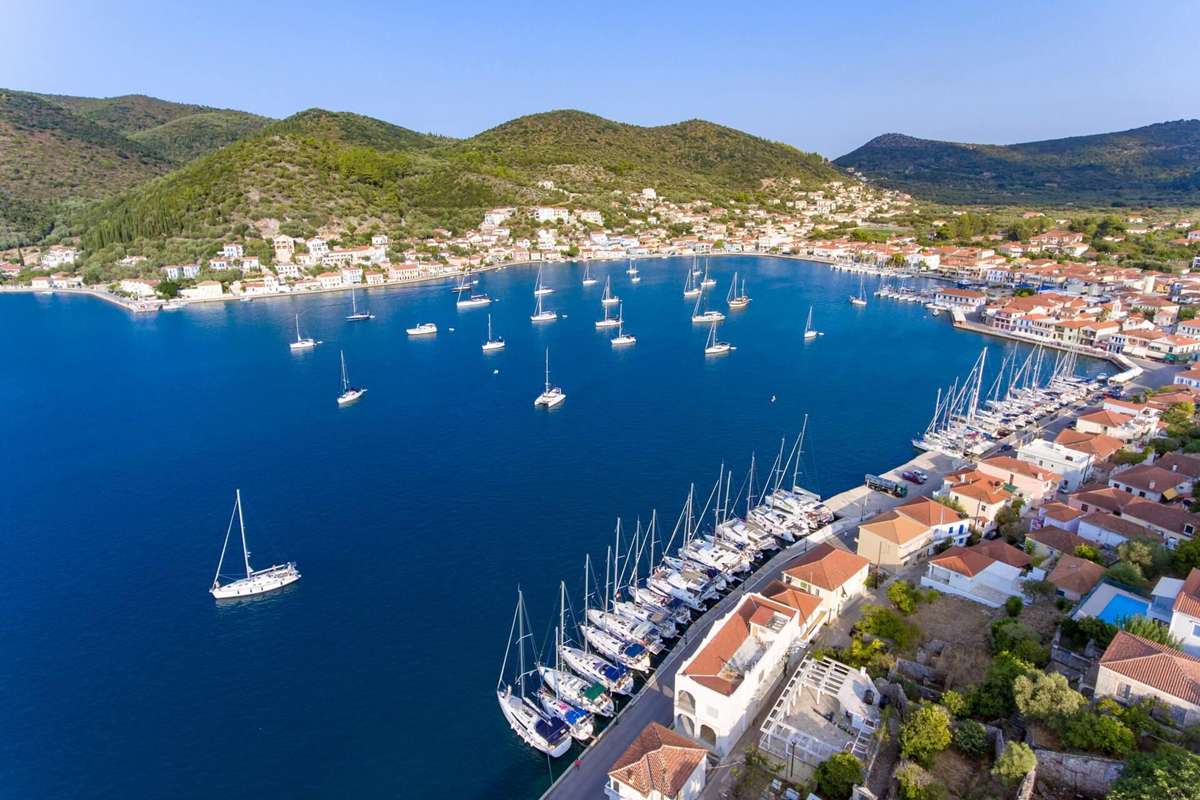
Odyssey locations are the real and proposed sites behind Homer’s Odyssey, the ancient Greek poem about Odysseus. Trips with a host on this theme take place across the Ionian Islands, Epirus and the Peloponnese. Topics here run from Homer’s Ithaca, Scheria and Nestor’s Pylos to the Menelaion near Sparta. Lefkada, Paliki and the Necromanteion of Acheron follow, with the people and finds of the poem. Related pages cover Greek mythology places, Greek mythology tours and Greek islands with ancient ruins. More trips sit under Greece tours.
Bookings made through the GetYourGuide widgets on this page earn Classical Greece Tours a commission, at no extra cost to the traveller.
What are the Odyssey locations?
The Odyssey locations are the places named in Homer’s ancient verse tale of the hero Odysseus. The main story unfolds in the Peloponnese and in the Ionian Islands, home of Ithaca and its neighbours. The Peloponnese forms the broad southern peninsula of mainland Greece.
Beyond these core regions, the poem names Troy, Phoenicia, Egypt and Crete only in passing. Phoenicia was an ancient land of traders on the eastern Mediterranean coast. Later readers matched Odyssey locations from the voyage with sites in Greece, Italy, Tunisia and Malta. Others looked further west, to the Iberian peninsula, the land of modern Spain and Portugal.
Scholars, ancient and modern, still disagree on whether any stop on his voyage was real. This doubt covers the Odyssey locations after Ismaros and before his return to Ithaca. Eratosthenes, a Greek geographer of the late 3rd century BC, doubted the search. He said the wanderings appear once someone finds the cobbler who sewed the bag of winds.
Odysseus tells of his wanderings at the court of the Phaeacians, a seafaring people of the poem. This tale is known as the Apologoi, a Greek word for tales or accounts. It runs through books 9 to 12 of the epic. In an epic, a poet recounts great deeds of heroes at length.
- Changing coasts: Silting, the build-up of mud and sand, and erosion over thousands of years can reshape coastlines.
- Poetry first: The Greek scholar Ioannis Kakridis held that the Odyssey is poetry, not a travel log.
- Last firm point: W. B. Stanford called the storms off Cape Malea the last clearly identifiable places of the voyage.
In his tale, Odysseus names peoples and places that he visits or claims to have visited. No ancient source apart from the poem records these Odyssey locations as history. No such source records them as news of its own day either.
How do scholars place Homer’s Ithaca among the Odyssey locations?
The Odyssey locations include Ithaca, the island home of Odysseus in Greek myth. The exact place of Homer’s Ithaca, as the epic describes it, remains a subject of debate. Ithaki is the Greek name of the modern Ionian island known as Ithaca in English.
Theories on the site of Homer’s Ithaca go back to the 2nd century BC. Eratosthenes, a scholar who lived from 276 to 194 BC, rejected the island outright. In his view, as Strabo records it, Homer simply invented Ithaca. Strabo was a Greek geographer whose writings preserve the views of earlier scholars like Eratosthenes.
Among the Odyssey locations, Ithaca gets a short portrait from Odysseus himself. He calls it low-lying and places it farthest out to sea, in the direction of the sunset. Low-lying means flat and close to the level of the sea. He also names Doulichion, Same and wooded Zacynthos as islands lying close by.
Strabo himself gave two different answers on this question. At Geography 8.3.26 he seems to place Homer’s Ithaca on Ithaki. At 10.2.12 he seems to set it on Lefkada instead. Geography is the title of his long survey of the known world. Lefkada is another island of the Ionian Sea.
- Tradition defended: Lord Rennell of Rodd argued in 1927 that Homer’s Ithaca lay on Ithaki.
- Paxos claim: Another writer, Athenagoras, argued that Paxos, an Ionian island, was the Ithaca of Homer.
- Wide search: Jonathan Brown tested rival Odyssey locations in Corfu, Kefalonia, Spain, Sicily, Denmark and the Azores, then backed Ithaki.
Writing in 1998, the scholar J. V. Luce also set Homer’s Ithaca on Ithaki. Luce lived from 1920 to 2011. His case keeps Ithaki among the Odyssey locations of the Ionian Sea. That sea lies between western Greece and southern Italy, as part of the Mediterranean.
Why is Scheria counted among the Odyssey locations?
The Odyssey locations include Scheria, a land also known as Phaeacia. The earliest mention of it comes in Homer’s Odyssey, as the land of the Phaeacians. The name Phaeacia simply means the country of that people. Their king in the poem is Alcinous.
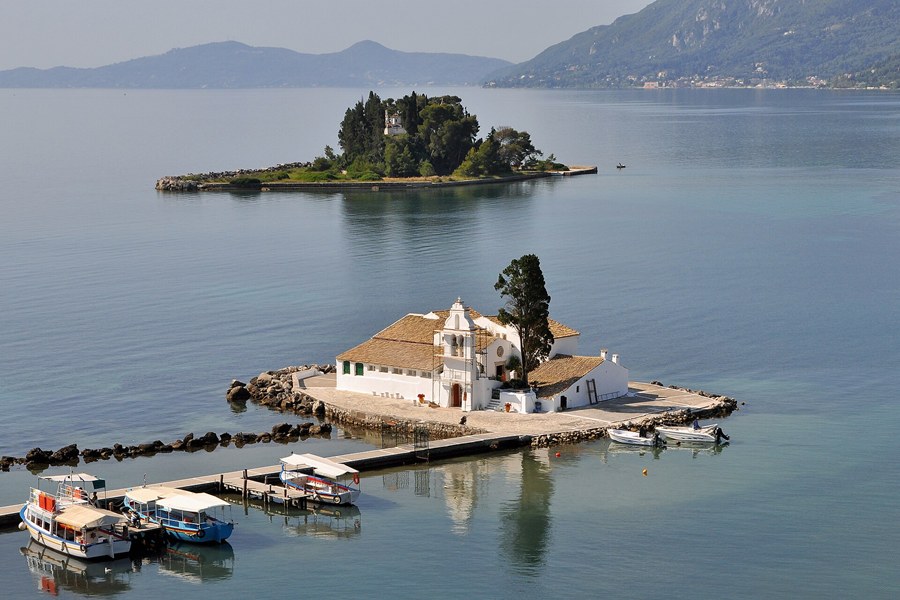
Ancient scholars tied Scheria to Corfu, known in antiquity as Corcyra. Callimachus, a poet and scholar of Alexandria, made this link. His student Apollonius of Rhodes repeated it in his epic about the Argonauts. The Argonauts sailed with Jason on the ship Argo. The Greek name of the Phaeacians comes from phaiós, meaning grey.
Other readers doubt Corfu’s place among the Odyssey locations. In the poem, Odysseus rules the majority of the Ionian Islands. If Scheria were Corfu, its people ought to know him, not call him a stranger. Other scholars link the seafaring and relaxed life of the Phaeacians with Minoan Crete. Minoan Crete was the Bronze Age civilisation of Crete.
Strabo, a Greek geographer, gave a far western answer. He placed two Odyssey locations, Scheria and Ogygia, far out in the Atlantic Ocean. Ogygia is the island where Odysseus builds a raft before he sails to Scheria. The Atlantic lies west of the Strait of Gibraltar, outside the Mediterranean Sea.
- Bronze walls: Homer gives the palace of Alcinous bronze walls that shine like the sun and golden gates.
- Metal dogs: Two dogs of silver and gold, made by the smith god Hephaestus, stand beside the front doors.
- Year-round fruit: Apple, pear and pomegranate trees grow in the palace garden in every season of the year.
Scheria, one of the Odyssey locations, ranks among the earliest descriptions of a utopia. A utopia is an imagined land where people live in an ideal order. The word is built from two Greek roots that together mean no place.
Which Pylos belongs on the list of Odyssey locations?
The Odyssey locations include Pylos, home of King Nestor, yet ancient Greece had more than one Pylos. In antiquity, towns of that name stood in Elis, Triphylia and Messenia. Each town claimed to be the home of Nestor. All three are regions of the Peloponnese.
Strabo, citing older writers, argued that Homer meant the Pylos of Triphylia. Triphylia was a district on the western shore of the Peloponnese. Modern scholars place Nestor’s Pylos, one of the mainland Odyssey locations, in Messenia instead. Messenia is the south-western region of the Peloponnese, where the modern town of Pylos stands.
Homer calls Nestor’s realm sandy Pylos in the Iliad and again in the Odyssey. The Iliad is Homer’s poem about the siege of Troy. Nestor was the son of Neleus and Chloris. Myth makes him the legendary king of Pylos. A realm means a kingdom, the territory under one ruler.
Behind these Odyssey locations stood the Mycenaean state of Pylos, which lasted from 1600 to 1200 BC. It covered an area of 2,000 square kilometres. Mycenaean names the Greek civilisation of the late Bronze Age, after the citadel of Mycenae. In the Bronze Age, people shaped tools and weapons from bronze, an alloy of copper with tin.
- Wise elder: Homer presents Nestor as the eldest and wisest hero of the Trojan War.
- Unfound city: Among the Odyssey locations, the urban centre of ancient Pylos is still only partly identified.
- Revived name: In 1833 a royal decree of King Otto gave the new town of Navarino the name Pylos.
The port and acropolis of Nestor’s Pylos are thought to have stood on the Koryphasion promontory. This headland lies 4 km north of the modern town. An acropolis is a walled citadel on high ground above a Greek city. No remains of either have been found there.
What does the Menelaion near Sparta add to the Odyssey locations?
The Odyssey locations on the Greek mainland include Sparta, where King Menelaus rules, and the nearby Menelaion. Telemachus, the son of Odysseus, travels there by way of Pylos. Scholars find that this mainland journey no longer poses any real puzzle of geography.
Book 4 of the Odyssey tells of the voyage of Menelaus home from Troy. It also pictures his home life in Sparta, another of the Odyssey locations. In Greek myth, Menelaus is the husband of Helen and brother of Agamemnon. Troy was the walled city whose siege forms the Trojan War story.
Menelaus tells how he and his men caught Proteus and made him reveal the way home. Proteus is a sea god of Greek myth with the gift of prophecy. Prophecy means telling what lies ahead before it happens. Homer counts him among the figures he calls the Old Man of the Sea.
Among the Odyssey locations, Pellana, north-west of Sparta, holds a supposed palace of Menelaus and Helen. Excavations there began in 1926 and went on until 1995. Other archaeologists doubt this claim. They argue that Pellana lies too far from other Mycenaean centres to be the capital of Menelaus. Mycenaean centres were the palace towns of Bronze Age Greece.
- No death: The Odyssey says Menelaus will not die but will pass to Elysium, a paradise for heroes.
- Early palaces: Hector Catling saw the Menelaion buildings as forerunners of the large palaces at Pylos, Mycenae and Tiryns.
- Stone gift: A stele, or inscribed stone slab, of the early 5th century BC records a gift to Menelaus.
The first systematic excavation of the Menelaion came in 1909, under the British School at Athens. The British School is a British research body for archaeology in Greece. Systematic means planned and recorded with care. Among the Odyssey locations, the Menelaion takes its name from Menelaus himself.
Why did Wilhelm Dörpfeld count Lefkada among the Odyssey locations?
The Odyssey locations in the theory of Wilhelm Dörpfeld, a German archaeologist, centre on Lefkada. After digs at a number of sites on Ithaca and Lefkada, he named Lefkada as Homer’s Ithaca. He set out this view in print in 1927.
His book bore the German title Alt-Ithaka, which means Ancient Ithaca. Its subtitle calls the work a contribution to the Homer question. The Homer question is the long debate over who composed the Homeric poems and how. Tradition already set Lefkada within the Odyssey locations, as a land ruled by Odysseus from Ithaca.
In ancient times, a narrow strip of land joined Lefkada to the mainland. That link made it a peninsula, with sea on every side but one. The Corinthians cut through the strip in the 7th century BCE. Corinth was a powerful city-state that guarded the land route into the Peloponnese.
The Odyssey twice repeats a jest about reaching Ithaca: no newcomer came there on foot. For his Odyssey locations, Dörpfeld is thought to have read this line as a hint at Lefkada’s causeway. The jest appears at Odyssey 14.190 and 16.224. A causeway carries a road on a raised bank across water or marsh.
- Silted channel: Modern geographers see today’s causeway as a recent result of silt, or fine mud, filling the channel.
- Tourism reading: Local tourism officials cite a passage that calls Ithaca reachable on foot, as Lefkada was.
- Romantic quest: Later accounts call his drive to prove that the Odyssey used real places rather romantic.
Dörpfeld secured funding for work on Lefkada by presenting the island as Homer’s Ithaca. Funding is money set aside for research or digging. That claim added Lefkada to the proposed Odyssey locations. Lefkada lies off the western Greek mainland, in the Ionian Sea.
Where does Paliki on Kefalonia stand in the Odyssey locations debate?
The Odyssey locations on Kefalonia include Paliki in one modern theory about Homer’s Ithaca. It holds that Paliki was cut off as an island in the era of the Trojan War. In this view, Paliki, not modern Ithaki, is the island that Homer calls Ithaca.
The theory comes from Odysseus Unbound, a 2005 book by Robert Bittlestone. James Diggle, a philologist, and John Underhill, a geologist, wrote its appendices. Philologists study old texts, and geologists study rocks and landforms. Paliki itself is a peninsula joined to the rest of Kefalonia at its north-east end.
In 1903 the writer G. Volterras added Paliki to the Odyssey locations as Homer’s Ithaca. He thought Paliki was once an island, cut off by a sea channel at its isthmus. This lost waterway is known as Strabo’s channel, after the ancient geographer. An isthmus is a slim bridge of land with water to either side.
The Bittlestone team later recanted its own claim about Strabo’s channel. To recant is to withdraw a claim in public. The wider Paliki case has not won broad acceptance among scholars of Odyssey locations. Critics point to geology, archaeology and philology, along with historical and Homeric study. Archaeology examines buried remains and old sites.
- Palace site: Nicolas Livadas places the palace of Odysseus on Paliki, near the village of Livadi.
- Warm review: The scholar Mary Beard gave Bittlestone “a very fair chance indeed” of being right.
- Open question: G. L. Huxley says Paliki as a former island still does not prove it was Ithaca.
Among the Odyssey locations, the writer Gilles Le Noan also chose Paliki for Homer’s Ithaca. He wrote on the question between 1989 and 2005. Yet he discounted the geology that supports the idea of Strabo’s channel. To discount an idea is to give it little weight.
Is the Necromanteion of Acheron one of the Odyssey locations?
The Odyssey locations proposed for north-western Greece include the Necromanteion by the river Acheron. Pausanias, a Greek geographer of the 2nd century AD, linked the nekyia with this river. The nekyia is the scene in which Odysseus calls up the spirits of the dead.
The shrine served necromancy and honoured Hades and his queen Persephone. Necromancy means calling on the dead for knowledge of hidden things. In myth, Hades was lord of the dead beneath the earth. Among Odyssey locations, tradition sets the temple beside the Acheron in Epirus, near ancient Ephyra. Epirus is the mountainous north-west of Greece.
The site stands where three rivers meet: the Acheron, the Pyriphlegethon and the Cocytus. Ancient belief held that these rivers flowed through the kingdom of Hades. Scholars read their names as joyless, burning coals and lament. A lament is a mournful song or cry for the dead. Joyless means without any happiness at all.
The archaeologist Sotirios Dakaris found evidence of offerings to the dead at the site. These matched the sacrifices that Homer describes Odysseus making at one of the Odyssey locations. In a sacrifice, worshippers kill an animal or give food as a gift to gods or spirits. Archaeologists dig carefully to recover the traces of ancient lives.
- Question for the dead: Herodotus says Periander, a ruler of Corinth, sent messengers to pose questions to his late wife, Melissa.
- Sailor’s view: Tim Severin set later Odyssey locations along the coast of north-west Greece, close to the Acheron.
- Doubtful hill: The site’s commanding hilltop position does not fit the idea of a shrine of the dead.
Digs at the hill ran from 1958 to 1964 and again from 1976 to 1977. Dakaris named the ruins the Necromanteion because of their place on the map. He also pointed to their likeness to accounts written by Herodotus and Homer.
How does Penelope join Sparta and Ithaca among the Odyssey locations?
Odyssey locations around Penelope begin in Sparta, the home of her father, King Icarius. In Homer’s poem she becomes the legendary wife of Odysseus and the queen of Ithaca. Penelope is also the mother of their son, Telemachus.
Folk etymology links her name to the Greek words pene, meaning weft, and ops, meaning face. Folk etymology is the way ordinary speakers explain where a word comes from. Weft is the thread that a weaver passes across a loom. A loom is a wooden frame on which cloth is woven by hand.
One myth says her parents threw her into the sea as a child. Birds called penelopes then carried her back to the shore. Among Odyssey locations, Lacedaemon later hosted a foot-race that Icarius set, with her marriage as the prize. Lacedaemon is an ancient name for the land of Sparta.
That race course, another of the Odyssey locations in Lacedaemon, later took the name Aphetaid Road. Odysseus won and raised three sanctuaries to Athena near that road. Each sanctuary was a plot of land given over to worshipping Athena. Asked to choose between husband and father, Penelope drew her veil across her face.
- Statue: Icarius set up a statue of Aidos, or Modesty, where she had veiled herself.
- Aidos: In Greek, aidos is the word for modesty, a quiet and respectful manner.
- Painter: One ancient vase painter is known today as the Penelope Painter, after his scenes of her.
On Ithaca, among the Odyssey locations, Penelope claimed to weave a shroud, or burial cloth, for Laertes. When it was done, she promised to choose a suitor, a man seeking her hand. For three years, she undid part of the cloth each night.
What part does Nausicaa play in the Odyssey locations of Scheria?
Odyssey locations in Phaeacia take in the home of Nausicaa, daughter of King Alcinous and Queen Arete. Homer makes her a character of the Odyssey. Her name means burner of ships, from the Greek words naus, ship, and kao, to burn.
In Book Six, Odysseus is shipwrecked on Scheria, one of the Odyssey locations, called Phaeacia in certain translations. To be shipwrecked is to lose a ship at sea and wash ashore. Nausicaa and her maids go down to the seashore to wash clothes. Their games wake Odysseus, who steps out of the forest and frightens the servants.
On this shore, another of the Odyssey locations, she gives Odysseus clothes to wear. She then takes him as far as the edge of the town. Keeping his arrival secret, she goes ahead into the town alone. Odysseus tells her that she resembles Artemis, a goddess of Greek myth.
Homer tells of a love that is never spoken, among the earliest cases of unrequited love in literature. Unrequited love is love that the other person does not return. Her father even says he is willing to let Odysseus marry her. She asks him never to forget her, since she gave him life.
- Ball-dance: Agallis credits Nausicaa with inventing the ball-dance of ancient Greece.
- Marriage: Aristotle and Dictys of Crete say that she later married Telemachus, son of Odysseus.
- Silence: Of all the women he met, Odysseus never tells Penelope about Nausicaa.
Among the Odyssey locations, the court of King Alcinous hears Odysseus tell of his long wanderings. This telling forms a frame story for a large part of the poem. A frame story is a tale inside which other tales are told.
Which Odyssey locations did Telemachus reach in search of his father?
Odyssey locations in the opening books follow Telemachus, son of Odysseus and Penelope. He is a central figure of the poem. Once he reached manhood, he set out for Pylos and Sparta. In both places he sought news of his wandering father.
His journeys to Odyssey locations fill the first four books, which are traditionally called the Telemachy. This title marks those books as the tale of Telemachus. His name means far from battle, or else fighting from afar, like an archer. An archer is a fighter who shoots arrows from a bow.
At the outset, Odysseus had been absent from Ithaca for twenty years. The goddess Athena gives Telemachus instructions and goes with him throughout the quest. At Pylos, one of the Odyssey locations, old Nestor gives him a warm welcome. The old man then recounts the glory of his father.
Nestor’s son Peisistratus then travels with him to the halls of King Menelaus and his wife, Helen. There the royal pair tell stories of Odysseus at Troy that agree in part yet contradict each other. From Menelaus, he learns that Odysseus was last reported stuck on the island of Ogygia. Contradict means to disagree.
- Clusium: Servius names Telemachus as the founder of Clusium, a town in Etruria.
- Oracle: In one ancient text, the Delphic Oracle names Ithaca as Homer’s home and Telemachus as his father.
- Bow: Telemachus is first to try the bow and nearly strings it on his fourth attempt.
On his return to the Odyssey locations of Ithaca, Telemachus goes to see the swineherd Eumaeus. A swineherd is a keeper of pigs. There Eumaeus is hosting Odysseus, who is in disguise. Father and son then plan the downfall of the suitors together.
Why is the Palace of Nestor counted among the Odyssey locations?
Odyssey locations include the Palace of Nestor, a major centre during the Mycenaean age. Tradition links the ruins to Nestor, the king who rules sandy Pylos in Homer’s poems. Mycenaean describes the early Greek world named after the city of Mycenae.
This site among the Odyssey locations holds the best preserved palace of Mycenaean Greece yet found. It rose to two floors, with store rooms, workshops, baths and rooms for receiving visitors. The plan also had light wells and a system of drains for sewage. A light well is a roofless shaft that brings daylight indoors.
The settlement was occupied for a long time, and its artefacts date mainly from 1300 BC. Artefacts are things that people shaped and used long ago. The ruins sit on the hill of Epano Englianos, 4 kilometres south of Chora. The site rises to 150 metres above the sea, over an area of 170 by 90 metres.
From the first day in 1939, the team found stone walls, fresco pieces, pottery and inscribed tablets. Frescoes are wall paintings done on fresh, damp plaster. Among Odyssey locations, this dig gave up around 1,000 Linear B clay tablets in 1939. Linear B is an ancient script, a system of written signs.
- Vaults: Before the war, the tablets went into bank vaults for safety and stayed there until 1950.
- Repair: The tablets were cleaned and repaired in Athens between late 1939 and early 1940.
- Eritha: Records from the palace tell of a land dispute involving Eritha, a priestess of Pylos.
Translated later, the tablets show this palace among the Odyssey locations as the centre of Mycenaean Messenia. North of the Bay of Navarino, two tholos tombs were dug in 1912 and 1926. The word tholos describes a circular stone grave capped by a dome.
Where do the Odyssey locations meet Polyphemus and his cave?
Odyssey locations include the island of the Cyclopes, home of Polyphemus. This giant with a single eye is a son of Poseidon and Thoosa. Homer first shows him as a savage giant who eats men, in the ninth book of the poem.
His name can mean very famous, or abounding in songs and legends. To abound means to be full of something. Among Odyssey locations, Odysseus and part of his crew enter a cave full of stored food. Polyphemus returns with his flocks and seals the mouth of the cave with a huge stone.
Within this cave, one of the Odyssey locations of Book Nine, Odysseus offers the giant strong, undiluted wine. Undiluted wine is wine with no water mixed in. The drunken giant falls asleep, and the men drive a glowing stake into his eye. Next morning, the men tie themselves beneath the sheep and slip out.
Euripides wrote a comic satyr play on this episode, called Cyclops. A satyr is a half-human woodland spirit of Greek myth. In it, Polyphemus keeps Silenus and his sons as slaves on Mount Etna in Sicily. The blinding and the escape are the only two Odyssey scenes on surviving seventh-century BC vases.
- Stamp: A 1983 stamp of 27 drachmas, the old Greek money, shows the hero under a sheep.
- Versions: More than two hundred versions of the tale exist, from around twenty five nations.
- Origins: Current scholars agree that these Polyphemus legends keep traditions older than Homer.
As Odysseus sails away from these Odyssey locations, he proudly shouts his real name to the giant. Hubris means pride that goes too far. Polyphemus then prays to his father, Poseidon, for revenge. He hurls huge rocks after the ship, which only just escapes them.
Which island among the Odyssey locations belongs to the nymph Calypso?
Odyssey locations include Ogygia, the island home of the nymph Calypso. In Greek legend, nymphs are minor female spirits tied to nature. In Homer’s poem, she promised Odysseus immortality if he stayed with her. Immortality means living forever, free from death.
The name Calypso grows out of kalypto, a Greek verb for covering or hiding. So the name translates as she who conceals. To conceal is to keep something out of sight. Calypso is commonly called a daughter of the Titan Atlas. A Titan was one of the elder gods of Greek myth.
Among Odyssey locations, a fragment of the Catalogue of Women ties Calypso to the Cephalonians. It says she bore that people to Hermes, who visits her island in the poem. The Catalogue of Women is a Greek poem once wrongly credited to Hesiod. A fragment here means a small surviving part of a damaged or lost work.
On Ogygia, among the Odyssey locations, Calypso sings as she weaves with a golden shuttle. A shuttle is the tool that carries thread across a loom. By day, Odysseus sits on a headland or on the shore and weeps. Zeus at last sends Hermes with an order to free him.
- Tools: For a boat, she supplies an adze, a curved wood-shaping blade, plus a drill and an axe.
- Supplies: She also gives him wine, bread and clothing for the voyage home.
- Children: Homer mentions no children by Calypso anywhere in his account of her island.
Her story among the Odyssey locations closely resembles a scene in the Epic of Gilgamesh. In that poem, a woman named Siduri meets the hero Gilgamesh. In both tales, a lone woman gives the hero drink and sends him over the sea.
Who was Sylvia Benton, and what did she dig up at Odyssey locations on Ithaca?
Odyssey locations on Ithaca connect with Sylvia Benton, a British classical archaeologist who dug on the island. Her fame rests on her studies of ancient Greece. An archaeologist studies the past through old objects and remains dug from the earth.
From 1907 to 1910, she studied Classics at Girton College, Cambridge. Classics is the study of ancient Greek and Roman language and writing. While she taught in schools, she grew interested in classical archaeology and in Homer. In 1934, she earned a degree with a dissertation, or long study, titled the Barony of Odysseus.
The British School at Athens once refused her a term for climbing the Taygetus mountains alone against orders. Among Odyssey locations, she worked on Ithaca under Walter Heurtley from 1930 to 1932 and in 1934. After he retired, she dug on her own at Tris Langades in North Ithaca from 1937 to 1938.
In one Ithaca cave among the Odyssey locations, work began underwater, as the sea covered its floor. She saw that the site was stratified, so the team brought in pumps. Stratified means built up in layers laid down over time. Finds showed steady use from the Mycenaean era, through the Dark Age, into late classical times.
- Earthquake: After the 1953 earthquake, she dived from a ship’s deck at 66 to be first ashore.
- Swimming: She swam across Polis Bay twice each evening after her work at Stavros.
- Benton’s Push: A hairpin bend on an Ithaca road was once called Benton’s Push, though she disputed it.
After 1953, she divided her time between the Odyssey locations of Ithaca and a home in Oxford. As late as 1965, she still took students of the British School to Ithaca. She died in hospital in 1985, at the age of 98.
What do travellers ask about Odyssey locations, and what are the answers?
Odyssey locations on Ithaca include the hut of Eumaeus, the swineherd and friend of Odysseus. His name means searching well in Greek. He was also a slave in the royal household. A swineherd is a farm worker whose job is to tend pigs.
Among Odyssey locations on Ithaca, how did Eumaeus come to the island?
His nurse died on the sea voyage, but the sailors who carried him off went on to Ithaca. There Laertes, the father of Odysseus, bought the boy as a slave. During his master’s long absence, Eumaeus bought a servant named Mesaulius from the Taphians. A servant is a person who works in another’s household.
Which nurse among the Odyssey locations of Ithaca knew Odysseus by a scar?
Eurycleia was the wet-nurse of Odysseus, a woman who fed him as a baby. When he came home in disguise, she bathed him. A scar above his knee, left by a boar in a hunt, gave him away. Before Telemachus left for Pylos, she gave him supplies from the storehouse.
At which of the Odyssey locations did Odysseus leave Mentor in charge?
The son of Alcimus, Mentor was a close friend whom Odysseus, king of Ithaca, trusted. Leaving for the Trojan War, Odysseus put Mentor in charge of his palace. Later, the goddess Athena takes on the form of Mentor. In that shape, she leads Telemachus on his voyage to learn his father’s fate.
Near the Odyssey locations of Pylos, what lay inside the Griffin Warrior Tomb?
In the first dig, the team found 1400 objects, including weapons, jewels and armour. Later finds include a Minoan sealstone called the Pylos Combat Agate. A sealstone is a carved stone used to press a design into clay. Four gold signet rings show scenes from the myths of Minoan Crete.