
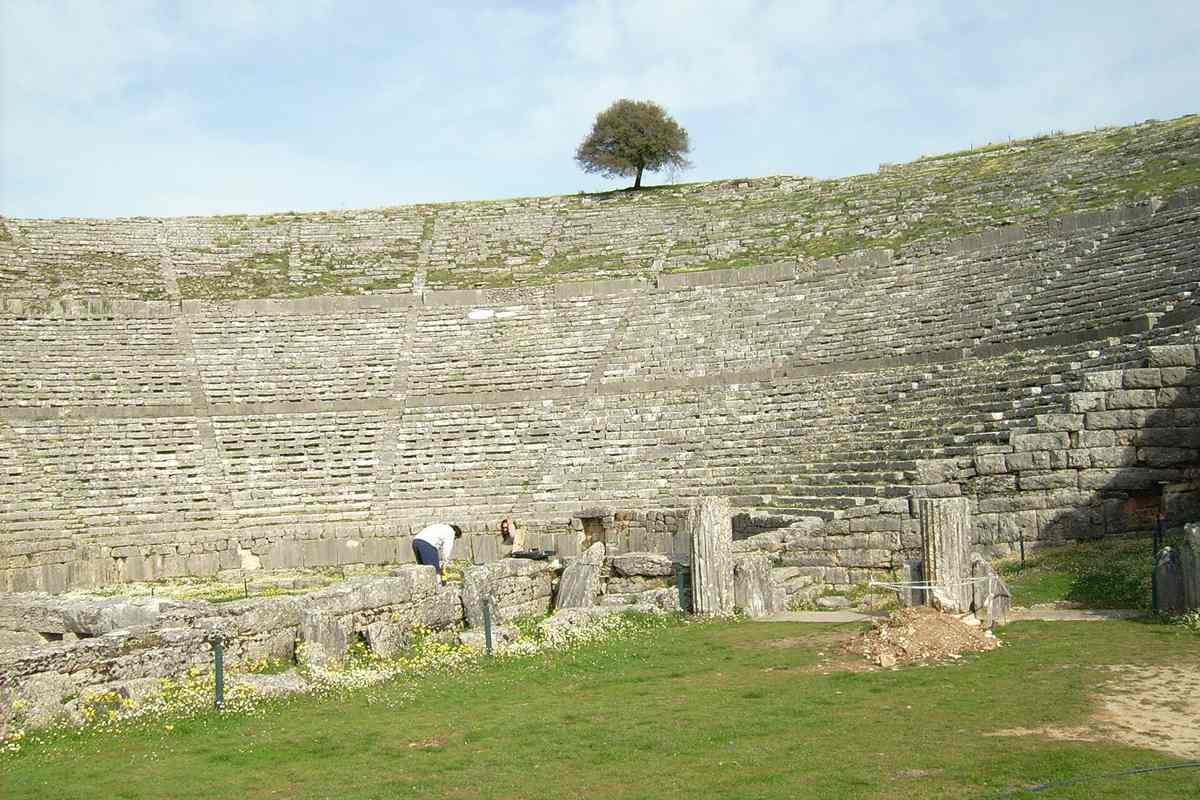
Dodona, an ancient shrine of Zeus, stands in Epirus in north-western Greece, close to the village of Dodoni. Expert-led trips run through Epirus and the rest of mainland Greece. The sections below look at the early finds, the lamellae and the dove stories, and the goddess Dione. They also cover King Pyrrhus, the Molossians, Mount Tomaros and the scholar Jebb. Further reading sits on Oracle of Delphi, Greek mythology places and Mainland Greece tour. Trips across the whole country gather on Greece tours.
Bookings made through the GetYourGuide widgets on this page earn Classical Greece Tours a commission, at no extra cost to the traveller.
What was Dodona?
Dodona was a sanctuary of Zeus in Epirus, north-western Greece, below Mount Tomaros. A sanctuary is holy ground set aside for worship. Herodotus thought its oracle possibly dated to the 2nd millennium BCE. An oracle was a shrine that answered questions in a god’s name.
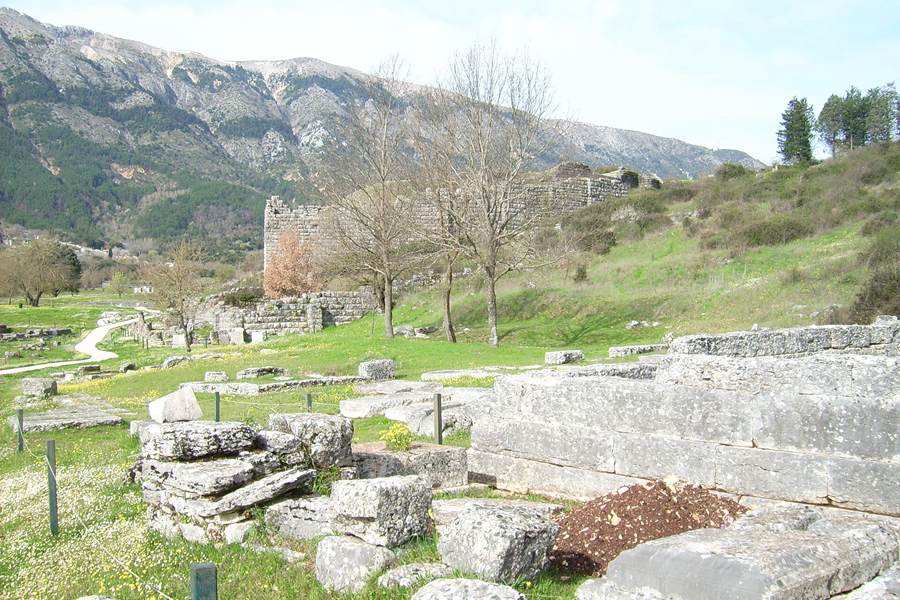
The earliest inscriptions at Dodona date from about 550 to 500 BCE. Digs over more than a century have found objects from the Mycenaean era, the late Bronze Age. Athens now holds a large share of them, in its National Archaeological Museum. Others are held in the nearby Archaeological Museum of Ioannina.
A Mycenaean sherd from about 1200 BC turned up at Dodona, together with kylix stems. A sherd is a fragment of a broken pot. A kylix was a two-handled drinking cup on a stem. Contact with southern Greece resumed in the 8th century BCE, as bronze tripods arrived from its cities. Tripods were bowls raised on three feet.
Until 650 BCE, Dodona served mainly the northern tribes as a religious and oracular centre. Oracular means linked to an oracle. After 650 BCE, it grew important for the southern tribes too. The Thesprotians first controlled the oracle, and later it passed to the Molossians. Both peoples were tribes of Epirus.
- Bronze gifts: Mycenaean bronze offerings of the 14th and 13th centuries BCE were brought to the site.
- Colony story: An old tradition held that it began as a colony of a Thessalian city of the same name.
- Aristotle: Aristotle placed the homeland of the Hellenes, the Greeks, in the region around Dodona.
Pilgrims kept consulting the oracle of Dodona until 391 or 392 CE. In those years Emperor Theodosius closed all pagan temples and banned pagan rites. Pagan here means the worship of the old Greek and Roman gods. A pilgrim is someone who journeys for religious reasons.
How did the oracle of Dodona give its answers?
Dodona kept an oracle of Zeus whose workings remain little known today. Ancient writers gave differing accounts of how the oracle reached its answers. Those accounts concern divination, which is the practice of seeking hidden knowledge from the gods.
Over two thousand lamellae have come from the site at Dodona. Lamellae are thin tablets inscribed with writing. The bulk of them carry questions put to the oracle, and a handful seem to hold answers. Personal questions make up the vast majority. They deal with marriage, children, travel, business and health.
The questions were seldom open-ended. Frequently they called for nothing more than a yes or a no, a binary answer. A story is linked to Callisthenes, a historian of the 4th century BC. In it, answers came from drawing lots, a choice left to chance. A handful of tablets at Dodona seem to show this method.
Herodotus, a historian of the fifth century BCE, heard a story from the priestesses of Dodona. Two black doves flew from Thebes in Egypt, and one settled on an oak there. It spoke in a human voice and called for an oracle of Zeus. The eldest priestess was Promeneia, the next Timarete, and the youngest Nicandra.
- Real doves: Other ancient writers suggest that real doves delivered oracles, or that priestesses read their flight.
- Strange speech: Herodotus guessed the women were called doves because their foreign speech sounded like birdsong.
- Pelasgi: Ephorus, quoted by Strabo, said the Pelasgi, an early people of Greece, founded the oracle.
At first, men uttered the prophecies at Dodona, according to Strabo. Later, three old women took on the role of prophets. A prophet is a person who speaks on behalf of a god. Strabo was a Greek geographer who wrote under Roman rule.
Which goddess shared the sanctuary of Dodona with Zeus?
Dodona honoured Dione as the partner of Zeus, in place of Hera, his usual consort elsewhere. A consort is the wife or partner of a ruler or god. Her name is the feminine form of Zeus, whose genitive, meaning “of Zeus”, is Dios.
Nicholas Hammond held that Dodona first served a Mother Goddess, called Dione here. At other sites the same figure went by the names Rhea or Gaia. In historical times, Zeus joined her and partly took her place. A Mother Goddess is a female deity linked with earth and birth.
Elsewhere in classical Greece, Dione shrank to a minor role and became an aspect of Hera. That change never happened at Dodona. An aspect is one side or form of a deity. Deity is another word for a god or goddess. Certain archaeologists date a small stone temple of Dione at the site only to the 4th century BCE.
At Dodona, Zeus bore the title Naios and Dione the matching title Naia. Such a title, called an epithet, describes a god in a set way. Ancient stories make Dione an Oceanid, a daughter of Oceanus and Tethys. Others call her a Titaness, a daughter of Gaia and Uranus. Titans were the older gods who ruled before Zeus.
- Aphrodite: Ancient accounts frequently name Dione as the mother of Aphrodite, with Zeus as father.
- Epithet: The name Dione also serves at times as a title of Aphrodite, the Roman Venus.
- Nymph: One Dione, of the rain-bringing Hyades, was a Dodonian nymph who nursed young Dionysus.
Priestesses had appeared at Dodona by the time Euripides mentioned it in his play Melanippe. The same holds for the years when Herodotus wrote about the oracle. Euripides was an Athenian writer of tragedies. Only fragments, or broken pieces, of Melanippe survive.
What did King Pyrrhus of Epirus build at Dodona?
Dodona became the religious capital of King Pyrrhus around 290 BCE. He ruled Epirus and adorned the sanctuary with a series of new buildings. Adorned means made finer and richer. A religious capital is the chief holy centre of a kingdom.
Pyrrhus grandly rebuilt the Temple of Zeus at Dodona and raised other buildings as well. He also founded a festival there. It held athletic games, musical contests and drama staged in a theatre. A Greek theatre was an open-air bowl of stone seats facing a stage. Drama means plays acted on that stage.
A wall went up around the oracle of Dodona and its holy tree. New temples honoured Dione and Heracles, the hero famed for his strength. In 1967 the film Oedipus the King was shot at Dodoni, the modern village near the ancient site. Oedipus the King is a tragedy by Sophocles, set in Thebes.
Pyrrhus was born around 319 BC to Prince Aeacides of Epirus and to Phthia. She was a Thessalian noblewoman, daughter of the general Menon. A noblewoman is a woman of a high-ranking family. Pyrrhus had two sisters, Deidamia and Troias. He belonged to the royal Aeacid house, a family named after the mythical hero Aeacus.
- Throne: Pyrrhus came to the throne of the Molossians in 295 BC.
- Heraclea: In 280 BC he beat the Romans under Laevinus, a consul, or chief Roman official.
- Rome: Pyrrhus ranked among the strongest opponents that early Rome faced in war.
Beyond Dodona, Pyrrhus seized the Macedonian throne from Antigonus II Gonatas in 274 BC. Macedon was the kingdom to the east of Epirus. A throne stands for royal power. In 272 BC he invaded the Peloponnese, the large peninsula of southern Greece.
Why do the Molossians matter to the story of Dodona?
Dodona lay at the heart of Molossis, the homeland of the Molossians. They were ancient Greek tribes of Epirus. Their land held a sanctuary of Zeus from at least the Geometric Age, about 1100 to 800 BC. That age takes its name from patterned pottery.
Epirus had fourteen tribes, according to Strabo. He ranked the Molossians, Chaonians and Thesprotians as the famous ones. These three peoples once ruled the whole region. Zeus was the supreme god of the Molossians. In their land, the oracle of Dodona drew pilgrims from all over the Greek world.
The shrine of Dodona also served as a public noticeboard. The Molossians displayed their public decisions there. They lived under a monarchy, which is rule by a king. Even so, they sent princes to Athens to learn about democracy, or rule by the people. They saw parts of democracy as fitting their own system.
Plutarch tells of Tharrhypas, the first Molossian king of his line to win fame. He organised his cities on Greek customs, rules and regulations. The earliest known decrees of the Molossian state date from 370 to 368 BC. They come from the reign of his grandson, Neoptolemus I. Decrees are official orders of a state.
- Old age words: Molossians used pelioi for old men and peliai for old women, as did Thesprotians and Macedonians.
- Coins: Molossian coins showed a Molossian dog on a shield, with the word Molossoi.
- Myth: Plutarch says the flood survivors Deucalion and Pyrrha founded Zeus worship at Dodona and settled with the Molossians.
The scholar Malkin links two of the three broad names for the Greeks with Dodona and Epirus. Those two are Graikoi and Hellenes. The third is Ionians, and all three names are still in use. Hellenes is the name Greeks use for themselves.
What do travellers ask about Dodona, and what are the answers?
Dodona looks up at Tomaros, a mountain of the south-western Ioannina regional unit. The Selloi were a tribe living between the oracle and the Achelous river. Aetolian troops looted and burned the sanctuary in 219 BCE. The modern municipality of Dodoni took shape in 2011.
How high does Mount Tomaros rise above Dodona?
Rising to the south of the site, Tomaros forms part of the Pindus range. The Pindus is the mountain chain running down mainland Greece. The peak of Tomaros reaches 1,974 m. Forests cover its lower slopes, while dry grasslands cover the highest ground. Grassland is open land where grasses grow instead of trees.
Who were the Selloi, the people tied to Dodona?
Aristotle wrote that the Selloi were once called Graikoi, but later Hellenes, two names for Greeks. Steve Reece, a scholar of ancient languages, traces the name Selloi to a historical tribe, the Helloi. He links it with Hellas and Hellenes. The scholar Jebb notes that the Selloi were also called tomouroi, after Mount Tomaros.
What happened to Dodona after the Aetolian raid?
Late in the 3rd century BCE, King Philip V of Macedon rebuilt all the buildings. The Epirotes, the people of Epirus, joined in this work. In 167 BCE, Roman forces under Aemilius Paulus destroyed the Molossian cities. Dodona was possibly destroyed too. Around 88 BCE, Thracian soldiers urged on by Mithridates sacked the sanctuary.
What did the scholar Jebb notice about Dodona?
Sir Richard Jebb read Neuos, a title of Zeus there, as the god of streams and of water. The land around the oracle was quite swampy, with lakes close by. Jebb also placed the Peleiades very early, before Phemonoe, the prophetess at Delphi. The Peleiades were the dove priestesses.
Featured photo: Marcus Cyron, CC BY-SA 3.0, via Wikimedia Commons (File:Dodona-Greece-April-2008-029.JPG).