
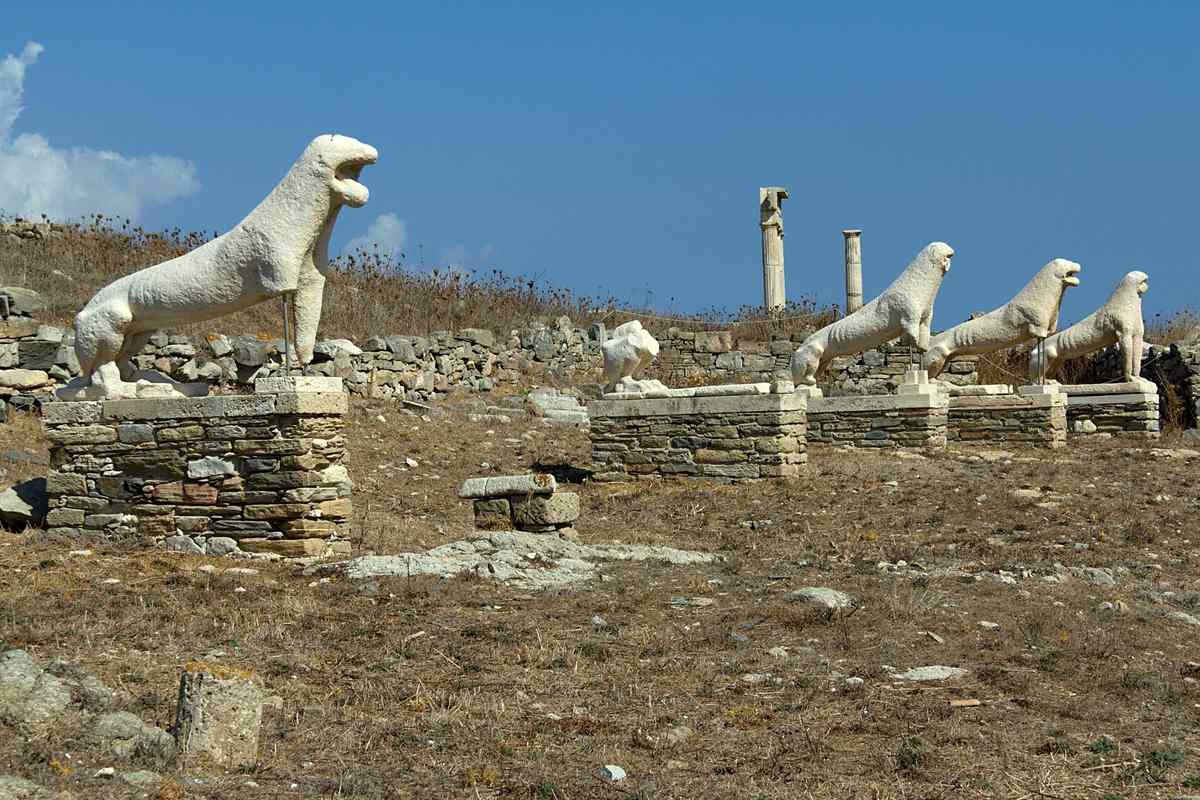
Ancient Greek sculpture survives in marble, bronze and clay across Greece. Expert-led trips through Greece take place in the regions where these works are kept, from Athens to Delphi. Topics here run from the Dedication of Nikandre and the Moschophoros to the Peplos Kore and Polykleitos. Later sections treat the Grave Stele of Hegeso, the Antikythera Ephebe and the ex voto of Daochos. Related pages cover the Parthenon, Museums in Greece and Ancient Greek architecture. Further trips appear under Greece tours.
Bookings made through the GetYourGuide widgets on this page earn Classical Greece Tours a commission, at no extra cost to the traveller.
What is ancient Greek sculpture?
Ancient Greek sculpture is the chief surviving fine art of ancient Greece. Almost no Greek painting has outlasted the centuries. Scholars split its large bronze and stone works into three stages: Archaic, Classical and the later Hellenistic age.
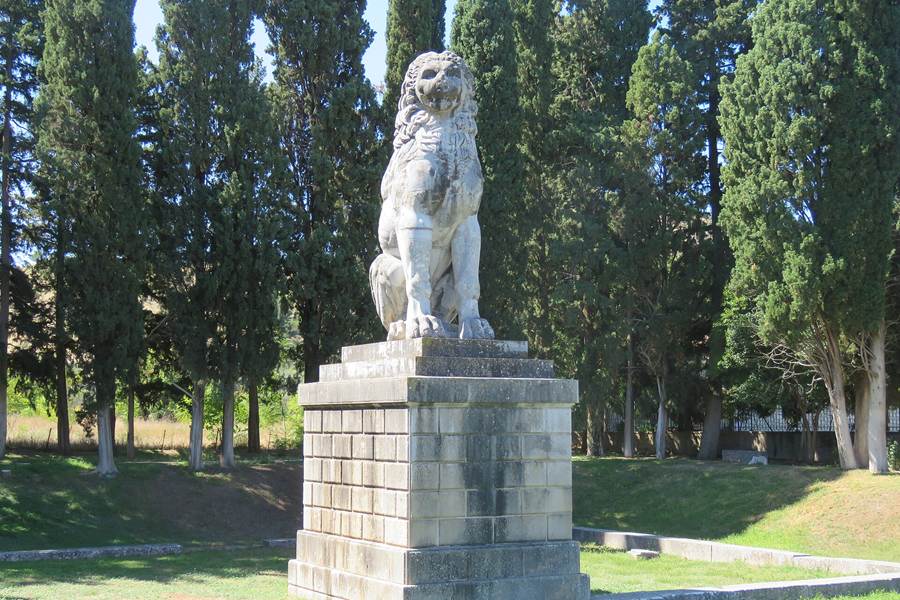
The Archaic stage of ancient Greek sculpture ran from about 650 to 480 BC. The Classical stage followed from 480 to 323 BC. Bronze carried the highest prestige of any material used. Prestige means high standing and respect. Yet bronze statues survive least, because the metal was valuable and recycled.
The Greeks chose the human form as the main subject of their art at an early stage. They pictured their gods in human shape too. Ancient Greek sculpture was first painted in a range of colours. The pigments, or colouring powders, have since faded. Holes cut into statues show where jewellery was once fixed.
In acrolithic statues, the head and bare skin were marble, while the clothed parts were wood. Plaster or stucco, a smooth wall coating, was sometimes used, but only for hair. The Lefkandi Centaur, a terracotta, or baked clay, figure found on Euboea, dates to about 920 BC. A centaur is half man and half horse.
- Xoana: Pausanias first described early wooden or ivory images for worship, called xoana, and none survive.
- Reliefs: Reliefs, carvings raised from a flat background, mattered too, though the free-standing statue led.
- Later subjects: Common people, children, animals and home scenes became accepted subjects in the Hellenistic age.
Ancient Greek sculpture was not made only for display. Wealthy aristocrats or the state ordered statues. These served as public memorials, as gifts to temples and sanctuaries, or as grave markers. A sanctuary was a sacred precinct, ground set aside for a deity.
How does the Dedication of Nikandre open the story of ancient Greek sculpture?
Ancient Greek sculpture from about 650 BC survives in the Dedication of Nikandre. This marble figure is listed as Inv. 1 in the National Archaeological Museum, Athens. It carries one of the oldest Greek inscriptions cut into stone. An inscription is writing carved on an object.
Théophile Homolle uncovered this ancient Greek sculpture in 1878 while digging around the sanctuary of Artemis on Delos. The statue lay in a ditch 12 to 15 metres from a corner of the sanctuary. Pieces of other statues lay with it, and all appear to have been broken before burial.
The inscription runs vertically down the left side of the figure. It names Nikandre’s father Deinodikos, her brother Deinomenes and her husband Phraxos. She calls herself “distinguished among women”, a claim to high standing in her community. The type of stone points to Naxos, where her family lived, as the place of carving.
The figure shares traits with the Daedalic style of ancient Greek sculpture. The style is named after followers of the mythical inventor Daedalus. It flourished between 675 and 600 BC. It is marked by strict frontality: the body faces straight ahead without twisting. Nikandre wears a peplos, a popular archaic gown for women, belted at the waist.
- Size: The figure stands 1.75 metres tall, yet it measures only 0.17 metres thick.
- Hands: Small holes pierce both hands, possibly to hold objects linked to Artemis, such as a bow.
- Meaning: John Boardman and Nigel Spivey both argue that the statue shows a priestess of Artemis.
Ancient Greek sculpture of later Hellenistic times treated the body in an ever more ideal way. Beside such work, early scholars scorned Nikandre’s flat form and heavy dress as poor craft. A. A. Donohue argues that the dress and stance instead showed her respectability and status.
What does the Moschophoros, the Calf Bearer, show about ancient Greek sculpture?
Ancient Greek sculpture on the Acropolis of Athens includes the Archaic Moschophoros, a name meaning “calf-bearer”. The man, dated to about 560 BC, carries a calf on his shoulders. He once stood an estimated 1.65 metres high and is now in the Acropolis Museum.
The man in this ancient Greek sculpture steps slightly forward on his left foot, like a kouros. A kouros shows an upright young man without clothes. His thick beard marks him as an adult. A thin cloak presents him as a respected citizen. The calf is the sacrifice he brings to the god.
This ancient Greek sculpture succeeds at a hard task: showing a man and an animal together. Here the calf’s legs are gripped firmly, forming a bold X shape. The man smiles the Archaic smile, a feature that began in the 6th century BC. His large eyes were once coloured stones, which are now missing.
Three plaits fall over his chest on each side, and a narrow ribbon ties the hair on top. The statue’s base came to light in 1887. It is cut from permeable limestone, which lets water pass through. Its inscription names the giver as Rhombos, though the first letters of the name are missing.
- God: Because the calf is male, scholars favour a male god such as Zeus Polieus or Erechtheus.
- Ram-bearers: Statues of a man carrying a ram, called kriophoros, are more common than this type.
- Condition: Both legs are lost below the knees, while the calf on his shoulders stays well preserved.
The inscription suggests a wealthy giver, a leading citizen of Attica, the region around Athens. He offered his own likeness to the god in this ancient Greek sculpture. Style and form point to an early 6th-century BC date, around 570 BC.
Which story does the Kroisos Kouros tell in ancient Greek sculpture?
Ancient Greek sculpture also marked graves, as the Kroisos Kouros from Anavyssos in Attica shows. This marble youth stood as the grave marker of Kroisos, a young warrior who fell in battle. The statue rises 1.95 metres high.
This ancient Greek sculpture is number 3851 in the National Archaeological Museum, Athens. There is no secure record of when or where it was found. Reports showed it had been dug up illegally from a burial mound at Anavissos. It was then sawn into parts and sent to Paris for sale.
In 1937 the kouros turned up in Paris, held by an art dealer. After an investigation, the statue returned to Athens. Its base asks each passer-by to stop and show pity at the marker of Kroisos. The lines add that raging Ares, the god of war, destroyed him in the front ranks.
The Kroisos Kouros stands at the centre of a debate in ancient Greek sculpture. Scholars ask whether kouroi, the plural of kouros, portray real young men or ideal types. In the ideal reading, it embodies the promachoi, warriors who fought in the front line. It is also one of the best-known examples of the archaic smile.
- Smile: Sculptors used the archaic smile chiefly in the second quarter of the 6th century BC.
- Meaning: One idea holds that the smile suggested the subject was alive and well.
- Status: Richard Neer links the smile to rank, since aristocrats were called Geleontes, or smiling ones.
In ancient Greek sculpture, the archaic smile appears across the Greek mainland, Asia Minor and Aegean islands. Another theory ties the smile to a technical problem. It holds that a curved mouth was hard to fit onto the blocky heads of the age.
Where does the Peplos Kore stand among the korai of ancient Greek sculpture?
Ancient Greek sculpture of the Archaic age counts the Peplos Kore among its best-known works. She stands in the Acropolis Museum. A kore, plural korai, is an archaic statue of a young woman. Its pose is stiff, and it looks straight ahead.
Yet this ancient Greek sculpture is not a typical kore. Her face leans slightly to one side, and her weight rests on one leg. The name comes from the peplos, but she is now known not to wear one. Her dress is closer to a long dress from Anatolia, with a cape draped over it.
The statue is carved from fine-grained Parian marble, stone from the island of Paros. Drilled holes in her head and shoulders once held bronze ornaments, thought to include a wreath. Shoulder pins called fibulae, or brooches, were fixed there too. The left arm, carved as a separate block, is now lost.
Scholars link this ancient Greek sculpture to the Rampin Master. He is named after a head of very similar style, now displayed in the Louvre. Vinzenz Brinkmann argues that this type of statue shows goddesses rather than mortal girls. Her head carries 35 drilled holes in two rows, with one more in her right hand.
- Crown: The holes suggest a rayed crown or a helmet, and objects such as a bow or a shield.
- View: She is carved in the round, meaning fully three-dimensional, yet made to be seen from the front.
- Graves: Korai also stood in Attic cemeteries as grave markers for women who had died.
Ancient Greek sculpture from the Acropolis includes similar korai that date back to the early 6th century BC. Scholars have suggested that such statues were offerings to the gods. In that reading, each figure stood in the place of the patron who paid for it.
What changed in ancient Greek sculpture with the Severe style?
Ancient Greek sculpture broke away from fixed archaic forms in the Severe style. It formed the bridge toward full classical art. Brunilde S. Ridgway names six traits that define it. The word Severe here means plain and stripped of extra detail.
The term was coined by Gustav Kramer in 1837 for the first red-figure vase painters. Red-figure means pale figures left in clay against a black background. Since a study by Vagn Poulsen in 1937, the name has belonged to sculpture alone. The style appeared across the Greek world, in bronze, carved slabs and building reliefs.
In Severe ancient Greek sculpture, eyelids gain volume and appear as thick rims around the eyes. Chins become heavy. Cloth is made to look heavier, almost “doughy”. The folds of drapery, meaning the hanging cloth, start to look like corrugated iron. A slight pout appears, with the upper lip set a little over the lower.
Subjects of ancient Greek sculpture changed as well. The kouros type now splits clearly into Apollo or a human being. Apollo wears his hair long, while the athlete of the day wears his short. Sculptors also took an interest in emotion. Its range runs from quiet brooding and worried thought to physical distress. Bronze became the main material.
- Tyrannicides: Kritios and Nesiotes made a new Tyrannicide group, dated by an inscription to 477/6 BC.
- Older bronze: Their group replaced Antenor’s bronze of 514 BC, made to honour the killers of Hipparchus.
- Myron: Myron of Eleutherae, a late master of the style, made the Discobolus, or discus thrower.
In one view, Severe ancient Greek sculpture peaked in the metopes of Olympia’s Temple of Zeus. Metopes are square carved panels above a temple’s columns. War and Solon’s laws on spending curbed Athenian sculpture in the first half of the 5th century BC.
Who was Polykleitos, and how did he shape the rules of ancient Greek sculpture?
Ancient Greek sculpture of the 5th century BC owes a written rulebook to Polykleitos, a sculptor from Argos. His lost treatise, the Canon, set out the ideal proportions of the male body. Proportions are the sizes of parts measured against each other.
The word canon comes from the Greek kanon, meaning a measuring rod or standard. Polykleitos ranks with Pheidias, Myron and Praxiteles as a leading master of classical ancient Greek sculpture. None of his original works are known to survive. Ancient texts that identify Roman marble copies let scholars rebuild his works.
His Doryphoros, or Spear Bearer, was a famous bronze nude. The Diadumenos shows a winner tying a diadem, a headband that marked the victor. Its bronze original dates to about 420 BC. A marble Diadumenos from Delos is in the National Museum, Athens. A cloak and a quiver, or arrow case, lie on its tree stump.
Contrapposto was a source of his fame. The word names a pose with the weight placed on one leg. In the Diadumenos, the chest and hips tilt in opposite directions. The feet rest halfway between standing and walking, which hints at movement. This planned pose became a standard formula for ancient Greek sculpture and Roman art.
- Hera: His colossal gold and ivory Hera stood in her temple, the Heraion of Argos.
- Roof copy: A Diadumenos copy joined the roof sculptures of the National Archaeological Museum, Athens, finished in 1889.
- Clay: Plutarch repeats his remark that the work is hardest when clay sits under the fingernail.
In his system for ancient Greek sculpture, a statue was built from clearly defined parts. Each part related to every other through ideal mathematical proportions and balance. Kenneth Clark saw his aim as clarity, balance and completeness, shown through an athlete’s bare body.
What scene does the Great Eleusinian Relief add to ancient Greek sculpture?
Ancient Greek sculpture includes the Great Eleusinian Relief. Athens’s National Archaeological Museum keeps this large marble relief. It shows a scene of the Eleusinian Mysteries, with Demeter, her daughter Persephone and the young hero Triptolemus. It dates to around 430-420 BC.
This ancient Greek sculpture came to light in 1859 at Eleusis, a town near Athens. It lay at the sanctuary of Demeter. The Mysteries were rites at Eleusis, a leading centre where Demeter and Persephone were worshipped. The find revived scholarly interest in the site and led to more digging in the 1860s.
The relief is carved from Pentelic marble, one of the two marbles the Greeks prized highest. It stands 2.20 metres tall, 1.52 metres wide and 15 centimetres thick. Triptolemus stands in the centre, with a goddess on each side. Demeter is the goddess of farming and plenty. Persephone is queen of the Underworld.
In this ancient Greek sculpture, the left-hand goddess wears a sleeveless chiton and a himation, or cloak. A chiton is a long tunic. She holds a sceptre and passes Triptolemus a gift, now widely agreed to be sheaves of wheat. The goddess on the right holds a large torch that reaches the ground.
- Names: Scholars accept the left figure as Demeter and the right as Persephone, though the reverse is argued.
- Use: Made for religious use, the relief was not a votive gift, one promised to a god.
- Plaster copy: A plaster copy stands in the Archaeological Museum of Eleusis, in the town where it was found.
Ancient Greek sculpture of this kind drew Roman copyists too. A copy in the Metropolitan Museum of Art, New York, is set from ten Roman fragments. A skyphos, a deep drinking cup, from Boeotia shows Demeter handing wheat to Triptolemus.
How does the Grave Stele of Hegeso honour a woman in ancient Greek sculpture?
Ancient Greek sculpture for the dead includes the Grave Stele of Hegeso. It ranks among the finest Attic grave stelae to survive. A stele means an upright slab of stone placed over a grave. Her stele dates to about 410-400 BC.
This ancient Greek sculpture is cut from Pentelic marble. It stands 1.49 metres high and 0.92 metres wide. It is shaped as a naiskos, a small temple front with flat pillars and a gable. It was found in 1870 in the Kerameikos, which now holds a replica. The original is in the National Archaeological Museum.
Hegeso, a mature Athenian woman, sits on a klismos, a light chair with slender parts. Her feet rest on a footstool. In her right hand she once held a piece of jewellery, painted on and now lost. A maidservant stands opposite and offers her a pyxis, a box linked with women and weddings.
The epitaph on this ancient Greek sculpture names her as Hegeso, daughter of Proxenios. An epitaph is a text honouring the dead. The stele was set in a peribolos, a walled family grave plot, facing the Street of Tombs. Its size and quality mark her family as wealthier and more important than the bulk of Athenian families.
- Footstool: Finely carved footstools served as a sign of rank in ancient Greece.
- Mood: Quiet contemplation, as in Hegeso and her maid, was common to fifth-century BC grave reliefs.
- Ban: Demetrios of Phaleron banned further elaborate tombs in 317 BC, ending such grand displays.
In a peribolos, such ancient Greek sculpture faced the street in a row above the front wall. That wall stood far higher than the three rubble walls around the burial area. From inside the plot, only the rough backs of the stelae showed.
What did the sea give back to ancient Greek sculpture in the Antikythera Ephebe?
Ancient Greek sculpture in bronze includes the Antikythera Ephebe. Sponge-divers found it in 1900 near an ancient shipwreck off Antikythera. An ephebe is a youth on the edge of manhood. The statue is kept in Athens’s National Archaeological Museum.
It was the first of a series of Greek bronzes raised from the Aegean and Mediterranean. These 20th-century finds reshaped how modern scholars see ancient Greek sculpture. The wreck site dates to about 70-60 BC. Coins found there suggest the ship set out from the Ionian coast, possibly from Ephesus.
This ancient Greek sculpture is 1.96 metres tall, a little over life size. It came up in a great number of fragments. A first restoration was later revised in the 1950s under Christos Karouzos. The new work altered the gaze, the abdomen and where the right arm sits. Experts everywhere count the re-restoration a success.
The Ephebe matches no familiar model, and no copies of the type are known. His right hand once gripped a round object. One theory makes him Paris handing the Apple of Discord to Aphrodite. Others prefer a young, beardless Heracles holding the Apple of the Hesperides, or Perseus with the Gorgon’s head.
- Date: The statue dates to around 340-330 BC, a product of Peloponnesian bronze work.
- Maker: It is possibly the work of Euphranor, a sculptor trained in the tradition of Polykleitos.
- Cargo: None of the recovered cargo has been traced to mainland Greece.
Ancient Greek sculpture shared the wreck with other finds. Divers also raised the Antikythera mechanism, a device for astronomical calculation. A lively head of a Stoic philosopher came up as well. Stoics followed a school of thought that prized calm reason.
How does the ex voto of Daochos at Delphi tie Lysippos to ancient Greek sculpture?
Ancient Greek sculpture at Delphi includes the ex voto of Daochos. This long marble base once held nine statues. Ex voto means an offering made under a vow. Eight figures showed members of the family of Daochos II, and one showed a god.
Daochos II, son of Agias, was a politician from Pharsalus. He served as hieromnemon, a sacred delegate, at the Delphi sanctuary from 336 to 332 BC. Recent studies place this ancient Greek sculpture inside the Treasury of the Thessalians. That building stood northeast of the temple of Apollo. Its likeliest date falls between 339 and 334 BC.
The statues were found in pieces during the Great Excavations of 1894. Every figure but the god carried an inscription. The god, held to be Apollo, appears seated with a lyre, a small harp. Agias won the pankration at three games open to all Greeks. The pankration was an unarmed combat sport mixing boxing and wrestling.
Because Agias appears, scholars credit this piece of ancient Greek sculpture to the workshop of Lysippos. He had made a statue of Agias at Pharsalus. Lysippos is counted with Scopas and Praxiteles as one of the top three sculptors of Classical Greece. The Agias is known through a marble copy found and kept at Delphi.
- Honour: Daochos II set up the monument as a mark of honour for his prominent family.
- Ruler: Daochos I, son of Agias, governed Thessaly for 27 years, as his inscription records.
- Runner: Agelaus, the younger brother, won the boys’ race at the Pythian Games, held at Delphi.
Pliny says Lysippos produced more than 1,500 works of ancient Greek sculpture, all in bronze. Born at Sicyon around 390 BC, he worked in bronze as a youth. He taught himself sculpture and later headed the school of Argos and Sicyon.
What does the Aphrodite, Pan and Eros group show of late ancient Greek sculpture?
Ancient Greek sculpture from Delos includes the marble Group of Aphrodite, Pan and Eros. It is number 3335 in the National Archaeological Museum, Athens. The goat-legged god Pan tries to woo Aphrodite, goddess of love. She and her son Eros drive him off.
An inscription names the maker of this ancient Greek sculpture as Dionysius, who carved it around 100 BC. It was found on Delos in 1904, inside the hall of the Poseidoniasts from Beirut. The Poseidoniasts were a club of worshippers of Poseidon, the sea god. It now stands in Room 30.
The group, cut from Parian marble, stands 1.55 metres tall with its large base. That makes it slightly smaller than life size. Aphrodite stands naked, her weight on her right leg. With her left hand she covers herself, while Pan grips her left wrist. In her right hand she brandishes a sandal.
Pan has two long pointed horns, a furry face and legs ending in goat’s hooves. He leans on a skin-covered tree trunk, the marble support of the group. Little winged Eros grabs Pan’s right horn and pushes him away. This ancient Greek sculpture sets the heroic nudity of the goddess against the wild nudity of Pan.
- Repairs: Three fingers of Aphrodite’s left hand and one finger of her right were restored in plaster.
- Losses: The right arm of Eros is missing, and his legs had to be reattached.
- Stick: Pan has left his hunting stick lying at the foot of the tree trunk.
Ancient Greek sculpture of the Hellenistic age no longer had to show people as ideals of beauty. New cities in Egypt, Syria and Anatolia ordered statues of Greek gods and heroes. Sculpture became an industry, so more Hellenistic statues survive today than Classical ones.
What do travellers ask about ancient Greek sculpture, and what are the answers?
The ancient Greek sculpture known today has gained new pieces from the sea in recent years. Marine archaeology and trawling have added striking bronzes that widen modern knowledge of ancient bronze art. Marine archaeology studies remains under water, and trawling drags fishing nets along the seabed.
Which bronze youth of ancient Greek sculpture came out of the bay of Marathon?
The Marathon Boy, also known as the Ephebe of Marathon, is a bronze statue. It was found in 1925 in the bay of Marathon. Soft muscles and exaggerated contrapposto tie its style to the circle of Praxiteles. With one arm lifted and his weight shifted, he once leaned on a support, such as a column.
Where is the Mourning Athena of ancient Greek sculpture shown, and what does it depict?
The Mourning Athena, or Pensive Athena, is a marble relief from Athens of about 460 BC. It is now displayed in the Acropolis Museum. The goddess leans on her spear, and her head is bowed. Scholars have debated the meaning of that bowed head since the relief’s excavation in 1888.
What does the Lacrateides Relief add to ancient Greek sculpture from Eleusis?
The Lacrateides Relief is a marble votive relief of the 2nd century BC. The priest Lacrateides gave it to the gods of Eleusis. Its fragments came to light in 1885 in the sanctuary of Pluto, god of wealth. About sixty pieces survive, now in the Archaeological Museum of Eleusis.
Why does the Euthydikos Kore mark a turning point in ancient Greek sculpture?
The Euthydikos Kore is a late Archaic kore of Parian marble, dated about 490-480 BC. It once stood among the votive statues on the Acropolis of Athens. Her full lips turn down at the corners, and she shows no archaic smile. She marks the change from late Archaic art to the Severe style.
Featured photo: Zde, CC BY-SA 3.0, via Wikimedia Commons (File:Terrace of the Lions Delos 130058.jpg).