
Ancient Greek pottery spans painted clay ware from the Protogeometric style to the Hellenistic age. Small-group trips through Greece run across the country that shaped and fired these pots. The Bronze Age background covers Minoan and Mycenaean wares. The main styles are Protogeometric, Geometric, Orientalizing, black-figure, red-figure and white-ground work. The craft also covers vase shapes, painters and workshops. Further reading sits under Museums in Greece, Greek souvenirs and Minoan civilization. More trip ideas appear under Greece tours.
Bookings made through the GetYourGuide widgets on this page earn Classical Greece Tours a commission, at no extra cost to the traveller.
What is ancient Greek pottery?
Ancient Greek pottery is the clay ware made in Greece after the Bronze Age. Scholars label earlier Minoan and Mycenaean wares “Aegean” instead. Vase painting faded in the Hellenistic age that Alexander the Great’s conquests began, when West Slope Ware appeared.
Potters of Archaic and Classical Greece worked first in black-figure, with dark figures set against light clay. Red-figure and the white ground technique came later. White ground means a pale coat of clay laid on as a painting surface. Painting led by human figures peaked from the late 7th century to about 300 BC.
Vases dug from tombs in Italy were first taken for Etruscan work, from ancient central Italy. Winckelmann’s history of art, printed in 1764, was the first to reject that origin. Stackelberg’s study of 1837 settled the dispute for good. Students of ancient Greek pottery call stray fragments disjecta membra, Latin for “scattered parts”.
Pots from Attica, Corinth and East Greece differ in style, and these differences helped mark out local communities. Writing on ancient Greek pottery takes two forms: incised, meaning scratched into the clay, and painted. The earliest incised words are as old as the Greek alphabet itself, of the 8th century BC. Painted ones appear a century later.
- Origin: Sub-Mycenaean ware blended into the Protogeometric style, the true start of ancient Greek pottery.
- Metal: Only a small number of metal vessels survive, since they were melted down and reused.
- Trademarks: Small marks called trademarks appear on Corinthian pieces from the start of the 6th century BC.
Ancient Greek pottery also became a dating tool. In the 1880s and 1890s, Furtwängler and his team dated dig layers by the pots inside them. This method of ordering finds in time is called seriation. Flinders Petrie later used it on plain Egyptian pottery.
Where does Minoan work from Crete sit in the story of ancient Greek pottery?
Ancient Greek pottery follows the Minoan ware of Crete, made by the island’s Bronze Age people. In the 18th century BC, Cretan pots of oils and ointments went abroad. They turn up across the Aegean islands, mainland Greece, Cyprus, coastal Syria and Egypt.
Minoan styles changed in steps, which helps archaeologists give relative dates to the layers of a site. A relative date places a find before or after another one. A newer method, fabric analysis, treats coarse, mostly plain sherds like rocks and studies their geology. Sherds are broken pieces of pottery. Evidence also points to women working as potters.
Long before ancient Greek pottery, Pyrgos Ware came in black, grey or brown with a burnished finish. Burnished means rubbed smooth until the surface shines. Scholars think these pots copied the look of wood. Lebena Ware, found in early Minoan tombs, had white patterns painted over a solid red ground.
The Floral Style shows palms, papyrus, lilies and finely drawn leaves. Papyrus is a tall water reed. Green, the true colour of leaves, appears rarely on these pots. Among the styles that came before ancient Greek pottery, the Marine Style flows freely, with no set zones. Its sea creatures seem to float, as they do in open water.
- Last style: The Marine Style was the final style that was purely Minoan in character.
- No names: Late Minoan workshop painters are known by their motifs, or repeated designs, yet no name appears.
- Knossos: The Palace Style, a later Cretan style, stayed largely confined to the palace of Knossos.
Minoan potters used slips widely, and slip is liquid clay brushed on as a coat. Ancient Greek pottery kept this habit throughout its great period. Around 1450 BCE, Mycenaean Greeks moved into the palace of Knossos. Cretan vase shapes and designs then grew more Mycenaean.
How do Mycenaean wares from the mainland fit the story of ancient Greek pottery?
Ancient Greek pottery has a mainland forerunner in Mycenaean ware, a name taken from the site of Mycenae. Heinrich Schliemann first applied the term to these finds. In absolute dates, meaning real calendar years, the Mycenaean period runs from about 1600 to 1000 BCE.
This era is also called Late Helladic, or LH. Helladic is the term for the Bronze Age of mainland Greece. Early Mycenaean pots stand out for a glossier paint than the Middle Helladic wares before them. Mycenaean art also keeps each part of a design clearly apart, while Minoan art flows more freely.
In LH IIB, Minoan potters on Crete began to copy Mycenaean pots. Ivy, lilies and nautili were popular patterns then. A nautilus is a sea creature with a coiled shell. The later Koine style is named from the Greek koinos, meaning “common”. In LH IIIA, experts can hardly say in which Mycenaean region a given vase was made.
Digs at Tell el-Amarna in Egypt uncovered large deposits of Aegean pottery. In the age after the palaces, warriors on foot and in chariots became popular scenes. Bold figure painting of this kind later grew into a typical feature of ancient Greek pottery. At the very end, pot making shrank to little more than a household trade.
- Legacy: The Protogeometric style of ancient Greek pottery took its motifs from this Mycenaean tradition.
- Trade: Large finds of Mycenaean pots across the eastern Mediterranean point to settled trade links.
- Origins: One view places the first Mycenaean pottery in the northeast Peloponnese, near Mycenae itself.
Submycenaean ware forms the final stage of LH IIIC, the last Mycenaean phase. Protogeometric pottery, an early style of ancient Greek pottery, follows it. The prefix sub means below or after, so the name marks the tail end of Mycenaean work.
Which changes did the Protogeometric style bring to ancient Greek pottery?
Ancient Greek pottery includes the Protogeometric style, which Athens led. Attica and Central Greece produced it from about 1025 to 900 BCE, in the Greek Dark Ages. The Dark Ages were a time of decline after the Bronze Age collapse.
Earlier studies set the start of the style near 1050 BCE. Radiocarbon dates from Lefkandi, Kalapodi and Corinth now centre the change from Sub-Mycenaean ware on about 1025 BCE. Radiocarbon dating measures the decay of carbon in old organic remains. The style rose as the first sign of a civilisation coming back to life.
A faster potter’s wheel let makers turn out vases with far more skill than earlier Dark Age work. Attic artists used the fast wheel to make pots taller, giving painters a larger field. Ornament stayed purely abstract. Bands and concentric circles, or rings sharing one centre, were drawn with a compass fitted with multiple brushes.
Unlike later Geometric work, these pots leave much of the surface plain. In this ancient Greek pottery, red and black come from one clay, prepared and fired in different ways. Control of this colour shift opened the road to three-phase firing. Three-phase firing runs a kiln, or pottery oven, with air, then without air, then with air again.
- Figures: No human figures appear yet in ancient Greek pottery of this phase, though horses do.
- Rarity: Besides jewellery, pottery is among the rare art forms known from this period.
- Spread: From Athens, the Protogeometric style spread to other centres of production.
Ancient Greek pottery of this phase also had regional flavours. Thessaly, Euboea and Crete each made their own local versions. Euboea’s version lasted into the early 8th century BC. Euboea is the long island lying just off the east coast of central Greece.
What patterns mark Geometric art in ancient Greek pottery?
Ancient Greek pottery in the Geometric style thrived between about 900 and 700 BC. Painters covered vases with stylised geometric motifs, or simplified shapes drawn with straight lines. From its centre in Athens, the style reached the trading cities around the Aegean.
The early phase, around 900 to 850 BC, uses only abstract motifs. Heavy black varnish gives it the name “Black Dipylon” style. The Dipylon was one of the cemeteries of ancient Athens. The meander, the defining mark of Geometric art, arrived in this phase. A meander is a line that folds back on itself in a band.
Human figures first appear around 770 BC, on the handles of vases. Men have triangular chests, egg-shaped heads, a blob for the nose and long, rounded legs. Women are just as abstract. A row of lines stands for their long hair. Because the black shapes never overlap, each figure in this ancient Greek pottery stays easy to pick out.
Large grave vases from the Dipylon show processions and funeral scenes. The prothesis is the laying out of the dead for mourning. The ekphora is the carrying of the coffin to the cemetery. Local schools of ancient Greek pottery also grew up. Argos favoured scenes with figures, while Crete kept to a stricter abstract manner.
- Dating: Dates for this style come from Geometric pots exported overseas and found in datable layers.
- Reading scenes: A fight of two warriors can be a duel from Homer’s poems or ordinary combat.
- New dates: Radiocarbon dates from Zagora on Andros move the first Late Geometric phase about 120 years earlier.
In the Middle Geometric phase, painters of ancient Greek pottery disliked empty space and filled it with meanders. Scholars call this habit horror vacui, Latin for “fear of the empty”. The habit lasted until the end of the Geometric period.
How did Eastern contact reshape ancient Greek pottery in the Orientalizing period?
Ancient Greek pottery took on Eastern motifs in the Orientalizing period, from the later 8th century BC. Art from Egypt, Phoenicia, Syria and Assyria was the main source. Orientalizing means borrowing from the Orient, the old word for the lands to the east.
In Athens, the local version, called Proto-Attic, grew up between 725 and 625 BC. Attic means from Attica, the land around Athens. Proto-Attic painters were the first in ancient Greek pottery to show clearly Greek religious and mythical themes. Men and animals are solid dark shapes with outlined heads, and women are drawn wholly in outline.
Corinth felt the Eastern pull earlier. Its potters made small, finely detailed proto-Corinthian vases, which pointed ahead to black-figure painting. New creatures entered ancient Greek pottery: lions, sphinxes and griffins. A sphinx has a lion’s body and a human head, and a griffin mixes lion and eagle. Lions no longer lived in Greece by then.
The Wild Goat Style is linked by tradition to Rhodes, after a find in the cemetery of Kameiros. In fact it spread across Asia Minor, with workshops at Miletus and Chios. Rows of stylised wild goats chase one another around the pots and give the style its name. Asia Minor is present-day Turkey.
- Aegina: On Aegina, the favourite moulded vase took the shape of a griffin’s head.
- Plant designs: Palmettes, or fan-shaped leaf designs, passed through Greek art to the greater part of Eurasia.
- Revolution: The scholar Walter Burkert called this burst of Eastern borrowing an “orientalizing revolution”.
In the Archaic period that followed, Eastern features in ancient Greek pottery and other crafts became thoroughly Greek. This process is called Hellenisation, after Hellas, the Greeks’ own word for their land. From the mid-sixth century BC, Persian power in Asia Minor cut Eastern imports.
What did black-figure painting add to ancient Greek pottery?
Ancient Greek pottery gained its first large group of known artists through black-figure painting. Its Ancient Greek name, melanómorpha, means black forms. Its heyday ran from the 7th century BC into the 5th. Pieces from as late as the 2nd century BC also survive.
Painters of ancient Greek pottery worked on unfired, leather-hard vases, dry but still slightly soft. They were either slaves or paid craftsmen. Figures went on as dark shapes, and fine outlines were incised, or scratched, into the paint before firing. White and red picked out details, and white frequently stood for women’s skin.
First the kiln reached about 800 °C, and air turned the whole vase reddish orange. Then heat rose to about 950 °C, with vents shut and green wood added to burn off oxygen. The vase turned black. Fresh air in the cooling stage brought the clay back to red, while the painted slip stayed black.
Black-figure began as an echo of engraved metalwork, since painted pots took the place of costlier metal tableware. From 425 to 350 BC, Kabeiric vases led black-figure output in Boeotia. Boeotia is the region of central Greece around Thebes. The vases are named after the Sanctuary of the Kabeiroi, a group of gods, near Thebes.
- Laconia: Over 360 Laconian vases are known, Laconian meaning from the region of Sparta.
- Humour: Kabeiric scenes in ancient Greek pottery poke fun at myths in a playful, exaggerated way.
- Corinthian clay: Corinthian clay was soft and yellow, with a green tint at times.
Corinth also left a puzzle in ancient Greek pottery: scenes of fat-bellied dancers. These drinkers wear cushions that pad out their bellies and buttocks. Their meaning is still disputed. One view links them to an early form of Greek comedy.
In red-figure painting, what did ancient Greek pottery gain and lose?
Ancient Greek pottery turned its colour scheme around with red-figure painting, named erythrómorpha in Ancient Greek. Put simply, the method reverses black-figure. Painters left the figures in bare clay and filled the space between them with a glossy grey slip.
Painters of ancient Greek pottery now drew inner details with a brush instead of scratching them. Key contours used a thicker slip, which left a slightly raised outline called a relief line. Experts think a hair or a bristle brush, loaded with thick paint, drew it. Figures now gained a third dimension, meaning depth and roundness.
The method also brought ancient Greek pottery its own drawbacks. The old code of black for male skin and white for female skin no longer worked. Early figures came out very thin, as their outline merged into the black ground. Spatial perspective, meaning the drawing of deep space, was almost never tried on the black ground.
Scholars such as Otto Jahn once dated the start of red-figure a century too late. The error was corrected in 1885, during digs on the Acropolis of Athens. Diggers found the so-called “Persian debris” there. It held red-figure pots smashed by Persian invaders in 480 BC. The Acropolis is the citadel hill of Athens.
- Athens: In Athens, vase making came to a halt around 330 to 320 BC.
- South Italy: Red-figure work went on in five regional styles in the Greek colonies of southern Italy.
- Kerch Style: The Black Sea colony of Panticapeum added gilding, or thin gold, in the Kerch Style.
Late Attic red-figure followed the “Rich” style of sculpture, with growing care for hair and jewellery. Rich here means crowded with fine detail. In southern Italy, this branch of ancient Greek pottery added polychromy, the use of extra colours.
Which place does the white-ground technique hold in ancient Greek pottery?
Ancient Greek pottery in the white-ground technique shows figures on a pale background. The method arose about 500 BC in Attica, the region around Athens. Its painted surface was more fragile than black-figure or red-figure, so it suited ritual and funeral vases.
Potters coated the vase in a pale or white slip made of kaolinite, a fine white clay. Scholars think the pale coat aimed to make vases look more precious, like ivory or marble. Ionia, Laconia and the Cycladic islands made such vases, but only Athens built a true style from it.
The oldest surviving white-ground piece of ancient Greek pottery is a broken drinking cup from about 570 BC. It came to light on the Athenian Acropolis. A white ground allowed more colours than the other methods. Yet the vases look less striking. In the 5th and 4th centuries, small oil flasks in this style became typical grave gifts.
A later type of the 5th century BC, from its second quarter, mixed slip with mineral paints. Non-ceramic paints, which never went into the kiln, included cinnabarite and Egyptian blue. Cinnabarite is a red mineral, and Egyptian blue is an ancient man-made pigment. Women’s daily life, called the gynaikion, is a frequent subject.
- Colour: The white ground is rarely pure white and leans towards yellowish or light beige tones.
- Wear: Later paints went on after firing, so these paintings in ancient Greek pottery wear away easily.
- Sub-styles: Five sub-styles can be traced in the growth of white-ground painting over time.
In the later 5th century, ancient Greek pottery used white-ground almost only for grave oil flasks. These flasks are called lekythoi, and each held oil offered to the dead. White-ground painting ended once these flasks fell out of use around 400 BC.
How did the two-handled amphora work in ancient Greek pottery?
Ancient Greek pottery includes the amphora, a jar with two handles. Its Greek name, amphiphoreus, joins amphi-, meaning “on both sides”, with phoreus, meaning “carrier”. A jar is a deep container with a wide body, used for storing food and drink.
The name points to the two carrying handles, set on opposite sides of the body. In ancient Greek pottery, a vessel is any hollow container for liquid or dry goods. The word already appears in Linear B records from Knossos. Linear B is an early script, and these records date from the Bronze Age.
Size set the amphora apart from the pithos, a much bigger storage jar in ancient Greek pottery. An amphora held less than half a ton, and normally under 50 kilograms. Its neck was kept narrow by design. That shape let one person pour while holding the bottom and one of the handles.
Amphorae is the Latin-style plural of amphora, and English also accepts the form amphoras. A plural names more than one of a thing. In ancient Greek pottery, the tallest amphorae stood 1.5 metres high. Others were less than 30 centimetres in height. A centimetre is one hundredth part of a metre.
- Amphoriskoi: The smallest amphorae carried the name amphoriskoi, which means “little amphorae” in Greek.
- Neck amphora: On this type, the neck and the body join each other at a sharp angle.
- One-piece amphora: In ancient Greek pottery, this type lets neck and body rise in one continuous curve.
The largest known amphora cargo wreck was discovered off Kefalonia, an Ionian island of Greece. It carried 6,000 pots. A wreck here means the sunken remains of a ship. Cargo means the goods that a ship carries on board.
What jobs did the hydria do in ancient Greek pottery?
Ancient Greek pottery includes the hydria, a vessel built for carrying water. It served other purposes as well, and its Greek plural is hydriai. Carrying water meant bringing it from a source, such as a spring, to where people needed it.
Three handles made the work easier. Two horizontal handles sat on the sides, and one vertical handle rose at the back. Horizontal means lying flat, and vertical means standing upright. In ancient Greek pottery, the hydria held more than water. It also stored oil and even received the votes of judges.
The hydria also served as a funerary urn, a jar for the ashes of the dead. In ancient Greek pottery, the form first appeared in the late Geometric period, in the 7th century BC. It lasted until the Hellenistic period, in the 3rd century BC. Hellenistic comes from Hellen, the Greek word for a Greek.
Making a hydria started on a potter’s wheel, a turning disc that spins the clay. The potter began with a large ball of clay. This step is called throwing. The term comes from an Old English word meaning to twist or turn. Clay is a soft, sticky earth that hardens when heated.
- Kalpis: In ancient Greek pottery, the kalpis became the vessel red-figure painters liked best in the 5th century BC.
- Caputi hydria: Its painted scene shows women at work, decorating a vase inside a pottery workshop.
- Female painters: Scholars such as Richter and Beazley agree the scene proves that women painters existed.
In the 5th century BC, the shape of the hydria changed. Its wide, rounded shoulders gave way to flatter ones meeting the body at an angle. In ancient Greek pottery, the shoulder is the upper part of a pot. There the body turns in towards the neck.
Who used the slim lekythos in ancient Greek pottery, and for what?
Ancient Greek pottery made the lekythos, plural lekythoi, to store oil, above all olive oil. Olive oil is the juice pressed from the fruit of the olive tree. Storing means keeping a supply safe until people need to use it.
The lekythos has a narrow body and a single handle fixed to its neck. In ancient Greek pottery, the neck is the slim upper part below the mouth of a pot. A lekythos has no pouring lip, so it differs from the oinochoe, a wine jug. The oinochoe is closer to a modern jug.
The lekythos served to anoint the bodies of the dead. To anoint means to rub oil onto a body as part of a ritual or ceremony. The flask held perfumed oil, offered to the dead person or to the gods of the underworld. Greek belief placed the dead in the underworld, a hidden land below the earth.
In ancient Greek pottery, lekythoi also went into the tombs of unmarried women. The aim was to let each of them prepare for a wedding in the afterlife. The afterlife means a life that goes on after death. A tomb is a grave, or a stone chamber built to hold a burial.
- Standard lekythos: This tube-shaped, or cylindrical, type measures between 30 and 50 cm in height.
- Acorn lekythos: A raised cup at the base of the body recalls the cup of an acorn.
- Plastic lekythos: Here plastic means moulded, with the body shaped as a head, an animal or another form.
In ancient Greek pottery, a lekythos normally carries only one painted image. That image sits on the side away from the handle, since the handle fills the other side. A handle is the loop that a hand grips to lift a pot.
What set the huge pithos apart within ancient Greek pottery?
Ancient Greek pottery has the pithos, a ceramic storage jar roughly the height of a man. Its plural is pithoi. Ceramic means made of clay and then fired, or baked hard in great heat. The jar had a large mouth closed by a lid.
Jars of this size were beyond handling by one person, above all when full. In ancient Greek pottery, handling means lifting and moving an object by hand. Even teams of people found no room around such a jar to grip it for a lift. A grip is a firm hold with the hands.
In ancient Greek pottery, pithoi built for sea transport carried no decoration as a rule. Decoration means patterns or pictures added to make an object look finer. Storage pithoi were treated differently. Their necks and shoulders carried decoration as a rule. A storage jar keeps goods such as wine, oil or grain over time.
Every large pithos had raised bands of thicker clay around it. These bands strengthened the joints where one section was lowered onto another. A joint is a seam where two parts are fixed together. Patterns were then rolled around the body with a seal-like roller, while the clay was still fresh. A seal is a small carved stamp.
- Motifs: Common repeated designs include spirals, waves and meanders, which are lines that turn back and forth.
- Rope patterns: Scholars call the wave bands “rope patterns” or “rope decoration”, as they resemble rope.
- Knossos display: Empty pithoi now stand in Knossos passageways, a convention of display, or set way of showing finds.
The largest pithoi first sat in pits in the storerooms, the rooms kept for goods. In ancient Greek pottery, a pit is a hole dug down into the floor. Archaeological evidence shows that the large jars were sunk into the floor.
Who was Exekias, and what did he sign in ancient Greek pottery?
Ancient Greek pottery from Athens includes the work of Exekias, a vase painter and potter. He was active there between roughly 545 BC and 530 BC. A potter shapes the clay vessel, while a painter adds the pictures and patterns to it.
Art historians count Exekias among the greatest of all Attic vase painters. Attic means from Attica, the region around Athens. He worked in black-figure, a method of ancient Greek pottery painting. Figures were painted in slip, a liquid clay, that fired black. Fine details were then scratched in, a step called incision.
Fourteen signed works by Exekias survive today. On twelve of them he signs as potter, not as painter, with the word epoiesen. The Greek word means “made me”, as if the pot itself were speaking. In ancient Greek pottery, a signature is the name an artist writes on a finished work.
Fragments of a column krater and a hydria by Exekias were dug up on the Acropolis of Athens. Fragments are broken pieces of a larger object. A krater is a wide bowl in which wine was mixed with water. The Acropolis was an important religious sanctuary, a holy site, in his home city.
- Vatican amphora: The Vatican amphora shows Achilles and Ajax, two heroes of the Trojan War, at a board game.
- Dice score: Painted words give Achilles a throw of four and Ajax a throw of three.
- Copies: Other painters copied this board-game scene over 150 times in the following fifty years.
The Andokides Painter and the Lysippides Painter are thought to have trained under Exekias. In ancient Greek pottery, a student learns the craft by working beside a master. A craft is a skill in making useful things by hand, such as pots.
What changes did Euphronios bring to ancient Greek pottery?
Ancient Greek pottery records Euphronios as both a vase painter and a potter. He was active in Athens in the late 6th and early 5th centuries BC. His method was red-figure, in which figures keep the reddish clay colour against a black background.
Scholars place Euphronios in the Pioneer Group. This modern label covers the vase painters who drove the shift from black-figure to red-figure. In ancient Greek pottery, black-figure is the older method, with dark figures on pale clay. A pioneer is one of the first people to take up a new idea.
Euphronios later painted for the potter Kachrylion, in a workshop supervised by the painter Oltos. A workshop is a place where a team makes goods by hand. To make bodies look more real, he brought in the relief line and diluted clay slip. A relief line is a raised line of paint that stands out from the surface.
In ancient Greek pottery, scholars think potters, called kerameis in Greek, were independent entrepreneurs, while painters were employees. An entrepreneur is a person who sets up and runs a business. Employees work for wages paid by someone else. A wage is money paid for work, counted by the day or week.
- Shades of slip: Depending on its use, thinned slip fires light yellow, dark brown or a shade between.
- A rival’s claim: On an amphora, the painter Euthymides claims that Euphronios never matched the picture he painted.
- Acropolis find: His only surviving black-figure piece, a Panathenaic prize amphora, was found in fragments on the Acropolis.
Around 500 BC, Euphronios took over a pottery workshop. His signature as a potter survives today on more vases than his signature as a painter. In ancient Greek pottery, taking over a workshop means becoming the new head of the business.
Where does Sophilos stand in the story of ancient Greek pottery?
Ancient Greek pottery knows Sophilos as an Attic potter and vase painter who worked in black-figure. His career fell between about 590 and 570 BC. No older Attic vase painter is known so far by a real name rather than a modern label.
Fragments of two dinoi in Athens carry his signature. A dinos is a large basin for wine, and dinoi is the plural. The signatures show that Sophilos both shaped and painted these two pieces. In ancient Greek pottery, to pot a vessel means to form its body from wet clay.
In total, 37 vessels are ascribed to him. To ascribe a work means to name its maker from its style. Amphorae, dinoi and kraters make up the bulk of them. The National Archaeological Museum in Athens keeps his neck amphora 991 and chalice krater 995. The numbers 991 and 995 are catalogue numbers, labels the museum gives its objects.
Sophilos ranks among the earliest painters to add extra colours on a large scale. In ancient Greek pottery, that step widened the visible gap between Corinthian and Attic work. Corinthian means from Corinth, a city west of Athens. A large scale here means across wide areas of each picture.
- Etruria: He helped Attic vases displace Corinthian ones in Etruria, the Etruscan lands of central Italy.
- Far exports: His works reached Egypt, Syria and the lands around the Black Sea.
- New scenes: His scenes with figures, chiefly from myths, were entirely new in their design.
Sophilos had a talent for inventing new scenes all the time. Yet in ancient Greek pottery terms, his drawing style was not very accurate as a rule. Accurate means exact and correct in every detail. Drawing style is the way an artist handles lines.
How does the National Archaeological Museum in Athens present ancient Greek pottery?
Ancient Greek pottery appears across the National Archaeological Museum in Athens. Its collections hold the amphora, hydria, krater, lekythos, pelike and skyphos among other vessel types. A pelike is a low-bellied amphora, and a skyphos is a deep two-handled cup.
Painters presented there include the Pan Painter, the Wedding Painter, the Meleager Painter and the Nessos Painter. The Analatos Painter appears on the same list. In ancient Greek pottery, scholars give such labels when a painter’s real name is lost. A painter in this sense is an artist who decorated pots.
Middle Helladic ceramics in the museum come from Boeotia, Attica and Phthiotis. In ancient Greek pottery, Middle Helladic refers to mainland Greece in the middle part of the Bronze Age. Mycenaean pots of stone, bronze and clay come from vaulted tombs at Mycenae and across the Peloponnese. A vaulted tomb has a curved stone roof.
In the early 20th century, the museum gained a new east wing on plans by Anastasios Metaxas. A wing is a section that branches off a main building. George Nomikos designed a two-storeyed building, added between 1932 and 1939. Two-storeyed means having two floors, one built above the other.
- Mycenaean sites: Mycenaean finds come from Pylos in Messinia, Vaphio in Lakonia, and Tiryns and Dendra in Argolis.
- Minoan frescoes: Rooms for Minoan frescoes, paintings made on wet plaster, opened to the public in 2005.
- Laboratories: Conservation laboratories, where specialists repair and protect objects such as ancient Greek pottery, are part of the museum.
Each year, the museum’s lecture hall hosts a large programme of archaeology lectures. A lecture is a talk given to an audience. Archaeology examines the human past by digging up and studying old objects. An audience is a group of people who listen.
What do travellers ask about ancient Greek pottery, and what are the answers?
The ancient Greek pottery shape called the oinochoe was a jug for pouring wine. The kantharos and the skyphos were cups for drinking it. The pyxis was a lidded box for small personal items. A jug is a pot with a handle and spout.
In ancient Greek pottery, what was an oinochoe used for?
The name oinochoe means “wine pourer”. It joins oinos, the Greek for wine, with a verb meaning “I pour”. The jug held liquid for a group of people until someone poured it. A trefoil mouth, shaped like a three-lobed leaf, let it pour in three directions at a crowded table.
Which god is linked to the kantharos in ancient Greek pottery?
The kantharos was a cup for drinking wine. Its Type A form has a deep bowl and a tall foot. Two high handles rise above the rim. The cup seems to be an attribute of Dionysus, the god of wine. An attribute is an object that marks out a god in art.
What did a pyxis hold in ancient Greek pottery?
A pyxis was a cylindrical box with no handles and a lid of its own. Pyxides, the plural, held cosmetics, trinkets or jewellery. Cosmetics are face paints and creams. Trinkets are small ornaments of little value. The name comes from Corinthian boxes made of boxwood, a wood called puksos in Greek.
How did Corinth shape the skyphos of ancient Greek pottery?
A skyphos is a deep wine cup with two handles. It sits on a low base with a jutting rim, or on no base. Corinth set the conventions for the shape, and Athens followed them. A glaux, or owl skyphos, has one level and one upright thumbhold, a grip for the thumb.
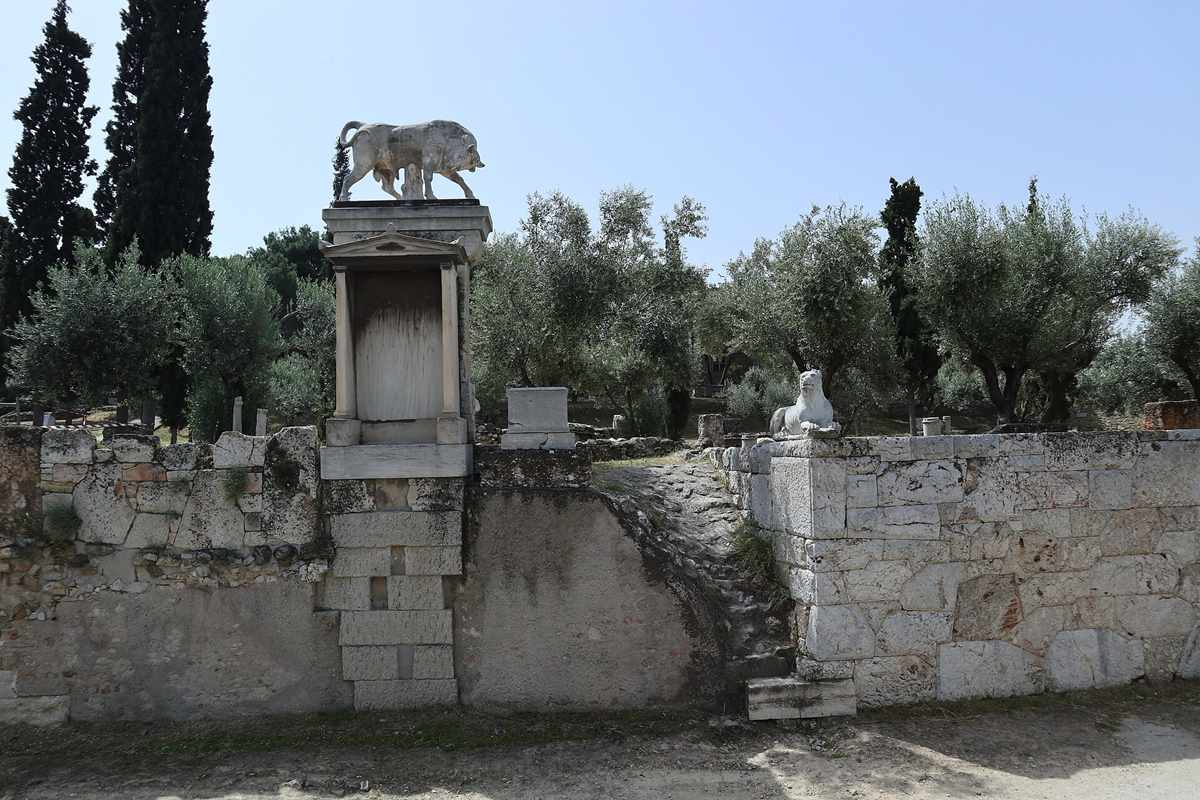
Featured photo: George E. Koronaios, CC0, via Wikimedia Commons (File:The ancient cemetery of Kerameikos in Athens, Greece.jpg).