
Ancient Greek medicine moved from temple healing to a written science of the body. Small-group trips through Greece take place across the mainland and the islands. Topics here run from the asclepieion to the Hippocratic Corpus. Later ones cover the four humours, Alcmaeon, Herophilos, Galen, Dioscorides and theriac. Related reading covers an Epidaurus tour, the Ancient Greek philosophers and Museums in Greece. Wider trip ideas sit on the page about Greece tours.
Bookings made through the GetYourGuide widgets on this page earn Classical Greece Tours a commission, at no extra cost to the traveller.
What was ancient Greek medicine?
Ancient Greek medicine held that health rested on a wide set of causes. Its healers named the humours, or body fluids, together with home region, social class, diet and injury. They also weighed the beliefs and the mindset of each patient.
In the earliest period, Greeks saw illness as a divine punishment from the gods. Healing, in turn, counted as a gift from those same gods. Over time, physicians tested their theories against symptoms and results. This purely spiritual view faded, and physical cause and effect became the base of ancient Greek medicine.
The Temple of Asclepius in Pergamum belonged to the Greek god of healing. A spring rose there and flowed down into an underground room inside the temple. People came to drink this water and to bathe in it. They believed that the spring held medicinal properties, meaning a power to treat illness.
Hippocrates and his students coined medical terms that remain in everyday use. Their words include acute, chronic, epidemic, exacerbation and relapse. An acute illness comes on quickly, while a chronic one lasts a long time. An epidemic describes an illness spreading widely through a population. Exacerbation means a worsening, and relapse means an illness returning.
- Name: The Greek term for the whole field of ancient Greek medicine was iatrikē.
- Brain: The word enkephalos, meaning brain, appears more than once in the Odyssey as well as the Iliad.
- Wind and water: Physicians held that local water and the direction of the wind shaped a town’s health.
Gentle remedies also had a place in ancient Greek medicine. At the healing temples, mud baths and hot chamomile tea served to calm patients. Peppermint tea soothed their headaches. That peppermint cure for a headache is still used as a home remedy today.
How did the asclepieion serve ancient Greek medicine?
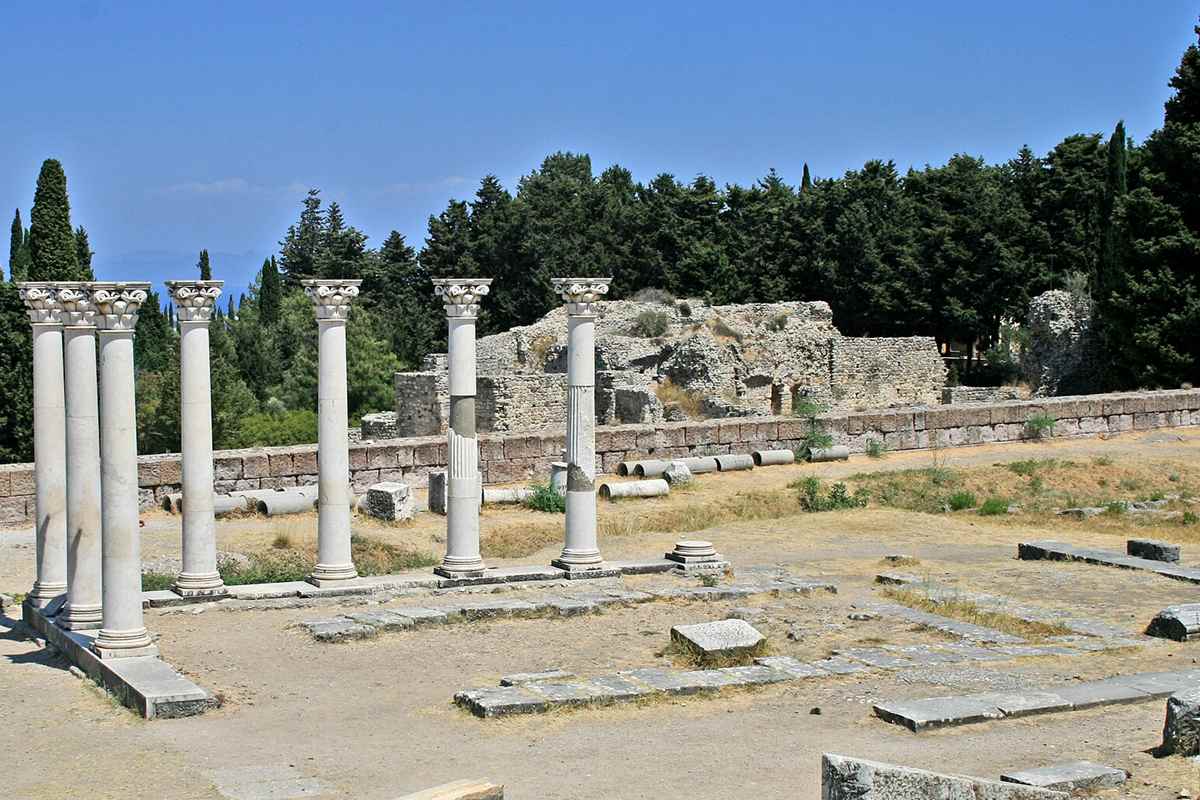
Ancient Greek medicine found a religious home in the asclepieion, a healing temple built for the god Asclepius. Its plural form is asclepieia. The best-known asclepieia stood at Trikka, Epidaurus, the island of Kos, Athens, Corinth and Pergamon.
Stories told that Asclepius was so skilled a doctor that he even raised the dead. Homer’s Iliad tells the story of the Trojan War in verse. In it, Asclepius is a mortal man rather than a god. There he serves as a physician to soldiers wounded on the battlefield.
Treatment at these temples centred on a healthy way of life. Each visitor’s spiritual needs received particular weight. The children of Asclepius shared in his fame as healers. Their names were Machaon, Podalirius, Hygeia and Panacea. Each was regarded as a highly effective healer in ancient Greek medicine.
Asclepius had certain totem animals, and stories said he came to sleeping supplicants in their shape. A totem animal is a creature that stands as the sign of a god. A supplicant is a person who comes humbly to ask for help. His three animals in ancient Greek medicine were the dog, the rooster and the snake.
- Trikka: Ancient writers of myth placed his birth at Trikka, yet excavations there have not found his shrine.
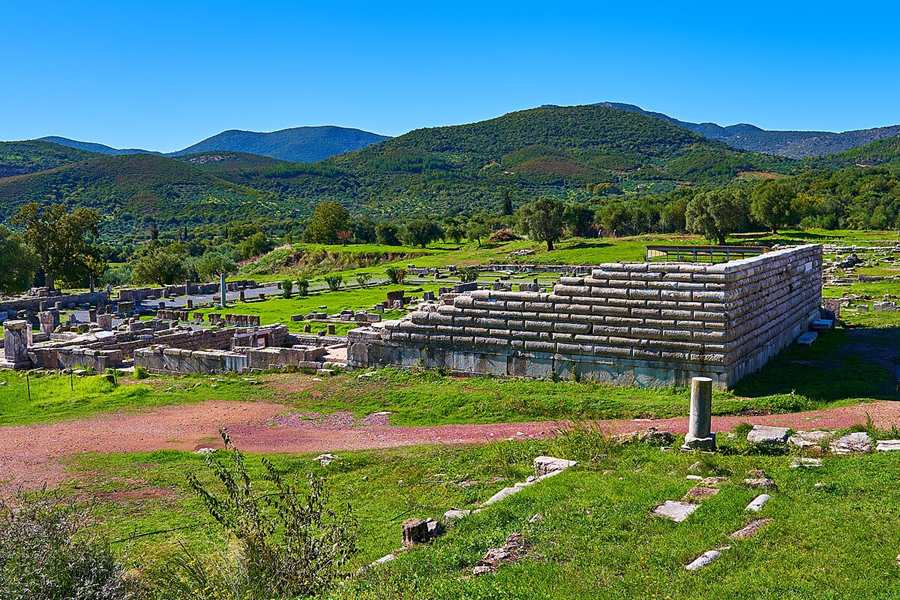
- Messene: The ancient city of Messene gained an asclepieion of its own in the third century BC.
- Dreams: Dream visits from the god were prognostic, revealing the expected course of each disease.
Ancient Greek medicine linked Asclepius with care for everyone. People admired him for serving all comers, whatever their class and social status. Such service to every level of society was rare among the Olympian gods. The Olympians were the chief gods of the Greeks.
Which writings form the Hippocratic Corpus of ancient Greek medicine?
Ancient Greek medicine survives in writing through the Hippocratic Corpus, also known as the Hippocratic Collection. Corpus is the Latin word for body, here a body of texts. It holds around 60 early medical works closely tied to the physician Hippocrates and his teachings.
Not one text in the collection is proven to come from Hippocrates himself. The works span his own era and school and reach centuries beyond it. The scholar Franz Zacharias Ermerins traced the hands of at least nineteen authors in the corpus. A hand, in this sense, means the work of one individual writer.
The corpus reaches beyond the Coan school of ancient Greek medicine. Coan means linked to the island of Kos. Works from the Cnidian school also appear in the collection. Cnidian refers to Cnidus, an ancient Greek city with a medical school of its own. A school here means a group of physicians who shared methods and teaching.
The bulk of these texts on ancient Greek medicine date from the Classical period. That span covers the last decades of the fifth century BC and the first half of the fourth. A closely linked group of surgical writings comes from about the same years. It includes On Fractures, On Joints and On Injuries of the Head.
- Origin: The corpus is possibly the remains of a library of Cos, or an Alexandrian collection.
- Languages: Texts of the Hippocratic tradition survive in Arabic, Hebrew, Syriac and Latin translations.
- Science: The writer Susan Wise Bauer calls the corpus the first surviving book of science.
Ancient Greek medicine fills the corpus in mixed forms. The collection holds textbooks, lectures, research, notes and philosophical essays. These pieces sit side by side in no particular order. Philosophical essays explore big ideas about life and knowledge.
What did the Hippocratic Oath ask of doctors in ancient Greek medicine?
Ancient Greek medicine gave the world the Hippocratic Oath, a sworn code of medical ethics for physicians. It ranks among the best-known Greek medical texts. An oath is a formal and binding promise, and ethics are the rules of right and wrong conduct.
Despite its name, modern scholars mostly do not credit the oath to Hippocrates himself. They place its writing in the fourth or fifth century BC instead. It is arguably the best-known text of the Hippocratic Corpus. That corpus is the collection of early works of ancient Greek medicine tied to his name.
In antiquity, a doctor who broke the oath faced punishment. That punishment ranged from a penalty to the loss of the right to practise medicine. The oath also banned the use of the knife, even for small operations. Yet other works of ancient Greek medicine in the Hippocratic Corpus explain how to perform surgery.
In the Byzantine Christian world, the oath stayed in use. Its references to pagan deities gave way to a Christian preamble. A preamble is the opening passage, and pagan means belonging to the old Greek gods. In the ninth century, the oath was translated into Arabic. That version replaced part of the preamble with an Islamic one.
- Secrecy: The Corpus work Physician speaks of keeping the holy things of medicine among doctors.
- Tombstones: The oath appears on the gravestones of physicians, a sign of its standing among doctors.
- First mention: The earliest surviving reference to the oath dates from 43 AD, by Scribonius Largus.
By the fourth century AD, this oath of ancient Greek medicine stood for the medical profession itself. A profession is a paid calling that demands long training and special skill. Law and medicine are the classic examples of such callings.
Why did the four humours matter in ancient Greek medicine?
Ancient Greek medicine taught that the body held four humours. Hippocrates named these vital bodily fluids as blood, phlegm, yellow bile and black bile. Phlegm means the thick mucus of the nose and throat. Bile is a bitter fluid made by the liver.
The English word humour comes from the Greek word chymos. Its literal meaning is juice or sap, and it also carried the sense of flavour. The theory was far from fixed across the Hippocratic writings of ancient Greek medicine. One set of writers accepted the existence of only two humours, while others left the theory out entirely.
Ancient Greek medicine had a name for each state of the humours. An imbalance was called dyscrasia, and doctors saw it as the direct cause of every disease. The proper blending and balance of all four was called eukrasia. That word joins the Greek parts for good and mixing, so it means a good mixture.
A Hippocratic treatise called On Airs, Waters, and Places ties disease to its surroundings. A treatise is a formal written study of one subject. In it, a physician arrives in an unnamed city. He studies the wind, the water and the soil there. From these, he predicts the diseases of that city by season and person.
- Treatment: Doctors removed excess humour through purging, bloodletting, which means drawing blood, and other methods.
- Black bile: Black bile counted as cold and dry, so it matched the season of autumn.
- Phlegm: Phlegm, both cold and wet, was paired with the winter months of the year.
The humours of ancient Greek medicine began to fall from favour in the seventeenth century. The later discovery of microbes finally disproved the whole theory. Microbes are tiny living things, such as bacteria, that are visible only under a microscope.
Who was Alcmaeon of Croton in ancient Greek medicine?
Ancient Greek medicine counts Alcmaeon of Croton among its early writers. He lived in the fifth century BC and worked as a medical writer and philosopher-scientist. A philosopher-scientist studied nature through both careful reasoning and direct observation.
Alcmaeon was born in Croton, a city of Magna Graecia, and his father was Peirithous. Magna Graecia, Latin for Great Greece, was the name for the Greek settlements of southern Italy. One tradition names him a pupil of Pythagoras, the philosopher and mathematician. Scholars of ancient Greek medicine believe he was born around 510 BC.
In ancient Greek medicine, he first proposed that health was a balance between opposing humours. Equality, or isonomia, among powers such as wet, dry, hot and cold kept the body healthy. The rule of one power over the others, which he called monarchy, produced disease. Monarchy here keeps its old sense of rule by one.
Alcmaeon also differed from his fellow thinkers about the mind. Empedocles held that the mind lived in the heart and that sensations came from like meeting like. Alcmaeon argued instead that sensations arose from meetings of unlike things. Sensations are what the senses take in. For him, the seat of the mind was the head.
- Other fields: Beyond medicine, Alcmaeon also practised astrology and meteorology, the study of weather.
- The ear: Ancient accounts credit him as the first person to identify the Eustachian tubes of the ear.
- On Nature: Tradition assigns him a work called On Nature, though the original title is uncertain.
A short saying by this pioneer of ancient Greek medicine survives as a fragment. In it, the earth serves as the mother of plants, while the sun acts as their father. A fragment is the remnant of a lost and longer text.
What did Herophilos discover for ancient Greek medicine?
Ancient Greek medicine gained one of its earliest anatomists in Herophilos. This Greek physician lived from 335 to 280 BC. An anatomist is an expert on the build of the body and its parts. His name sometimes appears in the Latin form Herophilus.
Herophilos was born around 335 BC in Chalcedon, a city of Asia Minor. The site is now Kadıköy, in Turkey. Asia Minor was the ancient Greek and Roman name for the peninsula of modern Turkey. At a fairly young age, he moved to Alexandria in Egypt to begin his schooling.
In ancient Greek medicine, Herophilos was the first scientist to carry out systematic dissections of human cadavers. A dissection is the careful cutting open of a body to study its inner parts. A cadaver is a dead human body kept for such study. Systematic means done step by step, according to a fixed plan.
Herophilos also worked out standards for measuring the pulse. These standards helped him to diagnose, or identify, sicknesses and diseases. The pulse is the regular throb of the arteries as blood flows through them. To time each pulse, he used a water clock. This device tracks time through water dripping at an even rate.
- Brain: He was the first in ancient Greek medicine to tell apart the cerebrum and the cerebellum.
- Eye: He called the retina retiform, because it resembles a casting net used for fishing.
- Gut: He gave the duodenum its name, and this organ forms part of the small intestine.
His pupil Philinus of Cos went on to found the Empiric school of ancient Greek medicine. That school joined the empirical drive of Herophilos with critical tools from Pyrrhonist philosophy, a school of doubt. Empirical means based on experience and observation, not on theory.
How did Galen of Pergamon carry ancient Greek medicine forward?
Ancient Greek medicine met Roman life in Galen of Pergamon, both a Roman and a Greek physician. He was born in September 129 CE and died around 216 CE. He also practised as a surgeon and wrote as a philosopher.
Galen’s Greek name, Galēnós, comes from a Greek adjective that means calm. His father, Aelius Nicon, was a wealthy patrician. A patrician was a member of the old noble class of Rome. Nicon worked as an architect and builder, and he held wide interests. These included philosophy, mathematics, logic, astronomy, farming and literature.
In Galen’s youth, Pergamon, now Bergama in Turkey, was a major centre of culture and learning. Its library ranked second only to the one in Alexandria. Around 145, Nicon dreamed that the god Asclepius appeared to him. In the dream, the god ordered him to send his son to study ancient Greek medicine.
In 157, aged 28, Galen returned to Pergamon. There he became physician to the gladiators of the High Priest of Asia. That priest stood among the wealthiest and the best-connected men in Asia. A gladiator was a trained fighter who fought in public shows. Asia here meant the Roman province in the west of modern Turkey.
- Travels: He studied ancient Greek medicine in Smyrna, Corinth, Crete, Cilicia and Cyprus, then at Alexandria.
- Wounds: Galen described the wounds of his gladiators as windows into the body.
- Results: Only five gladiators died during his post, against sixty under the doctor before him.
Galen held a firm rule within ancient Greek medicine. Before a diagnosis, a doctor had to observe and then reason. A diagnosis is the naming of an illness from its signs. To reason means to think a problem through with care.
Which plant cures did Dioscorides record for ancient Greek medicine?
Ancient Greek medicine drew on the plant knowledge of Pedanius Dioscorides. He lived from about 40 to 90 AD. He was a Greek pharmacologist, physician and botanist, and the author of De materia medica. A pharmacologist studies drugs, and a botanist studies plants.
Dioscorides was a native of Anazarbus in Cilicia, a region of Asia Minor. He is thought to have trained in ancient Greek medicine nearby, at the school in Tarsus. That school placed special weight on pharmacology, the science of drugs. He dedicated his medical books to Laecanius Arius, a medical practitioner there.
Dioscorides wrote his book in his native Greek between 50 and 70 AD. It filled five volumes. Its Greek title, Peri hylēs iatrikēs, means On Medical Material. Western Europe knew it better by the Latin title De materia medica. It became the forerunner of every modern pharmacopoeia, a book that lists medicines and their preparation.
The best-known copy is the lavishly painted Vienna Dioscurides. It was produced in Constantinople in 512 or 513 AD. Greek manuscripts of this work of ancient Greek medicine survive today in the monasteries of Mount Athos. A manuscript is a book that is copied out by hand.
- Title: Dioscorides is known as the father of pharmacognosy, the study of drugs from natural sources.
- Scope: His book describes about 600 plants in all, along with other medicinal substances.
- Yam: Linnaeus named the plant genus Dioscorea after him, and this genus includes the yam.
Ancient Greek medicine kept this book in steady use. Unlike other classical works, it needed no rediscovery in the Renaissance. It had never left circulation. For Western medicine into early modern times, its text eclipsed even the Hippocratic Corpus.
How does theriac fit into ancient Greek medicine?
Ancient Greek medicine gave its name to theriac, a mixed remedy. The Greeks first labelled it in the first century AD. Its use spread across the ancient world. It reached Persia, China and India along the trading links of the Silk Route.
The word theriac, a term of ancient Greek medicine, comes from the Greek thēriakē. This feminine adjective means pertaining to animals. It grows from thērion, the Greek word for a wild animal or beast. An adjective is a word that describes a noun. Feminine refers to the grammatical gender of the Greek word, not to women.
Legend traces the story of theriac back to King Mithridates VI of Pontus. He tested poisons and antidotes on his prisoners. An antidote is a substance that works against a poison. His remedy, known as mithridate, held opium, myrrh, saffron, ginger, cinnamon and castor. About forty other ingredients joined them in the mix.
Andromachus, physician to the emperor Nero, improved on mithridate. He raised the number of ingredients to sixty-four. Viper’s flesh, first roasted and then well aged, became its steadiest ingredient. The Greek physician Galen later devoted a whole book to theriac, titled Theriaké. In it he recorded notable theriacs such as Philonium.
- Purpose: In ancient Greek medicine, theriac served as an alexipharmic, an antidote against poisons and diseases.
- Emperor: Marcus Aurelius, the Roman emperor and a patient of Galen, took theriac on a regular basis.
- Later name: In the Middle East, theriac went by the name Tiryaq, and its makers were Tiryaqi.
According to Christiane Fabbri, the theriac of ancient Greek medicine and later ages brought real relief. The mixture very frequently contained opium. In her view, it eased pain and reduced coughing and diarrhoea. Opium is a strong drug made from the juice of the poppy.
What do travellers ask about ancient Greek medicine, and what are the answers?
The ancient Greek medicine of the temples left behind an emblem, the Rod of Asclepius. The symbol joins a snake and a staff, the two attributes of the healing god. The caduceus, with a pair of wings and two snakes, is sometimes misused in its place.
In ancient Greek medicine, what does the Rod of Asclepius look like?
The Rod of Asclepius is also called the Staff of Aesculapius. It is a rod with a serpent wound around it. Aesculapius is the Latin form of the god’s name. One view sees the staff as the walking stick of travelling physicians. The Greek word pharmakon meant drug, medicine and also poison.
Which doctor of ancient Greek medicine treated King Darius?
Democedes of Croton won praise from the historian Herodotus as the ablest physician of his time. His first post as a doctor seems to have been in the public service of Athens and Aegina. Later, King Darius sprained his ankle while hunting. His Egyptian doctors failed to help, but Democedes healed the ankle.
Which plant did ancient Greek medicine use against madness and gout?
Early doctors knew a black and a white hellebore. Greeks and Romans used black hellebore against paralysis, gout and psychosis, a grave mental illness. White hellebore is thought to be the kind Hippocrates used as a purgative, or laxative. In myth, Melampus of Pylos cured the daughters of the king of Argos with it.
Who was Soranus of Ephesus in ancient Greek medicine?
Soranus was a Greek physician of the first or second century AD. He was born in Ephesus but practised in Alexandria and later in Rome. He ranked among the leading figures of the Methodic school of medicine. He also spent time in Aquitania to treat skin diseases that were widespread there.
Featured photo: Karelj, Public domain, via Wikimedia Commons.