
Ancient Greek food lives on in small-group tastings, cooking classes and olive farm visits across Greece. These trips run in Athens, Crete, Corfu, Naxos, Rhodes, Santorini and Thessaloniki. The sections below explain barley maza, wheat loaves, lentils, Spartan black soup and the Cretan common meals. Further sections cover the symposium, silphium, Mithaecus, Archestratus, wine and Hekate’s monthly supper. Related pages cover Greek food, Olive oil tours in Greece and Greek wine regions. Every other trip appears under Greece tours.
Bookings made through the GetYourGuide widgets on this page earn Classical Greece Tours a commission, at no extra cost to the traveller.
What was ancient Greek food?
Ancient Greek food rested on cereals, which formed the staple of the daily diet across the Greek world. Cereals are grasses grown for their edible grain, such as wheat and barley. A staple is the basic food that a people eat every day.

Legumes counted for as much as the main crops in the average diet, if not more. Legumes are plants such as beans, lentils and peas, whose seeds grow in pods. Modern knowledge of ancient Greek food comes from three kinds of evidence. Scholars read written texts, study finds from digs and look closely at ancient art.
Fruit and vegetables made up a significant part of ancient Greek food. The Greeks ate much less meat than people in modern societies do. Fresh meat came mainly from sacrifices, when animals were killed as offerings to the gods. Sausage was far more common, and people across all levels of wealth ate it.
Men and women took their meals separately, and each group ate apart from the other. Mealtimes had no fork at all, because the fork was still unknown in Greece. Diners lifted every bite with their fingers instead. A fork is a pronged tool for lifting food, and Greek tables simply lacked one.
- Fruit bowl: Figs, raisins, dates and pomegranates ranked as the important fruits of the Greek table.
- Rare butter: Butter was known but seldom used, since Greeks saw it as a Thracian habit.
- Bread as cutlery: Pieces of bread served as spoons, or as napkins for wiping the fingers.
Olives were a common appetizer, a small dish served to open a meal. Beyond olives and grain, cooks of ancient Greek food knew a great diversity of ingredients. An ingredient is any single food that goes into a dish.
Why was maza called the basic dish of ancient Greek food?
Ancient Greek food had its basic dish in maza, which cooks prepared from barley flour. Barley is a cereal, a grass grown for the grain it carries. Flour is grain that millers have ground into a fine powder for cooking and baking.
Barley grew more easily than wheat in Greek fields. Turning it into bread, however, was a harder task for the baker. Barley was frequently roasted before it went to the mill. Milling then crushed it into a coarse flour called alphita, the raw material for maza. Coarse means rough and grainy rather than smooth.
Cooks served maza cooked or raw, so this ancient Greek food took more than one form. They also turned it into a broth, into dumplings or into flatbreads. A dumpling is a small ball of dough cooked in liquid. Like wheat breads, maza was at times made richer with cheese or honey.
The comic poet Aristophanes wrote a play called Peace. In it he used the phrase to eat only barley. The phrase carried the same sense as the English diet of bread and water. A diet of bread and water means the plainest ancient Greek food a person can live on.
- Serving dish: The mazonomus, named after maza, was a dish for handing out bread.
- Goddess name: The name Demeter possibly meant barley-mother, drawing on an ancient Cretan word for barley.
- Roasted groats: Pliny wrote that barley groats were dried and roasted before cooks made porridge.
Linear B tablets from Knossos and Pylos list barley rations handed out to workers. Linear B is the early script used to write Greek in the Mycenaean age. A ration is a fixed share of food. These records place barley in ancient Greek food from palace times.
How did wheat bread, or artos, fit into ancient Greek food?
Ancient Greek food used wheat for loaves called artos. Cooks first softened the wheat grains by soaking them in water. They then ground the grain into flour, kneaded it and shaped it into loaves. Kneading means pressing and folding dough with the hands.
In ancient Greek food, a small loaf had its own name, artidion. Bakers later learned to make dough rise with an alkali called nitron and with wine yeast. A leavening agent is anything that makes dough rise. An alkali is a salt-like mineral, and yeast is a living ferment that puffs up dough.
Families baked their dough at home, in a clay oven known as an ipnos. This oven stood on legs above the floor. A simpler method began with lit coals heaped on the floor. Cooks covered the heap with a dome-shaped lid called a pnigeus. A dome is a rounded cover shaped like half a ball.
Bread wheat was difficult to grow in a Mediterranean climate. White bread made from it was linked with the upper classes of ancient Greek food culture. The poor ate coarse brown breads instead. These darker loaves were made from emmer wheat and barley. Emmer is a wheat with a tough husk around each grain.
- Stone ovens: The stone oven did not appear in the Greek world until the Roman period.
- A baker’s shop: In Gorgias, Plato treats Thearion the baker as a new arrival in Athenian life, selling home-style goods.
- Loaf shape: Loaves were, as a rule, flat and round, and scored into four or more parts.
Pliny the Elder dated a shift in bread making to 171 BCE. From that year, he suggested, skilled artisans took over baking from families. An artisan is a worker trained in a craft. The change moved ancient Greek food toward the bakery.
Which place did the lentil hold in ancient Greek food?
Ancient Greek food counted lentils among its oldest foods. They were the earliest legumes harvested in the Mediterranean region, and the commonest too. A lentil is a small, flat seed that grows inside a pod. A legume is any plant that bears its seeds in pods.
Lentils entered ancient Greek food very early, and archaeologists have found them at Upper Paleolithic sites in Greece. The Upper Paleolithic is the late part of the Old Stone Age. Charred lentil seeds also came to light at Argissa-Magula in Thessaly. These seeds date from 6000 to 5000 BC. Charred seeds are seeds burnt black.
Lentils and chickpeas are the legumes named in classical literature more than any others. Classical literature means the writings of ancient Greek and Roman authors. Theophrastus wrote that no leguminous plant yielded as much as the lentil. He called it the prolific one, a word that means producing a large crop.
Vegetables were eaten as soups in ancient Greek food. Cooks also boiled them, or mashed them into a thick purée. They seasoned these dishes with olive oil, vinegar or herbs. A purée is food crushed until smooth and soft. Vinegar is a sour liquid that gives a sharp taste to a dish.
- Nickname: Hegemon the Thasian wrote cookbooks and was known by the nickname Lentil-soup.
- Comic glutton: Aristophanes showed the hero Heracles as a glutton with a fondness for mashed beans.
- Ritual vessel: Athenaeus described the kernos, whose little bowls held lentils, beans and other offerings.
The value of legumes went beyond the cooking pot in ancient Greek food. Greeks knew by the time of Xenophon that these plants replenish exhausted soil. To replenish soil means to give back the goodness that earlier crops took out of it.
Why did Sparta’s black soup stand out in ancient Greek food?
Ancient Greek food from Sparta included black soup, a dark broth served at Spartan tables. Ancient writers also called it haimatia, which means blood soup. Another of its names was bapha, a word that translates as dip sauce. Broth is a thin soup.
In Ancient Greek, melas means black, while zomos named any soup cooked with animal products. Black soup used blood, and cooks mixed vinegar into the blood during cooking. The vinegar slowed down clotting and kept the blood from spoiling. Clotting is the way blood thickens into lumps once it leaves the body.
Comic poets wrote this ancient Greek food into their plays. In The Miners by Pherecrates, a woman returns from the underworld. In myth, the dead dwelt in this underworld. She reports seeing black broth flowing freely through the streets. The poet Nicostratus once mocked a cook for not knowing how to prepare Spartan black soup.
The question of who first made this ancient Greek food has a stage answer. In The Brothers, a comedy by Euphron, a cook names a man called Lamprias as its inventor. Euphron wrote his comedies in the third century BC. A comedy is a funny play written for performance in a theatre.
- Pea soup: The poet Alcman suggested that ordinary Spartans ate pea soup rather than black soup.
- Cheap company: A poem by Matro of Pitane puts black soup beside boiled off-cuts such as ears and snouts.
- Sybarite joke: A man of Sybaris joked that anyone sensible preferred death ten thousand times over such a diet.
In one tale of ancient Greek food, a king of Pontus bought a Laconian cook. He wanted to taste black soup but found it extremely bad. The cook answered that the king needed to bathe first in the river Eurotas to enjoy it.
How did the syssitia shape shared meals in ancient Greek food?
Ancient Greek food was also eaten at syssitia, common meals shared by groups of men. Besides Crete and Sparta, the city of Megara held them in the time of the poet Theognis. Corinth held them under its ruler Periander. A syssition was one such dining group.
Ancient tradition credited the custom to Rhadamanthus, the legendary lawgiver of Knossos on Crete. A lawgiver is a person who draws up the laws of a state. In Crete, the shared meals took place in an andreion. That name was used for the building or public hall where the diners gathered.
Each Cretan town had two public buildings, according to the writer Dosiadas. One lodged strangers, and the other was the andreion for the common meals. Cretan diners always sat at their tables for this ancient Greek food. They kept this habit even after reclining on couches had come into use in Sparta.
An official called the Archon, or Master of the Tables, oversaw each Cretan hall. He received four portions of ancient Greek food instead of one. One portion was his as a citizen and one as president. The other two covered the building and its furniture. A portion is one person’s share of a meal.
- Table manager: A free-born woman managed the tables and gave the best portion to the leading citizen.
- Guests first: Strangers were served before citizens, and even before the Archon himself.
- Young diners: Boys sat near the men on a lower bench and got a half portion of meat.
Sparta had its own entry rite for these ancient Greek food clubs. Each member dropped a small ball of soft bread into a deep basin. A ball pressed flat between the fingers counted as a vote against the newcomer who hoped to join.
What role did the symposium play in ancient Greek food and drink?
Ancient Greek food and drink came together at the symposium. Its Greek name was long translated into English as banquet. Taken more literally, the word means a gathering of drinkers. A banquet is a large formal meal for invited guests, held to mark an occasion.
A symposium had two parts. The first was given over to food, which was plain as a rule. The second part was given over to drinking. At this stage, ancient Greek food meant snacks called tragemata, served with the wine. They included chestnuts, beans, toasted wheat or honey cakes, meant to soak up alcohol.
The drinking part opened with a libation, poured above all in honour of Dionysus. In a libation, the drinker spills a little wine as a gift to a god. Wine belonged to Dionysus in Greek religion. Guests reclined on couches called klinai. Low tables nearby held the food or the boards for table games.
Aristocrats held symposia to mark special occasions in ancient Greek food culture. A victory in an athletic contest gave one reason to gather. Success in a poetic contest gave another. An aristocrat was a member of the wealthy, high-born class. A contest is a competition judged to find a winner.
- Entertainers: Dancers, acrobats and musicians entertained the wealthy guests at these banquets.
- Young guests: Young men who joined in did not recline on couches but sat up.
- Shared cup: As a rule, one single cup passed from man to man around the room.
Ordinary Greek homes held banquets too, though on a smaller scale. Religious feasts or family events gave the occasion for these more modest gatherings. A modest banquet still joined ancient Greek food and wine, but without the cost of a great feast.
Which lost plant, silphium, once seasoned ancient Greek food?
Ancient Greek food was once seasoned with silphium, a plant that nobody can identify with certainty today. In classical antiquity it served as a seasoning, a perfume and a medicine. A seasoning is something added to food to give it more flavour.
Silphium was an essential item of trade for Cyrene, an ancient city in North Africa. The plant was so critical to the local economy that it appeared on the money. The majority of Cyrenian coins bore an image of silphium. An economy is the system of work and trade that keeps a place running.
The valuable part for ancient Greek food and medicine was the plant’s resin, known in Latin as laser. Resin is a sticky substance that oozes from certain plants. Scholars commonly believe silphium was a relative of giant fennel. That link places it in the genus Ferula. A genus is a rank that gathers closely linked species under one name.
The writer Theophrastus left a description of silphium for readers of ancient Greek food history. He noted a hollow stalk, similar to the stalk of fennel. He also described golden leaves like those of celery. Fennel and celery are both garden plants still grown for food today.
- Native range: Its narrow native range lay in the southern steppe of Cyrenaica, in present-day eastern Libya.
- No farming: Theophrastus wrote that silphium was odd because nobody managed to cultivate it.
- Last stalk: Pliny reported that the last known stalk went to Emperor Nero as a curiosity.
Silphium vanished from ancient Greek food and from the wild. Its loss has been suggested as the first extinction of a plant or animal species in recorded history. Extinction means that a species has died out completely, with no living plants left.
Who was Mithaecus, the first known cookbook writer of ancient Greek food?
Ancient Greek food gave the world Mithaecus, the first known author of any cookbook. A cookbook gathers recipes in written form for others to follow. A recipe is a set of steps that explains how to prepare a dish from start to finish.
Mithaecus worked as a cook and wrote cookbooks on ancient Greek food in the late 5th century BC. He was a Greek-speaking native of Sicily, then part of Magna Graecia. That name covered the Greek settlements of southern Italy and Sicily. In his day, the island was rich and highly civilised.
He is credited with bringing knowledge of Sicilian gastronomy to Greece. Gastronomy is the art of choosing, cooking and eating good food. Sources of varying reliability say he worked in Sparta. The Spartans expelled him as a bad influence, and he also worked in Athens. A bad influence is a person thought to lead others astray.
The philosopher Plato mentioned Mithaecus in his dialogue Gorgias, and the mention was unfavourable. A dialogue is a written work set out as a talk between speakers. Unfavourable means critical, so the remark gave this ancient Greek food writer no praise. Philosophy, the subject Plato taught, is the search for wisdom through reasoning.
- Dialect: The surviving recipe is in Doric Greek, suited to both Greek Sicily and Sparta.
- The fish: It deals with tainia, a ribbon-like fish known to science as Cepola macrophthalma.
- Method: The cook guts the fish, discards the head, rinses, slices, then adds cheese and olive oil.
Plato also named Mithaecus beside Thearion and Sarambos in ancient Greek food lore. He called the three men eminent connoisseurs of cake, kitchen and wine. A connoisseur is a person with expert taste in a field such as cooking.
What did the poet Archestratus write about ancient Greek food?
Ancient Greek food found a lively writer in Archestratus, a poet of the 4th century BCE. He gave himself the title of inventor of made dishes. A made dish is one prepared from a recipe, rather than plain food served as it comes.
His poem was written in hexameters, yet it survives only through quotations. Each hexameter line holds six measured beats of verse. Readers gave this ancient Greek food poem different titles. Lynceus and Callimachus called it The Art of High Living, while Clearchus called it The Art of Dining.
The poem had a certain notoriety among readers in the 4th and 3rd centuries BCE. Notoriety means fame of a doubtful or unwelcome kind. The comic poet Antiphanes referred to the work. So did Lynceus of Samos and the philosophers Aristotle, Chrysippus and Clearchus of Soli. A comic poet wrote comedies, the funny plays of the Greek stage.
In nearly every case, those writers spoke of the poem with scorn. Their remarks were disparaging, which means they belittled the work. They implied that a poem on ancient Greek food and luxury risked corrupting its readers. To corrupt someone means to lead that person into bad habits.
- Tripe recipe: He cooked paunch and tripe in cumin juice, vinegar and strong-smelling silphium.
- Latin version: The poet Ennius translated or imitated the poem in Latin, but that work is lost.
- Wine praise: Greek writers like Archestratus admired Bibline wine for its perfumed fragrance.
The philosopher Chrysippus warned readers away from this ancient Greek food poem. He advised against studying the Gastronomy of Archestratus in the hope of a better life. Gastronomy was one of the titles that ancient readers gave to the work.
How does the Deipnosophistae preserve ancient Greek food?
Ancient Greek food fills the pages of the Deipnosophistae, a long work by Athenaeus. Food and wine rank among its major topics, beside luxury, music, literary gossip and philology. Philology means the close study of old texts and the words they use.
Athenaeus framed the book as an account given to his friend Timocrates. Timocrates hears what the learned guests said about ancient Greek food at their dinners. Each conversation is long enough to occupy a number of days in real life. The whole book is thus a dialogue within a dialogue, in the manner of Plato.
Masurius, Zoilus, Democritus, Galen, Ulpian and Plutarch appear among the named guests. Research links a number of these guests with real people from other sources. The talk also quotes earlier writers of recipes. Among them are Glaucus of Locri, Epaenetus and Timachidas of Rhodes. A recipe writer records how dishes are made.
Athenaeus describes a variety of stuffed dishes from ancient Greek food. Cooks filled squid, spleen and ray. They also stuffed sheep, goose, boar, pig and piglet. A stuffed dish is a food opened or hollowed out and filled with another mixture before cooking. A ray is a flat sea fish with wide fins.
- Wrapped foods: Oysters came wrapped in seaweed, and eels came wrapped in beet leaves.
- Clever chef: Soterides, chef to King Nicomedes I of Bithynia, carved turnips to look like anchovies.
- Short version: A medieval Epitome, about 60 per cent of the text, survives complete.
A manuscript is a book copied out by hand. This great store of ancient Greek food lore survives in a single manuscript. The whole of books 1 and 2, and other pages too, disappeared from that copy long ago.
Where did wine fit into ancient Greek food and drink?
Ancient Greek food went hand in hand with wine from vines grown in Greece since the late Neolithic. Vine growing had become widespread by the early Bronze Age. Viticulture is the farming of grapevines for wine. The Neolithic is the New Stone Age.
The name Oinops, meaning wine-coloured, appears twice in Linear B tablets at Knossos. Linear B tablets carry an early form of written Greek, pressed into clay. Country folk made a secondary wine for home use, a humbler side of ancient Greek food and drink. They mixed water with pomace and lees. Pomace is the pulp left from squeezed grapes.
At crushing time, workers gripped a rope over the vat to keep steady. They trod the grapes with their feet, sometimes to the sound of a flute. The crushed grapes then went into large pithoi. These jars were where fermentation took place. Fermentation is the change that turns grape juice into wine.
Straw wine belonged to ancient Greek food and drink from early times. Hesiod and the Odyssey hold early mentions of it, among the first on record. Workers laid freshly picked grapes on mats until they dried nearly to raisins. Only then did the grapes go to the press for their juice.
- Free-run juice: Protropon, a wine from Lesbos, was among the first made only from free-run juice.
- Sweet must: Boiling grape must was discovered as another way to add sweetness to wine.
- Women and wine: Sparta was the only city where women routinely drank wine.
Vintage wines carried stamps from their producers or from city magistrates. These stamps guaranteed where the wine came from. They gave an early mark of origin in ancient Greek food and drink. A magistrate was a public official with legal duties in a city.
What was Hekate’s Deipnon in ancient Greek food customs?
Ancient Greek food used the word deipnon for the evening meal. As a rule, it was the day’s largest meal. Hekate’s Deipnon was something else: a religious offering meal. Families set it out once a lunar month for the goddess Hekate and the restless dead.
The Deipnon fell on the last day of the month. That date followed the Attic calendar of ancient Athens, which tracked both the moon and the sun. A calendar of this kind is called lunisolar. The rites let each family begin the new month, which they celebrated as the Noumenia.
The rite had three main parts. First came a meal set out at a crossroads. Then followed a sacrifice to make amends, and finally a cleansing of the house. Sources name certain ancient Greek food items again and again. They are raw eggs, a small cake, garlic, leeks or onions, and fish.
Families placed the ancient Greek food offering on top of, or inside, a small shrine to Hekate. The shrine stood outside the house door, and they set the food there after sunset. The street and the doorway together formed a three-way crossroads, sacred to Hekate. A shrine, in plain words, is a holy spot set aside for offerings.
- No glance back: The person who set out the meal never looked back at it.
- Hungry visitors: People in extreme poverty ate the meal themselves, though others thought this sacrilegious.
- Fallen food: Food that dropped to the floor was never picked up, since it now belonged to Hekate.
On the nights of the Deipnon, Athenians did not leave their homes after dark. Roaming spirits were believed to walk abroad during this ancient Greek food rite. A spirit, in this sense, is the ghost of a dead person.
What do travellers ask about ancient Greek food, and what are the answers?
The ancient Greek food world was bound up with song, sport, worship and the layout of the home. Banquet songs and the huge meals of a wrestler shaped how Greeks ate together. So did great animal sacrifices and a dining room kept for men.
In ancient Greek food culture, what was a skolion?
A skolion was a song sung by invited guests at banquets in ancient Greece. The plural is skolia. A lyre went with each song, handed from singer to singer as every turn came round. A lyre is a hand-held harp with strings over a frame. Alcaeus, Anacreon, Praxilla, Simonides, Sappho and Pindar all wrote skolia.
Which athlete is tied to huge meals in ancient Greek food stories?
Milo of Croton was a wrestler and a six-time Olympic winner. One of those wins came in the boys’ wrestling contest. Milo was said to eat twenty pounds of meat and twenty pounds of bread each day. He once carried a grown cow the length of the stadium. He then killed, roasted and ate it.
How did a hecatomb feed people in ancient Greek food traditions?
A hecatomb was a sacrifice of one hundred cattle to the Greek gods. The word joins Greek terms for one hundred and for a bull. In practice, a group of just twelve animals counted as a hecatomb. In the Iliad, the meat was roasted on spits, and every man had his full share.
Where did hosts receive dinner guests, according to ancient Greek food customs?
Hosts received male guests in the andron, the part of a Greek house reserved for men. The women’s quarters had a separate name, the gynaeceum. The andron held couches, kept to an odd number to leave space for the door. Its tables fitted under the couches when tucked away.
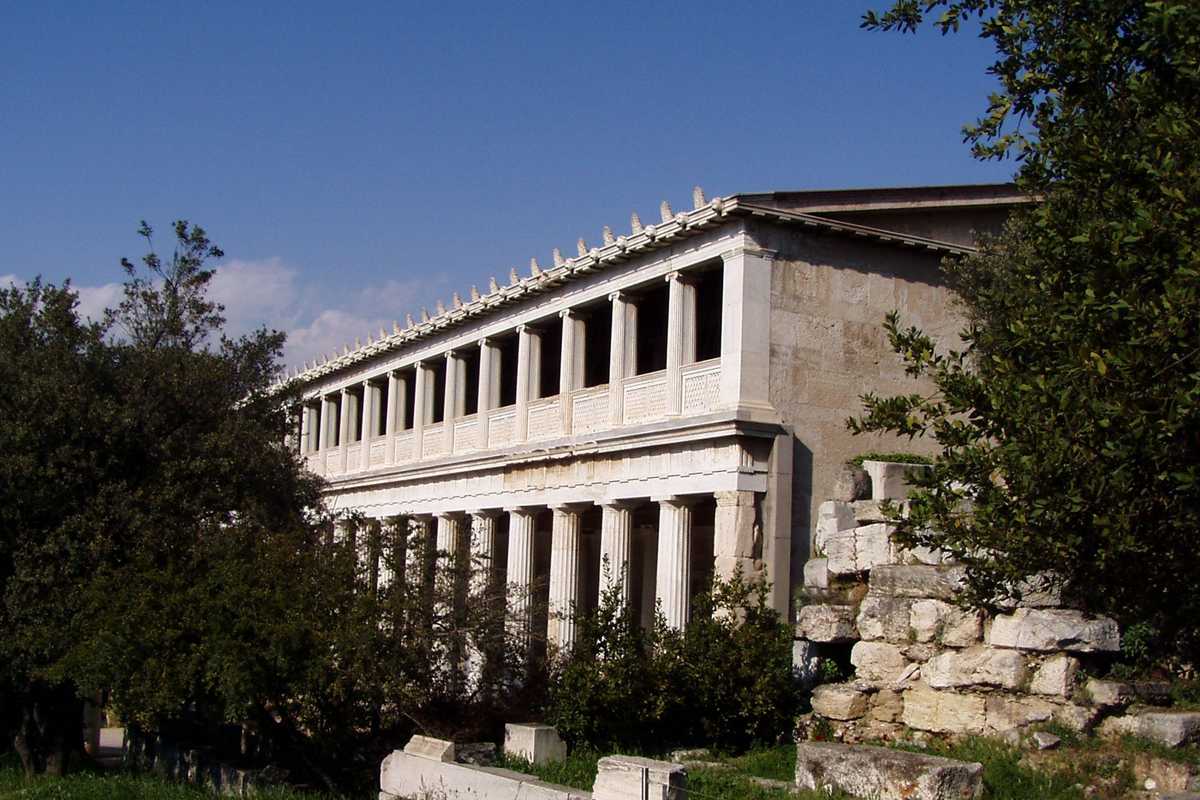
Featured photo: DerHexer, CC BY-SA 3.0, via Wikimedia Commons.