
Ancient Greek democracy began in Athens. The tours linked to it are expert-led outings in Athens and the wider region of Attica. The sections below explain the Pnyx, the ecclesia, the boule, the Heliaia, ostracism and the kleroterion. They also cover Solon, Cleisthenes, Ephialtes, Pericles, the Areopagus, Thrasybulus and sortition. Further reading covers the Parthenon, the Ancient Greek philosophers and other ancient Greek sites. Each of these outings also counts among the wider Greece tours.
Bookings made through the GetYourGuide widgets on this page earn Classical Greece Tours a commission, at no extra cost to the traveller.
What was ancient Greek democracy?
Ancient Greek democracy took shape in the city-state of Athens around the 6th century BC. A city-state, or polis, was a self-ruling city. It covered the city and the territory of Attica, upholding liberty, equality and security.
The Greek word demokratia has two parts. Demos means the people or the towns, and kratos means force or power. Literally, the word means people power. An older term, isonomia, meaning equality under law, named the same idea. Around 460 BC, Democrates appears as a name, possibly a nod to ancient Greek democracy.
Only free adult men with citizen rights took part in ancient Greek democracy. Minors, metics, women and slaves had no share in the system. A metic was a foreigner living in Athens without citizen status. By scholarly estimate, adult male citizens formed no more than 30 percent of the adult population.
Athens was neither the only city-state with ancient Greek democracy nor the first one. Other city-states set up comparable democratic systems ahead of Athens. By the late 4th century BC, up to half of over one thousand Greek cities were possibly democracies. Corinth, a major power, had no more than 15,000 adult male citizens.
- Macedonian conquest: Democratic forms in Athens lasted until Philip II of Macedon conquered the city in 338 BC.
- Roman honours: Under Roman rule, Domitian and Hadrian held the archon post, a senior office, as an honour.
- A seizure of power: In 88 BC, the philosopher Athenion seized sole power and forced the Assembly to elect his picks.
The Roman general Sulla defeated that revolt yet spared the lives of the Athenians. He also restored the previous government of Athens in 86 BC. Under Augustus, Athens lost even its nominal independence. Its government then ran like that of any Roman municipality, a self-governing town.
Why does the Pnyx matter to ancient Greek democracy?
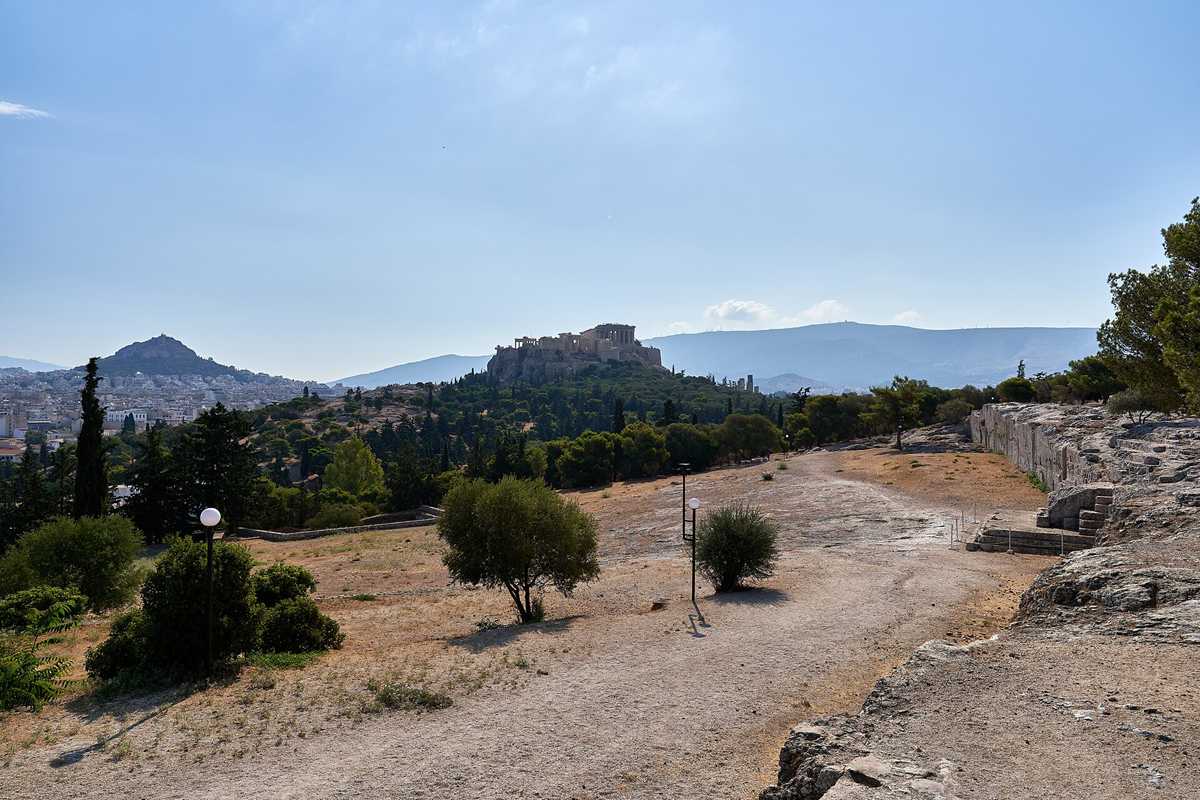
Ancient Greek democracy found its meeting ground on the Pnyx, a hill or hillside in central Athens. The citizen assembly met there, one of the earliest known democratic legislatures in the world. In Greek, the name Pnyx means tightly packed together.
In the early 5th century, ancient Greek democracy moved its assembly to a rise south-west of the Acropolis. The spot then lay outside the city proper, though near enough to be handy. Its mainly natural hollow served from before 500 BC, possibly until 404 BC. A hollow here means a bowl-shaped dip in the ground.
Around that date, builders set a retaining wall beneath the speakers’ platform and packed earth behind it. A retaining wall holds back soil on a slope. In a third phase, about 345 to 335 BC, the Pnyx was rebuilt and enlarged. Workers cut its southern side and the speakers’ platform straight from the bedrock.
A defensive wall guarded the Pnyx from the 4th century BC and was rebuilt a century later. Its new stretches stood two metres thick, built of near-solid masonry and squared blocks. Seven towers rose along it at 40-metre spacing. In the 1st century BC at the latest, ancient Greek democracy held assemblies in the Theatre of Dionysos.
- Standing room: In ancient times, the bare rock before the platform held about 6,000 standing men.
- Speakers: In practice, only a small share of citizens spoke or put forward proposals.
- Removed altar: An altar of Zeus Agoraios stood on the site until it was removed under Augustus.
Ancient Greek democracy gave its speakers a stage that scholars rank above the Roman Forum for inspiration. Today the site falls under an ephorate, or antiquities office, of the Greek Ministry of Culture. Its surrounding parkland is fenced off.
How did the ecclesia run ancient Greek democracy in Athens?
Ancient Greek democracy gave its last word on laws to the ecclesia, the assembly of citizens. City-states across ancient Greece held such assemblies, and the Athenian one is the best known. It also called magistrates, or officials, to account after their year in office.
Unlike members of a parliament, those in the assembly of ancient Greek democracy were not elected. Each attended by right when he chose. Every adult male citizen past his 20th year had a place, and attending counted as a duty. Back in 594 BC, Solon had opened the assembly to every Athenian citizen, whatever his class.
The assembly first met once a month, and later three or four times. A typical meeting drew around 6,000 people from a citizen body of 30,000 to 60,000. Citizens voted by raising hands, by counting stones, or with broken pottery. Under ancient Greek democracy, a simple majority decided each vote.
A vote by raised hands was called kheirotonia, meaning arm stretching, and officials judged the result by sight. Darkness made the count hard to read, but any member was free to demand a recount. As in other ancient democracies, a man had to attend in person to vote. Military service or distance kept others away.
- Citizenship votes: For grants of citizenship, voters dropped white stones for yes and black for no.
- Main meeting: In the 4th century BC, one monthly meeting became the kyria ekklesia, or main meeting.
- No hall: Athens had no ekklesiasterion, a hall built only for assembly meetings.
Poorer citizens outside the city centre found attending hard until payments began in the 390s BC. Regular meetings of ancient Greek democracy took place on the Pnyx. Two meetings each year were held in the Theatre of Dionysus.
What role did the boule play in ancient Greek democracy?
Ancient Greek democracy relied on the boule, a council that ran the daily business of the city. In Athens, it grew into a body of 500 male citizens after 508 BC. Its members met every day except on festival days and ill-omened days.
The boule began as a council of nobles who advised a king. Under Solon, the Athenian council heard appeals against the weightiest rulings of the courts. It held 400 members, with 100 drawn from each of the four old tribes. Men from outside those tribes had no vote and no seat.
Each of the ten tribes sent 50 men from its demes, or local districts. A candidate had to be a male citizen aged 30 or more who faced no criminal charge. He had to volunteer as well. No man sat on the council more than twice, or more than once in ten years.
The members from one tribe at a time acted as a standing committee called the prytaneis. The fifty men on duty lived and ate in the tholos, a round building. The committee’s chairman changed every day, picked by lot, or random draw. In ancient Greek democracy, the boule also drafted probouleumata, the proposals the assembly debated.
- Pay: Council pay in ancient Greek democracy began in the late 5th century, possibly to draw poorer citizens.
- Wealth gap: Evidence suggests richer citizens served on the council out of proportion to poorer ones.
- Modern name: The word boule, said Vouli in Modern Greek, still names the Parliament of Greece.
Ancient Greek democracy treated the boule as the cornerstone of its constitution. The council gave daily work a home and held the scattered tasks of government together. It also stood behind about half of the decrees that the assembly approved.
Where did the Heliaia fit into ancient Greek democracy?
Ancient Greek democracy staged its chief trials at the Heliaia, the largest court venue in Classical Athens. Ancient sources used the name for the whole court system too. Modern scholars keep it for the venue and call the courts the dikasteria, or people’s courts.
In ancient Greek democracy, the noun heliaia came from the verb halizein, meaning to gather people together. Despite the likeness, it has nothing to do with helios, the Greek word for sun. Inscriptions from the fifth century spell it eliaia, without the opening letter eta. At Argos, the related word haliaia named the popular assembly.
The Heliaia also meant the body of 6,000 citizens who swore the Heliastic Oath. The oath bound each juror to rule by the laws and decrees that the Assembly and Council passed. Where no law applied, he judged by his own sense of justice. The oath was renewed each year, and no complete text survives.
The Heliaia of ancient Greek democracy has never been located. After digs in the 1950s, experts tentatively linked it with a large unroofed enclosure. That enclosure stands at the south-west corner of the Agora, the old civic square. In 1998, Ronald S. Stroud proposed it was the Aiakeion, a shrine to the hero Aiakos of Aegina.
- Panel size: The building held the largest juries, from over 500 up to 2,500 jurors.
- Daily draw: A daily lottery partly aimed to keep the venue for each case unknown in advance.
- Timed speeches: A water clock, or clepsydra, timed each speech, with the prosecutor speaking before the defendant.
Justice under ancient Greek democracy moved fast. A case lasted no longer than one day and had to end by sunset. No judge presided, and nobody gave the jurors legal direction. Once a jury had voted, no appeal was possible.
How did ostracism protect ancient Greek democracy?
Ancient Greek democracy used ostracism to remove, in advance, a citizen seen as a threat to the state. Broken pottery, plentiful and nearly free, served as its ballot paper. No charge was laid, and the man named had no chance to mount a defence.
The assembly put the question in the sixth of the ten state months, around January or February. If a majority agreed, the vote itself took place two months later. Nine archons, or senior officials, oversaw the count with the council of 500. The archons sorted the ostraka, the inscribed shards, into piles, one for each name.
Under ancient Greek democracy, a banished man who tried to return early faced death. After ten years he came back free of stigma, or public shame. Before the Persian invasion of 479 BC, an amnesty, or general pardon, recalled at least two exiles. These were Xanthippus, father of Pericles, and Aristides the Just.
In ancient Greek democracy, ostracism belonged to the fifth century BC alone. The first man was not expelled until 487 BC. He was Hipparchos, son of Charmos, who was related to the tyrant Peisistratos. Tyrant here means a one-man ruler lacking any lawful claim. Cleisthenes’ nephew Megacles is named on 4647 surviving ostraka.
- Hunger: A handful of ostraka carry the word Limos, meaning hunger, instead of a person’s name.
- Olive leaves: Syracuse copied the practice and called it petalismos, since names went on olive leaves.
- Insults: Jibes did not spoil a vote, and one ostrakon labels a man named Agasias the donkey.
Ancient Greek democracy treated ostracism as a preventive step rather than a punishment. The vote took place no more than once a year and named one person only. Unlike a trial, it needed no single citizen to bring a prosecution.
What was the kleroterion in ancient Greek democracy?
Ancient Greek democracy relied on the kleroterion, a device that made random choices. Athens used it to fill the council and the juries. It also chose lawmaking panels and the bulk of state offices. The device was a stone slab cut with rows of slots.
Each citizen’s token went at random into a slot. All tokens from one tribe sat in the same column. Dice of two colours, assumed to be black and white, dropped through a tube. A die of one colour picked a whole row of citizens. A die of the other colour set the row aside.
Before 403 BC, citizens who wanted jury duty queued at the court entrance as the day began. Places went to whoever arrived first. Under ancient Greek democracy, allotment went through reforms from 403 BC onwards. Allotment here means handing out posts by drawing lots. The kleroterion came into use from 370 BC.
Aristotle described the jury draw of ancient Greek democracy in his Constitution of the Athenians. The first token pulled from a chest named the token inserter, or empektes. He also became a juror. Each machine held five columns, one per tribe section. The count of white dice rose and fell with the number of jurors required.
- Finds: Archaeologists first found kleroteria in the Athenian Agora in the 1930s, dating them to the second century BC.
- Machine, not room: Sterling Dow argued that kleroterion meant a machine rather than an allotment room.
- First study: James Wycliffe Headlam’s book Election by Lot, published in 1891, first examined Athenian allotment closely.
In 1937, Dow published a catalogue of eleven fragments of kleroteria found in the Agora. The release mechanism of these machines of ancient Greek democracy has not survived. Scholars think it used two nails, one blocking the tube and one holding back the next die.
How did Solon lay the groundwork for ancient Greek democracy?
Ancient Greek democracy looks back to Solon, an Athenian lawmaker listed with the Seven Sages of Greece. Aristotle called him the first champion of the people. Demosthenes later said that a golden age in Athens began with his reforms.
Solon came from a noble, or Eupatrid, clan. His brother Dropides was an ancestor of the philosopher Plato, six generations back. When Athens and Megara fought over Salamis, Solon led the Athenian forces. His nationalist poem about the island lifted the troops’ morale. Sparta later awarded the island to Athens after hearing his case.
Before Solon, the Areopagus picked nine archons, or chief magistrates, every year by noble birth and wealth. Solon then set up four property classes, an early step in ancient Greek democracy. Each class depended on the yearly yield of a man’s estate. The top class, the pentakosiomedimnoi, reaped at least 500 medimnoi, a dry measure of grain.
In Solon’s day, a horos was a wooden or stone pillar showing that a farmer owed a debt. When his law cancelled debts, Solon released his own debtors too. Those debts totalled five talents, a talent being a large weight of silver. His laws stood in the Prytaneion, the town hall, on axones, or upright wooden slabs.
- Travels: Solon left Athens for ten years so that no one pressed him to repeal his laws.
- Full armour: In protest at the rising power of Pisistratus, Solon stood outside his home in full armour.
- Office limits: Under Solon’s early form of ancient Greek democracy, only the top class stood for election as archons.
Within four years of his departure, the old social rifts in this early ancient Greek democracy opened again. Elected officials sometimes refused to stand down, and key posts were left empty. Plutarch says Solon accused the Athenians of stupidity and cowardice for allowing one-man rule.
Why is Cleisthenes central to ancient Greek democracy?
Ancient Greek democracy gained a new set of rules from Cleisthenes, an Athenian lawgiver born around 570 BC. He called his changes isonomia, meaning equality before the law, rather than demokratia. No ancient text mentions what happened to him after the reforms.
Unlike his grandfather, a tyrant or sole ruler, Cleisthenes adopted democratic ideas. He is credited with raising the power of the citizens’ assembly and cutting the power of the nobility. He reshaped the tribes to stop the old clan feuds that had once opened the way to tyranny.
He also replaced names taken from a father with names taken from a deme, or home district. That change raised the sense of belonging to a deme. Sortition, the random choice of citizens for posts, replaced kinship and heredity in ancient Greek democracy. Wealthy foreign men also gained a place in Athenian society.
Cleisthenes brought in the bouleutic oath, sworn by council members. Its words pledged to advise, under the laws, whatever was best for the people. The law courts were reorganised, with between 201 and 5001 jurors chosen each day. In ancient Greek democracy, the voters’ assembly then met in Athens about forty times a year.
- Divided rivals: The new demes also broke up and weakened the groups that opposed him.
- Persian embassy: In 507 BC, Athens sent envoys to Artaphernes, the Persian governor at Sardis, seeking help against Sparta.
- Envoys rebuked: The envoys offered earth and water, a sign of submission, but Athens later disowned them.
Herodotus reports that Artaphernes knew nothing of the Athenians and asked who they were. The historian D.M. Lewis sees the deme system as a balance. It joined the unifying force of one-man rule with ancient Greek democracy’s idea of rule by the people.
What did Ephialtes change in ancient Greek democracy?
Ancient Greek democracy found an early leader in Ephialtes, an Athenian politician of the democratic movement. In the late 460s BC, he cut back the power of the Areopagus, a council of former officials. Modern historians see this as the start of radical democracy.
Diodorus, an ancient historian, names his father as Sophonides. Ephialtes first appears in 465 BC as a strategos, or general, leading an Athenian fleet in the Aegean. In August 463 BC, he spoke for those who wanted to refuse Sparta’s call for military help. He argued that Sparta and Athens were natural rivals.
Since about 470 BC, ancient Greek democracy had run under an informal Areopagite constitution led by Cimon. By 486 BC, Areopagus members came from a lottery rather than election. Ephialtes weakened the council further by prosecuting certain of its members for maladministration, or poor management. T.E. Rihll argues the council had failed to check the magistrates.
Scholars think the reforms moved the dokimasia and the euthynai to other bodies. The dokimasia tested the abilities of people holding office. The euthynai made officials give a full account of their work as they left. Ephialtes also lowered the property bar for public office in ancient Greek democracy and redefined citizenship.
- Murder: Ephialtes was assassinated in 461 BC, and his deputy Pericles took over the leadership of Athens.
- Unknown killer: Antiphon, writing in 420 BC, states that the murderers had never been found.
- Named culprit: Aristotle’s Constitution of the Athenians names Aristodikos of Tanagra as the killer.
The reforms gave the courts of ancient Greek democracy more power than before. Records then show new problems, such as secret ballots that left jurors open to bribes. Demosthenes later mentioned Ephialtes as the father of a man named Philocrates.
Which reforms did Pericles bring to ancient Greek democracy?
Ancient Greek democracy opened up under Pericles, who gave the lower classes access to public office. He proposed a decree letting the poor watch plays free, with the state paying. He also lowered the wealth needed to become archon, a chief magistrate, in 458 to 457 BC.
The longest-serving leader of ancient Greek democracy, Pericles belonged to Acamantis, one of the Attic phylai, or tribes. Before his birth, his mother Agariste dreamed that she had borne a lion. He is seen as the first politician to give weight to philosophy. The thinker Anaxagoras became his close friend and shaped his outlook.
Ephialtes, leader of the democratic party, was his mentor. The assembly adopted the plan of Ephialtes to curb the Areopagus without opposition. Shortly after 454 BC, Pericles gave generous wages to citizens serving as jurors in the Heliaia. In ancient Greek democracy, the Heliaia served as the supreme court of Athens.
His measure that drew the sharpest criticism was a law of 451 BC. It limited citizenship to those with two Athenian parents. Cimon, back from exile in 451 BC, accepted the new democracy and did not fight that law. Just before his death, Athenians changed the law to make his son by Aspasia a citizen.
- Olympian: Ancient Greek writers called Pericles Olympian and praised his gifts as a speaker.
- Prayer: Quintilian says Pericles prayed to the gods before each speech, to avoid any improper word.
- Sea power: Members of the lower classes made up almost the whole crew of the Athenian fleet.
Critics held Pericles to blame for a slow decline of ancient Greek democracy. The 19th-century Greek historian Constantine Paparrigopoulos disagreed. He argued that Pericles worked to expand and steady every democratic institution in Athens. Samons says Pericles saw the common people as untapped Athenian strength.
How did the Areopagus shape ancient Greek democracy?
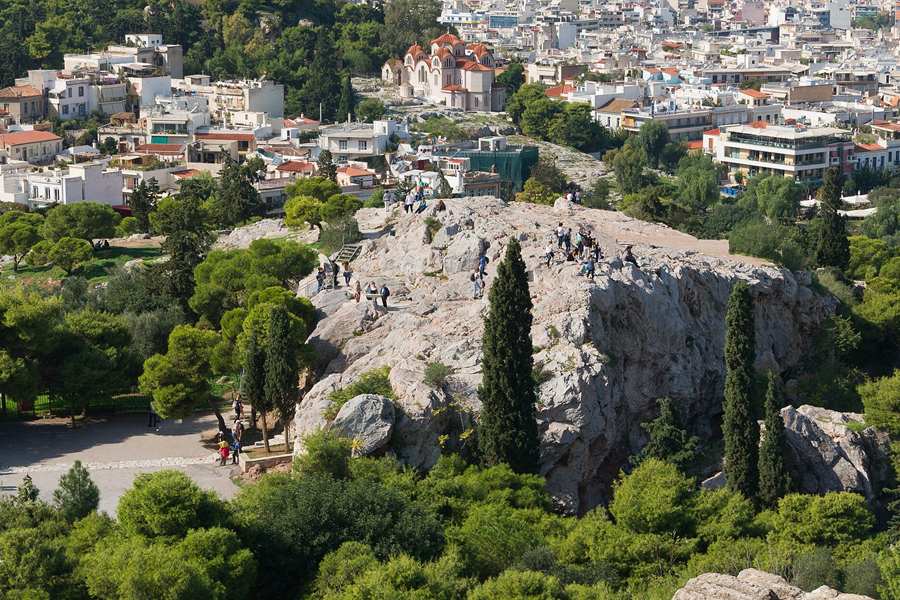
Ancient Greek democracy inherited the Areopagus, an Athenian council whose exact origins are still unclear. Before the 5th century BC, it was possibly a council of elders. Only men who had already served as archon, a chief magistrate, took a seat there.
Homicide trials on the hill possibly go back as far as the mid-8th century BC. Before the first democratic government, Athens was ruled by archons and by this council of former archons. Their members were mostly aristocrats. Little evidence suggests Cleisthenes altered the council, since he was in all likelihood a member himself.
Across the 5th century BC, the council lost two powers within ancient Greek democracy. One was eisangelia, or treason trials, and the other was dokimasia. Dokimasia was the first check on men newly elected to office. Little evidence shows the council had done anything to invite an attack by the time of Ephialtes.
Within ancient Greek democracy, the council possibly regained guardianship of the laws in the 4th century BC. Under later Byzantine rule, houses and dwellings spread over the hill. A church and a monastery there honoured Dionysius the Areopagite. In 1952, the poet Louis MacNeice named a poem Areopagus in his collection Ten Burnt Offerings.
- Myth type: The story of Ares on trial on the hill is an aetiological myth, one that explains an origin.
- Revolution: During the Greek Revolution of 1821, a regional government in eastern mainland Greece took the same name.
- Debating club: An Areopagus Society, formed in 1893, meets to debate topics at the Hotchkiss School in Connecticut.
Ancient Greek democracy sent a different kind of murder case elsewhere. A man claiming he had killed with justice came before judges called the ephetai at the Delphinium instead. The Eumenides breaks this rule by setting such a trial of Orestes on the Areopagus.
Why did Athens honour Harmodius and Aristogeiton in ancient Greek democracy?
Ancient Greek democracy turned Harmodius and Aristogeiton into national heroes, known as the Tyrannicides, or tyrant-slayers. The two lovers killed Hipparchus, brother of the tyrant Hippias, and were executed for it. Later democrats praised them partly to hide the role Sparta played in ending tyranny.
In Archaic Greece, before ancient Greek democracy, the word tyrant was neutral. It named a ruler who took power and governed outside the law of the state. Thucydides says Hipparchus invited the sister of Harmodius to carry the offering basket at the Panathenaea festival. He then sent her away in public, shaming the family.
The plot hid daggers inside the myrtle wreaths carried at the Panathenaic Games. Myrtle is a fragrant evergreen bush. On the day, the pair saw a fellow plotter greet Hippias warmly and feared betrayal. They struck at once and killed Hipparchus. Guards speared Harmodius on the spot, and Aristogeiton was soon arrested.
Once ancient Greek democracy began, Cleisthenes ordered a bronze group of the pair from the sculptor Antenor. It was the first statue paid for out of public funds. Special laws banned any other statues near it. Each year the polemarch, the Athenian minister of war, presented offerings there.
- Taken to Persia: Xerxes I took the bronze group as war booty in 480 BC and set it up at Susa.
- A new pair: Kritios and Nesiotes sculpted a replacement, set up in 477/476 BC after the victory at Salamis.
- Return trip: Arrian says Alexander the Great found the original at Susa and shipped it back to Athens.
Ancient Greek democracy rewarded the families of the pair. Later writers say their descendants held hereditary rights. These included free meals at the town hall and front-row seats in the theatre. A copy of the later group, found at Hadrian’s villa, is now in Naples.
How did Thrasybulus restore ancient Greek democracy?
Ancient Greek democracy owed its return in 403 BC partly to Thrasybulus, a Greek general and democratic leader. He led the resistance to the Thirty Tyrants, a narrow regime that Sparta imposed on Athens. An oligarchy like theirs meant rule by a small group.
A son of Lycus, this champion of ancient Greek democracy came from the deme, or district, of Steiria. He served as trierarch, a citizen who paid to run a warship, on more than one occasion. Plutarch credits him with the loudest voice in Athens. The general Conon called him bold in counsel.
In 411 BC, pro-democracy sailors at Samos elected Thrasybulus as a general after an oligarchic coup in Athens. He soon arranged the recall of the exiled nobleman Alcibiades. In 389 BC, he led triremes, or oared warships, to support Rhodes, where a democratic government faced Sparta. He also captured Byzantium on that campaign.
Once ancient Greek democracy returned, Thrasybulus pushed through a law that pardoned all but a handful of oligarchs. It prevented revenge by the winning side. His fellow citizens gave him an olive crown. He also urged a return of political pay. He sought citizenship for the metics, or resident foreigners, who fought beside him.
- Exile in Thebes: Exiled to Thebes, he found support from the Theban leader Ismenias and his followers.
- Successor: In the revived democracy, Archinus soon replaced him at the head of the state.
- Death: In 388 BC, he was killed in his tent during a night raid by the people of Aspendus.
Demosthenes counted him among the great and distinguished orators. He firmly backed ancient Greek democracy in its Periclean form. Periclean means in the style of Pericles. He also favoured the growth of Athenian power overseas. Estimates place his birth between 455 and 441 BC.
What was the graphe paranomon in ancient Greek democracy?
Ancient Greek democracy used the graphe paranomon to challenge measures that broke existing law. Athens is believed to have brought in this legal action around 415 BC. Its name means a suit against bills that run contrary to the laws.
In ancient Greek democracy, a citizen brought the suit against laws or decrees already passed, or against proposals. After he swore an oath to sue, the measure was put on hold until the case ended. Athens had no way of unmaking a law. Each new law therefore had to agree with the laws already in force.
The review took place before ordinary citizens, not legal experts. These jurors had to be over thirty and under oath, unlike assembly members over twenty. Review was never automatic in ancient Greek democracy, since a citizen had to start it. The case was framed as a prosecution of the man who had put the motion forward.
The proposer stayed liable for one year only. After that, the law was open to attack, but he faced no penalty. After five years, the law was safe from any suit. A conviction brought a fine, at times too large to pay. An unpaid fine led to atimia, the loss of citizen rights.
- Stand-ins: Active politicians began to recruit surrogates, or stand-ins, to propose bills they had written themselves.
- Honours: A large share of known prosecutions concerned honorary decrees rather than major laws.
- Famous case: Two speeches survive from a case of 333 BC: On the Crown and Against Ctesiphon.
Scholars have seen this suit as a replacement for ostracism in ancient Greek democracy. Ostracism fell into disuse around the same time. David Whitehead disagrees with that view. He notes that the suit carried legal shame, while ostracism carried none.
Who were the strategoi of ancient Greek democracy?
Ancient Greek democracy entrusted war to the strategoi, a board of ten generals elected each year. The word strategos means military general in Greek. In Athens, it took its best-known form with the reforms of Cleisthenes in 501 BC. Each tribe supplied one general.
Strategos joins two Greek words, stratos and agos. Stratos means army, a word first meaning what is spread out, and agos means leader. The ten generals held equal rank and replaced the polemarchos, the former senior war commander. Today, in the modern Hellenic Army, the title strategos remains the highest officer rank.
At Marathon in 490 BC, the generals settled strategy by majority vote. Each took a turn presiding for a day. Elections were held each spring, and the term ran from midsummer to midsummer. Unlike other Greek states, ancient Greek democracy let its generals lead fleets as well as armies.
In the early 5th century, generals such as Themistocles, Aristides, Cimon, Pericles and Cleon played political roles. Their power came from personal charisma rather than from the office. Ancient Greek democracy kept a close watch on its generals. The assembly voted in every prytany, or council term, on whether each one was doing his job well.
- Pericles fined: In 430 BC, Pericles himself was removed from his post as general and fined.
- Arginusae: In 406 BC, six of the eight generals who led the fleet at Arginusae were condemned to death.
- Home defence: From the mid-4th century, one general held a post for the defence of Attica.
After about 440 BC, two generals sometimes shared one tribe, leaving another without one. Athens later added tribes in the Hellenistic period, the age of Greek kings after Alexander. Even so, the board of ancient Greek democracy stayed fixed at ten generals.
Why did sortition define ancient Greek democracy?
Ancient Greek democracy filled its offices by sortition, the choice of officials or jurors at random by lottery. In Athens, it was the traditional and main way to appoint political officials. People regarded it as a principal mark of democracy.
Ancient Greek democracy in Athens grew out of isonomia, or equality of law and rights. Lot became the chief means of reaching that fairness. It chose the bulk of the magistrates and filled juries, which as a rule held 501 men. Scholars once linked the lot to divine will, a view now out of favour.
To enter the draw in ancient Greek democracy, citizens first put themselves forward. Lotteries in kleroteria, the allotment machines, then made the choice. Every male citizen over 30 who had not lost his rights through atimia, or civic disgrace, was eligible. No man held the same lot office twice, though he was free to take others.
Athenians at large held that lot, not election, was democratic. Their complex procedures blocked the corrupt tricks oligarchs used to buy their way into office. Aristotle, Plato, Herodotus and Pericles all stressed selection by lot. Elections counted as oligarchic, favouring rule by a small elite. Socrates and Isocrates, however, doubted that randomly chosen people had enough expertise.
- Elected posts: Military roles such as strategos, or general, stayed elected rather than drawn by lot.
- Honest errors: Headlam wrote that the Council of 500 sometimes set taxes too high.
- Divine draw: In Greek myth, Zeus, Poseidon and Hades drew lots for the sky, the sea and the underworld.
Ancient Greek democracy’s use of the lot found support in the Enlightenment writer Montesquieu. His book The Spirit of Laws argues that lot suits democracy, just as elections suit aristocracy. Today, sortition is still the common way to pick prospective jurors in common-law systems.
What does the Constitution of the Athenians reveal about ancient Greek democracy?
Ancient Greek democracy is set out in detail in the Constitution of the Athenians. Aristotle or one of his students wrote this work on the government of Athens. Of the 158 constitutions credited to his school, it is the only one to survive intact.
This account of ancient Greek democracy is not part of Aristotle’s works handed down in medieval manuscripts. It was lost until 1879, when two leaves of a papyrus codex turned up in the Fayum. A codex is an early book with bound pages. In 1890, an American missionary bought a longer papyrus text in Egypt.
E. A. Wallis Budge of the British Museum acquired that papyrus later the same year. Frederic G. Kenyon published the first edition in January 1891. The roll came from Hermopolis and now rests in the British Library. If Aristotle wrote it himself, it is his only surviving work that was meant for publication.
The work falls into two parts. Chapters 1 to 41 trace its forms up to the return of ancient Greek democracy in 403 BC. The second part describes institutions such as access to citizenship, the magistrates and the courts. Its lost opening survives only in a handful of quotations and a summary by Heraclides Lembus.
- Dating clue: Chapter 54 mentions a festival of Hephaestus founded under the archon Cephisophon, in 329 BC.
- Date range: Scholars date the writing to no earlier than 328 BC and no later than 322 BC.
- Rare details: Chapters 21 to 22, parts of 26, and 39 to 40 hold facts no other ancient text gives.
Athens offers a fuller record of ancient Greek democracy than other cities, partly through this complete constitution. Historians hailed its discovery as nearly a new era for Greek history. It names triremes, oared warships, but not quinqueremes, which points to 325 BC or earlier.
What did the tyrant Peisistratus leave to ancient Greek democracy?
Ancient Greek democracy in Athens began after the Pisistratids lost power in 510 BC. That family of three tyrants was Peisistratus and his sons, Hipparchus and Hippias. A tyrant, in Greek eyes, was a ruler who seized power without legal right.
Peisistratus drew his strength from the poorest people of Athens, who lived up in the hills. He organised them into a third faction, the Hyperakrioi, or hill dwellers. A faction is a group that competes for power. Long before ancient Greek democracy, this hill party outnumbered the other two parties combined.
Herodotus tells a story about one of his returns to power after an exile. A tall woman named Phye, from the village of Paiania, posed as the goddess Athena. She rode in a chariot, dressed in full armour. Heralds went ahead, crying that the goddess herself was leading Peisistratus back to her Acropolis.
During a later exile, Peisistratus settled near Mount Pangaeus in northern Greece. He grew rich from the gold and silver mines nearby. Back in power, he set up travelling judges, who held trials on the spot out in the countryside. The tyrant himself sometimes joined these judges to settle local quarrels.
- Farm tax: Aristotle says a ten percent tax on farm produce paid for loans to small farmers.
- Owl coins: The switch to owl coins came late in the Pisistratid era or early in ancient Greek democracy.
- Water: Under his rule, an aqueduct fed the Enneakrounos fountain beside the agora, the market square.
Aristotle tells of a farmer on stony ground who said the tyrant took a tenth of his crop. Peisistratus let the man off his taxes. Ancient Greek democracy later used ostracism, an exile of up to ten years, as a guard against tyrants.
Which officials called archons served ancient Greek democracy in Athens?
Ancient Greek democracy kept the old office of archon, a Greek word meaning ruler. It was a title for a public office. Under the democracy, the archon eponymos stayed the formal head of state in Athens. His political weight, however, had shrunk.
The word comes from a Greek verb stem meaning to be first, or to rule. Monarch and hierarchy grow from the same root. In early Greece, the chief magistrates of city states bore the title archontes. Archontes is the plural form. A magistrate is an official who runs public business or hears cases.
Athens came to have three archons serving side by side. Aristotle writes that the power of the old kings passed to them. Aristocrats filled these posts through elections held every ten years. The archon eponymos was chief magistrate, and the polemarch headed the armed forces. The archon basileus looked after the civic religious rites.
After 683 BC, each archon served for a single year only. Athenians named each year after its archon eponymos. Ancient calendars of this kind did not number their years one after another. After 487 BC, under ancient Greek democracy, archons were chosen by lot from any citizen. Lot means a random draw.
- Generals: A new board of generals, the strategoi, took over the military duties of the polemarch.
- Helpers: Junior archons, called thesmothetai, assisted the senior archons with their work.
- Areopagus: From 487 BC, ancient Greek democracy sent former archons into the Areopagus council for life.
Under ancient Greek democracy, the archon also prepared festivals months in advance. He picked three playwrights for each contest from outlines of their planned plays. Each playwright then received a choregos, a wealthy patron who paid for costumes, masks and chorus training.
Why does the Stoa Basileios matter to ancient Greek democracy?
Ancient Greek democracy kept its laws in the Stoa Basileios, or Royal Stoa, in the Athenian Agora. A stoa is a covered hall, with a row of columns on its open front. This small building held great meaning as the seat of the King Archon.
The stoa stood in the northwest corner of the Agora. In ancient times, people called that area the Herms, after the crowd of herms that stood there. Each herm was a square pillar crowned by a sculpted head. Fragments of 19 of these herms have come to light.
The laws of Draco and Solon were written on wooden pillars called axones and kyrbeis. Ephialtes is thought to have moved them into the stoa in the 460s BC, under ancient Greek democracy. Late in the fifth century BC, the laws went through a revision. Inscribed copies then went up in its end porches.
Under ancient Greek democracy, the Areopagus council sometimes met inside the stoa. This council handled religious affairs and murder trials. A rope was set up to stop people interrupting its meetings. After a revolt in Chalcis in 446 BC, Athens leased out the seized land. The lease contracts were carved on stone slabs in the stoa.
- Statue: Experts ruled out that a colossal female statue found nearby shows Democratia, meaning Democracy.
- Letter: A lead tablet found in 1974 holds a letter by Lesis, a slave able to write.
- Dialogue: Plato set his dialogue Euthyphro, on piety or duty to the gods, in front of the stoa.
Pausanias, who wrote about his travels in the 2nd century AD, described the building. His account confirms that the ruins belong to the Stoa Basileios. Ancient Greek democracy also set up statues around it, starting with Conon, Timotheus and King Euagoras of Cyprus.
What role did the prytaneion play in ancient Greek democracy?
Ancient Greek democracy treated the prytaneion as the official home of all the people. This building was the seat of the prytaneis, the executive officials who led a Greek city. It normally stood in the centre of the city, in the agora.
Every Greek state, city or village kept its own central hearth with a sacred fire. A hearth is a fireplace. The fire burned without a break, tended by the king or his family. The building holding this fire was the prytaneion. That fire stood for the unity and life of the community.
Settlers who left to found a colony took a burning brand from the prytaneion altar. With it they lit the new fire of their colony. Thucydides says that Theseus joined the halls of the separate Attic communities into one central prytaneion in Athens. Under ancient Greek democracy, it hosted foreign ambassadors as public guests.
In Plato’s Apology, Socrates made a bold proposal to the court of ancient Greek democracy. Instead of death, he said, he deserved to be cared for in the prytaneion. The fatherless daughters of Aristides counted as children of the state at Athens. They were married from the prytaneion, as from their own home.
- Site: The exact site of the Athenian prytaneion has never been fixed with certainty.
- Archons: Aristotle names it the official residence of the archons, the chief officials of Athens.
- Laws: Polemon of Athens says copies of Solon’s laws sat there on square wooden tablets that turned on pivots.
In 2006 Geoffrey Schmalz linked the prytaneion of ancient Greek democracy with ruins in St Catherine’s Square. These lie near the Lysikrates Monument. An inscription naming the building was later found. In 2014 two scholars then argued for a spot slightly north and west.
How did the dokimasia test officials in ancient Greek democracy?
Ancient Greek democracy in Athens used the dokimasia to test its citizens. It checked that they were fit to exercise public rights and duties. Every official faced this check before taking office. Even members of the Boule, the Council of 500, had to pass it before serving.
Under ancient Greek democracy, a young man joining the epheboi went through the same kind of test. The epheboi were young citizens in military training. An assembly of his district checked that both his parents came from Athenian citizens. It also checked that he was physically fit for military service.
For officials, the test did not measure skill for the post. That skill was simply taken for granted in every single candidate. Instead, it looked at descent from Athenian citizens, at life and character. For posts handling large sums of money, it even checked the amount of property a man owned.
The archons ran the examination in public, with the Boule present. Anyone in the crowd had the right to raise an objection. A valid objection meant the candidate was rejected. He then had the right to take the decision to a court. The court then heard the matter as a formal case.
- Taxes: The test made sure a candidate had met his duties as a tax-paying citizen.
- Family: It checked that an unpaid post did not rob his family of money to live on.
- Judgement: Archons of ancient Greek democracy judged by their political and moral views whether a man posed a danger.
Even after a candidate passed, any citizen had the right to take him to court. If that court then ruled against him, he lost his office and also faced punishment. Only a full citizen of ancient Greek democracy was allowed to address the assembly.
How did the liturgy make the rich pay for ancient Greek democracy?
Ancient Greek democracy drew on the liturgy, a public service. The richest residents of a city paid for it. Citizens and resident foreigners alike financed the state from their own wealth, more or less willingly. The system goes back to the first years of Athenian democracy.
Under ancient Greek democracy, certain liturgies followed the yearly round of religious and sporting festivals. The gymnasiarchia meant running and funding the gymnasium, a public training ground. The hestiasis paid for the public dinner of the liturgist’s tribe. In 355 or 354 BC, Demosthenes counted sixty such liturgies a year.
Military liturgies came only when needed. The main one was the trierarchy. This meant fitting out a trireme and keeping its crew for a year. A trireme was a war galley rowed with oars set in three tiers. Under ancient Greek democracy, the trierarch also commanded the ship under a general, unless he paid a substitute.
Magistrates appointed each liturgist. They first asked for volunteers, then named those best able to serve. Metics, or resident foreigners, gave as much money as citizens, except for the trierarchy. In the 4th century BC, a fortune of 10 talents placed a man in the liturgical class. One talent equalled a large sum.
- Rest: A trierarch had the right to a break of two years before serving again.
- Families: The same families tended to supply trierarchs from one generation to the next.
- Count: A careful count finds at least 97 civilian liturgists a year in Athens.
A man named for a liturgy had a legal escape, the antidosis, meaning exchange. He sued a citizen he claimed was richer than himself. That man then accepted the duty, swapped fortunes, or went to trial. No exchange of fortunes under ancient Greek democracy is known.
Which Attic deme gave ancient Greek democracy more councillors than any other?
Ancient Greek democracy drew more councillors from Acharnae than from any other deme. In the fourth century BC, 22 of the 500 members of the Athenian council came from there. Thucydides calls Acharnae the largest deme in Attica. A deme was a local unit of Athens.
Acharnae lay 60 stadia north of Athens, south of Mount Parnes. The stadion served as a Greek measure of distance. Under ancient Greek democracy, the deme belonged to the tribe called Oineis. Its ancient site lies at and southwest of Menidi, a town now renamed Acharnes. Locals traded charcoal from the mountain woods.
In ancient times, people believed the name came from acharna, a word for sea bass. The plain there looked like a fish. Another view linked it to Acharnas, a mythical hero and founder. The Acharnians said that ivy first grew in their deme. They honoured Dionysus Cissus, meaning Dionysus of the Ivy.
In the first phase of the Peloponnesian War, King Archidamos II led a Spartan army up to Acharnae. Pericles, a statesman of ancient Greek democracy, had gathered the people of Attica inside the walls of Athens. Thucydides says the deme sent 3,000 hoplites, or heavy infantry. Historians think the real number was only 1,000.
- Farming: Farmers of Acharnae mainly raised cereals, grapes and olives on fertile land.
- Comedy: The chorus of The Acharnians, a comedy by Aristophanes, is made up of charcoal burners.
- Ares: A temple to Ares, the war god, was later shifted to the Agora of Athens.
During the Athenian civil war, a large battle took place near Acharnae. Thrasybulus led the democratic rebels against the forces of the Thirty Tyrants. He had only 700 men and two cavalry units. The fighters for ancient Greek democracy won, killing about 120 foes.
What did Pericles praise about ancient Greek democracy in his Funeral Oration?
Ancient Greek democracy found a famous voice in the Funeral Oration of Pericles, recorded by the historian Thucydides. Pericles spoke as the Peloponnesian War completed its first year. The speech formed part of the yearly public funeral held for the war dead.
By the late 5th century BC, ancient Greek democracy honoured all its war dead with a public funeral. The remains lay in a tent for three days. Ten coffins of cypress wood then went in procession, one for each Athenian tribe. One more stood empty for the missing and unrecovered dead.
The dead were buried in a public grave at the Kerameikos, a cemetery of Athens. A leading citizen chosen by the state then gave a speech. Under ancient Greek democracy, this honour fell to Pericles. Thucydides admits that the speeches in his history are not exact, word-for-word records.
Pericles praised the laws of Athens for giving equal justice to all in private disputes. These lines are the roots of the famous phrase equal justice under law. At the climax, he called the city of ancient Greek democracy the school of Hellas. Hellas is simply the Greek name for Greece.
- Author: In his Menexenus, Plato says the speech came from Aspasia, companion of Pericles.
- Widows: Pericles told the widows that a woman’s greatest glory was not to be spoken of.
- Music: Peter Aston set the speech for choir in 1976 as So they gave their bodies.
Pericles gave another funeral speech in 440 BC, during the Samian War. Parts of both can sit in the version by Thucydides. Louis Warren and Garry Wills, two American Civil War scholars, compare it with Lincoln’s Gettysburg Address. Both praise a state’s commitment to democracy.
Why was Cleon a divisive voice in ancient Greek democracy?
Ancient Greek democracy gave Cleon, the son of a wealthy tanner, a path to power. He was among the first top politicians in fifth-century BC Athens from outside the old elite. He served as both politician and general, and died in 422 BC.
Under ancient Greek democracy, Cleon sided with the poor citizens and the rising class of traders in Athens. In 430 BC he led the attack on the leadership of Pericles. He accused Pericles of mishandling public funds. Pericles was found guilty and removed from office, but he was soon back in power.
After the plague killed Pericles in 429 BC, Cleon rose fast. Thucydides says that by 428 BC no speaker in the Assembly was more persuasive. Under ancient Greek democracy, he raised the pay for jury service. That pay was a living for a large number of poorer citizens.
In 428 BC the city of Mytilene revolted against Athenian rule. After its surrender, Cleon asked the Assembly to put all its adult men to death. Diodotus argued against him, and Cleon’s motion failed by a slim margin. The Assembly still executed the leaders of the revolt, about 1,000 men of the elite.
- Generals: In 424 BC voters elected Cleon one of the 10 strategoi, or generals.
- Talks: Cleon urged the Assembly to refuse Spartan envoys a private round of peace talks.
- Stage: Cleon lodged a complaint against Aristophanes over his lost play, the Babylonians.
The historian Thucydides spent 20 years in exile after Amphipolis fell to the Spartans. A later Life of Thucydides blames the slanders of Cleon. Modern historians of ancient Greek democracy still debate how fair these early portraits of Cleon really are.
Who was the last politician ancient Greek democracy sent away by ostracism?
Ancient Greek democracy ostracised Hyperbolus in 416 or 415 BC, the last Athenian to suffer this fate. Ostracism was a vote that sent a citizen into exile. Hyperbolus was an Athenian politician of the Peloponnesian War who came to the fore after Cleon died.
The 4th-century BC historian Theopompus names his father as Chremes. Yet surviving ostraka prove that the father was really called Antiphanes. Under ancient Greek democracy, ostraka were broken pottery pieces used as ballots. Certain ancient writers claim Hyperbolus came from a slave family. His father’s Greek name makes that unlikely.
Hyperbolus was a demagogue, a leader backed by ordinary people. He seems to have sat on the boule, the council, and possibly served as a trierarch. The comic poets of Athens made him a frequent target. Aristophanes alludes to him in seven surviving plays. They run from the Acharnians in 425 to the Frogs in 405 BC.
Hyperbolus himself had proposed that ostracism. Plutarch says he hoped to see Nicias or Alcibiades sent away. Instead, those two rivals put aside their differences. Their supporters then voted to ostracise Hyperbolus. In 412 or 411 BC he was murdered on Samos. Thucydides says the Athenian general Charminus took part in the killing.
- Body: Theopompus claims his corpse went into the sea, packed inside a wineskin.
- Inscription: An inscription restored in 1949 by A. G. Woodhead suggests he was still active after 417 BC.
- Year: P. J. Rhodes leans towards 415 BC as the year of this last ostracism of ancient Greek democracy.
Ancient Greek democracy seems never to have used ostracism again, though it was never formally abolished. Plutarch says the Athenians were disgusted by the result. Rhodes calls the method too imprecise. From the late fifth century, Athens turned to sharper ways of holding officials to account.
How did the coup of 411 BC overturn ancient Greek democracy?
Ancient Greek democracy in Athens fell in a coup in 411 BC, during the Peloponnesian War with Sparta. A brief oligarchy called the Four Hundred took its place. Oligarchy means government by a narrow circle of men. In a coup, a faction suddenly grabs control.
By the time of the war, democracy in Athens was about 100 years old. It stood out as an exception, since other Greek city states lived under tyrants or oligarchies. The failed expedition to Sicily in 413 BC caused a money crisis. Wealthy men who disliked the broad democracy sought an oligarchy of the elite.
That same year, ancient Greek democracy elected a board of elders called the probouloi. They were to find money and timber for ships and defences. One of them was the playwright Sophocles. He later admitted that he approved of setting up the Four Hundred, saying nothing better was possible.
Commissioners then rewrote the constitution of ancient Greek democracy. Thucydides counts ten of them, while Aristotle gives 20. A new council of 400 unpaid men replaced the old one, which shut out poorer citizens. The 400 had the power to choose 5,000 Athenians. Only those men were allowed to take part in assemblies.
- Date: The oligarchs seized power in Athens on 9 June 411 BC, in the month of Thargelion.
- Plotters: Historian W. G. Forrest thinks nearer fifty than four hundred men pushed the coup against ancient Greek democracy.
- Numbers: Men wealthy enough for hoplite service fell from about 25,000 before the war to about 9,000.
The Four Hundred soon split between moderates and extremists. Theramenes and Aristocrates led the moderates. Hoplites in Piraeus tore down a new fortification raised by the extremists. Days later, the 5,000 officially replaced the Four Hundred and ruled until after the victory at Cyzicus.
What did the Thirty Tyrants do to ancient Greek democracy in 404 BC?
Ancient Greek democracy in Athens gave way to the Thirty Tyrants. This oligarchy ruled the city from 404 to 403 BC. Sparta installed them after the Athenian surrender that closed the Peloponnesian War. They held power for only eight months.
The Athenian navy was destroyed at Aegospotami in 405 BC. Without ships to bring in food, a large number of citizens starved. Athens surrendered in March 404 BC. Certain allies of Sparta wanted the city wiped out, but the Spartans refused. They called Athens one of the great cities of Greece.
The peace terms forced Athens to pull down the long walls of Piraeus. Its navy shrank to only twelve ships. Under Spartan pressure, ancient Greek democracy had to pick thirty men to draft new laws. Theramenes chose ten, five ephors, or overseers, chose ten, and the Assembly chose the last ten.
The Thirty restored the Boule, the council of ancient Greek democracy, with 501 members. They hired 300 whip bearers, called mastigophoroi, to act as a police force. Citizenship shrank to only 3,000 hand-picked Athenians. Only these men had the right to bear arms and to a jury trial. They alone were allowed to live inside the city limits.
- Executions: Isocrates and Aristotle say the Thirty executed 1,500 people without trial.
- Theramenes: Critias, leader of the Thirty, forced Theramenes to drink hemlock, a poison.
- Garrison: Members of the Thirty used Spartan soldiers as personal bodyguards in Athens.
Plato looked back on their rule in his Seventh Letter. Next to the Thirty, he wrote, the former ancient Greek democracy seemed like a golden age. Scholars question whether the letter is truly his. Their regime ended in 403 BC, and Athens returned to a democratic government.
How did the orator Lysias live through the crises of ancient Greek democracy?
Ancient Greek democracy in Athens was home to Lysias, a logographer. He lived from about 445 to 380 BC. A logographer wrote speeches for others to deliver in the law courts. Lysias counts among the ten Attic orators, a list of top speakers.
His father Cephalus came from Syracuse and settled in Athens at the invitation of Pericles. Plato’s Republic opens at the house of Polemarchus, the eldest son, in Piraeus. As a youth Lysias lived in Thurii, a new colony on the Tarentine Gulf. In 412 BC its anti-Athenian faction drove him out, and he settled at Athens.
Lysias and Polemarchus inherited wealth from their father. They ranked as isoteleis, foreigners taxed only at the citizen rate. Near Piraeus the brothers ran a shield factory with a hundred and twenty skilled slaves. Lysias claims that, as resident aliens in ancient Greek democracy, they funded public services with great generosity.
After ancient Greek democracy fell in 404 BC, the Thirty Tyrants turned on the resident aliens. The brothers appeared on a list of ten men marked out as the first victims. Polemarchus was arrested and forced to drink hemlock. Lysias paid a large bribe, slipped out by a back door and took a boat to Megara.
- Citizenship: In 403 BC Thrasybulus proposed citizenship for Lysias, but the move was blocked.
- Olympia: At the Olympic festival of 388 BC, Lysias denounced Dionysius I of Syracuse.
- Speeches: Thirty-four speeches by Lysias survive in full to this day.
In 403 BC Lysias accused Eratosthenes, one of the Thirty, in court. This was his only direct step into Athenian politics. Back in ancient Greek democracy, he spent his later years working hard as a logographer. He has been called the Euripides of Attic prose.
Why did ancient Greek democracy put Socrates on trial in 399 BC?
Ancient Greek democracy tried the philosopher Socrates in 399 BC on two charges. One was asebeia, or impiety, meaning disrespect for the gods. The other was corrupting the young. His accusers said he ignored the gods of the city and brought in new ones.
The case began when the accuser Meletus swore to his charge before the archon. This official, who had mostly religious duties, judged that a real case existed. He then summoned Socrates for a trial by jury. Under ancient Greek democracy, juries were drawn by lot from hundreds of male citizen volunteers.
A jury of 501 men seems to have been the legal norm. Plato writes that a switch of just 30 votes meant acquittal. With 501 jurors, this points to a verdict of 280 votes against 221. The death sentence then passed by an even larger majority. The citizens lived in fear after years of war and plague.
A number of the Thirty Tyrants had been students of Socrates. Critias, one of their leaders, appears in two dialogues by Plato. Socrates also praised the laws of Sparta and Crete. Ancient Greek democracy had pardoned political acts from the time of the Thirty in an amnesty. The prosecutor Anytus broke it.
- Daimonion: Socrates spoke of a spirit, his daimonion, which only ever warned him against actions.
- Flight: Socrates refused, on principle, to break the law by fleeing Athens.
- Age: Socrates was 70 years old when he carried out his own death sentence.
Plato and Xenophon, students of Socrates, each left an account of this trial under ancient Greek democracy. Xenophon also covered it in his Memorabilia. In 1988 the journalist I. F. Stone published a book called The Trial of Socrates.
What was the Theoric Fund in ancient Greek democracy?
Ancient Greek democracy in Athens ran the Theorica, also called the Theoric Fund or Festival Fund. Its money paid for festivals, sacrifices and public shows. At times the state also shared it out among the people as gifts of cash.
Xenophon says Athens held more festivals than all the rest of Greece. The statesman Eubulus created or revived the fund around 350 BC, after the Social War. That war had left Athens in deep military and money trouble. The fund helped poorer citizens attend festivals such as the Dionysia, the Panathenaea, the Eleusinia and the Thargelia.
The Theatre of Dionysus once had only wooden benches, says the scholar Libanius. Fights broke out as everyone rushed for a seat. Under ancient Greek democracy, the leaders brought in an entry charge to stop the violence. Pericles later passed a law letting the poor receive their entry money from the state.
The poor of ancient Greek democracy applied for this money in the public assembly. That assembly frequently met in the theatre. After a lawless period called the anarchy, Agyrrhius restored the system. A board of managers took charge. Voters chose its members by show of hands at the Great Dionysia, one from each tribe. They served four-year terms.
- Powers: Under Eubulus, the board also ran the building of docks, arsenals and streets.
- Revenue: Demosthenes says yearly revenue rose to 400 talents from an earlier 130 talents.
- Penalty: Eubulus threatened death to anyone ranking the fund below the military fund.
Demosthenes wanted spare money spent on war against Philip II of Macedon. In 339 or 338 BC he had the surplus sent back to the military fund. The orator Demades called the Theoric Fund the glue of ancient Greek democracy.
How did Demetrius of Phalerum limit ancient Greek democracy in Athens?
Ancient Greek democracy in Athens faced limits under Demetrius of Phalerum. He was an orator from Phalerum, an ancient port of Athens. Cassander, King of Macedon, appointed him to govern the city. Demetrius ruled Athens alone for ten years.
Demetrius was born in Phalerum around 350 BC. His father, Phanostratus, had neither rank nor property. With the poet Menander, he studied in the school of Theophrastus. Demetrius became one of the first members of the Peripatetic school, a group of thinkers who followed Aristotle. Under ancient Greek democracy, he began his public career around 325 BC.
Demetrius belonged to the party of Phocion, which favoured oligarchy over ancient Greek democracy. After Phocion died in 317 BC, Cassander put Demetrius at the head of Athens. He brought in major reforms of the legal system. One famous law limited luxury at funerals. Cicero mentions this law, and its effects show in the excavated cemeteries of Athens.
The Athenians gave him extraordinary honours. Stories claim that no fewer than 360 statues of him were set up. The scholar Stephen V. Tracy doubts that story. The lower classes and the friends of ancient Greek democracy disliked him. They resented his limits on the democratic franchise, meaning the right to vote.
- Debt: One story says Demetrius paid the tax on foreign residents owed by the philosopher Xenocrates.
- Stage: With tragedy too costly to stage, he had rhapsodists, or reciters, perform Homer’s poems in the theatre.
- Library: Strabo says Demetrius inspired the Mouseion, home of the Library of Alexandria.
Demetrius later lived at the court of Ptolemy I Soter in Alexandria. After his fall from power, Athens tore down all his statues but one. He is said to have died after a bite from a venomous snake in Egypt.
What do travellers ask about ancient Greek democracy, and what are the answers?
An ancient Greek democracy like Athens also had residents called metics. Metics at Athens made up roughly half the free population. A metic lived there but held citizenship of another city. Metics were allowed to stay without time limit but had no political rights.
Who was Isagoras in the early story of ancient Greek democracy?
Isagoras, son of Tisander, was an Athenian aristocrat who lived in the late 6th century BC. In 508 BC he was elected archon eponymous, the chief magistrate, but Cleisthenes opposed him. Ordinary citizens revolted and besieged him and his Spartan backers on the Acropolis for two days.
Who kept order at meetings of ancient Greek democracy?
Ancient sources describe a police force of 300 armed Scythians in 5th-century BC Athens. Scythians were a nomadic people of the Eurasian Steppe. These men were public slaves, owned by the city. They kept order in the Assembly and the council. Vase paintings show them in high pointed hats and wide trousers.
What rights did metics hold under ancient Greek democracy?
Metics had to do military service, just like citizens. They were barred from the assembly and excused from jury service. Yet their access to the law courts matched that of citizens. Every metic named a citizen sponsor, called a prostates. The word means one who stands on behalf of another.
Which oath bound young Athenians to ancient Greek democracy?
Young men of Classical Athens, as a rule the 18-year-old sons of citizens, swore the ephebic oath. They swore it on entering the Ephebic College, a military academy. Each wore full armour, with shield and spear in his left hand. He promised to defend the constitution against anyone trying to overthrow it.
Featured photo: George E. Koronaios, CC BY-SA 4.0, via Wikimedia Commons.